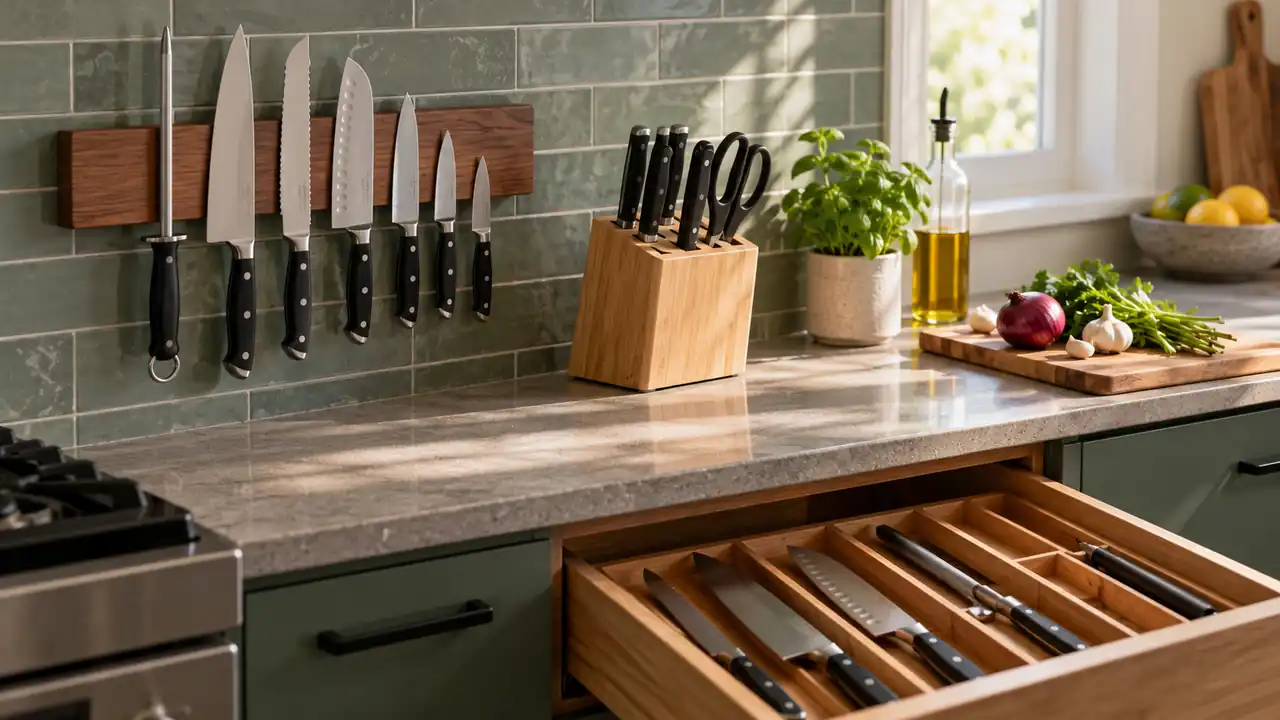
Store kitchen knives so each blade is dry, secured, and separated from other utensils. A knife block, magnetic rack, in-drawer organizer, or properly fitted blade guard can all work well. The right method prevents accidental contact, protects the cutting edge, and keeps moisture from lingering against the blade.
Never leave sharp knives loose in a drawer or hidden under items in a sink. Loose storage can damage the edge and exposes anyone reaching into the drawer or sink to an avoidable injury risk.
If a countertop block fits your space, compare knife blocks by layout and capacity rather than choosing by slot count alone. The other storage methods below may suit a drawer or a kitchen with limited counter space better.
How to Store Kitchen Knives Safely
- Wash the knife by hand. Use mild dish soap and a soft sponge or cloth. Keep the cutting edge pointed away from your hand.
- Dry the entire knife immediately. Wipe the blade, handle, bolster, and any joints where moisture could collect. This is especially important for carbon steel, although stainless steel can also corrode under unfavorable conditions.
- Inspect the storage location. Make sure the block, rack, guard, or drawer organizer is clean and dry.
- Place the knife in its assigned position. The blade should remain covered or securely retained without contacting neighboring blades or metal utensils.
- Keep storage away from hazards. Knives should not be within easy reach of children, near a sink edge, above a stove, or where they could fall onto a person or work surface.
Do not store a damp knife, wrap it in a wet towel, or put it into a closed sheath while moisture remains on the blade. Prolonged moisture exposure can stain the blade, encourage corrosion, and affect some handle materials.
Storage access and supervised learning are separate decisions. The guide to teaching children kitchen-knife skills does not replace keeping knives out of their unsupervised reach.
Choosing a Storage Method
| Storage Method | Main Advantage | Primary Limitation | Suitable Setting |
|---|---|---|---|
| Knife block | Keeps blades covered and readily accessible | Slots can collect debris and moisture | Countertops with sufficient clear space |
| Magnetic rack | Saves counter and drawer space | Requires secure installation and careful handling | Open wall space away from traffic and heat |
| In-drawer organizer | Stores knives out of sight with separated slots | Requires adequate drawer dimensions and clearance | Kitchens with available drawer space |
| Blade guard or sheath | Protects individual blades in drawers or during transport | Fit and ventilation vary by design | Small collections and multipurpose drawers |
| Knife roll or case | Organizes knives for transport | Poor drying habits can trap moisture | Travel or temporary storage |
If wall mounting is unsuitable but counter space is available, countertop magnetic knife blocks provide a different layout to assess for stability and blade separation.
Using a Knife Block
A traditional block separates knives and covers their cutting edges. Choose slots that accommodate each blade without forcing it. A knife should slide in and out smoothly without the edge scraping heavily against the slot.
Place only clean, fully dry knives into the block. Food residue and moisture can accumulate inside narrow slots, where cleaning and drying are difficult. Follow the block manufacturer’s cleaning instructions because solid wood, composite, and removable insert designs may require different care.
Position the block on a stable counter where it cannot be bumped or pulled down. Avoid placing it beside the sink, where splashes can enter the slots, or near a cooktop, where heat and grease may affect the block and handles.
Does the Blade Need to Face Up or Down?
The correct orientation depends on the block’s slot design. Some horizontal slots support the blade on its side and reduce edge contact. With vertical slots, inserting a blade edge-up may reduce pressure on the cutting edge, but that orientation is appropriate only if the knife fits securely and the exposed handle position does not create a hazard. Follow the block manufacturer’s intended orientation rather than modifying how the block is used.
Mounting Knives on a Magnetic Rack
A magnetic rack keeps knives visible and frees counter space. Retention strength, surface material, dimensions, and installation requirements differ between racks, so use the supplied mounting hardware and instructions. The rack must be attached to a suitable wall structure and positioned where a released knife cannot fall onto a person.
For a wall location, compare magnetic knife holders with the mounting surface, removal clearance, and safe access in mind.
Check that each knife is held securely along a broad section of the blade. A weak magnet, short contact area, thick blade covering, or unsuitable knife material may reduce retention. Do not assume that a rack can safely support every cleaver or unusually heavy knife.
How to Attach and Remove a Knife
- Approach the rack slowly with the handle under firm control.
- Let the spine or flat of the blade meet the rack before allowing the rest of the blade to settle against it.
- Avoid snapping the cutting edge directly against a bare metal surface.
- To remove the knife, hold the handle securely and rotate the cutting edge away from the rack so the spine releases last.
- Do not pull straight outward with uncontrolled force.
Wood-faced or otherwise covered magnetic racks can reduce direct metal-to-metal contact, but retention still needs to be adequate. Leave enough space between knives to grip one handle without touching a neighboring edge.
Install the rack away from doorways, narrow walkways, cooking heat, and areas where children can reach it. Mounting knives above the sink or stove may expose them to water, steam, grease, and awkward retrieval angles.
Storing Knives in a Drawer
An in-drawer knife organizer provides protected, low-profile storage. Each knife should have a dedicated slot or compartment that prevents the blade from sliding into another utensil. Confirm that the drawer has enough vertical clearance for both the organizer and knife handles before closing it.
A fitted drawer arrangement should keep blades separated and accessible. These in-drawer knife organizers illustrate different layouts and size limits.
Secure the organizer if it shifts during normal drawer movement. A sliding insert can expose blades or cause them to strike one another. Arrange handles so they can be grasped without reaching across a cutting edge.
A knife should never be placed uncovered in a general utensil drawer. Contact with metal tools can dull or chip a fine edge, while a concealed blade presents a direct risk to anyone searching through the drawer.
Using Blade Guards and Sheaths
A blade guard can make drawer storage safer when a dedicated organizer is unavailable. Select a guard that covers the full cutting edge and tip without requiring force. It should remain attached during normal movement but release without placing fingers near the edge.
Where an individual cover is appropriate, compare knife guards by their fit and construction. A guard still belongs on a clean, dry blade.
Size matters. A guard that is too short leaves the tip exposed, while one that is too loose can slip off. A tight guard may scratch the blade or create an unsafe removal process. Check the manufacturer’s compatibility information rather than assuming a universal guard fits every chef’s knife, cleaver, or paring knife.
Wooden sheaths, often called sayas, are shaped for specific blade profiles or narrow groups of knives. Confirm that the blade fits without pressure against the cutting edge. Pins or other retention features should be used as intended.
Soft sleeves and leather sheaths may retain moisture, depending on their materials and construction. They are better suited to clean, completely dry blades and should be inspected regularly. If a sheath becomes damp, remove the knife and let both parts dry separately.
Knife Rolls and Cases Are Mainly for Transport
Knife rolls and cases keep blades separated during travel, but they require the same moisture precautions as stationary storage. Clean and dry every knife before packing it. Guards may still be needed if the case has fabric pockets that do not fully protect the edges.
For moving knives between locations, compare chef’s knife rolls as transport equipment rather than assuming they are suitable for enclosing damp knives indefinitely.
Secure the roll or case during transport so knives cannot shift or work their way out. Upon arrival, unpack damp or recently used knives rather than leaving them sealed inside. A case is also a poor place to hide a dirty knife until later cleaning.
Storage Needs for Different Knives
Carbon Steel Knives
Carbon steel generally demands prompt drying and closer attention to humidity. Store the blade only after it is fully dry, and inspect it periodically for active rust. A normal patina can appear gray, blue, or dark and is different from flaky or spreading rust.
Reactive blades deserve particular attention to moisture. The carbon-steel and stainless-steel care comparison explains the material distinction behind that routine.
For extended storage, follow the knife manufacturer’s care directions. Some manufacturers may permit a thin coating of food-safe protective oil on a clean blade, but handle materials and sheath construction can affect the proper method.
Stainless Steel Knives
Stainless steel offers greater corrosion resistance than many carbon steels, but it is not corrosion-proof. Salt, acidic food residue, trapped water, and prolonged humidity can still cause staining or corrosion. Dry stainless knives before putting them away.
Serrated Knives
A bread knife or other serrated blade needs enough storage length to cover its tip and full edge. Deep serrations may catch on a poorly fitted guard or narrow block slot. Avoid forcing the blade into storage that does not match its profile.
Cleavers and Large Blades
Large cleavers may exceed the dimensions or retention capacity of storage made for ordinary kitchen knives. Use a slot, guard, rack, or organizer intended to accommodate the blade’s height and weight. A magnetic rack must retain the knife securely according to its manufacturer’s directions.
Single-Bevel and Thin-Edged Knives
Fine edges can be more sensitive to impact against hard surfaces. Keep these knives separated and avoid storage that presses the cutting edge against metal or allows it to rattle against other blades. The storage principle is the same for single-bevel and double-bevel knives, but a fitted sheath must match the actual blade shape and asymmetry.
Where Kitchen Knives Should Not Be Stored
- Loose in a utensil drawer: The edge can strike metal objects, and the blade may be hidden from view.
- In the sink: Cloudy water or dishes can conceal the blade, creating a serious contact hazard.
- On the edge of a counter: The knife can be knocked off or reached by a child.
- Beside direct heat: A stove or oven area can expose handles and storage materials to heat and grease.
- While wet: Enclosed damp storage encourages staining, corrosion, odors, and material deterioration.
- Under towels or cutting boards: A hidden knife may be grabbed or moved accidentally.
- With the tip protruding: Any exposed point defeats a central purpose of safe storage.
Keep the Storage System Clean and Secure
Inspect storage periodically for crumbs, grease, moisture, cracks, loose hardware, weak retention, or worn guards. Remove an organizer or block from use if it can no longer hold knives securely.
Cleaning methods depend on the material. Removable plastic components may have different care requirements from unfinished wood, magnetic hardware, fabric rolls, or leather. Follow the manufacturer’s directions and let every part dry fully before returning the knives.
Wall-mounted racks deserve periodic checks for movement or loose mounting points. Do not continue using a rack that shifts under normal knife removal. Drawer organizers should also be checked for sliding, broken dividers, and inadequate clearance.
Frequently Asked Questions
What Is the Best Way to Store Kitchen Knives?
The best method is one that keeps every blade dry, separated, stable, and inaccessible to children. A correctly used block, magnetic rack, drawer organizer, or fitted guard can satisfy those requirements. Kitchen layout, available space, knife dimensions, and household safety determine which option is most practical.
Can Kitchen Knives Be Stored in Their Original Boxes?
Original packaging may work for longer-term storage if it securely covers the blade, remains structurally sound, and contains no trapped moisture. Thin cardboard sleeves and display packaging may loosen with repeated use, so inspect them before relying on them for routine access.
Should Knives Be Oiled Before Storage?
Routine oiling is usually unnecessary for many stainless steel kitchen knives. Some carbon steel blades may benefit from an appropriate food-safe protective oil during extended storage, subject to manufacturer care instructions. The blade must first be clean and dry.
Can Several Knives Share One Blade Guard?
No. Each knife should have its own properly fitted guard. Stacking blades inside one cover allows the edges to contact each other and may leave tips or cutting surfaces exposed.
Is a Magnetic Rack Safe for All Kitchen Knives?
No rack should be assumed suitable for every knife. Retention depends on the rack, installation, blade material, blade dimensions, contact area, and knife weight. Follow the rack manufacturer’s instructions and test placement cautiously while maintaining control of the handle.
A Safe Storage Routine Protects People and Edges
Clean and dry each knife, place it in dedicated storage, and confirm that the edge and tip cannot be contacted accidentally. Keep the storage system stable, clean, and away from moisture, heat, traffic, and children. With those conditions met, blocks, magnetic racks, drawer organizers, and fitted guards can all provide effective kitchen knife storage.
