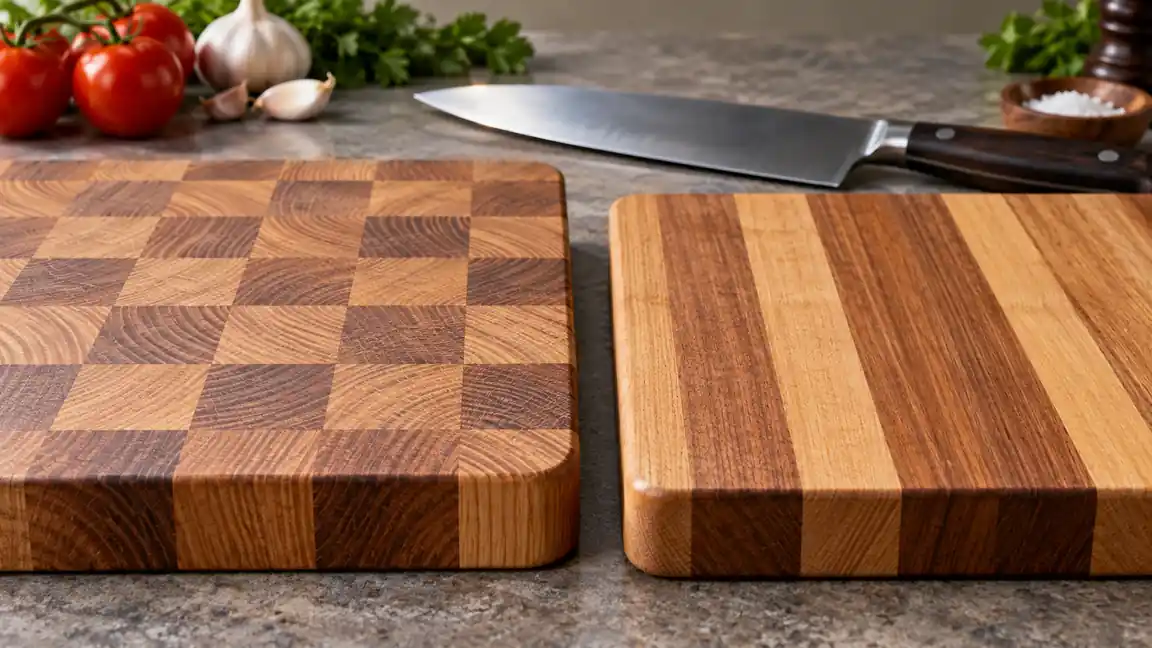
End grain and edge grain cutting boards differ in how their wood fibers meet the knife. An end grain board exposes the ends of the fibers, allowing the blade to press between them. An edge grain board presents long fibers running across the cutting surface. End grain is generally gentler on knife edges and hides shallow cut marks well, while edge grain is usually thinner, lighter, less expensive, and easier to maintain.
Neither construction is universally better. A well-made edge grain board is suitable for everyday kitchen work, while end grain often appeals to cooks who do frequent chopping and want a substantial work surface. Wood species, construction quality, thickness, condition, and care also affect how either board performs.
If you are comparing actual boards, the knife-friendly cutting-board guide puts dimensions, material, and construction alongside one another. The grain comparison below explains just one part of that decision.
End Grain vs. Edge Grain at a Glance
| Feature | End Grain | Edge Grain |
|---|---|---|
| Fiber orientation | Fiber ends face upward | Long fibers run along the surface |
| Effect on knife edges | Generally more forgiving because the edge can move between fibers | Usually produces more direct contact across the fibers |
| Visible knife marks | Often less noticeable | Usually become visible sooner |
| Typical construction | Many small blocks bonded together | Long strips or wider sections bonded side by side |
| Weight and thickness | Frequently heavier and thicker | Often lighter and thinner |
| Moisture sensitivity | Requires careful drying and consistent maintenance | Still vulnerable to warping and splitting, but often simpler to care for |
| Typical cost | Higher because construction requires more material and labor | Lower for comparable wood and dimensions |
| Best fit | Frequent chopping, dedicated prep stations, users prioritizing edge care | General food preparation, easier handling, limited storage, lower cost |
How Wood Grain Orientation Changes the Cutting Surface
A piece of wood contains bundles of fibers that run primarily along the length of the tree. Cutting boards can orient those fibers in different directions.
End Grain Construction
An end grain board is assembled so the cut ends of the fibers form the working surface. The pattern often resembles a checkerboard, although block size and arrangement vary. When a knife contacts the surface, the edge can separate the fibers slightly rather than cutting directly across all of them.
This structure creates the characteristic “self-healing” reputation of end grain boards. That term should not be taken literally. The fibers can close around shallow cuts and make them less visible, but gouges and deep scoring do not repair themselves. A damaged board may still require resurfacing or replacement.
Edge Grain Construction
An edge grain board is usually made from long wooden strips arranged side by side. Their fibers run parallel to the board’s surface and length. A knife therefore crosses the exposed sides of the fibers instead of entering between their ends.
Some sellers use edge grain, long grain, and face grain loosely. In traditional lumber terminology, the edge and broad face of a board are different surfaces. For practical cutting-board comparisons, edge grain commonly refers to a board made from long strips with continuous grain visible across the work surface.
Which Grain Orientation Is Better for Kitchen Knives?
End grain generally has the advantage for minimizing abrasive and impact stress at the cutting edge. The blade can move into the fiber structure, so contact may feel softer than chopping across long grain. This can be valuable for thin, finely sharpened kitchen knives used for repeated push cutting or chopping.
The advantage is relative rather than absolute. Grain orientation is one part of the cutting surface. Knife wear is also influenced by:
- The wood species and its hardness
- Natural mineral content or contaminants embedded in the surface
- The amount of cutting force
- Whether the user chops, slices, rocks, or twists the blade
- The knife’s steel, heat treatment, thickness, and edge geometry
- Grooves, cracks, or dried food residue on the board
- How often the board is cleaned and maintained
A smooth edge grain board made from an appropriate wood can be easier on a knife than a poorly maintained end grain board with raised joints, embedded grit, or an excessively hard surface. Grain orientation does not guarantee longer edge retention.
Both types are preferable to glass, stone, ceramic, and similarly hard surfaces for ordinary knife work. Those rigid materials provide little cushioning and can accelerate dulling or contribute to edge damage, especially with thin or brittle cutting edges.
Durability Depends on Construction and Care
End grain boards contain numerous blocks and glue joints. Their durability depends heavily on accurate joinery, suitable adhesive, properly dried wood, and accommodation for natural wood movement. A quality board can remain serviceable for many years, but neglected moisture exposure can cause open seams, cracks, or uneven areas.
Edge grain boards usually have fewer joints and a simpler structure. They tend to be easier to manufacture in thinner, lighter formats. Knife marks may appear more readily because cuts cross the long fibers, yet surface scratching alone does not mean the board is structurally unsound.
Wood expands and contracts as its moisture content changes. Either construction can warp or split after soaking, dishwasher exposure, prolonged contact with a wet counter, or uneven drying. End grain’s exposed fiber ends absorb moisture readily, making prompt washing and drying especially important.
Thickness and Weight Affect Daily Use
End grain boards are often thick because the block construction benefits from substantial dimensions. Their weight can help them remain stable during cutting, but it also makes them harder to move to a sink or storage area.
Edge grain boards are available in a wider range of thicknesses and are commonly easier to lift. A thin board can slide or warp more readily, so it should rest on a dry, stable surface. A damp kitchen towel or nonslip mat placed underneath can reduce movement, provided the board is removed and dried afterward.
Cleaning and Food Safety
Grain orientation does not remove the need for sound cleaning practices. Both end grain and edge grain boards must be cleaned after food preparation, kept free of deep debris-filled grooves, and dried thoroughly.
For routine care:
- Remove food scraps without dragging a sharp knife edge sideways across the board.
- Wash the surface promptly with warm water, mild dish soap, and a clean sponge or cloth.
- Clean both sides when practical so moisture exposure is more balanced.
- Rinse away soap and residue.
- Dry the board with a clean towel, then allow air to circulate around it.
- Store it only after it is fully dry.
Avoid leaving a wooden board submerged in water. A dishwasher’s prolonged moisture, heat, and detergent can damage many wood boards unless the manufacturer specifically permits that cleaning method.
Raw meat, poultry, and seafood require careful cross-contamination control. Using a separate board for these foods can simplify kitchen hygiene. Follow applicable public health guidance for cleaning or sanitizing food-contact surfaces, along with the board maker’s instructions. Replace a board if deep grooves or separated joints can no longer be cleaned effectively.
Oiling and Surface Maintenance
Wood cutting boards may need periodic treatment with a finish approved for food-contact cutting surfaces. The correct schedule depends on the wood, finish, climate, washing frequency, and manufacturer’s directions. A dry, pale, or rough surface can indicate that maintenance is needed.
Food-grade mineral oil is commonly used for unfinished or oil-finished boards. Some board conditioners combine mineral oil with wax. Ordinary cooking oils are generally poor substitutes because some can oxidize, become sticky, or develop unpleasant odors.
Apply any treatment according to its label and the board manufacturer’s guidance. A film-forming finish that chips or peels is unsuitable for a working cutting surface unless it was specifically intended for that use.
Shallow scratches can sometimes be removed by sanding, followed by thorough cleaning and refinishing. End grain is difficult to plane cleanly because its exposed fibers can tear out, so substantial resurfacing may be better handled by someone familiar with cutting-board repair. Boards with loose blocks, wide cracks, mold growth in inaccessible joints, or unstable surfaces may need replacement.
Choosing Between End Grain and Edge Grain
End Grain Suits a Permanent Prep Station
End grain makes sense when knife-edge care, surface stability, and resistance to visible scoring are high priorities. It is particularly useful for repeated vegetable chopping and other board-intensive preparation. The trade-offs are greater weight, a higher typical price, and closer attention to moisture control.
Edge Grain Is Practical for Everyday Handling
Edge grain is a strong general-purpose option for slicing vegetables, portioning boneless meat, carving cooked foods, and routine meal preparation. It is often easier to wash, move, and store. The surface may show cut marks sooner, but that cosmetic wear does not prevent safe use while the board remains smooth, intact, and cleanable.
Wood Species and Build Quality Still Matter
Two boards with the same grain orientation can behave differently. Dense wood, soft wood, bamboo, mixed-species construction, thick laminations, and thin panels each respond differently to knives and moisture. Bamboo is a grass-based material and is commonly bonded into board panels. Its cutting feel and hardness can vary with construction, so it should not be treated as identical to a typical hardwood board.
Inspect the surface rather than relying on the grain label alone. It should be flat, smooth, free from open joints, and large enough for the intended knife work. Stability on the counter is also important for safe cutting.
Cutting Habits That Protect the Board and Knife
- Use controlled chopping or slicing rather than striking the board with excessive force.
- Avoid twisting the knife while its edge is pressed into the wood.
- Use a bench scraper or the knife’s spine to move food instead of scraping with the cutting edge.
- Keep the board free of grit, ceramic fragments, and other hard debris.
- Do not use an ordinary cutting board as a surface for cutting frozen food or bones with a delicate kitchen knife.
- Check periodically for raised glue lines, cracks, unstable feet, and deep grooves.
Protecting the edge also continues after board work. The guide to dry, separated knife storage covers that part of the routine.
Frequently Asked Questions
Does End Grain Keep Knives Sharp Forever?
No. End grain can reduce some cutting-edge stress, but every knife becomes dull through use. Blade steel, edge geometry, cutting technique, ingredients, board condition, and maintenance all affect how quickly sharpening becomes necessary.
A gentler cutting surface does not eliminate edge maintenance. The honing-versus-sharpening explanation clarifies what to do when performance changes.
Is Edge Grain Bad for Japanese-Style Knives?
No. A smooth wooden edge grain board can be suitable for Japanese-style and Western-style kitchen knives. Thin edges benefit from controlled technique and a forgiving cutting surface, but knife style alone does not require end grain. Avoid hard surfaces and lateral twisting with delicate edges.
Can End Grain Boards Go in the Dishwasher?
Most traditional wooden end grain boards should be hand-washed because dishwasher conditions can promote warping, cracking, and joint failure. Follow the manufacturer’s care instructions for the specific board.
Why Is an End Grain Board More Expensive?
Its construction usually requires cutting, arranging, bonding, flattening, and finishing many individual wood blocks. The board also tends to use more material and greater thickness than a basic edge grain design.
Which Type Is Better for a Small Kitchen?
Edge grain is often more convenient where sink space and storage are limited because it is commonly thinner and lighter. A compact end grain board remains an option if there is enough room to wash, dry, and store it properly.
The Practical Choice
End grain offers the more forgiving fiber orientation for knife edges and usually conceals shallow scoring better. Edge grain provides a simpler, lighter, and often more affordable surface that handles everyday food preparation well. A smooth, stable, properly maintained board of either type is a sound partner for kitchen knives. Construction quality and consistent care matter as much as the direction of the grain.
