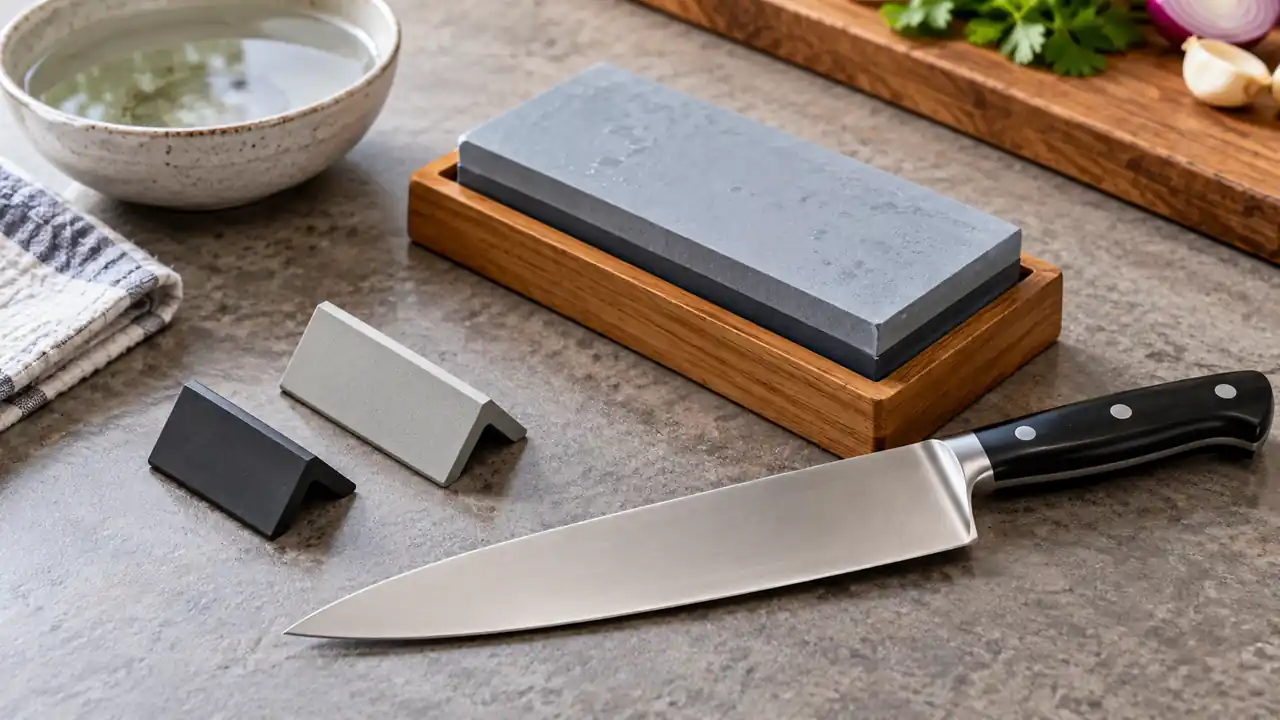
A sharpening stone can reveal every little wobble in your technique. One pass sits at a shallow angle, the next rises too high, and the edge develops an uneven bevel that makes a kitchen knife feel dull again quickly. A knife sharpening angle guide gives your hands a physical reference, helping you repeat the chosen angle across the blade instead of relying entirely on wrist memory.
The main choice is between a guide that clips to the knife, a wedge that sits beside the stone, a fixed-angle jig, and a digital device that reports the angle as you work. A fixed 15-degree guide may suit a thin Japanese-style kitchen knife, while a broader adjustable tool is more useful for Western chef knives, outdoor blades, cleavers, and other edge tools. Buyers should also check blade thickness, minimum blade length, stone type, and whether the guide touches the blade or travels independently across the stone.
This comparison focuses on those practical differences rather than treating every angle guide as interchangeable. The SHARPAL 196N is a particularly flexible choice for home sharpening because it offers four marked angles and two different base styles, while the SHARPAL 195H gives advanced users live digital feedback. The right option depends on whether you want simple repetition, broad angle coverage, or a more controlled sharpening system.
Quick Answer
SHARPAL 196N Angle Pyramid Guide is the strongest general-purpose choice. Its 14°, 17°, 20°, and 25° settings cover common kitchen-knife angles, and the two included guides accommodate both ferrous sharpening stones and traditional or ceramic stones.
The 15° Knife Sharpening Angle Guide is a straightforward option for beginners sharpening standard kitchen knives on a whetstone. Its ceramic glide points and clip-on design provide a simple reference without requiring angle calculations.
SHARPAL 195H Digital Angle Guide suits users who want measurable feedback across a wide range of tools. Its 0° to 80° range reaches well beyond ordinary kitchen knives, although it costs more and requires a more deliberate setup.
Best Knife Sharpening Angle Guide Comparison Table
| Product | Best For | Angle Range | Guide Style |
|---|---|---|---|
| SHARPAL 196N Angle Pyramid Guide | Most kitchen knives | 14°, 17°, 20°, 25° | Stone-mounted pyramid |
| 15° Knife Sharpening Angle Guide | Beginner whetstone users | 15° | Clip-on blade guide |
| SHARPAL 195H Digital Angle Guide | Measured freehand sharpening | 0° to 80° | Digital magnetic guide |
| SHARPAL 194H Angle Guide | Knives and edge tools | 15° to 45° | Adjustable magnetic guide |
| 4-in-1 Knife Sharpening Angle Guide | Multiple blade types | 12°, 14°, 18°, 30° | Clip-on ceramic guide |
| LAVODA SG01 Sharpening Jig | Controlled jig sharpening | 0° to 30° | Adjustable clamp and ball joint |
| Work Sharp Precision Adjust | Repeatable guided sharpening | 15° to 30° | Complete fixed-angle system |
| Sharp Pebble Angle Guide | 15° to 20° kitchen edges | 15° to 20° | Clip-on ceramic guide |
| Wedgek AGM Angle Wedges | Learning freehand control | 10° to 20° | Independent stone-side wedge |
The detailed reviews below show how each guide behaves conceptually, which blades it accommodates, and where its limitations may affect your sharpening routine.
1. SHARPAL 196N Angle Pyramid Guide 4 Universal Angles 14° 17° 20° 25°, 2-Pack — Best Overall

Angle selection is the reason this guide earns the top position. Instead of locking you into one bevel, the pyramid presents four choices: 14°, 17°, 20°, and 25°. That spread gives a home cook room to work with thinner kitchen blades, general-purpose Western knives, and sturdier outdoor or utility edges without collecting several separate guides.
The two-piece arrangement is useful because the guides use different bases. The orange version has a magnetic base intended for ferrous-metal sharpening stones, while the black version uses an anti-slip rubber pad for traditional stones, ceramic whetstones, and similar surfaces. That distinction matters on a wet countertop, where a guide that slides can turn a careful stroke into a crooked one.
Pros
- Four clearly defined angle settings cover common sharpening tasks.
- Two base designs suit different stone surfaces.
- Useful for both beginners and users refining existing technique.
- Compact format is easy to keep with a sharpening setup.
- Angle choices are broader than a single-purpose 15° guide.
Cons
- Fixed pyramid positions do not provide every angle between the marked settings.
- Users must still maintain steady blade contact against the guide.
This is the sensible starting point for a mixed kitchen drawer because it gives a clear angle reference without becoming a full sharpening system. It is especially useful for someone who alternates between a thinner blade and a more robust chef knife. Buyers who need an exact custom angle, or who want the guide to clamp directly to the knife, should look at the adjustable models below.
To buy this product, click here.
2. Knife Sharpening Angle Guide for Whetstone, 2 Pack 15° Knife Angle Guide with Ceramic Glide — Best for Beginners

A single 15° reference can make the first sharpening session feel far less mysterious. This guide clips onto the knife spine, giving the blade a physical relationship to the stone while you work. The design is aimed at kitchen knives and chef knives, so it fits the common situation where a home cook has one or two straight-edge blades that need a repeatable angle.
The ceramic glide contact points are intended to move across the stone while limiting direct scraping between the guide, blade, and abrasive surface. That does not remove the need to use controlled strokes or keep the stone stable, but it gives a new sharpener one less variable to manage. The two-pack also allows a spare to remain in a second sharpening area or tool box.
Pros
- Simple 15° setting is easy for beginners to understand.
- Clips onto the knife spine for a direct visual and physical reference.
- Ceramic contact points are intended to glide across the stone.
- Works with whetstones, diamond stones, and oil stones.
- Two guides provide a convenient spare.
Cons
- One fixed angle offers less flexibility for different blade designs.
- Not recommended for very small pocket knives or unusually thin spines.
This is a good fit for a standard kitchen knife owner who wants to practice one consistent angle rather than study a range of bevels. It is less suitable for a collection containing very thin blades, unusual spine shapes, or tools that need a larger angle. Its strength is simplicity, and that is exactly what makes it approachable beside a damp whetstone.
To buy this product, click here.
3. SHARPAL 195H Digital Angle Guide for Knife Sharpening Stone and Whetstone — Best Digital Guide

The SHARPAL 195H takes a different approach from a plastic angle block. It provides a real-time readout in 1° increments while attached to the blade, helping users see whether the angle changes during a stroke. Its stated 0° to 80° range reaches from small kitchen edges to axes, chisels, and plane irons, so it has a broader role in a workshop than a kitchen-only guide.
The motion-filtering design is intended to reduce interference from movement as the device travels with the blade. A strong magnetic base helps hold it in place, while the removable silicone pad creates a softer contact surface and can be removed for cleaning. IP54 protection offers resistance to dust and splashes, but the device still belongs in a careful sharpening setup rather than sitting in pooled water.
Pros
- Wide 0° to 80° range accommodates many edge tools.
- Displays angle changes in 1° increments.
- Motion-filtering design is intended for moving sharpening strokes.
- Magnetic base and removable silicone pad support practical use.
- Useful for users who want feedback while developing freehand control.
Cons
- More involved than a simple wedge or clip-on guide.
- Digital feedback does not replace proper stone handling or blade control.
This guide makes sense for a serious hobby sharpener who works on several tool types or wants to study technique with measurable feedback. A home cook who sharpens one chef knife twice a year may find its broader range unnecessary. Its value lies in visibility: instead of guessing whether your wrist lifted, you can watch the readout and correct the movement.
To buy this product, click here.
4. SHARPAL 194H Whetstone Knife Blade Sharpener Angle Guide — Best Adjustable Magnetic Guide

Some sharpening benches contain more than kitchen knives. A chisel, plane iron, or heavier blade may require a steeper setting than a typical chef knife, and the SHARPAL 194H addresses that range with adjustment from 15° to 45°. Its magnetic base is intended to keep the guide positioned on a sharpening surface while the angle is checked or changed.
The broad adjustment makes it more versatile than a fixed kitchen guide, but that versatility also places more responsibility on the user. You need to select an appropriate angle for the edge being sharpened and keep the stone secure. The lanyard hole is a small storage convenience for a workshop drawer, tool roll, or sharpening station.
Pros
- Adjustable range covers 15° through 45°.
- Useful for knives, chisels, and plane irons.
- Magnetic base supports positioning during sharpening.
- Allows users to check or alter the angle as needed.
- Compact format suits a shared kitchen and workshop setup.
Cons
- Broad adjustment can be unnecessary for a basic kitchen-only routine.
- Angle selection is left to the user rather than limited to common knife settings.
Choose this guide if your sharpening tasks change from week to week. It is a practical bridge between a basic knife angle reference and a dedicated jig, particularly for households that maintain both kitchen and woodworking tools. Users who want a quick, predefined kitchen angle may find the SHARPAL 196N easier to use.
To buy this product, click here.
5. 4-in-1 Knife Sharpening Angle Guide 2 Pack — Best for Mixed Blade Types

This two-pack targets households where the sharpening drawer contains several blade styles. Its four settings are 12°, 14°, 18°, and 30°, creating a spread from relatively narrow kitchen edges to heavier utility or cleaver-style work. The listed compatibility includes water stones, diamond stones, ceramic rods, and oil stones, which gives it broad medium flexibility.
The ceramic gliders are intended to protect the blade finish while moving across the stone, and the guides are listed for blades up to 14 inches. That long-blade allowance may appeal to users with larger chef or hunting knives, while the stated restriction against blades under 3.5 inches helps define where the tool is less suitable.
Pros
- Four settings cover 12°, 14°, 18°, and 30°.
- Useful across several sharpening mediums.
- Listed for blades up to 14 inches.
- Ceramic gliders are intended to reduce direct surface contact.
- Two complete guides support consecutive sharpening sessions.
Cons
- Not recommended for blades shorter than 3.5 inches.
- The 30° setting may be unsuitable for thin kitchen edges.
This is a useful choice for a home cook who also maintains outdoor or heavier blades. The angle spread is more varied than the typical kitchen-only guide, although users should avoid selecting a setting simply because it is available. Check the intended edge geometry of each knife and treat the angle markings as a control aid rather than a guarantee of the correct bevel.
To buy this product, click here.
6. LAVODA SG01 Knife Sharpening Angle Guide Adjustable 0° to 30° — Best Controlled Sharpening Jig

The LAVODA SG01 is aimed at users who want a clamped blade and a guided movement rather than a loose angle reference beside the stone. Its micro-adjustable system covers 0° to 30°, and the 304 stainless steel ball joint is designed to let the guide move across the stone while the blade remains secured. That setup can be appealing during longer sessions where repeated wrist positioning becomes tiring.
Compatibility depends on the physical setup. The guide is listed for stones 25 to 55 mm thick and blades up to 7 mm thick. Nylon clamp screws, removable painter’s tape, and an oil-based marker are included for blade protection and edge tracking. An angle gauge is not included, so buyers must supply a way to establish the desired setting.
Pros
- Micro-adjustable angle range reaches 0° to 30°.
- Clamp-based design provides a controlled sharpening path.
- Ball joint supports movement across the stone.
- Specified compatibility covers many kitchen and outdoor blades.
- Blade-protection accessories are included.
Cons
- Does not include an angle gauge.
- Requires stones within the stated thickness range.
This jig suits an enthusiast who wants a more structured process and is comfortable checking measurements before sharpening. It is less convenient for someone who wants to grab a guide and start immediately with a standard whetstone. The clamp and stone-thickness requirements deserve attention before purchase, especially if your current stone is unusually thin or thick.
To buy this product, click here.
7. Work Sharp Precision Adjust Knife Sharpener Kit — Best Complete Guided System
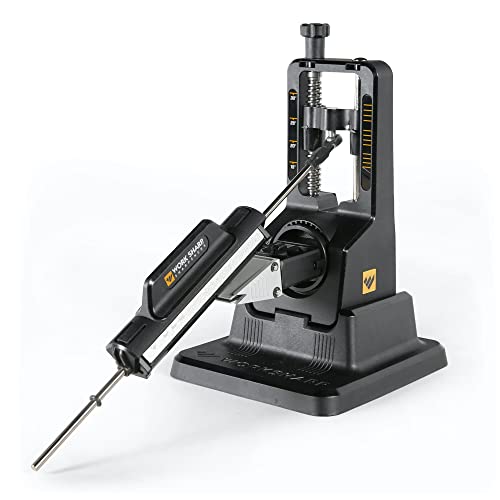
The Work Sharp Precision Adjust goes beyond an angle guide by combining angle adjustment with a guided manual sharpening system. Its range runs from 15° to 30°, and the kit is intended for kitchen, pocket, hunting, and fillet knives. Because the blade is sharpened through a fixed-angle arrangement, it may be easier for users who struggle to keep a separate guide and knife aligned over repeated strokes.
The abrasive progression moves from coarse work toward finer finishing, and the listing states that the system can address serrated edges. It folds for storage and needs no power, making it suitable for a drawer, workbench, or travel kit. This is a different purchase from a simple stone guide, so it makes the most sense for someone who wants a repeatable sharpening station rather than an inexpensive angle aid.
Pros
- Fixed-angle system reduces reliance on freehand wrist control.
- Adjustable range covers 15° to 30°.
- Intended for kitchen, pocket, hunting, and fillet knives.
- Includes coarse-to-fine abrasive progression.
- Manual and foldable design needs no cord or batteries.
Cons
- More equipment than needed for someone seeking only a stone guide.
- Its angle range does not cover settings above 30°.
Pick this system if repeatability matters more than preserving a traditional freehand sharpening routine. It is especially relevant for a mixed knife collection where consistent angle control is difficult to maintain. A whetstone owner who already has good technique may prefer a simpler guide and keep the rest of the process open-ended.
To buy this product, click here.
8. Whetstone Knife Sharpening Angle Guide by Sharp Pebble — Best for Common Kitchen Angles
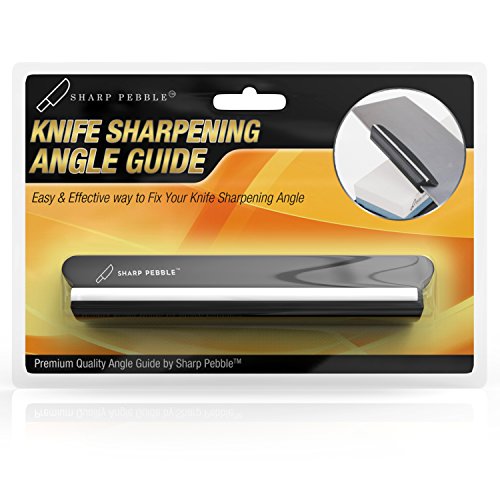
The Sharp Pebble guide stays within the narrow range most home cooks associate with kitchen knife sharpening: 15° to 20°. Its plastic body and protective ceramic layer are intended to help maintain the guide position while reducing contact between the blade and stone. That focused range keeps the tool easy to understand for someone sharpening ordinary kitchen knives rather than workshop tools.
The listing describes the guide as suitable for different knife sizes, but the physical fit of any clip-on guide still depends on the blade spine and overall shape. It is best treated as a reference for common double-bevel kitchen knives, not as a universal solution for every edge design. The ceramic layer may also help limit wear during repeated sessions, although careful cleaning remains sensible after wet sharpening.
Pros
- Focused 15° to 20° range suits many kitchen knives.
- Ceramic protective layer is intended to protect the sharpening surface.
- Simple clip-on format is approachable for new users.
- Plastic construction keeps the guide compact.
- Designed for use with whetstones.
Cons
- Limited angle range is less useful for heavy tools.
- Fit may still depend on the knife spine and blade shape.
This guide is a reasonable match for a kitchen drawer filled with standard chef, utility, and paring knives that fall within its stated range. It is less compelling for users who need 25° or higher settings, or who sharpen blades that cannot accept a clip-on guide. Its appeal comes from staying focused rather than trying to cover every possible sharpening task.
To buy this product, click here.
9. Wedgek AGM Angle Wedges for Sharpening Knives — Best for Practicing Freehand Technique
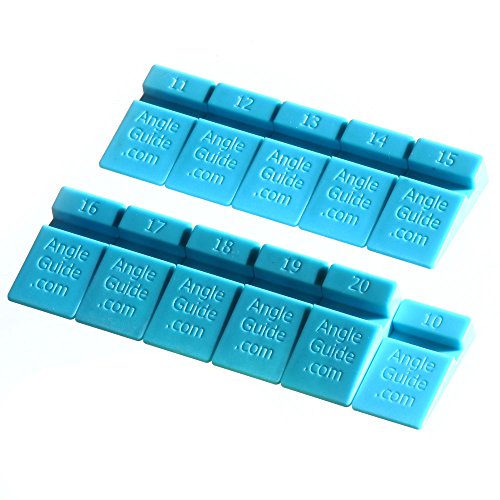
Wedgek takes the guide away from the blade. The AGM wedge sits beside the stone and helps establish a sharpening angle before each stroke, while the user holds the knife at that height. Its stated range is 10° to 20°, and two wedges can be tied together for angles up to 39°. The compact plastic body measures 1.5 inches long and includes two rubber bands.
This arrangement teaches a different skill from a clip-on guide. Because the wedge does not travel with the knife, your hands still need to maintain the position throughout the stroke. That may appeal to someone who wants a physical training aid without attaching anything to the blade, but it requires more concentration than a guide that follows the spine.
Pros
- 10° to 20° range covers narrow kitchen knife angles.
- Two wedges can be combined for steeper settings.
- Independent design does not attach to the blade.
- Compact plastic construction is easy to store.
- Rubber bands are included for combining the wedges.
Cons
- The user must hold the knife at the set angle for every stroke.
- Its 10° to 20° range is limited for heavier edge tools.
Choose Wedgek if your goal is to develop steadier freehand habits while keeping a simple angle reference nearby. It can be useful for a patient learner who wants less hardware attached to the knife, but it will not provide the same direct control as the Work Sharp system or LAVODA jig. The trade-off is clear: more hand involvement, less blade-mounted hardware.
To buy this product, click here.
Buying Guide
Match the Guide to the Sharpening Method
Clip-on guides travel with the knife and give beginners a direct physical reference. Stone-mounted pyramids and wedges sit beside the abrasive, leaving more of the movement to your hands. Fixed-angle systems go further by controlling the sharpening path, while digital guides display changing angles during freehand work. Decide whether you want a training aid, a measurement tool, or a complete guided sharpener before comparing angle ranges.
Understand Per-Side Angle Versus Total Edge Angle
Most knife angle guides describe the angle on one side of a double-bevel blade. A 15° setting generally refers to one side, with the two sides forming the complete edge angle together. Product listings do not always explain this distinction clearly, so avoid comparing a per-side setting with an inclusive angle as though they were the same measurement.
A guide’s stated angle is not a universal recommendation for the blade. Review Japanese-knife edge geometry and sharpening before treating a fixed position as the correct setting.
Check the Blade and Spine Compatibility
A clip-on guide needs enough spine thickness and a shape that allows it to sit securely. The 15° two-pack specifically excludes very small pocket knives and unusually thin spines, while the 4-in-1 guide is listed for blades from 3.5 inches upward. A guide intended for a long chef knife may be awkward on a tiny paring knife, so match the physical design to the blades you actually sharpen.
Choose the Angle Range for Your Collection
A narrow 15° to 20° guide is easy to use for common kitchen knives, but it will not cover every outdoor blade or heavy tool. The SHARPAL 196N offers four kitchen-friendly settings, the SHARPAL 194H reaches 45°, and the digital 195H extends to 80°. A broad range is useful only when your collection needs it. More settings also mean more responsibility for selecting an appropriate angle.
Consider the Stone Surface
Stone-mounted guides depend on staying put. The SHARPAL 196N includes a magnetic base for ferrous-metal stones and a rubber-padded base for traditional or ceramic stones. Other guides are intended to clip onto the knife or move with a ball joint. Confirm how the guide contacts your whetstone, especially if you sharpen on a wet surface where sliding can interrupt the stroke.
Do Not Confuse Angle Control With Sharpening
An angle guide helps maintain blade position, but it does not supply the abrasive action needed to create an edge. You still need a suitable whetstone, diamond stone, oil stone, or complete sharpening system. The Work Sharp kit includes abrasives, while most of the standalone guides do not. Keep the stone flat, secure the setup, and remove swarf from the working surface as directed by the stone manufacturer.
Account for Edge Design
Angle guides are most straightforward with ordinary double-bevel kitchen knives. Single-bevel blades, serrated edges, very thin edges, and unusual profiles may need a different method. The Work Sharp listing includes serrated-edge support, but a basic clip-on guide should not automatically be treated as suitable for every serration or single-bevel knife.
Best Knife Sharpening Angle Guide FAQ
What angle should I use for a kitchen knife?
The correct setting depends on the knife’s edge design and the intended use. The supplied guides commonly offer settings from 14° to 20° for kitchen knives, while some include 25° or 30° positions for sturdier edges. Use the manufacturer’s stated angle when available rather than assuming every Japanese-style or Western-style knife shares one setting.
Is a 15° angle guide suitable for a chef knife?
It can be suitable for a chef knife if the knife’s existing geometry supports that angle. A 15° guide is especially useful for users who want a consistent narrow reference, but the guide should fit the blade spine securely. Check the blade design before changing a significantly different existing bevel.
Are knife sharpening angles measured per side?
They commonly are, although product listings may not always state the convention clearly. A 15° guide generally positions one side of a double-bevel blade at approximately 15° relative to the stone. The total angle across both sides is different, so read the product instructions and avoid mixing measurement systems.
Are clip-on guides safe for every knife?
No. Fit can be affected by spine thickness, blade height, blade length, and the guide’s opening. The supplied 15° guide excludes very small pocket knives and unusually thin spines, while the 4-in-1 model is not recommended for blades under 3.5 inches. A loose guide can make the stroke inconsistent and may mark the blade.
What is the difference between a wedge and a fixed-angle jig?
A wedge sits beside the stone and gives your hands a height reference. A fixed-angle jig attaches to or controls the blade and guides its movement more directly. Wedges encourage freehand practice, while jigs generally provide more mechanical consistency. The best choice depends on whether you want to learn the motion or minimize variation.
Can I use an angle guide on a diamond stone or oil stone?
Several supplied guides are listed for more than one sharpening medium. The 15° clip-on guide is described for whetstones, diamond stones, and oil stones, while the SHARPAL 196N includes different base styles for different stone surfaces. Always check whether the guide is intended to slide on the specific surface you use.
Does an angle guide sharpen a dull knife by itself?
No. It controls position, but the stone or abrasive performs the material removal. A coarse abrasive may be needed for a damaged or very dull edge, followed by a finer abrasive for refinement. A guide can make the motion more repeatable, but it cannot replace suitable grit selection, a stable stone, or careful strokes.
Final Verdict
The SHARPAL 196N is the best overall choice for most home kitchens because it combines four useful angle settings with two base designs. It gives beginners a visible reference while remaining flexible enough for different kitchen knives and sharpening stones. For a simple one-angle setup, the 15° ceramic-glide guide is easier to understand and keeps the process focused.
Users who want feedback rather than a fixed reference should choose the SHARPAL 195H Digital Angle Guide, while those seeking a complete guided sharpening process should look at the Work Sharp Precision Adjust. The SHARPAL 194H, LAVODA SG01, and Wedgek models serve more specialized preferences, from workshop angles to hands-on freehand practice. Match the guide to your blade spine, sharpening medium, and desired angle range, then prioritize steady strokes over chasing a number that your knife was never designed to use.
