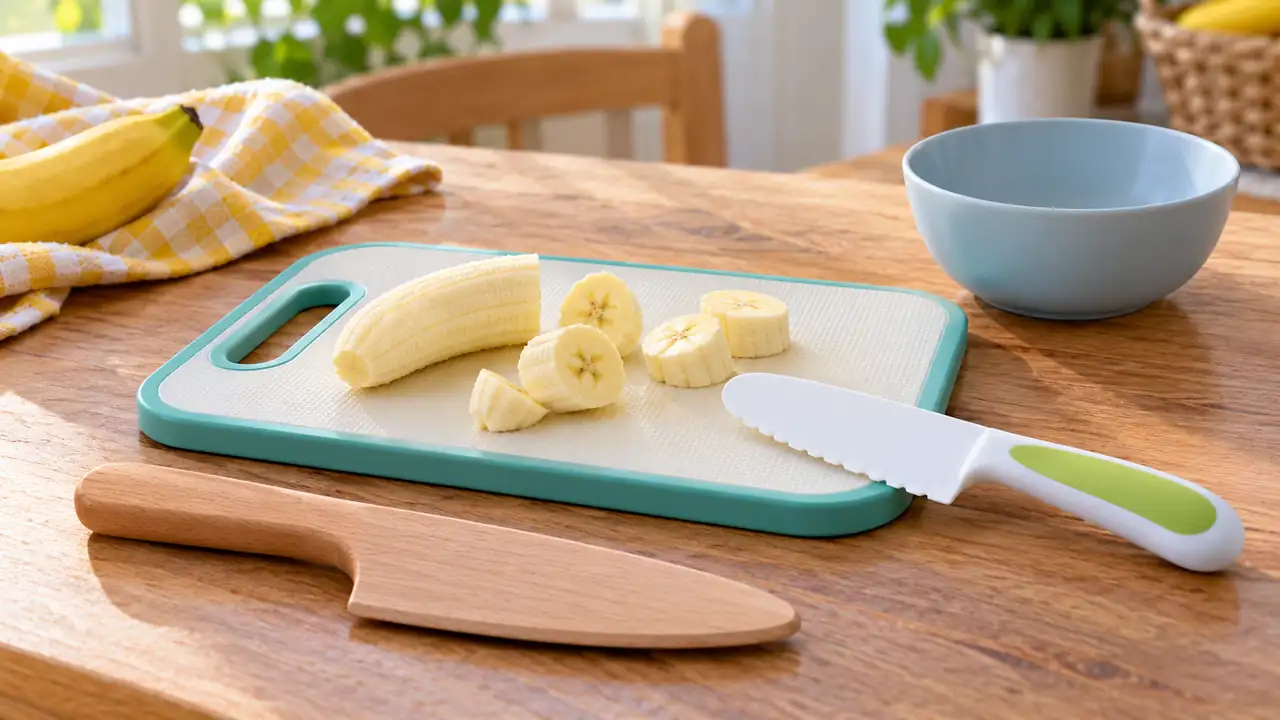
Teach children kitchen-knife skills through direct adult supervision, a stable workspace, suitable soft food, and one controlled movement at a time. Readiness depends on attention, coordination, willingness to follow instructions, and the task itself. A birthday, a “kid-safe” label, or success during one lesson does not establish that a child can use a knife independently.
Tool selection is only one part of a supervised lesson. These kitchen knives designed for children can be compared by their stated features, but no product label replaces adult supervision or a check of the child’s readiness.
Check Readiness Before Choosing the Tool
Begin with a conversation and a demonstration away from active cutting. The child should be able to listen, pause when asked, and keep the tool on the work surface. If those expectations are difficult today, washing produce, separating leaves, measuring, or arranging food may be a better activity.
Readiness can change with fatigue, excitement, frustration, or a distracting kitchen. Treat each session as a fresh decision. An adult who is also managing a hot pan or another child may not be able to give cutting practice the attention it requires.
The University of Minnesota Extension’s Cooking Matters programs place knife skills within broader instruction about appropriate tasks and safe food preparation. Learning the rules and preparing the space are part of the lesson, rather than preliminaries to rush through.
Prepare a Workstation the Adult Can Control
- Use a stable board on a secure work surface. Check that the child can see the food without stretching or leaning over the cutting path.
- Clear away unused knives, breakable dishes, hot equipment, and ingredients that are not part of the exercise.
- Wash hands and prepare the food before placing the cutting tool in reach.
- Position yourself so you can observe the holding hand, the tool, and the blade’s intended path.
- Agree on a simple stop instruction. When it is given, the child puts the tool down and moves their hands away.
Do not improvise an unstable platform to solve a height problem. If the available setup does not allow a balanced position and close supervision, choose a different activity.
Start With Soft Food and a Simple Motion
A peeled banana or another soft, stable ingredient lets the adult focus on movement without asking the child to overcome a hard skin or dense center. Food still needs to be appropriate for the child’s abilities and the intended tool. An adult should do any difficult peeling, splitting, or initial trimming separately.
- Demonstrate without rushing. Show where the tool rests, where the holding hand belongs, and where the cutting movement will finish.
- Explain the holding hand. Keep fingertips out of the cutting path. Demonstrate an appropriate controlled grip for the food and tool; stop if the child cannot maintain it.
- Make one cut. Let the child repeat only the movement that has been demonstrated. Do not introduce several cutting styles in the same exercise.
- Put the tool down. Rearrange the food with the blade at rest. This separates cutting from reaching and moving ingredients.
- Review the result together. Look at control, positioning, and stopping when asked. Perfectly even pieces are not the goal of an introductory lesson.
A tool that requires force on the selected food is a reason to stop. Do not solve that problem by asking the child to push harder or hold the food closer to the edge. Change the ingredient, let the adult complete the task, or return to a simpler exercise.
Build Habits Before Adding Difficulty
Introduce a more demanding task only when the existing task is consistently controlled and an adult judges the next step appropriate. Change one variable at a time: the ingredient, the size of the pieces, or the tool. A different blade and a harder food together make it harder to recognize what caused a problem.
Demonstrate putting a tool down before turning to speak, passing tools only in a controlled adult-led manner, and keeping the cutting space clear. Do not allow waving, carrying a knife around the kitchen, or reaching for a falling tool. The Illinois Extension kitchen guidance emphasizes considering children’s skill levels before using scissors or sharp knives. Match the exercise to the child rather than treating an age band as permission.
Stop the session if attention drifts, the child becomes frustrated, or the adult cannot continue observing closely. Ending after a small successful task is preferable to extending practice until the rules break down.
Keep Adult Preparation Separate
A child’s participation does not require the child to perform every stage of a recipe. An adult can prepare difficult ingredients and leave a clearly defined, suitable portion of the work. The guide to the essential knives in an adult home kitchen explains the broader toolkit; it is not a list of knives to hand to a beginning child.
Do not describe a plastic, nylon, wooden, or rounded-tip tool as incapable of causing injury. Different designs work on different foods, and none removes the need to supervise movement and keep other people out of the cutting path.
End With Cleaning, Counting, and Storage
The adult should account for every cutting tool before the food-preparation area is cleared. Follow the tool’s cleaning instructions, deal with concealed edges carefully, and do not leave knives under dishes or in a sink. Letting the child help with non-cutting cleanup does not mean the adult must hand over a blade for washing.
Return tools to storage that children cannot access on their own. The principles in storing kitchen knives dry and separated apply alongside that access control; a guard or countertop block by itself is not a child-resistant storage system.
