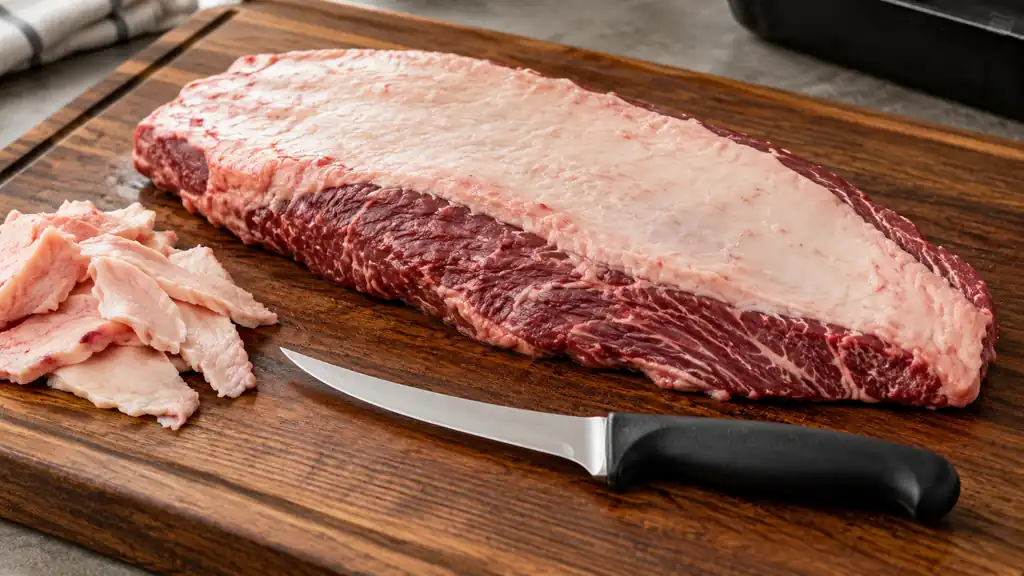
A brisket trim can turn messy fast. Thick fat caps, silver skin, seams, and tight pockets around the point demand a narrow blade that can follow contours without forcing the cook to hack or twist. That is why the best boning knife for trimming brisket usually has a curved or tapered profile, a manageable length, and enough control for short slicing motions. A broad chef’s knife may handle a cooked brisket, but it is awkward during raw trimming and can remove more meat than intended.
Blade shape matters more than flashy packaging. A flexible or semi-flexible 5.5- to 7-inch blade can work beneath fat and around connective tissue, while a full-tang handle with a secure grip helps during greasy preparation. Steel descriptions also deserve a careful reading. Several knives below list high-carbon German or Japanese steel, but those general descriptions do not establish identical metallurgy or edge retention. Hand washing and prompt drying remain sensible habits for every option here, regardless of corrosion-resistant claims.
The strongest choices differ according to the job. A dedicated 6-inch boning knife makes sense for cooks who already own a brisket slicer, while a two-piece set is more useful for anyone preparing, carving, and serving the same cut. Larger butcher sets add breaking and filleting tools, though they require more storage and cost more than a single trimming knife. This guide compares nine relevant options by blade length, construction, intended use, and included equipment.
Quick Answer
Cutluxe Curved Boning Knife is the strongest overall match for brisket trimming because its 6-inch curved blade, listed flexible design, full tang, pakkawood handle, and stated 14-16-degree-per-side edge all align closely with controlled meat preparation.
Mercer Culinary Ultimate White is a straightforward standalone choice for cooks who want a compact curved boning knife for fat and sinew work. Its textured handle and 6-inch blade keep the design focused.
For a complete brisket workflow, Cutluxe Carving Knife Set pairs a 6-inch boning knife with a 12-inch slicer. Buyers who also break down larger cuts may prefer the Cutluxe Butcher Knife Set, which adds a 10-inch breaking knife.
Best Boning Knife For Trimming Brisket Comparison Table
| Product | Best For | Blade Length | Construction | Included Tools |
|---|---|---|---|---|
| Cutluxe Curved Boning Knife | Overall brisket trimming | 6 inches | Flexible, full tang | Knife only |
| Mercer Culinary Ultimate White | Focused standalone trimming | 6 inches | Curved boning design | Knife only |
| OAKSWARE Pro Boning Knife | Compact BBQ preparation | 5.5 inches | Full tang, double bevel | Knife only |
| DRAGON RIOT Boning Knife | Meat and fish versatility | 6 inches | Flexible, curved blade | Knife only |
| DRGSKL Boning Knife | Longer precision trimming | 7 inches | Full tang, ATS-34 steel | Knife only |
| Cutluxe Carving Knife Set | Trimming and slicing brisket | 6-inch boning knife | Full tang | 12-inch slicer |
| Sunnecko BBQ Carving Knife Set | Large roasts and BBQ prep | 7-inch boning knife | Full tang | 12-inch slicer, sheath, tweezer |
| Cutluxe Butcher Knife Set | Breaking down primals | 6-inch boning knife | Full tang | 12-inch slicer, 10-inch cimeter |
| Cutluxe Four-Piece Butcher Set | Broad meat-preparation duties | 6-inch boning knife | Full tang | Slicer, breaking knife, fillet knife |
The detailed reviews explain where each blade fits in a brisket workflow, from trimming a single packer to breaking down several large cuts.
1. Cutluxe Curved Boning Knife, 6 Inch — Best Overall

A 6-inch curved blade is a practical middle ground for brisket trimming. It is long enough to make controlled cuts through fat and silver skin, yet short enough to maneuver around the point and the irregular edges of a packer brisket. Cutluxe describes this knife as flexible, which suits cooks who use shallow slicing motions instead of pressing a stiff blade through every section.
The listed high-carbon German steel, 56+ Rockwell hardness, and 14-16-degree-per-side edge provide useful specification context, though they do not independently prove edge retention or cutting performance. The full-tang construction and triple-riveted pakkawood handle should appeal to buyers who want a traditional meat-preparation handle. It is also listed for filleting, skinning, butterflying, and deboning, so it can remain useful after the Saturday brisket is finished.
Pros
- Six-inch curved profile suits controlled brisket trimming.
- Listed flexible design can follow seams and contours.
- Full-tang construction supports a substantial handle structure.
- Triple-riveted pakkawood handle provides a traditional grip design.
- Published specifications include high-carbon German steel and 56+ HRC hardness.
Cons
- Flexibility may feel less suitable for buyers who prefer a stiff boning blade.
- Pakkawood requires careful hand washing and drying rather than careless soaking.
This is the most balanced choice for a home pitmaster who wants one dedicated trimming knife without filling a drawer with specialized tools. Its size also works for poultry and fish, although users who regularly break down primals may need a larger breaking blade. Buyers who prefer a very short blade should look at the 5.5-inch OAKSWARE, while those who want slicing equipment in the same purchase should move to a set.
To buy this product, click here.
2. Mercer Culinary Ultimate White, 6 Inch Curved Boning Knife — Best Focused Standalone Design
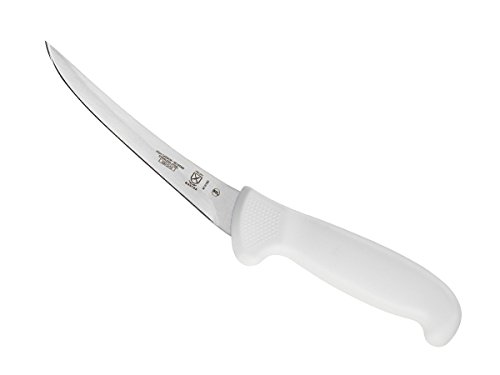
Mercer keeps this knife centered on the core task: separating meat from bone and trimming fat or sinew. Its curved 6-inch blade is a sensible size for a brisket trim, where a cook may spend several minutes making small cuts around the deckle and point rather than carving in long, sweeping strokes. The product information identifies the blade as high-carbon Japanese steel, but it does not provide a specific alloy designation or hardness value.
The white textured handle includes finger-point details intended to support grip security. That feature may be useful during greasy preparation, though handle comfort remains dependent on hand size and grip style. The design is less elaborate than the larger sets in this roundup, which can be a benefit for someone who already owns a slicing knife and wants a dedicated prep blade that is easy to store and understand.
Pros
- Curved 6-inch blade is appropriately sized for detailed brisket trimming.
- Product information specifically includes fat and sinew trimming.
- Textured handle with finger points supports a secure grip design.
- High-carbon Japanese steel is listed for the blade.
- Focused single-knife format avoids redundant BBQ accessories.
Cons
- The available specifications do not identify the exact steel alloy or hardness.
- Hand washing and complete drying are required for long-term care.
Choose the Mercer for a simple, task-focused setup. It makes sense beside a separate brisket slicer, carving fork, or general kitchen knife. The lack of a stated flexibility rating means buyers cannot precisely compare its bend characteristics with the Cutluxe or DRAGON RIOT, so cooks with a firm preference for flexible trimming should select a product that documents that feature.
To buy this product, click here.
3. OAKSWARE Pro Boning Knife, 5.5 Inch — Best Compact BBQ Option
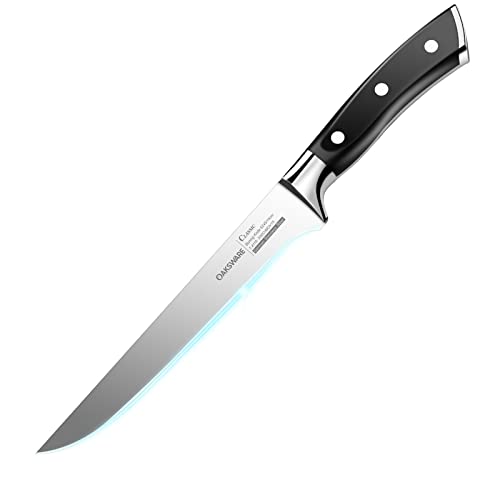
The OAKSWARE is the shortest dedicated blade in this group, at 5.5 inches. That compact length can be useful on a crowded cutting board, particularly when a brisket has already been separated into smaller sections and the work calls for precise removal of thin layers. The listing specifically describes brisket, ribs, fat caps, and silver skin, giving it a direct connection to BBQ preparation rather than relying on general deboning language.
Its published specifications include a 14-16-degree double-bevel edge and 57+ HRC German steel. The full-tang handle has triple rivets, a contoured shape, and a finger guard. The listing also describes an elevated resting design intended to keep the blade away from the counter, although that feature should not replace safe knife storage or careful handling. Its stated use across meat, poultry, and fish gives the short blade some flexibility beyond brisket day.
Pros
- Five-and-a-half-inch blade offers close control in tight trimming areas.
- Brisket, fat-cap, and silver-skin preparation are specifically listed.
- Double-bevel edge suits ordinary right- or left-handed cutting motions.
- Full-tang, triple-riveted handle includes a finger guard.
- Published specifications include 57+ HRC German steel.
Cons
- Shorter reach may require more passes across broad brisket sections.
- The listing does not provide a specific flexibility classification.
This knife is a good fit for cooks who value nimble handling over reach. A short blade can help prevent oversized cuts during trimming, though it is less efficient for long seams or larger cuts of meat. It also suits a compact BBQ station where a 7-inch boning knife may feel cumbersome. Buyers who want one blade for brisket, fish, and poultry should compare it with the flexible DRAGON RIOT.
To buy this product, click here.
4. DRAGON RIOT 6 Inch Curved Boning Knife — Best for Meat and Fish Versatility

DRAGON RIOT takes a multipurpose approach, presenting the 6-inch knife for trimming meat, deboning poultry, and filleting fish. The curved, flexible format is relevant to brisket because it supports the short, contour-following movements used around fat seams. A cook who moves from a brisket on Saturday to salmon or chicken during the week may appreciate the broader task list.
The blade is described as German high-carbon stainless steel with a stated 58±2 HRC range and a 15-degree edge bevel. That is more specific than a general high-carbon claim, though a published hardness range still does not establish measured edge life in a particular kitchen. The fiberglass-reinforced nylon handle is lightweight and textured, which may be easier to clean than natural wood after handling raw meat.
Pros
- Curved and flexible 6-inch design fits detailed trimming work.
- Stated uses include meat, poultry, and fish preparation.
- Published blade material includes high-carbon stainless steel.
- Textured fiberglass-reinforced nylon handle is suited to frequent cleaning.
- Stated 15-degree bevel provides a clear edge specification.
Cons
- Flexible construction may offer less support for buyers who prefer stiff blades.
- The lightweight handle may feel less substantial than a full-tang pakkawood design.
This is the practical crossover option for a cook who sees brisket trimming as one part of a broader prep routine. The stainless-oriented construction and synthetic handle may appeal to users who want fewer concerns around moisture, while the flexible profile remains specialized enough for meat preparation. A dedicated brisket-only buyer may prefer Mercer’s simpler design or Cutluxe’s full-tang handle.
To buy this product, click here.
5. DRGSKL 7 Inch Boning Knife — Best for Longer Precision Trimming

At 7 inches, the DRGSKL offers more reach than the compact knives above. That extra length can help when a brisket trim involves broad surfaces or longer seams, although it also asks for more deliberate control in tight areas. The narrow, tapered blade and sharp point are described for separating meat from bone, trimming fat, and working around joints, all relevant motions for a raw brisket.
This product stands apart through its listed ATS-34 steel, full-tang structure, and walnut handle with a sculpted finger groove. The black coating is described as a Dual-Tech Black Shield finish. The available information does not establish the coating’s effect on cutting performance, so its practical role is mainly finish and surface protection. Buyers should hand wash and dry the knife, particularly because the handle is natural walnut rather than a fully synthetic material.
Pros
- Seven-inch blade provides useful reach across larger brisket sections.
- Narrow, tapered profile is listed for fat trimming and joint work.
- ATS-34 steel is identified by alloy designation.
- Full-tang walnut handle includes a sculpted finger groove.
- Coated blade and gift-box presentation distinguish the design.
Cons
- Longer blade may feel less nimble in small trimming areas.
- Walnut handle requires attentive hand washing and drying.
The DRGSKL suits someone who prefers a longer precision blade and values a distinctive handle. It is a more specialized choice than the 6-inch models, with reach taking priority over compactness. Buyers working mostly around the point or trimming small portions may find the shorter knives easier to position, while those processing larger cuts can make better use of the added length.
To buy this product, click here.
6. Cutluxe Carving Knife Set — Best Trimming and Slicing Pair
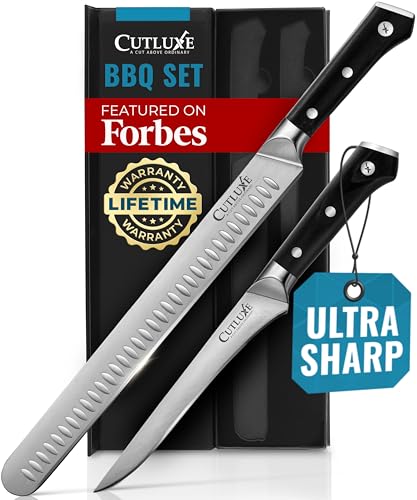
A brisket trim and a brisket carve call for different blade shapes. This Cutluxe set addresses both stages with a 6-inch boning knife and a 12-inch slicing knife. The smaller blade is the relevant tool for removing fat and connective tissue before cooking, while the longer blade is intended for portioning the finished brisket. That pairing prevents the common mistake of expecting one blade to perform both close trimming and long, even slicing equally well.
Both knives are described with full-tang construction, German steel, and Granton-style blade features. The available information does not specify the exact steel alloy or hardness, so buyers should treat the general German-steel description as limited product information. The set also carries a listed lifetime warranty. Its main trade-off is specialization: a buyer who needs only a trimming knife will have a second slicer to store, but a BBQ cook who regularly serves brisket can use both pieces.
Pros
- Includes a dedicated 6-inch boning knife for brisket preparation.
- Includes a 12-inch slicer for the cooked brisket stage.
- Full-tang construction is listed for both knives.
- Granton-style features are intended to reduce sticking during slicing.
- A lifetime warranty is listed for the set.
Cons
- Requires more storage space than a standalone boning knife.
- The exact steel alloy and hardness are not identified in the supplied information.
This is the sensible set for a cook whose brisket routine includes trimming, resting, and serving. The slicer adds real function rather than a decorative accessory, while the 6-inch boning knife remains a suitable size for prep. If your kitchen already has a dependable carving knife, the standalone Cutluxe or Mercer will avoid duplication.
To buy this product, click here.
7. Sunnecko BBQ Carving Knife Set — Best for Larger Roasts and BBQ Prep

Sunnecko pairs a 7-inch boning knife with a 12-inch carving knife, giving this set a slightly longer trimming blade than the Cutluxe pair above. That difference may appeal to cooks who prepare large briskets, roasts, or turkey and prefer a little more reach while separating fat and tissue. A longer boning blade can cover more surface with each stroke, though tight areas still reward a careful hand.
The set lists high-carbon steel, 58+ Rockwell hardness, and edges sharpened at 12-15 degrees per side. Those figures describe the seller’s specifications, not independent measurements. The pakkawood handles are described as comfortable and non-slip, while a sheath, kitchen tweezer, and gift box expand the package. The sheath is useful for protecting the blade during storage, but it should be dry before covering a clean knife.
Pros
- Seven-inch boning knife provides added reach for larger meat cuts.
- Includes a 12-inch slicer for serving brisket and roasts.
- Published specifications list 58+ HRC high-carbon steel.
- Includes a blade sheath for protected storage.
- Pakkawood handles and a gift box complete the BBQ-oriented package.
Cons
- The 7-inch trimming blade may feel large for close work on smaller briskets.
- Extra accessories add storage items beyond the two primary knives.
Sunnecko is best for a household that routinely prepares large roasts and wants a paired carving setup. It offers more reach than a 6-inch boning knife, but that is a preference rather than an automatic performance advantage. Buyers with limited board space or a short-blade preference should select a standalone 5.5- or 6-inch model.
To buy this product, click here.
8. Cutluxe Butcher Knife Set — Best for Breaking Down Primals
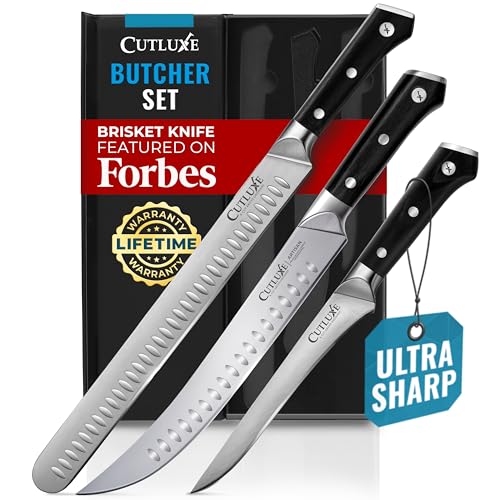
This three-piece set extends beyond brisket trimming. It includes a 6-inch boning knife, a 12-inch brisket slicer, and a 10-inch breaking cimeter. The cimeter is the meaningful difference here. It is intended for breaking down larger cuts, while the boning knife handles close trimming and the slicer handles finished portions. A buyer who purchases whole primals or prepares meat in quantity can put all three profiles to work.
The knives are listed with high-carbon German steel and full-tang pakkawood handles. The supplied information describes the blades as rust resistant, but does not identify a specific alloy or provide hardness data. Since a three-piece set occupies more drawer or wall space, it deserves a place in a meat-focused kitchen rather than a casual setup where the boning knife may be the only frequently used piece.
Pros
- Includes a dedicated 6-inch boning knife for trimming.
- Ten-inch breaking cimeter adds a distinct primal-cutting function.
- Twelve-inch brisket slicer covers the serving stage.
- Full-tang pakkawood handles are listed across the set.
- Three different blade profiles reduce the need to force one knife into every task.
Cons
- The set takes substantially more storage space than a single boning knife.
- It may be excessive for buyers who trim occasional briskets and do little breaking work.
This set earns its place for serious meat preparation, not because a larger piece count automatically means a better purchase. Its value is functional separation. The boning knife can stay focused on seams and fat, while the cimeter handles larger breakdown work. If your routine starts with a trimmed brisket and ends with sliced portions, the smaller Cutluxe pair is easier to justify.
To buy this product, click here.
9. Cutluxe Four-Piece Butcher Knife Set — Best for Multiple Meat-Preparation Tasks

The four-piece Cutluxe set is the broadest option in this ranking. It includes a 6-inch boning knife, a 12-inch brisket knife, a 10-inch breaking blade, and a 7-inch fillet knife. For a household that prepares meat and fish, that mix offers a clear division of labor. The boning knife remains the relevant brisket-trimming tool, while the other blades address large-cut breakdown, slicing, and fish preparation.
All four knives are described with German steel and full-tang pakkawood handles. The listing does not provide a specific steel designation or hardness value, so the set should be judged by its configuration and intended uses rather than assumed metallurgy. Four knives also create a larger storage requirement and more cleaning work. That may be reasonable for frequent BBQ preparation, but it is unnecessary if brisket is an occasional project.
Pros
- Includes a 6-inch boning knife suited to brisket trimming.
- Twelve-inch slicer handles finished brisket portions.
- Ten-inch breaking blade supports larger-cut preparation.
- Seven-inch fillet knife adds a separate fish-preparation function.
- Full-tang pakkawood handles are listed across the collection.
Cons
- Four knives require more storage and maintenance than a focused pair.
- The available information does not identify the exact German steel alloy.
This set is aimed at cooks whose cutting board regularly sees brisket, large cuts, and fish. Its advantage is coverage, while its drawback is commitment to a larger knife collection. Someone seeking the best single boning knife for trimming brisket will get more focused value from the Cutluxe curved knife, Mercer, or OAKSWARE.
To buy this product, click here.
Buying Guide
Match the Blade Profile to Brisket Trimming
A boning knife for brisket should give the edge access to seams, fat pockets, and connective tissue without requiring a chopping motion. Curved and tapered blades are useful because they can work in short, controlled strokes around uneven surfaces. A flexible blade may follow contours more readily, while a stiffer option can provide greater support when removing thicker material. Neither style is universally superior. The choice depends on whether your trimming method favors delicate separation or firmer pressure.
Keep the meat cold and work in shallow passes. The guide to trimming a whole brisket explains the sequence behind the narrow-blade control discussed here.
Choose a Practical Blade Length
The products here range from 5.5 to 7 inches. A 5.5-inch blade offers close control and can feel less awkward on a smaller board. A 6-inch knife is a versatile midpoint for brisket, poultry, and fish. A 7-inch blade provides additional reach across broad sections, though it needs more room and deliberate handling around tight corners. Length should follow the cuts you make most often, rather than the idea that a longer blade is automatically more capable.
Separate Trimming From Slicing
A boning knife removes fat and tissue before cooking. A brisket slicer portions the cooked meat afterward. The long slicing blades in the Cutluxe and Sunnecko sets are useful because they reduce the temptation to use a short trimming knife for long serving cuts. If you already own a slicer, a standalone boning knife avoids duplication. If brisket preparation and serving happen in the same session, a two-piece set can create a cleaner workflow.
Read Steel Claims Carefully
Some listings identify a specific material, such as ATS-34 or 5Cr15MoV, while others use broad terms such as high-carbon German steel or high-carbon Japanese steel. A named alloy offers more information than a regional or marketing description, but it still does not reveal every factor that affects cutting behavior. Geometry, heat treatment, edge preparation, and care all matter. Stainless or corrosion-resistant descriptions also do not make a knife immune to staining, so wash and dry the blade after raw-meat preparation.
Consider the Handle During Greasy Prep
Full-tang construction, triple rivets, textured surfaces, and finger guards appear throughout this group. These features describe how a knife is built, but they cannot guarantee that every handle will suit every hand. Pakkawood and walnut handles may offer a traditional appearance, while fiberglass-reinforced nylon or other synthetic materials can be convenient for frequent washing. Grip security matters during brisket trimming because fat and moisture can change how the handle feels from one cut to the next.
Plan for Cleaning and Storage
The supplied products generally call for hand washing and thorough drying. Avoid leaving a sharp knife submerged, and do not assume a corrosion-resistant blade is dishwasher-proof unless the specific product says so. A sheath can protect a blade in a drawer, but it should be placed over a clean, dry knife. Larger sets also need a storage plan. A single boning knife can fit into an existing knife block or protected drawer space, while a three- or four-piece butcher set may need dedicated storage.
Use the Right Knife for the Material
Boning knives are intended for meat, poultry, and related trimming tasks. They should not be treated as cleavers for chopping through hard bones, and delicate edges should not be forced through frozen food. A brisket trim is best handled with the blade traveling through fat and connective tissue, not with heavy downward blows. When the knife begins to drag, safe sharpening or professional maintenance is preferable to adding force.
Best Boning Knife For Trimming Brisket FAQ
What blade length is best for trimming brisket?
A 6-inch blade is a practical starting point because it balances reach and control. A 5.5-inch model can be easier to position around small sections and tight contours, while a 7-inch knife may suit larger briskets or cooks who prefer longer strokes. The correct length depends on board space, hand control, and the trimming motion you use.
Should a brisket boning knife be flexible?
Flexibility can help the edge follow curved surfaces beneath fat and around seams. A stiffer blade may feel more controlled for thicker material and firmer cuts. Product listings describe the Cutluxe and DRAGON RIOT knives as flexible, while the OAKSWARE and DRGSKL information focuses more on blade shape and construction than a precise flexibility rating.
Is a curved blade better than a straight boning knife for brisket?
A curved blade can suit the shallow, contour-following strokes common during brisket trimming. A straight blade may feel more predictable for certain cuts or users who prefer direct slicing. Curvature should be evaluated alongside blade length, flexibility, handle security, and the way you remove fat rather than treated as a stand-alone guarantee.
Can I use a brisket boning knife for other foods?
Yes, the products in this guide are also listed for tasks such as poultry deboning, fish filleting, skinning, and trimming other meats. A narrow blade is useful for detail work, but it is not a replacement for every kitchen knife. Avoid using it as a heavy chopping tool or against hard bones unless the product specifically supports that use.
Are high-carbon German and Japanese steels the same?
No. Those descriptions identify broad material or regional categories, not one universal steel. The Mercer listing refers to high-carbon Japanese steel, while several other products describe high-carbon German steel. Unless the exact alloy is supplied, buyers should avoid assuming identical hardness, corrosion resistance, sharpening behavior, or edge retention.
How should I clean a boning knife after trimming brisket?
Follow the product’s care instructions, which generally call for hand washing with mild soap, rinsing, and complete drying. Avoid prolonged soaking. Raw meat residue should not remain on the blade or handle, and a dry knife is safer to store than one placed away while damp.
Should I buy a single knife or a brisket knife set?
Choose a single boning knife if trimming is your main need or you already own a slicer. A two-piece set becomes more useful if you also carve cooked brisket. Larger three- and four-piece sets make sense for cooks who break down primals or prepare fish as well. Extra blades are useful only when their distinct profiles match your regular tasks.
Final Verdict
The Cutluxe Curved Boning Knife is the strongest overall match for brisket trimming. Its 6-inch curved and listed flexible blade sits in the useful middle of the size range, while the full-tang handle, stated edge angle, and broad meat-preparation uses make it a well-rounded choice. The Mercer Culinary Ultimate White is a more focused alternative for buyers who want a simple standalone knife, and the OAKSWARE suits cooks who prefer a compact 5.5-inch format.
For a complete brisket routine, the Cutluxe Carving Knife Set adds a dedicated 12-inch slicer without moving too far beyond the core task. The larger Cutluxe sets and Sunnecko package serve buyers who regularly break down large cuts and want several specialized blades. Match the purchase to your actual preparation habits, keep the edge clean and dry, and choose control over excess size when brisket trimming is the primary job.
