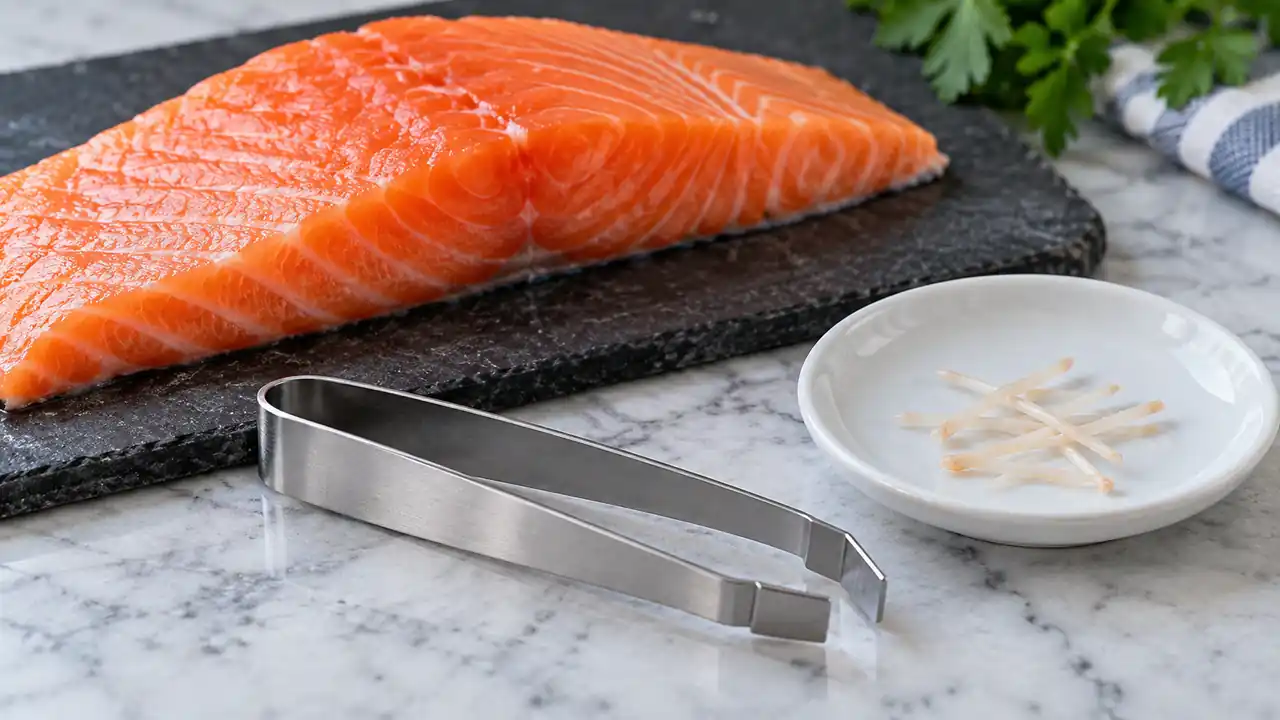
Pin bones can turn a neatly portioned salmon fillet into a fiddly prep job. A pair of purpose-built fish bone tweezers gives you the control to find and pull those thin bones without digging into the flesh with a knife or crushing the fillet with oversized pliers. The best fish bone tweezers should close evenly, grip slippery bones securely, and remain comfortable through a full batch of trout, salmon, cod, or similar fish.
Buyers often focus on the tip shape and overlook the rest of the tool. Length, jaw design, grip texture, spring tension, stainless-steel construction, and cleaning instructions all influence how practical a pair will be at the cutting board. A flat or beveled tip generally suits ordinary pin bones, while slanted tips can help reach bones at awkward angles. Some options are single-purpose tweezers, while others combine precision tweezers with serrated-jaw pliers for larger or more stubborn bones.
This comparison weighs those documented features rather than assuming a higher price guarantees better control. The Yoshihiro is the strongest overall match for cooks who want a dedicated Japanese-made tool, while Shun, Mercer, and the multi-piece sets serve different priorities. The right choice depends on how often you prepare fish, whether you need multiple grip styles, and how much counter space you want to give a small but useful kitchen accessory.
Quick Answer
- Yoshihiro Non-slip Fish Bone Tweezers are the best overall choice for a dedicated fish-bone tool, with 18-0 stainless steel, an ergonomic grip, and Japanese manufacture.
- Shun 4″ Fish Bone Tweezers are a strong precision alternative. Their tapered, flat tip is intended for tiny fish bones and pin feathers.
- Fish Bone Pliers and Tweezers Set is the most versatile pick for cooks who want serrated pliers plus flat and slant tweezers in one kit.
Best Fish Bone Tweezers Comparison Table
| Product | Best For | Tip or Jaw Design | Construction |
|---|---|---|---|
| Yoshihiro Non-slip Fish Bone Tweezers | Dedicated fish preparation | Non-slip tweezer grip | 18-0 stainless steel |
| Shun 4″ Fish Bone Tweezers | Fine pin-bone work | Tapered flat tip | Stainless steel |
| Mercer Culinary Deluxe Fish Bone Tweezer | Longer handled control | Beveled tips | Tempered stainless steel |
| Kwizing Fish Bone Tweezers | Fish and scale removal | Curved jaws | Stainless steel |
| Fish Bone Pliers and Tweezers Set | Multiple bone sizes | Serrated plier, flat and slant tweezers | Stainless steel |
| Fish Bone Pliers and Tweezers Set | Two-tool flexibility | Serrated plier and fine tweezers | Food-grade stainless steel |
| ZAUGONTW Flat and Slant Pliers Set | Different pulling angles | Flat and slant tips | Food-grade stainless steel |
| 2-Piece Fish Bone Tweezers | Compact everyday use | Flat and slant tweezers | 430 stainless steel |
| Global 4 1/2-Inch Fish Bone Tweezers | Global knife owners | Beveled tips | Satin-finish stainless steel |
The detailed reviews explain how each tip, jaw, grip, and cleaning profile fits different fish-preparation routines.
1. Yoshihiro Non-slip Fish Bone Tweezers: Best Overall

The Yoshihiro earns the top position by staying focused on the central task. It is a dedicated fish bone tweezer made from 18-0 stainless steel, with an ergonomic grip and a non-slip Eastern-style design. That combination suits the cook who handles a salmon fillet on a board, pauses to feel for hidden bones, then needs a controlled pull rather than a forceful tug. The tool is also listed as made in Japan, which may appeal to buyers who prefer a Japanese-made preparation accessory.
A dedicated tweezer is usually easier to store and quicker to reach for than a larger deboning kit. The non-slip grip matters most around wet fish, where smooth metal can become awkward to hold. Its design is better suited to ordinary pin-bone removal than heavy bone extraction, so the technique remains gentle: locate the bone, pinch close to the surface, and pull in the direction it lies. That approach protects the delicate flesh and keeps the tool doing a precise job.
Pros
- Dedicated design for removing fish bones.
- 18-0 stainless-steel construction.
- Non-slip ergonomic grip.
- Listed as made in Japan.
- Compact alternative to a larger deboning kit.
Cons
- Does not provide a separate serrated plier for larger bones.
- The available information does not specify tip dimensions or overall length.
This is the best fit for home cooks and sushi-style preparation where small pin bones are the main nuisance. Buyers who occasionally need poultry deboning or a second tip profile may prefer one of the multi-piece sets below. For a simple fish-first tool with a documented stainless-steel grade and non-slip handling, the Yoshihiro presents the clearest overall match.
To buy this product, click here.
2. Shun 4″ Fish Bone Tweezers: Best for Fine Pin-Bone Work

Shun’s four-inch tweezers are aimed at detailed prep rather than broad kitchen utility. The tapered, flat tip is intended to grip tiny pin bones from raw fish, and the same shape can remove pin feathers from poultry. That narrow focus makes sense for a cook who portions fish carefully and wants a short tool that can maneuver around a fillet without bringing a bulky plier into the job.
The stainless-steel construction should also make cleanup straightforward, while the tool’s extra kitchen uses may help justify keeping it in a utensil drawer. Stems and seeds are listed among its possible applications, although fish remains the relevant reason to buy it. The four-inch length favors close control and compact storage, but shoppers who prefer a longer handle or stronger grip for slippery, stubborn bones may be more comfortable with Mercer or a plier set.
Pros
- Tapered flat tip suits small pin bones.
- Four-inch length supports close, detailed work.
- Stainless-steel construction is easy to clean.
- Can also remove poultry pin feathers.
- Useful for select small food-preparation tasks.
Cons
- Shorter length may provide less reach for large fillets.
- Does not include a separate plier or alternate tip.
Choose this model if precision and compact handling matter more than multi-tool versatility. It is a particularly sensible option for cooks who already use Shun kitchen knives and want a matching accessory, though the brand connection should not replace a check of the tip style and intended task. Those preparing large quantities of fish may prefer a longer tweezer or serrated jaw.
To buy this product, click here.
3. Mercer Culinary Deluxe Fish Bone Tweezer: Best for Longer Reach

At 5 5/8 inches, the Mercer offers one of the longer documented handles in this group. That extra reach can be useful across a broad salmon fillet or whenever a cook prefers to keep the hand farther from the wet work surface. Its beveled tips are intended to hold bones, while raised crosshatch grips give the fingers a textured contact area instead of leaving them against a completely smooth metal surface.
The tempered stainless-steel construction is listed as helping the tweezer maintain its shape, and the satin finish is intended to conceal wear. Mercer recommends hand washing with mild soap and warm water, while also stating that its stainless-steel products are dishwasher-safe. Hand washing remains the more controlled routine for preserving the finish and avoiding harsh detergents, particularly since the instructions warn against bleach or heavy chlorination.
Pros
- 5 5/8-inch length provides useful reach.
- Beveled tips are shaped for firm bone contact.
- Raised crosshatch grips support finger stability.
- Tempered stainless steel is listed for shape retention.
- Satin finish helps conceal surface wear.
Cons
- Longer size may feel less compact in a small utensil drawer.
- The care guidance favors hand washing for best upkeep.
Mercer is a practical choice for frequent fish preparation, especially for cooks who dislike working with a very short tweezer. Its length and grip texture are more meaningful here than broad claims about professional use. Buyers seeking the smallest tool for occasional pin bones may find the four-inch Shun or a compact two-piece set easier to store.
To buy this product, click here.
4. Kwizing Fish Bone Tweezers by RCI Global: Best for Fish and Scale Removal
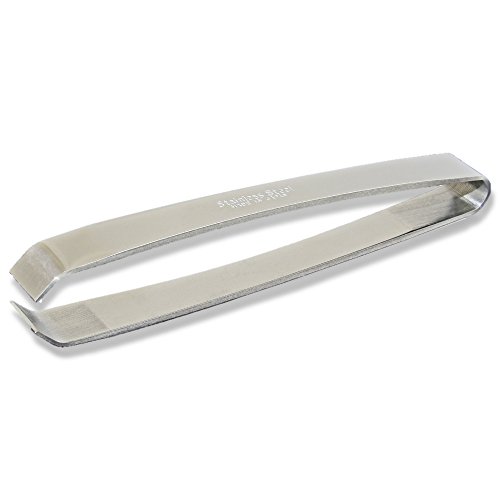
The Kwizing tweezers take a broader fish-cleaning approach than a tool aimed at pin bones alone. The listing describes curved jaws, a non-slip grip, and a 4 3/4-inch size. Curved jaws can help the user approach bones from a slightly different angle, while the moderate length keeps the tool close enough for controlled work on salmon, bass, catfish, trout, and similar fish.
Stainless-steel construction and listed dishwasher-safe cleaning make this option appealing after messy preparation. The product information also presents it for fish scales, although the exact scale-removal technique and tip dimensions are not specified. That missing detail means it should be treated as a general fish tweezers option rather than a guaranteed replacement for a dedicated scaler. Its made-in-Japan positioning and satisfaction guarantee may matter to buyers who place weight on origin and after-purchase support.
Pros
- 4 3/4-inch size balances reach and control.
- Curved jaws support angled bone removal.
- Non-slip grip is suited to wet preparation.
- Stainless-steel construction.
- Listed as dishwasher-safe.
Cons
- The available information does not specify the stainless-steel grade.
- Scale-removal capability is described broadly without detailed tip measurements.
This model suits cooks who prepare several types of fish and want a moderate-length tool with curved jaws. It is less compelling for a buyer who wants an explicitly documented steel grade or a kit with multiple jaw formats. Its cleaning convenience and fish-focused design keep it relevant for regular home seafood preparation.
To buy this product, click here.
5. Fish Bone Pliers and Tweezers Set: Best Complete Deboning Kit

This three-piece set is the most adaptable choice in the lineup. It includes a serrated-jaw plier plus flat and slant tweezers, giving the cook three ways to approach a slippery or awkward bone. The plier is the logical starting point for a bone that needs a firmer hold, while the flat tip offers a broad contact area and the slant tip can reach from a less direct angle.
The set is listed as stainless steel with textured, non-slip plier handles. That arrangement is useful for a household that prepares whole fish or several fillets at once, since one tool can handle stronger gripping and another can handle fine cleanup. More pieces also mean more items to wash and store. The listing identifies several seafood applications, but it does not provide individual dimensions, so buyers should confirm that the set’s storage needs suit their drawer.
Pros
- Includes one serrated-jaw plier and two tweezer styles.
- Flat and slant tips cover different approach angles.
- Non-slip plier handles support wet-hand control.
- Stainless-steel construction.
- Useful for fish with varied bone sizes.
Cons
- Three separate tools require more storage space.
- Individual tool dimensions are not provided in the available information.
This is the better purchase for a cook who wants a small fish-preparation kit rather than one dedicated tweezer. It makes less sense for occasional salmon fillets where a single compact tool will do. The added plier is the reason to choose it, while the flat and slant tweezers provide useful follow-up control around delicate flesh.
To buy this product, click here.
6. Fish Bone Pliers and Tweezers Set: Best Two-Tool Combination

This set pairs serrated-jaw fish bone pliers with fine-tipped tweezers. That two-step arrangement fits a common preparation rhythm: use the plier for a bone that resists a narrow tip, then switch to the tweezer for tiny pin bones or detail work near the skin. The product information lists salmon, trout, cod, tuna, and other fish, so it is aimed at a broad seafood routine rather than one species.
Ergonomic anti-slip handles are specified for both tools, and the construction is described as food-grade stainless steel. Those details address two practical annoyances, slippery hands and cleanup after raw fish. The set is also presented for small poultry or meat bones, though fish remains its strongest category match. Since the kit includes fewer tweezer formats than the three-piece set above, it offers a simpler storage choice at the expense of slant-tip flexibility.
Pros
- Combines serrated pliers with precision tweezers.
- Anti-slip handles are specified for both tools.
- Food-grade stainless-steel construction.
- Fine tips suit small pin bones.
- Can handle several common fish types.
Cons
- Does not include separate flat and slant tweezers.
- Individual dimensions and jaw measurements are not specified.
Choose this pair if you want more gripping force than a tweezer alone provides but do not need three separate tools. It is a sensible middle ground for households that prepare seafood regularly and occasionally debone poultry. Buyers who frequently work around tricky angles should step up to the three-piece version with a slant tip.
To buy this product, click here.
7. ZAUGONTW Flat and Slant Pliers Set: Best for Different Pulling Angles
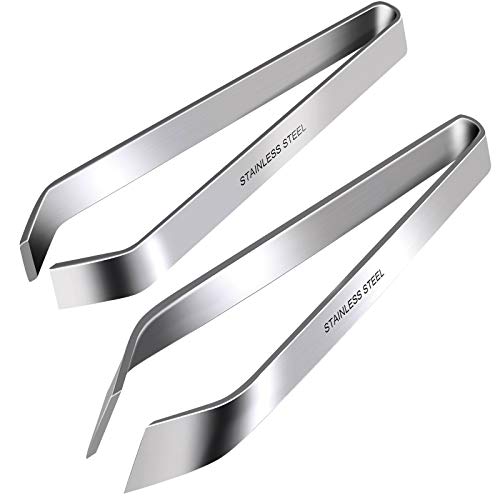
ZAUGONTW takes a two-tip approach rather than adding a serrated plier. The flat tweezer is intended for ordinary bones, while the slant tweezer is meant to reach bones or hairs in less convenient positions. That distinction can matter on a fillet where the pin bones do not all sit at the same angle. A cook can keep the flat tip for broad contact and switch to the slant tip when the working space becomes tight.
The tools are described as food-grade stainless steel with smooth ergonomic forms and closely sealing ends. They are also listed as dishwasher-safe. The set’s extra uses include poultry feathers and other small plucking tasks, though those applications may be secondary for a seafood-focused buyer. Since no length or tip dimensions are supplied, the main supported reason to choose this set is its two different tip profiles.
Pros
- Includes both flat and slant tweezers.
- Food-grade stainless-steel construction.
- Tip styles suit different bone positions.
- Ergonomic shape is intended for a secure hold.
- Listed as dishwasher-safe.
Cons
- Does not include serrated pliers for stronger gripping tasks.
- Overall length and tip dimensions are not specified.
This set makes sense for buyers who encounter awkwardly positioned pin bones but generally need tweezer-level precision. It is less suitable for whole-fish work involving tougher or slippery bones that call for serrated jaws. The two profiles provide meaningful variety without the storage demands of a three-piece kit.
To buy this product, click here.
8. 2-Piece Fish Bone Tweezers: Best Compact Pair

With a documented 4.6-inch length, this two-piece set sits in a compact middle range. It includes flat and slant tweezers, so the buyer gets two approach angles without adding a plier. The flat and slant designs are described as useful for getting close to the fish surface, which is exactly where control matters most. A shorter accessory can also disappear into a utensil drawer instead of taking up the space of a larger seafood kit.
The tools are made from 430 stainless steel and listed as dishwasher-safe. The product information describes an ergonomic size that is neither especially large nor especially small, although individual handle measurements are unavailable. The lack of a serrated jaw limits the set for stubborn bones, but the dual-tip format remains practical for routine salmon or trout preparation.
Pros
- Documented 4.6-inch length.
- Includes flat and slant tip profiles.
- 430 stainless-steel construction.
- Compact format for drawer storage.
- Listed as dishwasher-safe.
Cons
- No serrated plier is included.
- 430 stainless steel is specified without further material detail.
This pair is a good fit for occasional fish cooks who want two useful tip shapes and a modest storage footprint. It may be less appropriate for a professional-style prep routine involving large quantities or resistant bones. Buyers who want a clearly documented Japanese-made tool should look to Yoshihiro or Shun instead.
To buy this product, click here.
9. Global 4 1/2-Inch Fish Bone Tweezers: Best for Global Knife Owners

Global’s GS-20/B is a dedicated 4 1/2-inch fish bone tweezer with beveled tips and a satin-finish stainless-steel body. The beveled ends are intended to hold bones firmly, while the molded handle uses dimples for grip. That gives this tool a straightforward specification profile: moderate length, beveled contact points, and a handle shaped around the Global design language.
The listed lifetime warranty against defects may interest buyers who prefer a recognized knife-accessory line and already use Global knives. Still, the tool should be judged on its fish-preparation features rather than brand matching alone. The available data does not specify the stainless-steel grade, tip width, or dishwasher guidance, so careful washing and drying are sensible until the product’s own care instructions are confirmed.
Pros
- Documented 4 1/2-inch length.
- Beveled tips are intended for firm bone contact.
- Dimpled molded handle supports grip.
- Satin-finish stainless-steel construction.
- Listed lifetime warranty against defects.
Cons
- Steel grade is not specified in the available information.
- Does not include alternate tips or a serrated plier.
This model is most appealing to cooks already invested in Global’s stainless-steel kitchen tools or those who prefer a dedicated tweezer with a documented length and beveled tip. It is less versatile than the multi-piece kits and less detailed in its published material information than Yoshihiro. For occasional fish prep, its moderate size keeps the design practical.
To buy this product, click here.
Buying Guide
Match the Tip Shape to the Bone
Flat or beveled tips are useful for gripping ordinary pin bones across a broad contact area. Slant tips change the approach angle, which can help when a bone sits close to the fillet surface or points toward an awkward edge. Serrated pliers provide a stronger hold for slippery or more resistant bones, but their extra grip is unnecessary for every delicate pin-bone task. A single tweezer is usually enough for trimmed fillets, while a mixed kit makes more sense for whole-fish preparation.
Choose a Length You Can Control
Short tools such as the four-inch Shun keep the hand close to the work and store easily. Longer models such as the 5 5/8-inch Mercer provide more reach across a large fillet and keep the fingers farther from wet ingredients. Neither length is universally superior. A cook working on a small board may prefer compact handling, while frequent salmon preparation may feel more natural with additional reach.
Look for Grip Features That Suit Wet Fish
Fish preparation can leave the hands and tool damp, so raised crosshatch surfaces, molded dimples, or non-slip handles have a practical purpose. Grip texture does not guarantee comfort for every hand size, and the available product information rarely supplies handle dimensions. Treat the feature as a useful design aid rather than proof that a tool will suit every user.
Separate Stainless-Steel Claims from Steel Grades
Several products list stainless steel, but only some provide a specific grade. Yoshihiro identifies 18-0 stainless steel, the compact two-piece set identifies 430 stainless steel, and other products use broader stainless-steel descriptions. A named grade gives more information about construction, but it does not by itself establish superior gripping performance. Regardless of grade, rinse away fish residue, wash according to the product guidance, and dry the tool before storage.
Decide Whether You Need a Kit
A dedicated tweezer takes little drawer space and is efficient for routine fillets. A two-piece flat-and-slant set adds approach flexibility, while a three-piece kit adds a serrated plier for stronger gripping. More tools can be helpful during a large seafood prep session, yet they also create more pieces to clean and store. Choose the smallest configuration that covers your actual fish-preparation routine.
Check Cleaning Instructions
Some listings identify their tools as dishwasher-safe, including the Kwizing, ZAUGONTW, and compact two-piece set. Mercer recommends hand washing with mild soap and warm water while also describing its stainless-steel products as dishwasher-safe, and it warns against bleach or heavy chlorination. Follow the exact instructions associated with the selected product, then dry the tool fully so fish residue and moisture do not linger around the tips or joints.
Best Fish Bone Tweezers FAQ
What are fish bone tweezers used for?
Fish bone tweezers remove thin pin bones left in a fillet after trimming. They provide more control than trying to grab a small bone with the edge of a kitchen knife. Grip the bone close to the flesh and pull in the direction it is pointing to limit tearing.
Pin bones are removed after the main fillets have been separated. The salmon preparation and pin-bone steps explain where tweezers fit into the process.
Are fish bone tweezers different from ordinary cosmetic tweezers?
Kitchen fish tweezers are built for food preparation and generally use broader, stronger tips than cosmetic tweezers. Their shapes are intended to grip bones, while cosmetic tweezers may have narrow tips designed for hair. Use a tool identified for kitchen or food-preparation use.
Should I choose flat tips or slant tips?
Flat tips offer a broad contact area for ordinary pin bones. Slant tips can approach bones from an angle and may be useful near the edge of a fillet or in a tight section. If you prepare different fish regularly, a set with both styles provides more flexibility.
When are serrated fish bone pliers useful?
Serrated pliers are useful when a bone is slippery, larger, or difficult to grip with a smooth tweezer. They provide more bite, but delicate fillets still require a gentle pull. A fine tweezer remains the better choice for the smallest bones.
Can fish bone tweezers be used for poultry?
Several products in this guide list poultry feathers or small poultry bones among their additional uses. The tool should still be matched to the task. A tweezer can help with fine plucking, while a serrated plier may be more suitable for a small bone that needs a firmer hold.
Are stainless-steel fish tweezers dishwasher-safe?
Dishwasher suitability varies by product. The Kwizing, ZAUGONTW, and 4.6-inch two-piece set are listed as dishwasher-safe, while Mercer provides more specific hand-washing guidance alongside a general stainless-steel dishwasher statement. Check the exact product instructions, avoid harsh chemicals where warned, and dry the tool after cleaning.
How should I store fish bone tweezers?
Rinse and dry the tweezers, then store them in a clean utensil drawer or container where the tips will not be bent. Multi-piece kits need enough space to keep the plier and alternate tweezers together. Avoid leaving food residue around serrated jaws or hinge areas.
Final Verdict
The Yoshihiro Non-slip Fish Bone Tweezers are the best overall choice in this group because the product information directly supports the needs of dedicated fish preparation. Its 18-0 stainless-steel construction, ergonomic non-slip grip, and listed Japanese manufacture give it a clear identity as a fish-focused kitchen tool. The Shun is the better alternative for very fine work with a short, tapered flat tip, while Mercer is a stronger fit for cooks who prefer a longer 5 5/8-inch handle and beveled tips.
For broader seafood preparation, the three-piece serrated plier and tweezer set offers the most complete range of grip styles. The two-piece kits are easier to store and provide useful flat or slant-tip flexibility without adding a plier. Match the choice to the bones you usually remove, the size of your fillets, and the cleaning routine you are prepared to follow. A well-fitting dedicated tweezer is often all a home cook needs, while a varied kit earns its space during larger or more demanding fish-preparation sessions.
