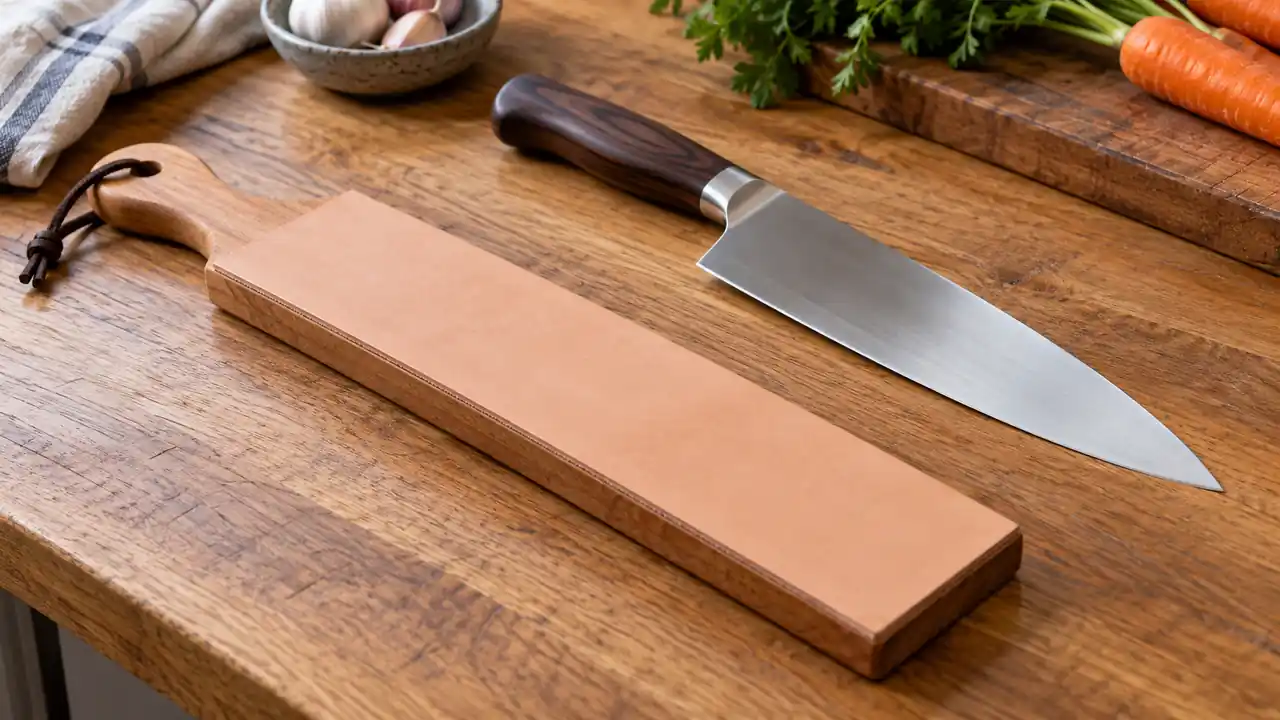
A kitchen knife that has recently visited a whetstone can still leave a faint wire edge behind. A leather strop is the finishing tool for that moment, refining the edge with light, controlled pull strokes rather than removing steel as aggressively as a coarse abrasive. The right strop can make routine edge maintenance feel simple, but the wrong size, soft backing, or confusing compound arrangement can make a careful cook round the apex instead of polishing it.
For kitchen knives, look closely at the leather surface, backing rigidity, usable width, handle design, compound selection, and storage requirements. A long paddle gives more room for a full chef’s-knife pass, while a compact block takes less space beside a cutting board. A single green compound keeps setup straightforward, whereas multiple compounds can provide a more deliberate progression from burr refinement to final polishing. Different buyers have different priorities, so a home cook maintaining one chef’s knife may want simplicity, while a sharpening enthusiast may prefer several compounds and a broad, flat working face.
The products below are selected from the available leather strops and ranked for kitchen-knife maintenance. The comparison focuses on documented construction, size, included compounds, handling features, and compatibility with a practical post-sharpening routine.
Quick Answer
- Bacher Leather Strop — Best Overall: The 12.6-inch paddle combines a 3 mm cowhide surface, solid beech backing, four compounds, balm, applicators, and a guide. It suits cooks who want a complete, structured finishing system.
- SHARPAL 205H — Best for Guided Technique: Its double-sided cowhide surface, included compound, and four-angle guide give beginners a clear starting point.
- HORL Leather Strop — Best for HORL Owners: This vegetable-tanned cowhide accessory is made for HORL rolling sharpeners while remaining suitable for whetstone users.
Best Leather Strop For Kitchen Knives Comparison Table
| Product | Best For | Size or Working Format | Compound Setup |
|---|---|---|---|
| Bacher Leather Strop | Complete finishing system | 12.6-inch paddle, 3 mm leather | Four compounds and balm |
| SHARPAL 205H | Guided beginner use | 13.2 x 2.4 inches | Green compound, four-angle guide |
| Double-Sided Genuine Cowhide Strop | Two-stage edge finishing | Handled double-sided block | Coarse and fine compounds |
| HORL Leather Strop | HORL sharpening systems | Accessory strop | Used with HORL accessories or stones |
| SHARPAL 204N | Stable countertop stropping | 8 x 3 inches | Green compound, four-angle guide |
| ANGERSTONE Double-Sided Strop | Multiple compound choices | 14 x 2 inches | Green, white, and red compounds |
| Hutsuls Brown Leather Strop | Simple kitchen setup | 3 x 8 inches, 4 mm leather | Green compound |
| Sharp Pebble Leather Paddle Strop | Secure bench use | Large paddle surface | Green compound |
| BeaverCraft LS6P1 | Long paddle stropping | 14-inch handled strop | Polishing compound |
The detailed reviews explain how each strop’s surface, dimensions, compound arrangement, and handling format fit a kitchen-knife maintenance routine.
1. Bacher Leather Strop — Best Overall

The Bacher stands out because it treats stropping as a complete finishing process rather than a leather paddle with one tube of compound. Its 12.6-inch format gives a kitchen knife a useful travel path, while the listed 3 mm bark-tanned cowhide and solid beech backing are intended to keep the working face firm. That matters for a chef’s knife because a soft, unsupported surface can make careful edge alignment more difficult.
The compound selection is unusually broad for this group. Red, white, green, and black pastes are supplied in progressive grades listed from 2000 through 12000, along with a balm and five applicators. A cook can keep the routine simple with one side and one compound, or build a more deliberate sequence after a whetstone. The included guide also helps remove some of the guesswork surrounding light, edge-trailing strokes and compound application.
Pros
- Broad 12.6-inch paddle format suits longer kitchen knives.
- Listed 3 mm cowhide and solid beech backing support a firm stropping surface.
- Includes four compounds spanning medium through ultra-fine finishing work.
- Includes balm, applicators, presentation packaging, and an instructional guide.
- Useful beyond kitchen knives, including chisels, carving tools, and straight razors.
Cons
- Multiple compounds require labeling and careful separation between surfaces.
- The larger kit may be more involved than a home cook needs for occasional maintenance.
This is the strongest match for cooks who sharpen with stones and want one organized system for finishing different edges. The broad face also makes sense for a household with chef’s knives, paring knives, and workshop tools sharing the same maintenance area. Buyers who want a tiny, single-compound strop may find the compound range excessive, but anyone interested in controlled progression will get more flexibility here than from a basic paddle.
To buy this product, click here.
2. SHARPAL 205H Double-Sided Leather Strop — Best for Guided Technique

The SHARPAL 205H is a sensible choice for someone learning how a kitchen-knife strop should be used. Its 13.2-inch length offers plenty of room for a controlled pass, and the 2.4-inch width gives a chef’s knife a workable platform without making the tool unwieldy. The product uses genuine vegetable-tanned cowhide with a smooth side and suede side, so the two faces can serve different finishing roles.
Its strongest beginner-oriented feature is the included four-angle guide. The guide does not replace good technique, and the correct angle still depends on the knife and the edge already established, but it gives a new user a physical reference while learning light pressure and edge-trailing movement. The wood handle includes a hanging hole, which is handy for keeping compound-coated leather away from loose kitchen equipment.
Pros
- Long 13.2-inch format accommodates many kitchen-knife passes.
- Double-sided smooth and suede cowhide provides two working surfaces.
- Includes a 2-ounce green polishing compound.
- Four-angle guide offers a practical reference for beginners.
- Wood handle and hanging hole support controlled use and storage.
Cons
- The single included compound gives less progression than a multi-compound kit.
- Users must still avoid pressing hard or rolling the knife over the leather.
Choose the 205H if you want a conventional handled strop with a little extra guidance. It fits the cook who has just begun finishing knives after sharpening and wants an uncomplicated way to practice. More experienced users may prefer a bare leather finishing side or several distinct compounds, but the combination of length, two surfaces, and angle reference makes this an approachable kitchen option.
To buy this product, click here.
3. Double-Sided Genuine Cowhide Strop — Best for Two-Stage Finishing

This handled cowhide strop is aimed at the cook who wants a clear coarse-to-fine routine without assembling separate accessories. The listing describes thick, vegetable-tanned genuine cowhide, a solid wood handle, and two included compounds. One side is intended for deburring, while the other is intended for finer polishing, creating a straightforward sequence after a knife has been sharpened.
The pull-stroke instructions are useful for first-time users because they reinforce the direction that protects the leather. The listed 15 to 20-degree guidance should be treated as a starting reference rather than a universal rule for every kitchen knife, particularly when the existing edge geometry is unknown. The hang hole also makes sense in a busy kitchen or workshop where a strop should be kept clean and easy to find.
Pros
- Double-sided leather supports separate rough and smooth finishing stages.
- Includes coarse and fine compounds.
- Solid wood handle gives the paddle a defined grip.
- Hang hole provides convenient storage.
- Instructions explain edge-trailing pull strokes for beginners.
Cons
- The product information does not give a specific overall working length.
- Two compound surfaces require care to prevent cross-contamination.
This model suits a home cook who wants more structure than a one-sided green-compound paddle provides. It is also a practical bridge for someone moving from occasional honing into post-stone stropping. Buyers who need a precisely documented long face or a larger compound range should look toward the Bacher, while this option keeps the basic two-step idea easier to manage.
To buy this product, click here.
4. HORL Leather Strop — Best for HORL Sharpening Systems

The HORL leather accessory has a more specific role than a general paddle strop. It is listed as compatible with HORL3, HORL3 Cruise, HORL3 Pro, and HORL 2 rolling sharpeners, while also being suitable for whetstone sharpening. That makes it especially relevant to a kitchen where a HORL system is already part of the maintenance routine and the owner wants a matching leather finishing stage.
The vegetable-tanned cowhide is described as finely porous and hand-finished in Germany. The supplied instructions emphasize light pressure and moving the blade toward its spine, which keeps the edge from cutting into the leather. A slight scratching sensation is described as a sign of burr, followed by further work with the rolling sharpener before the final leather passes.
Pros
- Purpose-built as an accessory for several HORL rolling sharpeners.
- Also suitable for finishing knives sharpened on a whetstone.
- Uses vegetable-tanned cowhide.
- Fine-pored surface is intended to remove residual grinding particles.
- Clear edge-trailing instructions support careful use.
Cons
- Its strongest compatibility advantage applies to HORL owners.
- The available product information does not list an overall strop size.
This is the specialist pick rather than the most flexible standalone kit. A HORL owner who wants a dedicated leather finishing accessory has a direct reason to choose it, while a buyer starting from scratch may prefer a paddle with a handle, compound, and published dimensions. Its role is clearest after the main sharpening stage, where light leather passes can refine an already established kitchen-knife edge.
To buy this product, click here.
5. SHARPAL 204N Leather Strop — Best for Stable Bench Use

The 204N takes a compact, bench-friendly approach. Its 8 x 3-inch genuine cowhide surface sits on a natural wood base with anti-slip mats, so it can rest on a work surface rather than being held through every pass. That format can be useful beside a whetstone, where a cook wants to move from sharpening to stropping without chasing a narrow paddle across the counter.
The included green compound is described as using 1 to 2 micron particles, with a comparison to a fine 10,000 to 14,000-grit range. That information identifies the compound’s intended finishing role, but it does not mean the strop replaces a coarse stone or repairs a heavily damaged edge. Four angle settings are included as a reference, giving new users a way to practice consistent positioning.
Pros
- Compact 8 x 3-inch format fits smaller work areas.
- Anti-slip mats help keep the base in place.
- Includes genuine cowhide and a natural wood base.
- Supplies green compound for fine finishing.
- Four-angle guide provides a repeatable reference.
Cons
- Shorter length gives less room for a full pass than long paddle models.
- Only one compound is included.
The 204N makes sense for a cook with limited counter space or a fixed sharpening station. Its stable base favors short, deliberate work, while the 3-inch width gives a useful amount of lateral room. A long-blade owner who prefers uninterrupted strokes may find the 8-inch length restrictive, but users who value a compact footprint and a guided setup have a strong reason to choose it.
To buy this product, click here.
6. ANGERSTONE Double-Sided Leather Strop — Best for Multiple Compounds

ANGERSTONE gives kitchen-knife owners a long 14 x 2-inch paddle and three supplied compounds. The listing identifies green chromium oxide, white aluminum oxide, and red polishing compound, so the kit offers more flexibility than a single-paste strop. One leather side is rough and the other smooth, allowing the user to keep different stages separated if the compounds are applied carefully.
The ergonomic handle is useful during repeated passes, especially for someone maintaining several blades in one session. The 2-inch width is narrower than the Bacher or SHARPAL 205H, so the user needs to keep the blade aligned across the face. In exchange, the 14-inch length provides a generous travel path for longer chef’s knives and reduces the need to stop midway through a stroke.
Pros
- Long 14-inch format works well with longer kitchen knives.
- Includes green, white, and red compounds.
- Rough and smooth leather faces support separate finishing roles.
- Vegetable-tanned cowhide is listed as the strop material.
- Ergonomic handle supports handheld use.
Cons
- The 2-inch width leaves less lateral margin than wider models.
- Three compounds require careful labeling and surface management.
This is a good fit for a sharpening enthusiast who wants several compound options in one long paddle. It can cover more than kitchen knives, including chisels, carving tools, and straight razors, which may appeal to a household with mixed edge-maintenance needs. A first-time user seeking the simplest possible routine may prefer one compound and a guide, while an experienced user will appreciate the extra finishing choices.
To buy this product, click here.
7. Hutsuls Brown Leather Strop — Best for a Simple Setup

The Hutsuls strop keeps the format familiar: a 3 x 8-inch two-sided leather block, a green compound, and a step-by-step guide. The product information lists 4 mm genuine buffalo leather, with a smooth side and a rougher side. For a cook who wants to finish a chef’s knife after sharpening without sorting through several pastes, that straightforward arrangement is easy to understand.
The 3-inch width gives a little more room than a narrow paddle, although the 8-inch length is better suited to controlled sections or shorter kitchen knives than long uninterrupted passes. Both sides can be used for honing, and the kit is also described for axes, gouges, chisels, plane blades, and other tools. Keeping the compound on its intended surface and using light pressure remain important, particularly with a thick leather surface.
Pros
- Compact 3 x 8-inch format is easy to store.
- Listed 4 mm buffalo leather provides a substantial surface.
- Includes green compound for polishing work.
- Two-sided design gives smooth and rough working options.
- Step-by-step guide supports new users.
Cons
- Eight inches of length may be limiting for long chef’s knives.
- The single compound offers less progression than multi-compound kits.
Choose Hutsuls if the goal is a small, understandable kit rather than a full sharpening bench system. It is particularly suitable for a kitchen drawer or compact workshop where a 14-inch paddle would be awkward. Users who maintain long gyuto or chef’s knives may prefer the longer Bacher or ANGERSTONE, while cooks with ordinary household blades can benefit from the uncomplicated format.
To buy this product, click here.
8. Sharp Pebble Leather Paddle Strop — Best for Non-Slip Bench Positioning

The Sharp Pebble model combines a leather paddle with a bamboo base and non-slip rubber. That combination gives the buyer two ways to work: hold the lightweight paddle or place it on a counter and use the rubber base for additional stability. A stable setup can be reassuring beside a sink or sharpening stone, where a sliding tool can interrupt an otherwise careful edge-finishing routine.
The included green compound is intended for polishing after a stone or whetstone, and the product is described for chef’s knives, pocket knives, hunting knives, chisels, plane irons, and axes. The available information does not specify the leather thickness or exact working dimensions, so buyers who need a precisely sized face should choose a model with clearer measurements. Its large stropping area and instructional eBook still make the format approachable for general kitchen use.
Pros
- Non-slip rubber base supports countertop use.
- Bamboo base is described as lightweight and durable.
- Includes green polishing compound.
- Large leather area supports a range of kitchen and workshop blades.
- Can be held or positioned on a work surface.
Cons
- The available product information does not specify exact strop dimensions.
- Only one compound is included.
This model suits a cook who values stability and wants a paddle that can stay put on the counter. The dual-use format is more flexible than a fixed block, although the missing size detail makes it harder to compare directly with the measured 8-, 13.2-, or 14-inch models. Pick it for its non-slip positioning and broad application range, rather than for a documented multi-stage compound system.
To buy this product, click here.
9. BeaverCraft LS6P1 Leather Strop — Best for a Long Handheld Paddle

The BeaverCraft LS6P1 is a 14-inch double-sided paddle with an ashwood shaft and included polishing compound. Its long format is useful for cooks who prefer a continuous pull across a kitchen knife, while the handled construction keeps the leather away from the fingers. The two sides give the user a rougher and smoother surface arrangement for different stages of maintenance.
The kit is marketed toward both beginners and experienced users and includes digital guidance focused on sharpening carving knives. That material is not kitchen-specific, but the same edge-trailing principle applies to a chef’s knife. The product is also described for chisels and other tools, making it a practical shared strop for a household where the kitchen knife is not the only edge being maintained.
Pros
- Fourteen-inch length gives ample room for long knife passes.
- Double-sided leather supports different finishing tasks.
- Ashwood handle provides a defined handheld grip.
- Polishing compound is included.
- Instructional eBooks support users learning stropping technique.
Cons
- The product is oriented toward carving tools as well as kitchen knives.
- The available information does not specify leather thickness or exact working width.
This BeaverCraft is a sensible choice for someone who wants a long handled paddle and expects to maintain chisels or carving tools alongside kitchen knives. It is less specialized for cooks than the HORL accessory and less comprehensive than the Bacher compound kit, but its length and simple two-sided design keep the routine familiar. Make sure the storage area can accommodate a 14-inch tool before choosing it.
To buy this product, click here.
Buying Guide
Match the Strop to the Sharpening Stage
A leather strop is primarily a finishing and edge-refining tool. It belongs after the knife has been sharpened on a suitable abrasive, especially when the goal is to clean up a fine burr and polish the apex. A strop should not be treated as the only answer for a dull edge, a chipped edge, or a bevel that needs substantial reprofiling. The Bacher’s range of compounds supports a more graduated finishing routine, while the single-compound kits keep the final step simpler.
A strop is a finishing tool within a suitable maintenance sequence, not a cure for every damaged edge. The honing and sharpening overview explains the different roles.
Choose Enough Length for the Blade
Long paddles such as the 13.2-inch SHARPAL 205H, 14-inch ANGERSTONE, and 14-inch BeaverCraft LS6P1 give a chef’s knife more room for a continuous pull. Shorter 8-inch models take less storage space but may require more segmented movement. Neither format is automatically superior. A compact kitchen with a shorter utility knife may favor the SHARPAL 204N or Hutsuls, while a cook maintaining long chef’s knives may appreciate a longer face.
Look for a Firm, Controlled Surface
Backing rigidity affects how predictable the stropping surface is. The Bacher lists 3 mm cowhide over solid beech, while other products use wood bases, handles, or bamboo construction. Leather thickness alone does not establish the complete behavior of a strop, but a supported surface is easier to keep consistent than loose leather. Use light pressure. Pressing deeply into the hide can alter the contact at the edge and make the final bevel less consistent.
Decide How Much Compound Variety You Need
A single green compound is convenient for a cook who wants one repeatable finishing step. Two-sided kits with coarse and fine compounds offer more separation between deburring and polishing. The Bacher goes further with four listed compounds and a balm, while ANGERSTONE includes green, white, and red compounds. More options add flexibility, but they also require clear labeling and careful handling so abrasive particles do not migrate between surfaces.
Consider Guided Versus Freehand Use
The SHARPAL 204N and 205H include four-angle guides. These accessories can provide a visual reference while a new user learns to keep the blade edge trailing and the angle steady. They do not establish one correct angle for every kitchen knife, and they should not be used as a reason to force an edge into an unsuitable position. A freehand paddle may be preferable for someone already matching the angle established on a stone.
Plan Storage and Compound Care
Leather should be kept clean, dry, and separate from loose kitchen debris. Hanging holes on some handled paddles help keep the face off a cluttered counter, while a compact block may fit in a sharpening drawer. Multi-compound kits need extra organization. The Bacher includes balm intended for leather care, but buyers should still follow the supplied instructions rather than applying random oils or household products to the stropping surface.
Best Leather Strop For Kitchen Knives FAQ
What does a leather strop do for a kitchen knife?
A leather strop refines and polishes an edge after sharpening. It can help address a fine burr left by an abrasive and improve the finish of an already established bevel. It is not a substitute for a coarse sharpening stone when a knife is very dull, chipped, or incorrectly shaped.
Should a strop be used before or after a whetstone?
For the products in this guide, the practical sequence is generally after the whetstone or other sharpening abrasive. The stone establishes the edge, and the leather provides a lighter finishing step. Follow the compound instructions supplied with the selected strop, and use only light, edge-trailing passes.
Can a leather strop damage a kitchen knife?
Improper pressure or technique can make the edge less consistent, particularly if the blade is pushed into soft leather or rolled over the edge during a pass. Keep the spine and edge moving in a controlled direction, use light pressure, and avoid treating the leather as a forceful sharpening surface.
Is a double-sided strop better than a single-compound strop?
It depends on the maintenance routine. A double-sided strop can separate rougher and finer finishing work, while a single-compound model is easier to set up and maintain. The Bacher offers several compounds for staged work, whereas the SHARPAL 204N and similar kits are more straightforward for a single finishing step.
What size leather strop is suitable for a chef’s knife?
A longer face gives more room for a continuous pull, which can be convenient with a long chef’s knife. The 13.2-inch SHARPAL 205H, 14-inch ANGERSTONE, and 14-inch BeaverCraft models provide generous length. An 8-inch strop can still work, but the user may need shorter controlled sections and more attention to alignment.
Does a strop sharpen both sides of a kitchen knife?
Many double-sided kitchen knives can be stropped on both bevels, using the same general edge-trailing principle. The correct movement depends on the knife’s edge construction. A single-bevel knife or specialized blade should not automatically receive the same treatment as a standard double-bevel chef’s knife.
How much compound should be applied?
Use the amount and application method supplied with the product. A thin, even coating is generally easier to control than a thick layer that leaves loose abrasive on the surface. With multiple compounds, dedicate each side or section to one grade and keep the surfaces from mixing.
Final Verdict
The Bacher Leather Strop is the strongest overall match for kitchen-knife owners who want a complete finishing system. Its listed 12.6-inch length, 3 mm cowhide, solid beech backing, four compounds, balm, applicators, and guide give it the broadest documented maintenance range in this group. It is especially suitable for someone who already uses a whetstone and wants more control over the final edge-polishing stage.
The SHARPAL 205H is the better fit for beginners who value a long double-sided surface and an angle reference, while the HORL Leather Strop makes the most sense for owners of compatible HORL sharpeners. Compact users can look toward the SHARPAL 204N or Hutsuls, and compound-focused enthusiasts may prefer ANGERSTONE. Match the final choice to your knife length, available storage, preferred stropping method, and willingness to manage multiple abrasives. A careful, light finishing routine matters more than choosing the most elaborate kit.
