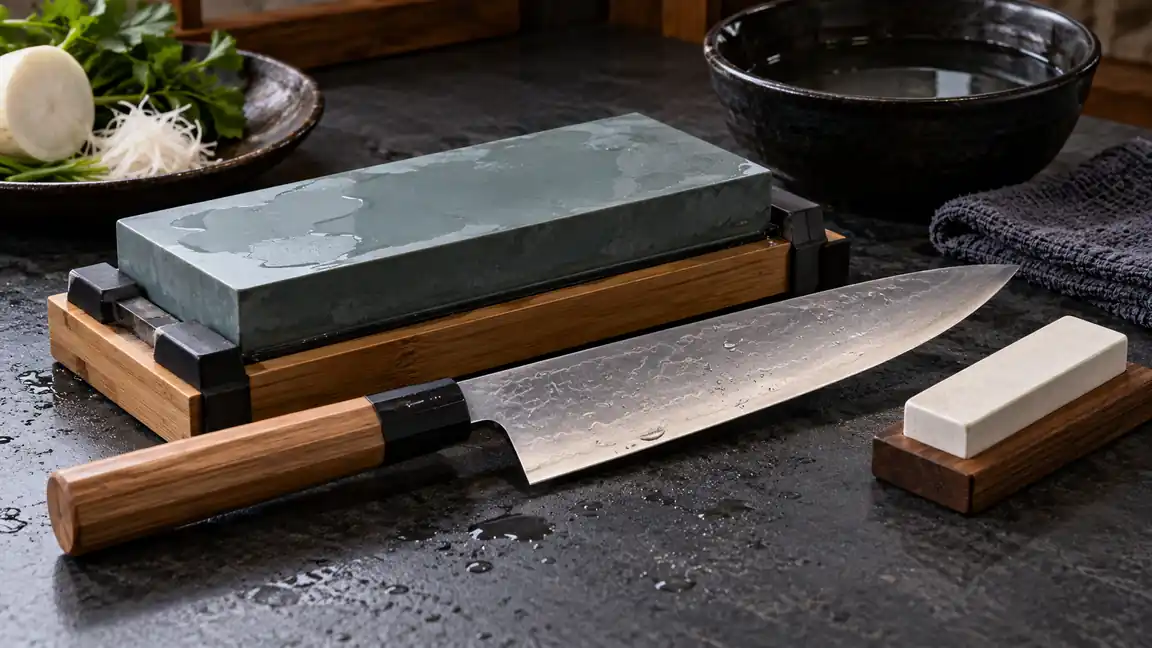
A Japanese kitchen knife can go from crisp, controlled slicing to frustrating tearing after months of ordinary prep. The right sharpener helps restore the edge without forcing a delicate blade through an unsuitable slot or grinding away more steel than necessary. For most Japanese-style kitchen knives, the strongest choices in this group are water stones and guided systems that let you work with a controlled angle.
Shoppers often focus on grit numbers or attractive wooden housings while overlooking the sharpening method. A coarse abrasive can remove material quickly, but it may be unnecessary for a lightly worn edge. Fixed-angle rollers are convenient, yet their preset positions may not match every knife. Water stones require more setup, including soaking, a stable base, and eventual flattening, but they provide more control over the edge. The best choice depends on whether you value traditional technique, quick maintenance, angle guidance, or compatibility with several straight-edge knives.
This comparison focuses on those practical differences rather than treating every sharpener as interchangeable. The selected products include multi-grit whetstones, magnetic rolling systems, and manual sharpeners with fixed or adjustable guides. The HMPLL set earns the strongest overall position because it combines broad grit coverage with a base, angle guide, strop, and flattening stone, while several alternatives make more sense for faster or more controlled maintenance.
Quick Answer
- HMPLL Knife Sharpening Stone Set: The strongest overall match for Japanese-style kitchen knives when you want coarse repair, medium sharpening, fine finishing, and the accessories needed for a complete water-stone setup.
- Rolling Knife Sharpener Kit: A practical choice for straight-edge Santoku, chef, paring, and fillet knives when preset 15-degree and 20-degree positions are preferable to learning freehand sharpening.
- MITSUMOTO SAKARI 1000/3000 Grit Whetstone: A focused option for routine edge maintenance, with a useful 1000/3000 grit combination and a non-slip bamboo base.
Best Knife Sharpener For Japanese Knives Comparison Table
| Product | Best For | Sharpening Method | Grit or Angle |
|---|---|---|---|
| HMPLL Knife Sharpening Stone Set | Complete stone setup | Water stone | 400/1000 and 3000/8000 |
| Rolling Knife Sharpener Kit | Guided straight-edge maintenance | Diamond and ceramic roller | 15 and 20 degrees |
| Intelitopia Complete Stone Set | Stone beginners wanting accessories | Water stone and strop | 400/1000 and 3000/8000 |
| AIERLIAN Rolling Sharpener | Magnetic angle control | Diamond and ceramic roller | 15 and 20 degrees |
| Sharp Pebble Whetstone | Simple two-stage sharpening | Water stone | 1000/6000 |
| MITSUMOTO SAKARI Whetstone | Routine Japanese-style maintenance | Water stone | 1000/3000 |
| The Original Tumbler Sharpener | Premium rolling design | Diamond roller and helix honing disc | 15 and 20 degrees |
| Sharp Pebble Precision Adjust | Adjustable manual angles | Three-stage pull-through | 12, 15, 18, 21, and 24 degrees |
| Zwilling 4 Stage Sharpener | Labeled slot convenience | Pull-through ceramic stages | Coarse and fine ceramic stages |
The detailed reviews below explain which sharpening approach fits different Japanese knife owners, from hands-on water-stone users to cooks who want guided maintenance with minimal setup.
1. HMPLL Knife Sharpening Stone Set – Best Overall

The HMPLL set is the most complete fit for a cook who wants to maintain Japanese-style knives with a water stone rather than relying on a fixed pull-through slot. Its two stones provide 400/1000 and 3000/8000 surfaces, giving you a coarse side for a significantly worn edge, a general sharpening side, and finer surfaces for refining the result. That range is useful because a knife used for delicate vegetable slicing does not need the same treatment every time it loses bite.
Setup is more involved than rolling a guided sharpener across a blade. The stones are water-lubricated, and the listing says they should be soaked for approximately 10 to 15 minutes before use. The bamboo base, silicone holder, and rubber support help keep the work area stable, while the angle guide can assist users who are still learning consistent hand positioning. The included flattening stone matters too, since water stones can develop an uneven surface with repeated use. For a household that owns several straight-edge Japanese knives, this is a broad and adaptable kit.
Pros
- Four usable grit levels from 400 through 8000.
- Includes a bamboo base, silicone holder, angle guide, strop, and flattening stone.
- Water-based setup avoids the need for sharpening oil.
- Suitable for listed carbon-steel and stainless-steel knife types.
- Offers more control than a fixed pull-through sharpener.
Cons
- Requires soaking and more cleanup than a roller or manual slot sharpener.
- The available information does not specify compatibility with single-bevel Japanese knives.
This set suits owners who want one sharpening station for repair, routine maintenance, and finishing. It is especially appealing if you are willing to learn a steady angle instead of removing material automatically through a preset guide. A cook who wants a quick touch-up beside the stove may find the soaking and flattening steps excessive, but anyone building a more deliberate knife-care routine gets the broadest documented setup here.
To buy this product, click here.
2. Rolling Knife Sharpener Kit – Best for Guided Straight-Edge Maintenance

This rolling sharpener takes a different path from a traditional Japanese water stone. A magnetic support presents 15-degree and 20-degree positions, while the roller carries a 400-grit diamond disc on one side and a 3000-grit ceramic disc on the other. That combination gives a clear sequence: use the diamond surface for a dull edge, switch to ceramic for refinement, then use the included leather strop for additional finishing.
The appeal becomes obvious for someone who keeps a Santoku or straight-edge chef knife in regular rotation but does not want to practice freehand angle control at the sink. The beechwood body and magnetic guide create a defined workflow, and the listing specifically identifies compatibility with many straight-edge Japanese and chef knives. It does not suit serrated or ceramic blades, and the two preset angles should be compared with the knife maker’s guidance before use. That check matters more than simply selecting the smaller number because it sounds more Japanese.
Pros
- Provides two clearly marked 15-degree and 20-degree positions.
- Combines 400-grit diamond and 3000-grit ceramic discs.
- Includes a leather strop for edge finishing.
- Requires no soaking, oil, or water-stone flattening.
- Specifically listed for many straight-edge Japanese-style kitchen knives.
Cons
- Not suitable for serrated knives, ceramic knives, or scissors.
- Preset angles may not match every Japanese knife’s intended edge geometry.
This is a strong match for a cook who values repeatable setup and compact storage over traditional sharpening feedback. It can make routine maintenance less intimidating, although it offers less freedom than a stone for unusual profiles or specialized edges. Confirm the blade’s recommended angle first, and use light, controlled passes rather than treating the diamond disc as a tool for aggressive grinding.
To buy this product, click here.
3. Intelitopia Complete Knife Sharpening Stone Set – Best Complete Whetstone Accessory Kit

Intelitopia’s kit follows the same broad water-stone format as the HMPLL set, with 400/1000 and 3000/8000 grit combinations. Its distinction is the emphasis on a full collection of supporting pieces. Along with the dual-sided whetstones, the package includes a coarse flattening stone, bamboo base, three non-slip rubber bases, angle guide, leather strop, and instructions. Those pieces address the small frustrations that can make a first sharpening session feel improvised.
For Japanese kitchen knives, the 1000-grit surface is the likely everyday starting point when the edge is dull but not damaged, while the higher grits allow more refined finishing. The 400 side is better reserved for substantial wear or edge repair because coarse abrasives remove material more quickly. The flattening stone is a practical inclusion for ongoing care, although users still need to learn how to use it correctly. This is a hands-on system, so it rewards patience more than speed.
Pros
- Offers 400/1000 and 3000/8000 grit surfaces.
- Includes a flattening stone for maintaining the whetstone surface.
- Provides a bamboo base, rubber supports, and angle guide.
- Includes a leather strop for burr refinement.
- Lists compatibility with Japanese knives and several other blade types.
Cons
- Water-stone preparation and maintenance take more time than manual sharpeners.
- The product information does not provide a specific edge-angle recommendation for individual Japanese knives.
Choose this kit if the goal is a complete learning setup with fewer separately purchased accessories. It makes sense for a household with several knives and enough counter space for a deliberate sharpening session. A minimalist cook may prefer the smaller MITSUMOTO stone or a rolling system, but the added flattening and stropping tools give this set a wider maintenance role.
To buy this product, click here.
4. AIERLIAN Rolling Knife Sharpener – Best for Magnetic Angle Control
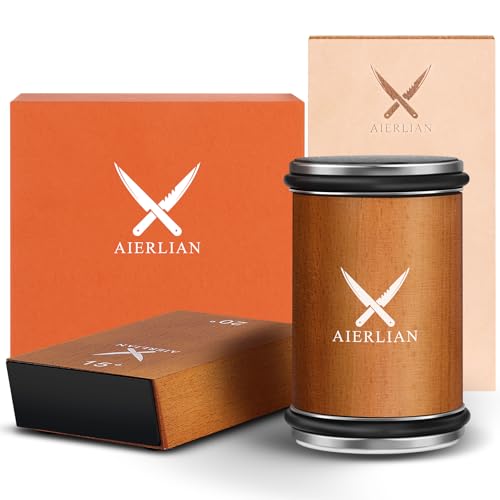
The AIERLIAN system is aimed at users who want a guided rolling motion with two abrasive stages. Its 400-grit diamond disc handles edge work, while the 3000-grit ceramic disc provides a finer follow-up surface. Four N42 magnets are listed in the magnetic support, which is intended to keep the blade in place as the sharpener moves along the edge. The wood construction also gives it a more substantial countertop presence than a small plastic pull-through tool.
The two available positions, 15 and 20 degrees, create a useful distinction between a finer supported angle and a more durable everyday setting. That does not make either position universally correct. Japanese knives vary in construction and edge design, and the supplied information does not establish suitability for single-bevel blades. The leather strop adds another finishing step, making this more versatile than a basic two-slot sharpener, but the roller remains limited to compatible straight edges.
Pros
- Uses separate diamond and ceramic discs for sharpening and refinement.
- Offers 15-degree and 20-degree magnetic angle positions.
- Includes a leather strop for additional edge finishing.
- Uses a magnetic support with four listed N42 magnets.
- Wood construction provides a stable guided sharpening platform.
Cons
- Not intended for serrated knives or scissors.
- The fixed-angle design may not suit every Japanese knife profile.
This model is a reasonable middle ground for cooks who want more control than a pull-through slot without managing soaking water and stone flattening. It is best reserved for compatible straight-edge knives, with the selected angle checked against the knife’s instructions. If you own several blades with different edge requirements, the HMPLL or Intelitopia stones provide more room to adapt.
To buy this product, click here.
5. Sharp Pebble Whetstone Knife Sharpener – Best Two-Stage Stone for Beginners

Sharp Pebble keeps the stone setup focused with a 1000/6000 grit water stone, a non-slip bamboo base, an angle guide, and written instructions. The 1000 side is suited to routine sharpening of an edge that has become dull, while the 6000 side provides a finer finishing surface. For someone caring for a Japanese chef knife or Santoku at home, that two-stage arrangement avoids the larger assortment of abrasives found in four-sided kits.
The angle guide is the key beginner-oriented feature. Freehand sharpening involves maintaining a consistent relationship between blade and stone, and a guide can help users establish that position while they learn. The stone is water-based rather than oil-based, so preparation remains relatively clean, but it still requires a stable work area and proper drying after use. The listing also describes the stone as intended for kitchen knives, pocket knives, scissors, chisels, and razors, although each blade type still deserves compatibility checks.
Pros
- Simple 1000/6000 grit combination for routine sharpening and finishing.
- Includes a non-slip bamboo base and angle guide.
- Uses water rather than sharpening oil.
- Provides instructions and additional sharpening guidance.
- Compact setup compared with multi-stone kits.
Cons
- Does not include a coarse 400-grit surface for substantial edge repair.
- Requires water setup and careful stone maintenance.
This is a sensible entry point for a Japanese knife owner who wants to learn stone sharpening without choosing among four grit levels. It is less suitable for chipped or heavily damaged edges, where a coarser abrasive may be useful. For ordinary maintenance of a straight-edge kitchen knife, its restrained configuration is easier to understand than a crowded accessory kit.
To buy this product, click here.
6. MITSUMOTO SAKARI 1000/3000 Grit Whetstone – Best for Routine Edge Maintenance
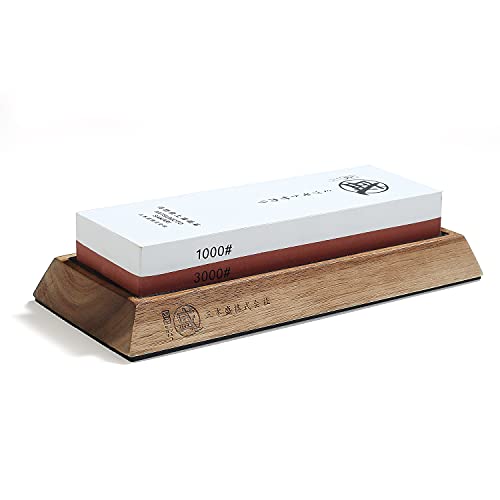
The MITSUMOTO SAKARI stone is built around a practical 1000/3000 grit pairing. That range suits the common situation in which a Japanese kitchen knife needs its edge refreshed rather than completely reshaped. The 1000 side handles ordinary sharpening work, and the 3000 side refines the edge afterward. It is a narrower tool than the four-sided kits, but that can be an advantage for someone who wants fewer decisions during a regular maintenance session.
The stone uses white corundum according to the supplied information and sits in a bamboo base with a non-slip pad. Its controlled water absorption is intended to create a consistent slurry after soaking, while the bonded dual-sided construction keeps both working surfaces together. The listing describes a 15 to 20-degree sharpening range, but that should be treated as a general guide rather than a universal instruction for every Japanese blade. Exact requirements can vary with the knife’s edge design.
Pros
- Useful 1000/3000 grit combination for everyday sharpening and refinement.
- Includes a non-slip bamboo base.
- Uses water lubrication without sharpening oil.
- White corundum construction is specified in the product information.
- Compact dual-sided format keeps the setup straightforward.
Cons
- Lacks a coarse grit for repairing heavily damaged edges.
- Does not include a flattening stone, leather strop, or angle guide.
This stone suits a cook who already understands basic angle control or plans to develop that skill without a large bundle of accessories. It is a particularly focused option for maintaining a small collection of Japanese-style kitchen knives. If you need repair capability, a guide, or a strop in the same package, the HMPLL and Intelitopia kits are more complete.
To buy this product, click here.
7. The Original Tumbler Rolling Knife Sharpener – Best Premium Rolling Design

The Original Tumbler uses a rolling format with a diamond-plated disc, magnetic angle support, and fixed 15-degree and 20-degree positions. Its intended workflow is simple: secure the blade, roll the abrasive along the edge, then use the separate helix disc to refine it. That arrangement appeals to cooks who want a guided process without the water, slurry, and surface maintenance associated with whetstones.
The supplied information presents this sharpener for kitchen, utility, field, and specialty blades. For Japanese kitchen knives, the important question remains whether the blade is a compatible straight edge and whether one of the two fixed angles matches its intended geometry. The product does not provide a broad adjustable range, so it is less adaptable than a freehand stone. Its wood construction and magnetic guide may suit a countertop setup where appearance and a defined procedure matter, but those features do not remove the need to select the correct angle.
Pros
- Uses a diamond-plated disc for the sharpening stage.
- Includes a separate helix disc for edge refinement.
- Provides fixed 15-degree and 20-degree angle positions.
- Requires no soaking, oil, or stone flattening.
- Rolling and magnetic guidance simplify the sharpening sequence.
Cons
- Fixed angles limit adjustment for knives with different edge requirements.
- The available information does not establish suitability for serrated or single-bevel Japanese knives.
This is best for a buyer who prefers a polished guided system and expects to sharpen compatible straight-edge kitchen knives. It may be excessive for someone who wants the broad grit flexibility of a stone, while its limited angle choices may frustrate owners of varied Japanese blades. Confirm compatibility before use, especially if the knife has a specialized edge.
To buy this product, click here.
8. Sharp Pebble Precision Adjust Knife Sharpener – Best Adjustable Manual Angle System
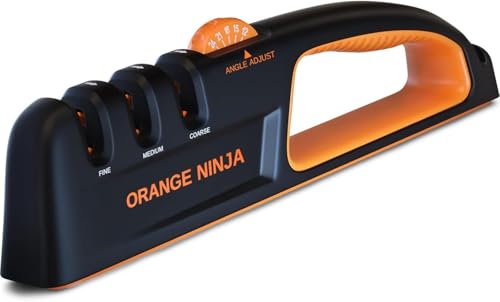
The Precision Adjust system is aimed at users who want more angle choices than the common 15-degree and 20-degree rolling systems. Its listed settings are 12, 15, 18, 21, and 24 degrees, giving the owner a way to match the tool more closely to a knife’s documented sharpening requirement. It uses a three-stage manual process and is intended for straight-edge blades, with the knife placed into labeled slots and pulled through by hand.
That adjustment range is useful in principle, but it should not encourage guesswork. Japanese-style knives do not all share one edge angle, and the listing does not identify a specific setting for every blade category. The plastic body is designed for repeated household use, and the slot-based operation is less involved than a whetstone. It is also explicitly unsuitable for serrated knives and scissors, which narrows its role to compatible straight-edge knives.
Pros
- Offers five listed angle settings from 12 to 24 degrees.
- Uses a three-stage manual sharpening process.
- Simple slot-based operation requires no soaking or oil.
- Suitable for straight-edge kitchen, pocket, and hunting knives.
- Provides more angle adjustment than fixed 15/20-degree systems.
Cons
- Not suitable for serrated knives or scissors.
- Pull-through operation provides less hands-on control than a whetstone.
This system makes sense for a Japanese knife owner who wants adjustable guidance and quick storage. It is more flexible than a fixed-angle sharpener, though still less adaptable than freehand sharpening. Use the knife maker’s recommended angle where available, and avoid treating every setting as equally appropriate simply because the selector offers it.
To buy this product, click here.
9. Zwilling 4 Stage Ultra-Sharp Knife Sharpener – Best Labeled Slot Convenience

The Zwilling sharpener is built for cooks who want a clearly labeled pull-through process rather than a loose stone or a rolling guide. It provides two ceramic grits per side, described as coarse and fine, and is listed for both Western and Asian-style blades. A rubberized non-slip base helps keep the tool steady, while the safety grip keeps the hand farther from the blade during use.
The additional scissor slot gives it broader household usefulness, although that feature does not make it suitable for every Japanese knife. Pull-through systems can be convenient for compatible double-bevel straight edges, but Japanese knives vary widely in geometry and construction. The supplied information does not specify the exact angle of each stage or identify compatibility with single-bevel knives. That makes this a convenience pick rather than the most adaptable option for a varied Japanese knife collection.
Pros
- Provides labeled coarse and fine ceramic sharpening stages.
- Listed for Western and Asian-style blades.
- Includes a separate scissor sharpening slot.
- Uses a non-slip rubberized base.
- Safety grip keeps fingers away from the blade during operation.
Cons
- The available information does not specify the sharpening angles.
- Pull-through stages may be unsuitable for specialized or single-bevel Japanese edges.
This sharpener is best for a household with compatible straight-edge knives and a strong preference for simple labeled controls. It is less suitable for someone who wants to preserve maximum control over a delicate edge or work with several specialized Japanese profiles. For those cases, a whetstone remains the more adaptable route.
To buy this product, click here.
Buying Guide
Match the Sharpening Method to Your Edge Control
Water stones provide the most direct control in this group. You decide how the blade contacts the abrasive, how many passes to make, and which grit to use. That flexibility is useful for Japanese knives with different profiles, though it requires practice. Rolling systems and pull-through sharpeners reduce the angle-learning burden, but their guides can limit compatibility. A guided tool is convenient only when its angle and abrasive path suit the knife.
Identify the bevel configuration before choosing a system. The Japanese-knife sharpening guide explains how grind and manufacturer instructions affect compatibility.
Use Grit for the Actual Condition of the Edge
Coarse surfaces such as 400 grit are intended for more substantial sharpening or repair. A 1000-grit surface is a practical general sharpening point for an edge that has become dull, while 3000, 6000, and 8000 surfaces are used for progressively finer refinement. A larger grit number does not automatically make a sharpener better. Starting with a very coarse surface on a lightly worn Japanese knife can remove more material than necessary.
Check the Angle Before Using a Guided Sharpener
The products in this comparison list fixed or adjustable angles, but those numbers should be checked against the knife’s instructions. The 15-degree and 20-degree positions on rolling systems are convenient reference points, not universal rules. Sharp Pebble’s adjustable system offers more choices, yet selecting an angle still requires judgment. Treat angle as a compatibility question rather than a marketing shortcut.
Distinguish Sharpening From Honing and Stropping
Sharpening uses an abrasive to reshape or renew the edge. Honing generally refines or realigns an existing edge, while stropping helps polish and remove fine burr remnants after abrasive work. A leather strop can complement a stone or roller, but it does not replace a coarse sharpening surface when the edge has become genuinely dull. Likewise, a honing rod should not automatically be treated as a complete sharpening system.
Plan for Water-Stone Maintenance
Water stones may need soaking or surface wetting before use, depending on their construction. They also require a stable base and should be maintained so the working surface remains usable. Sets that include flattening stones offer a more complete long-term arrangement. A compact dual-grit stone can be easier to store, but it may lack the coarse repair surface, strop, or flattening accessory found in larger kits.
Confirm Blade Compatibility
Most of the products here are intended for straight-edge kitchen knives. Several specifically exclude serrated knives, ceramic knives, or scissors, while the Zwilling includes a dedicated scissor slot. Single-bevel Japanese knives require particular care because ordinary double-bevel sharpening instructions may not apply. If the product information does not clearly cover your knife’s edge design, a water stone with controlled technique is generally easier to evaluate than a fixed pull-through path, but compatibility should still be confirmed.
Best Knife Sharpener For Japanese Knives FAQ
Is a whetstone better for Japanese knives than a pull-through sharpener?
A whetstone generally offers more control over grit selection, pressure, and angle, which can be useful for Japanese knives with varied edge designs. A pull-through sharpener is quicker and simpler, but its fixed abrasive path may not suit every blade. The better choice depends on whether control or convenience is your main priority.
What grit should I use to sharpen a Japanese kitchen knife?
A 1000-grit surface is a common starting point for routine sharpening when the edge is dull but not badly damaged. A 3000, 6000, or 8000 surface can refine the edge afterward. Use a 400-grit surface for more substantial repair rather than making it the default for every maintenance session.
Are 15-degree rolling sharpeners suitable for every Japanese knife?
No. A 15-degree guide may suit some straight-edge knives, but Japanese knives do not all share the same edge geometry. Check the knife’s documentation before selecting 15 or 20 degrees. A fixed-angle system may also be inappropriate for a specialized or single-bevel edge unless compatibility is clearly stated.
Can these sharpeners be used on single-bevel Japanese knives?
The supplied product information does not establish single-bevel compatibility for the reviewed systems. Single-bevel knives require a different sharpening approach from ordinary double-bevel kitchen knives, so avoid assuming that a standard roller or pull-through sharpener is suitable. A knowledgeable sharpening method matched to the knife’s construction is safer.
Do I need a flattening stone with a Japanese whetstone?
A flattening stone can be useful because repeated sharpening may wear a water stone unevenly. The HMPLL and Intelitopia kits include flattening stones, while the Sharp Pebble and MITSUMOTO SAKARI products do not list one in their supplied accessories. If you choose a stone without a flattening accessory, plan how you will maintain its surface.
Should I use the coarsest grit every time my knife feels dull?
No. Coarse abrasives remove material faster and are better reserved for significant wear or repair. For a knife that still has an intact edge but has lost some bite, a medium sharpening surface such as 1000 grit may be more appropriate, followed by a finer surface if desired.
Are ceramic rollers suitable for Japanese knives?
Ceramic can serve as a fine abrasive or finishing stage, as seen in the rolling systems reviewed here. Suitability depends on the complete sharpener, the supported blade type, and the angle guide. Ceramic rollers should not be assumed suitable for every Japanese knife simply because the abrasive is fine.
Final Verdict
The HMPLL Knife Sharpening Stone Set is the strongest overall choice for Japanese kitchen knife owners who want a complete, adaptable sharpening setup. Its 400/1000 and 3000/8000 surfaces cover repair, routine sharpening, and fine finishing, while the base, angle guide, strop, and flattening stone address much of the equipment needed for ongoing care. It takes more time and technique than a roller, but that trade-off brings greater control over the sharpening process.
For faster guided maintenance, the Rolling Knife Sharpener Kit is the clearest alternative because it combines 15-degree and 20-degree positions with diamond and ceramic discs and a strop. The MITSUMOTO SAKARI is a more focused stone option for routine 1000/3000-grit work, while the Sharp Pebble Precision Adjust suits buyers who want a wider range of manual angle settings. Match the tool to the actual edge design, use the least aggressive abrasive that fits the problem, and avoid assuming that one angle or sharpening method suits every Japanese knife.
