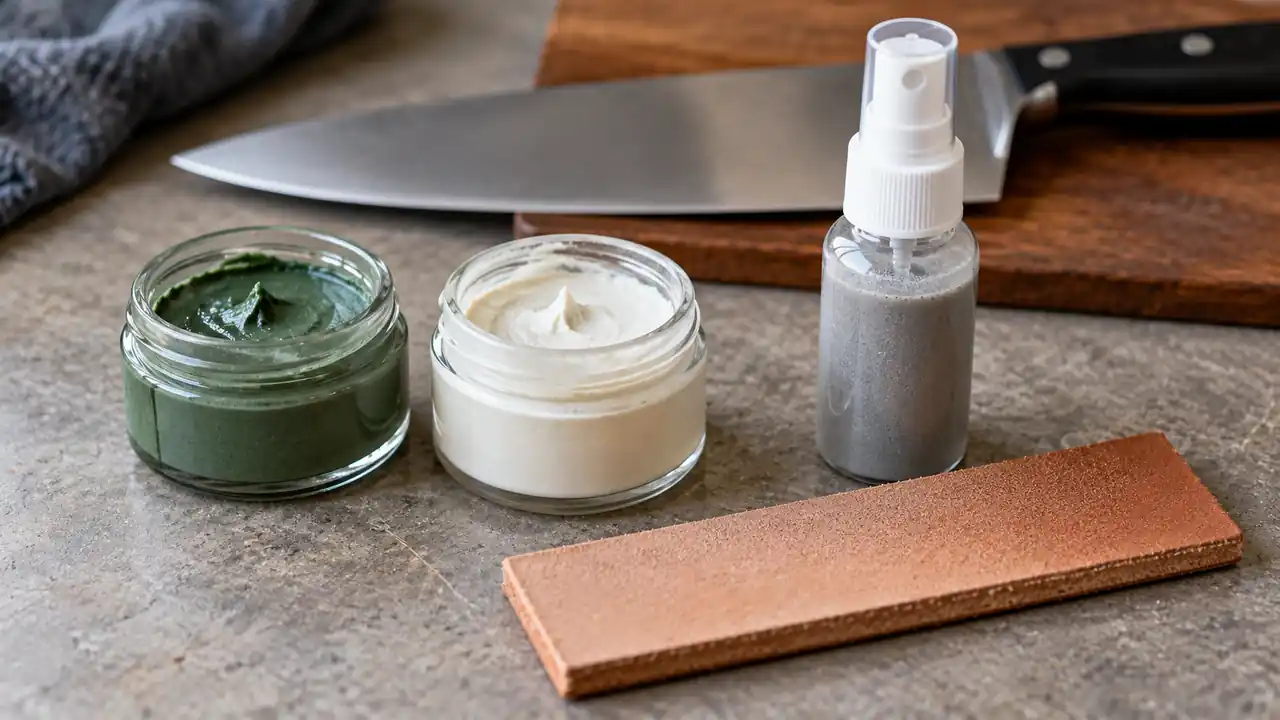
A knife strop can bring back a clean, refined edge between sharpening sessions, but the compound on that strop determines how much metal is removed and how polished the result becomes. A coarse diamond emulsion can refresh a tired working edge, while a fine green compound is better suited to final polishing and burr removal. Choosing the wrong abrasive can make a simple maintenance routine feel slow, messy, or ineffective.
The main mistake is treating every green bar or diamond emulsion as interchangeable. Micron size, abrasive type, dispensing method, and compatibility with leather, synthetic fabric, wood, or other stropping surfaces all matter. A compound must also match the stage of sharpening. A 6-micron formula has a different job from a 0.5-micron emulsion, and neither should be chosen solely because the package promises a mirror finish.
This guide compares nine products for kitchen knives, pocket knives, woodworking tools, and general edge maintenance. Some are concentrated liquid diamond abrasives, while others are traditional solid compounds or multi-color kits. The Jende 4 Micron Poly Diamond Emulsion earns the strongest overall position because its grit sits in a useful middle range, its pump bottle supports controlled application, and its listed uses cover routine touch-ups and post-sharpening refinement.
Quick Answer
Jende 4 Micron Poly Diamond Stropping Emulsion is the best overall choice for buyers who want a versatile liquid compound for routine edge maintenance and finishing after medium-fine sharpening. Its 25ml pump bottle is practical for applying a measured layer to leather, Nanocloth, and compatible surfaces.
Jende 1 Micron Poly Diamond Stropping Emulsion is the stronger pick for fine finishing, while Jende Max Concentration 6 Micron Emulsion suits users who need more abrasive action for working-edge maintenance or earlier finishing stages. For a traditional solid bar, SHARPAL 208H offers a straightforward green compound in a two-pack format.
Best Knife Stropping Compound Comparison Table
| Product | Best For | Type | Stated Abrasive Range |
|---|---|---|---|
| Jende 4 Micron Poly Diamond Emulsion | General edge maintenance | Liquid poly diamond | 4 micron |
| Jende 1 Micron Poly Diamond Emulsion | Fine finishing | Liquid poly diamond | 1 micron |
| Jende Max Concentration 6 Micron | Working-edge refinement | Concentrated liquid diamond | 6 micron |
| Jende Max Concentration 1 Micron | High-abrasion fine finishing | Concentrated liquid diamond | 1 micron |
| 0.5 Micron Diamond Emulsion | Fine surface refinement | Liquid monocrystalline diamond | 0.5 micron |
| SHARPAL 208H Green Compound | Traditional stropping | Solid green compound | 1 to 2 microns |
| SHARPAL 209H Green Compound | Frequent use and larger supplies | Solid green compound | 1 to 2 microns |
| SCOTTCHEN Fine Green Compound | Multiple leather strops | Solid green compound | Not stated |
| BeaverCraft Three-Color Compound Kit | Compound progression | Three solid compounds | Multiple grades |
The detailed reviews below separate liquid diamond formulas from traditional bars and explain where each one fits in a practical sharpening routine.
1. Jende Poly Diamond Stropping Emulsion 25ml, 4 Micron – Best Overall

A 4-micron compound occupies a useful middle position for knife care. It has more cutting action than a very fine finishing emulsion, yet it remains appropriate for refining an edge after sharpening around the 3K to 4K range. The listed application also includes polishing the grooves of an edge sharpened around 1K to 2K, which gives this formula practical flexibility for everyday kitchen maintenance.
The pump dispenser is a meaningful advantage in a small sharpening workspace. Instead of rubbing a hard bar repeatedly across leather, the user can apply a controlled amount to leather, Nanocloth, or another compatible surface. The water-based formula is listed as fast drying, and the color-coded labeling helps separate it from other Jende grits. Its stated compatibility with various steel types and ceramic blades broadens its usefulness, though the strop material still needs to be suitable for the blade and compound.
Pros
- Useful 4-micron middle grit for maintenance and finishing.
- Pump bottle supports controlled liquid application.
- Suitable for leather, Nanocloth, and compatible stropping surfaces.
- Listed for a wide range of steels and ceramic blades.
- Color coding makes grit identification easier.
Cons
- Less suitable than a finer formula for the final polishing stage.
- Requires a separate strop or compatible stropping surface.
This is the most balanced option for someone who wants one compound for regular edge touch-ups rather than a complete micron progression. It fits a cook who sharpens occasionally and wants a liquid abrasive that is easier to portion than a solid bar. Users chasing the finest possible finish may prefer the 1-micron Jende formulas, while beginners should still learn how much pressure their strop can tolerate before applying any abrasive.
To buy this product, click here.
2. Jende Poly Diamond Stropping Emulsion 25ml, 1 Micron – Best for Fine Finishing

The Jende 1-micron emulsion is aimed at the later part of a sharpening sequence. Its listed use is finish stropping after sharpening around 8K to 16K, or polishing the grooves left by work performed from 1K to 8K. That makes it more specialized than the 4-micron version, especially for users who want to refine an already clean edge rather than remove larger sharpening marks.
The 25ml pump bottle suits a dedicated sharpening station where the compound will be used repeatedly across a leather, Nanocloth, or other compatible strop. Jende describes the formula as water-based and fast drying, with a color system shared across its emulsion range. A user building a progression can identify grits quickly, although this bottle alone does not replace a coarser compound when an edge needs substantial refinement.
Pros
- Fine 1-micron abrasive for late-stage edge refinement.
- Useful for polishing grooves from a broad range of sharpening grits.
- 25ml pump bottle offers a practical working quantity.
- Color-coded packaging supports a multi-grit setup.
- Listed for steel and ceramic blades.
Cons
- Too fine for efficient correction of a heavily worn edge.
- Needs careful grit separation to avoid contaminating a finer strop.
Choose this formula if your stones or sharpening system already produce a refined edge and the strop is used as the finishing step. It is particularly logical for a user who values a clean, fine polish and already understands progression order. A single-compound beginner setup may be better served by the 4-micron option, which has a broader maintenance role.
To buy this product, click here.
3. Jende Max Concentration Poly Diamond Knife Stropping Emulsion, 6 Micron – Best for Working-Edge Refinement

The 6-micron Max Concentration formula is the more assertive choice in this group. Its listed position is around a 3K-grit equivalent, with uses that include maintaining a working edge, finishing after sharpening from 1K to 3K, and polishing grooves left by sharpening from 120 to 1K. That range gives it a place earlier in the stropping sequence than the 1-micron products.
Users maintaining several kitchen knives may appreciate the higher-concentration liquid format because it is intended to provide stronger abrasive action than conventional finishing compounds. It can act as a bridge between sharpening and polishing, although the aggressive side of that role demands light pressure and sensible progression. It is better suited to edge refinement than casual polishing of an already finished blade.
Pros
- 6-micron abrasive supports stronger edge refinement.
- Suitable for maintaining a practical working edge.
- Listed for use after sharpening from 1K to 3K.
- Liquid format spreads across compatible strops.
- Max Concentration formula targets efficient cutting action.
Cons
- Too coarse for the final mirror-polishing step by itself.
- Requires more care than a fine compound to avoid excessive abrasion.
This is a sensible choice for people who let kitchen knives go a little too long between sharpening sessions and want a compound with more bite. It can also serve as the first stage in a compound progression. Buyers seeking a simple final polish should skip it and choose a 1-micron or 0.5-micron product instead.
To buy this product, click here.
4. Jende Max Concentration Poly Diamond Knife Stropping Emulsion, 1 Micron – Best High-Concentration Fine Compound

This 1-micron Max Concentration emulsion combines fine abrasive size with the stronger formulation associated with the Max Concentration line. The listed guidance places it after sharpening around 8K to 16K, while also allowing it to polish grooves from edges prepared between 1K and 8K. That gives experienced sharpeners room to use it as a finishing compound without limiting it to one exact stone sequence.
The product is aimed at chef knives, kitchen knives, pocket knives, and other precision blades. Its 25ml liquid format is easier to portion than a traditional waxy bar, and the stated range of available Jende grits makes it possible to build a coordinated progression. It remains a specialized fine compound, so a rough or visibly damaged edge should be repaired with a suitable sharpening abrasive first.
Pros
- Fine 1-micron abrasive for polished edge refinement.
- Higher-concentration formulation is intended for efficient cutting.
- Useful across kitchen and pocket knife applications.
- 25ml bottle provides a practical supply for repeated use.
- Part of a broad stated micron progression.
Cons
- More specialized than a middle-grit maintenance compound.
- Requires a clean, compatible strop and careful grit control.
This makes sense for a sharpening enthusiast who wants a fine liquid compound with more concentrated abrasive action than a basic finishing product. It is less compelling for occasional users who simply want to refresh a standard kitchen knife, especially if their sharpening routine stops around a medium grit.
To buy this product, click here.
5. 0.5 Micron Diamond Emulsion – Best for Ultra-Fine Refinement

The 0.5-micron formula is intended for fine gloss and surface refinement after a stronger polishing step. Its monocrystalline diamond particles are suspended in a liquid, and the pump bottle is meant to distribute a thin layer over leather, synthetic strops, kangaroo leather, balsa, MDF, denim, and similar surfaces. That broad surface compatibility is useful for users who maintain more than one style of strop.
Because the compound is fine, it fits the final stages of a progression rather than heavy edge repair. The product information also describes applications beyond knives, including hard materials such as metal, glass, ceramics, carbides, and stone. For kitchen knife owners, its main appeal is controlled finishing without the buildup associated with rubbing a solid wax bar across the strop.
Pros
- Very fine 0.5-micron abrasive for surface refinement.
- Pump bottle supports thin, controlled application.
- Compatible with several leather and synthetic stropping surfaces.
- Liquid format avoids rubbing a hard bar onto the strop.
- Useful for knives and other hard materials.
Cons
- Too fine to replace a coarser sharpening compound.
- Requires a clean progression for best grit control.
Pick this product if the goal is a refined final finish and the earlier sharpening stages are already handled. It suits a careful hobbyist with multiple strops or surfaces. A first-time buyer with one general-purpose strop will likely find a 4-micron or 1-micron compound easier to integrate.
To buy this product, click here.
6. SHARPAL 208H Polishing Compound Fine Green, 2-Pack – Best Traditional Compound
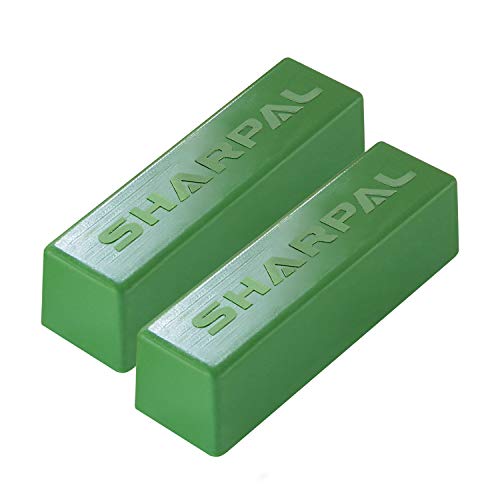
SHARPAL 208H takes the familiar solid green compound approach. The listed abrasive blend combines aluminum oxide and chromium oxide, with particle sizes described as 1 to 2 microns. That places it in the fine polishing category for burr removal and final edge work on kitchen knives, pocket knives, axes, chisels, and other metal tools.
The bar format is simple: apply it to a leather strop or honing wheel and work with light, controlled passes. The product information describes a smooth surface with few pits or bubbles and a hardness intended to make application manageable. A two-piece package is convenient for a shared workshop or for keeping a spare available, although it lacks the measured dispensing of a pump emulsion.
Pros
- Fine 1 to 2-micron abrasive blend.
- Traditional bar format is easy to store.
- Suitable for leather strops and honing wheels.
- Broad use across knives and woodworking tools.
- Two-piece package supports regular workshop use.
Cons
- Application is less measured than a liquid pump bottle.
- Requires rubbing the bar onto the chosen stropping surface.
This is a practical match for users who prefer familiar solid compounds and do not need a specialized micron progression. It also works well for a household sharpening drawer where a bar can sit ready beside a leather strop. Buyers wanting a precisely dispensed diamond emulsion should look at the Jende or 0.5-micron liquid options.
To buy this product, click here.
7. SHARPAL 209H Polishing Compound Fine Green, 8 Oz – Best for Frequent Use
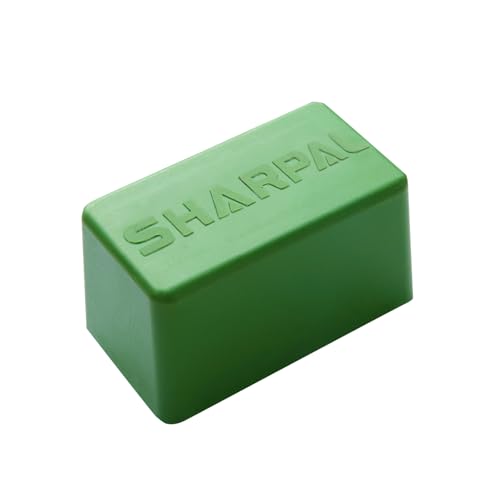
The 209H uses the same general fine green compound concept as the smaller SHARPAL option, with an aluminum oxide and chromium oxide blend listed at 1 to 2 microns. Its larger 222g supply is the distinguishing feature. That quantity makes more sense for a workshop, a household maintaining several blades, or anyone who also strops chisels, axes, and other edged tools.
Its solid form loads onto leather or a honing wheel by rubbing the bar across the surface. The published information describes a smooth compound with appropriate hardness and packaging intended to reduce breakage. Users should still keep separate surfaces for different grits, since cross-contamination can make a fine strop behave less predictably.
Pros
- Fine 1 to 2-micron abrasive size.
- Larger supply suits repeated stropping.
- Works with leather strops and honing wheels.
- Listed for kitchen knives and many metal tools.
- Solid bar stores easily between sharpening sessions.
Cons
- Large quantity may be unnecessary for occasional knife care.
- Does not provide the measured application of liquid formulas.
The 209H is the logical SHARPAL choice for users who go through compound regularly or maintain a collection of edged tools. A single kitchen knife owner may prefer the smaller package, while someone setting up a shared sharpening area will appreciate having more material available without changing compound types.
To buy this product, click here.
8. SCOTTCHEN Fine Green Stropping Compound, 3-Pack – Best for Multiple Strops

SCOTTCHEN offers three solid green bars intended for leather strops, honing wheels, knives, chisels, razors, and other edged tools. The listing describes each bar as 35g, with a total quantity of 4 ounces. Its stated hardness is intended to make loading a leather surface easier, although users may need to warm a dry bar with a hair dryer or heat gun before application.
The maintenance advice is useful for anyone working with traditional leather. The listing suggests softening overly dry or hard leather with mineral oil or honing oil, but the surface should be prepared cautiously and kept free of excess residue. Since the grit is not specified in the available information, this product is harder to place within a precise micron progression than the Jende, SHARPAL, or 0.5-micron options.
Pros
- Three-bar package supports several strops or work areas.
- Intended for leather strops and honing wheels.
- Suitable for knives, razors, chisels, and other tools.
- Solid format is easy to store.
- Listing includes guidance for loading dry compound.
Cons
- Available information does not state a micron size.
- Hard or dry compound may require warming before use.
This kit fits a user who values quantity and wants to keep separate bars in different sharpening locations. It is less suitable for someone building a carefully documented progression where exact abrasive size is central. Treat the unspecified grit as a limitation rather than assuming it matches a familiar green compound.
To buy this product, click here.
9. BeaverCraft Stropping Compound Kit, Red White Green – Best for Compound Progression

BeaverCraft’s P03 kit is aimed at users who want several traditional compounds in one package. It includes white, red, and green-gray formulas, with the product information assigning different polishing roles to each. White is described as suitable for harder metals or lighter cutting action on softer ones, red is positioned for polishing with little cutting action, and green-gray is intended for a higher-luster finish on metals including stainless steel.
The three-color arrangement can help a user experiment with a staged routine, but it demands careful labeling and separate strops or clearly separated areas. The available information does not provide exact micron sizes, so the colors should not be treated as a universal grit chart. This is a broader metal-polishing kit than a single-purpose kitchen knife compound, which explains both its flexibility and its less precise sharpening guidance.
Pros
- Includes three distinct compound colors and functions.
- Supports staged polishing on suitable leather strops.
- Useful for knives, chisels, and various metal surfaces.
- Green-gray compound is listed for high-luster finishing.
- Offers more progression options than a single solid bar.
Cons
- Exact micron sizes are not provided.
- Multiple compounds require careful separation to prevent contamination.
Choose this kit if flexibility matters more than a tightly specified abrasive progression. It can suit a workshop where knives and other metal tools share the same polishing supplies. A kitchen knife owner who wants predictable micron-based finishing will find the labeled Jende or SHARPAL options easier to place in a sharpening routine.
To buy this product, click here.
Buying Guide
Match the Micron Size to the Sharpening Stage
Micron size gives a useful indication of abrasive fineness. The 6-micron Jende Max Concentration formula is positioned for a working edge and earlier refinement, while 4 microns sits in a versatile middle range. The 1-micron products and 0.5-micron emulsion belong later in the process. A fine compound cannot efficiently replace a coarse abrasive when a blade has chips, a rounded edge, or substantial damage.
Choose Liquid or Solid Based on Application Control
Liquid emulsions make it easier to apply a thin, measured layer, especially with a pump dispenser. Solid bars cost less space and have a familiar, low-fuss format, but loading a strop takes more rubbing and judgment. A liquid bottle suits a user who changes grits often, while a solid bar is convenient for a simple household strop.
Keep Different Grits Separate
Fine stropping compounds work best when stray particles from a coarser product do not migrate onto the same surface. Use separate strops where possible, or clean and clearly mark each working area. This matters especially with multi-color kits such as BeaverCraft P03, where color alone does not establish an exact micron progression.
Check the Stropping Surface
Product compatibility depends on the surface as well as the compound. The Jende emulsions are listed for leather, Nanocloth, and other compatible media. The 0.5-micron emulsion lists leather, synthetic strops, kangaroo leather, balsa, MDF, and denim. A compound should be applied in a thin layer, and the surface should remain flat enough to avoid rounding the knife edge.
Understand Stropping Versus Sharpening
Stropping is generally a finishing or maintenance step, while sharpening removes more material to establish a new edge. A compound may refine a slightly tired edge, but it will not replace a suitable stone or sharpening system when the bevel is damaged or badly worn. Use light pressure and avoid treating a soft hanging strop as a rigid sharpening stone.
A compound belongs only in a compatible finishing process. The honing and sharpening explanation helps distinguish refinement from the heavier work needed to restore a worn edge.
Consider Steel and Blade Compatibility
The supplied product information lists several compounds as suitable for broad steel ranges, and some Jende products are also listed for ceramic blades. That does not mean every blade responds identically or that every strop is suitable for every edge. Follow the compound instructions, use a compatible surface, and keep the abrasive progression appropriate for the blade’s existing finish.
Best Knife Stropping Compound FAQ
What Is the Best Micron Size for Everyday Knife Stropping?
A middle grit such as 4 microns is a practical starting point for routine maintenance because it can refine an edge after medium-fine sharpening without being as aggressive as a 6-micron compound. A 1-micron product is better suited to final finishing after a finer sharpening stage.
Is Diamond Emulsion Better Than Green Stropping Compound?
Neither format is universally better. Diamond emulsions offer clearly stated micron sizes and controlled liquid application, while green solid compounds are simple to store and use. The better choice depends on whether you need a documented progression, a traditional bar, or a broad-purpose finishing compound.
Can Stropping Compound Sharpen a Dull Kitchen Knife?
Compound can refine and maintain an edge, but it is not a substitute for repairing a badly dull or damaged bevel. A knife with chips, a rounded edge, or significant wear usually needs a suitable sharpening abrasive before stropping.
Can One Strop Be Used With Several Compounds?
It is possible, but mixing grits on one surface makes the progression harder to control. Separate strops are preferable. If one strop must serve several compounds, remove residue as thoroughly as possible and mark each area clearly.
What Is the Difference Between 4 Micron and 1 Micron Compound?
A 4-micron abrasive is coarser and generally removes or refines more material during a pass. A 1-micron abrasive is finer and better suited to polishing an edge that has already been prepared. Using the finer product first will not provide the same correction as starting with the coarser option.
Can These Compounds Be Used on Ceramic Blades?
Several Jende formulas in this comparison are listed for ceramic blades. Users should still confirm that the stropping surface and technique are suitable for the particular blade, and they should follow the product’s stated application guidance rather than assume every compound works identically on ceramic.
Should Stropping Compound Be Applied Thickly?
A thin, even coating is generally easier to control than a heavy layer. Excess compound can create buildup and make the surface less predictable. Pump emulsions should be dispensed sparingly, while solid bars should be rubbed across the strop only enough to load the working area.
Final Verdict
The Jende 4 Micron Poly Diamond Stropping Emulsion is the strongest overall match for most knife owners because its abrasive size sits between heavier edge refinement and very fine finishing. The pump bottle makes application more controlled, and the listed use cases cover routine touch-ups, post-sharpening work, leather, Nanocloth, and other compatible surfaces.
Choose the Jende 6 Micron Max Concentration formula for more assertive working-edge maintenance, or move to the Jende 1 Micron and 0.5 Micron options for late-stage polishing. SHARPAL 208H and 209H suit users who prefer solid green compound, with the 209H offering a larger supply for frequent use. BeaverCraft’s three-color kit is the broadest option, though its unspecified micron sizes make it less precise for a carefully measured progression. Match the compound to the edge condition, keep grits separated, and use a compatible strop with light pressure.
