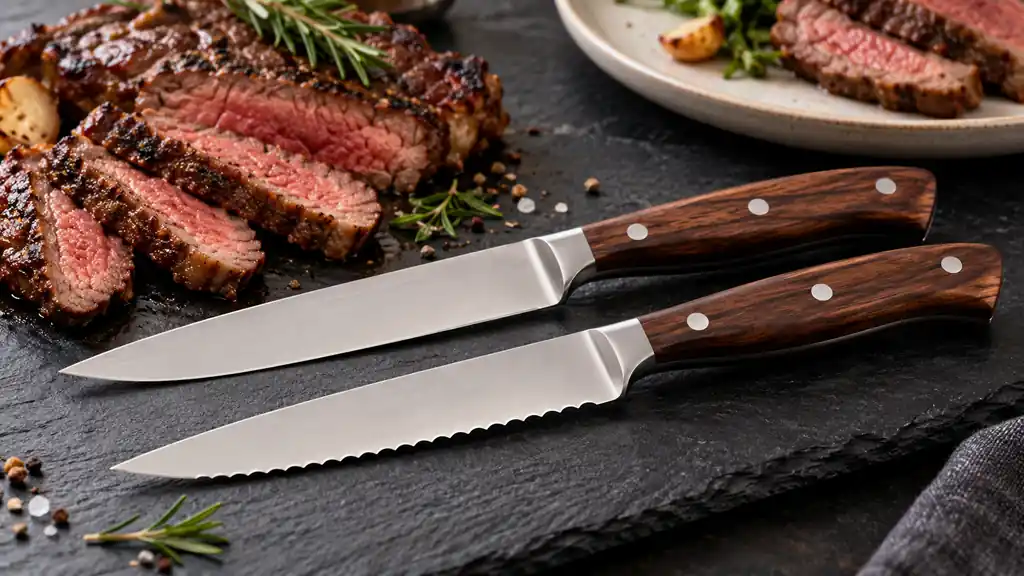
Serrated steak knives have toothed or scalloped edges that keep cutting after some wear and handle browned crusts well. Non-serrated steak knives, also called plain-edge steak knives, make smoother, more precise slices but require regular sharpening to maintain that performance. Neither style is universally better. The practical choice depends on whether you value low-maintenance cutting or clean slices and straightforward sharpening.
A sharp plain edge usually produces the cleanest cut through steak. A serrated edge is more forgiving of infrequent maintenance and repeated contact with dinner plates. Edge design, sharpness, construction, and care matter more than the label alone.
Once you have decided which edge style suits your maintenance routine, compare steak knives with different edge designs. The explanation below covers the practical trade-offs behind that choice.
Serrated vs. Non-Serrated Steak Knives at a Glance
| Characteristic | Serrated Steak Knife | Non-Serrated Steak Knife |
|---|---|---|
| Edge design | Scallops, teeth, or small serrations | Continuous, smooth cutting edge |
| Cut quality | Effective on crusts, but may tear softer meat when dull or used aggressively | Clean, controlled slices when sharp |
| Cutting motion | Usually works best with a light sawing motion | Uses smooth slicing strokes |
| Maintenance frequency | Often continues cutting acceptably despite wear | Loss of sharpness becomes apparent sooner |
| Sharpening | Requires a tool and method suited to the serration pattern | Works with many conventional sharpening methods |
| Plate contact | Recessed sections receive some protection, while projecting teeth still contact the plate | The continuous edge contacts the plate across more of its length |
| Best fit | Low-maintenance everyday service and heavily seared meats | Clean presentation, precise cuts, and owners willing to sharpen |
How the Two Edge Styles Cut Steak
Serrated Edges Concentrate Force at Their Teeth
A serrated knife has alternating high and low points along its edge. The projecting points initiate the cut, while the curved recesses help slice through the food as the knife moves back and forth. This geometry can penetrate a firm seared crust without requiring the entire edge to be equally sharp.
The recesses also receive less direct contact with a plate than a continuous edge. That partial protection helps a serrated knife remain functional after the exposed teeth have experienced some wear. It does not make the knife immune to dulling. Hard plates can still round or damage the projecting points, and the scallops gradually lose cutting ability through use.
A serrated knife can pull apart meat fibers instead of separating them cleanly if its teeth are coarse, its edge is dull, or the user applies too much downward force. Controlled, shallow strokes produce better results than forceful sawing.
Plain Edges Slice Through Fibers Continuously
A non-serrated steak knife presents one uninterrupted cutting edge to the meat. When properly sharpened, it moves smoothly through the crust and interior without the individual tooth marks associated with some serrated blades. This can produce cleaner portions and release fewer juices onto the plate through unnecessary compression.
That smooth performance depends heavily on edge condition. A dull plain-edge knife may slide over a seared surface or require excessive pressure. Its full cutting edge also meets the plate near the end of each stroke, accelerating wear compared with cutting on a suitable board.
Blade geometry still matters. A thin blade with an appropriate edge can cut more easily than a thick blade with the same nominal edge type. Steel, heat treatment, bevel geometry, and sharpening quality also influence how the knife behaves.
Which Edge Produces a Cleaner Cut?
A sharp non-serrated knife generally produces the cleaner slice. Its continuous edge separates meat fibers with a smooth motion, making it well suited to tender steaks and neatly portioned cuts. This difference becomes less clear when comparing a poorly sharpened plain edge with a well-maintained serrated edge.
Serrations are useful where the exterior resists the first cut. A deeply browned crust, charred edge, or firm outer layer can be easier to penetrate with small teeth. Once the knife reaches the softer interior, coarse serrations may leave a rougher cut surface than a sharp plain edge.
The user’s technique can amplify or reduce that effect:
- Use long, controlled strokes instead of pressing straight down.
- Let the edge do the work rather than forcing it through the meat.
- Keep the blade aligned with the intended slice.
- Avoid scraping the cutting edge sideways across the plate.
Maintenance Is the Largest Practical Difference
Plain Edges Are Easier to Sharpen at Home
Most ordinary non-serrated steak knives can be sharpened with a suitable stone, guided system, or compatible manual or electric sharpener. The correct method depends on the blade’s bevels and the equipment manufacturer’s instructions. A fixed-angle device should match the knife’s edge geometry rather than forcing the blade into an unsuitable slot.
For plain edges, the distinction between honing and sharpening helps explain why routine maintenance and restoring a worn edge are different jobs.
Sharpening removes metal to restore the cutting edge. A traditional smooth honing steel may help maintain some edges between sharpenings, while ceramic and diamond rods are abrasive and can remove material. Honing cannot restore every worn or damaged edge.
Steak knives are exposed to ceramic, stoneware, and glass plates, all of which are harder on an edge than common knife-friendly cutting boards. A plain edge may therefore need attention more frequently than a similarly constructed kitchen knife used only on wood or plastic boards.
Serrated Edges Need Pattern-Specific Tools
Serrated knives should not be sharpened like plain edges. Each curved recess may need to be worked individually with a tapered or appropriately sized rod. The tool must fit the scallop without widening or reshaping it unnecessarily. Many serrated knives have grinding concentrated on one side, but construction varies, so the existing geometry should guide the method.
A serrated pattern needs a compatible method. The guide to sharpening serrated knives separates maintainable designs from cases needing specialist advice.
After sharpening the scalloped side, a light burr may remain along the opposite face. Removing it requires care and minimal abrasion so the original blade geometry is preserved. Manufacturer instructions take priority where available.
Very fine microserrations can be difficult to reproduce with common home sharpening tools. A professional sharpening service may be appropriate if the pattern is small, irregular, or badly worn. Running a serrated knife through an incompatible pull-through sharpener can damage both the edge and the device.
How Dinner Plates Affect Steak Knife Edges
Cutting directly against a hard plate is unfavorable for either edge style. With a plain edge, much of the sharpened line can contact the plate during each complete stroke. This contact gradually rounds the apex, which is the narrowest part of the cutting edge.
On a serrated knife, the tips take much of the direct contact while portions inside the scallops remain recessed. The knife can continue cutting through a crust after the tips begin to wear because the inner curves still participate during a sawing motion. This explains much of the serrated edge’s reputation for long-lasting service.
That service life should not be confused with permanent sharpness. A serrated knife can feel functional long after its original edge quality has declined. Increased sawing, torn fibers, and greater pressure are signs that maintenance may be needed.
Choosing an Edge for Your Priorities
Choose Serrated Steak Knives If You Prefer:
- Reliable cutting with limited routine sharpening
- Easy penetration of heavily seared or charred surfaces
- An edge that remains usable as exposed sections wear
- Everyday table service where guests may use varied cutting techniques
Serrations are particularly practical for households that do not sharpen knives regularly. Coarse teeth can feel less refined, though, and eventual sharpening requires more specialized attention.
Choose Non-Serrated Steak Knives If You Prefer:
- Smooth, clean slices through meat
- Precise control with minimal tearing
- Sharpening with conventional edge-maintenance equipment
- A consistent cutting feel across the full blade
Plain edges suit users who are comfortable maintaining knives or arranging periodic professional sharpening. Their advantage depends on keeping them sharp. A neglected plain edge loses much of the quality that makes it appealing.
Other Features That Influence Performance
Edge style is only one part of a steak knife. Several construction details can change how either type feels and cuts:
- Blade thickness: A thinner blade usually moves through food with less wedging, provided its construction is appropriate for the task.
- Serration pattern: Broad scallops, pointed teeth, and fine microserrations behave differently. Coarser patterns may grip crust aggressively, while smoother scallops can reduce tearing.
- Blade stiffness: A typical steak knife should feel controlled during table use. Excessive flex can make precise slicing harder.
- Handle shape: Comfort depends on hand size, grip, handle dimensions, and surface texture. No single profile works equally well for every user.
- Balance and weight: These affect handling but do not determine sharpness or edge retention.
- Steel and heat treatment: These influence corrosion behavior, toughness, wear resistance, and sharpening response. Edge style alone does not reveal steel quality.
A full tang, forged construction, or a particular steel description does not automatically make one steak knife cut better than another. Practical performance reflects the complete design and the condition of the edge.
Care Tips for Both Styles
- Wash steak knives promptly after use with mild dish soap and a nonabrasive sponge.
- Dry the blade and handle thoroughly before storage.
- Follow the manufacturer’s care instructions, especially for handle materials and dishwasher use.
- Store knives so their edges do not strike other utensils. A suitable block, tray, or fitted guard can protect both the blade and the user.
- Avoid using steak knives to pry, twist, open packaging, or cut bones and frozen food.
- Inspect handles, tips, and edges for damage before setting the table.
Stainless steel resists corrosion better than many non-stainless steels, but it is not corrosion-proof. Prolonged moisture, food residue, and harsh dishwasher conditions can still affect blades and handles. Hand washing is generally gentler on a knife unless its manufacturer provides different care guidance.
Frequently Asked Questions
Do Serrated Steak Knives Stay Sharp Longer?
They often remain functionally effective longer because the recessed portions of the edge receive less direct plate contact. The exposed teeth still wear, and the entire edge eventually needs maintenance. Continued cutting ability does not mean the edge remains at its original sharpness.
Can a Non-Serrated Steak Knife Cut Through a Thick Crust?
Yes. A sharp plain edge can slice through a substantial crust cleanly. A dull edge may struggle to start the cut, which makes serrations more forgiving under the same conditions.
Can Serrated Steak Knives Be Sharpened?
Yes, but the sharpening tool must suit the scallop size and edge geometry. Some patterns can be maintained with a tapered rod, while very fine serrations may be better handled by a sharpening professional. An ordinary flat stone cannot reach deeply into curved serrations without a specialized technique.
Are Microserrated and Scalloped Edges the Same?
Both fall within the broad serrated category, but their geometry differs. Microserrations use many very small teeth, while scalloped edges have larger curved recesses. These designs can vary in cutting feel, tendency to tear, and ease of sharpening.
Which Steak Knife Edge Is Better?
A non-serrated steak knife is the stronger choice for clean, precise slicing, provided the edge receives regular maintenance. A serrated steak knife is more forgiving, handles firm crusts effectively, and often remains useful longer between sharpening sessions.
Choose based on the trade-off you prefer. Serrated edges favor convenience and sustained functionality. Plain edges favor cutting refinement and easier home sharpening. In either case, a well-made knife with sound geometry, a secure handle, and a properly maintained edge will perform better than a neglected knife of either type.
