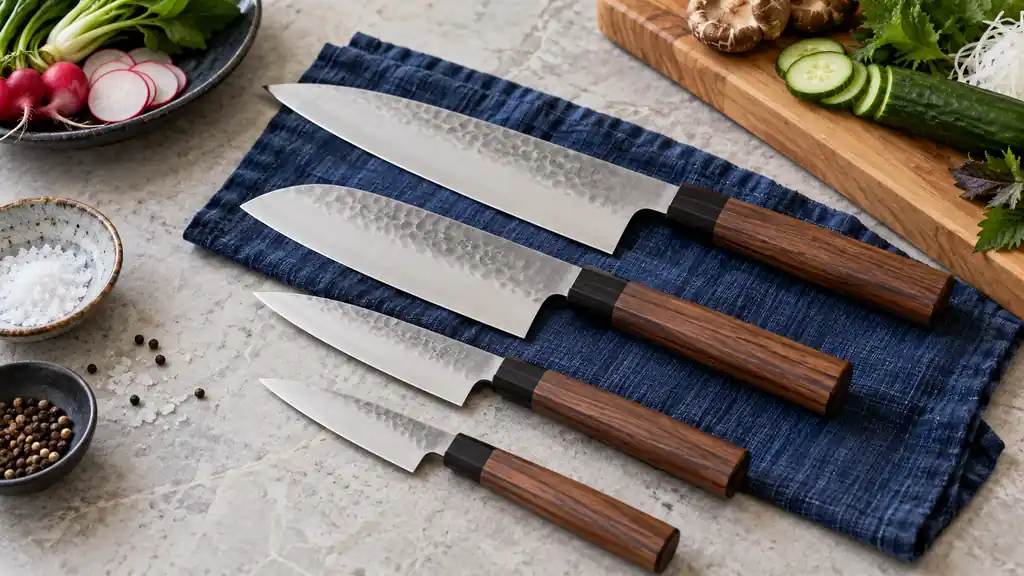
A Japanese knife set can bring welcome order to a busy kitchen. Instead of reaching for one general-purpose blade for every task, you can use a gyuto or chef’s knife for large prep, a santoku for compact chopping, a paring knife for detail work, and a bread knife for crusty loaves. The challenge is separating a genuinely useful set from a collection padded with duplicate blades, decorative patterns, or accessories that will spend most of their lives in a drawer.
The most useful comparison points are the actual knife mix, blade lengths, steel description, edge angle, handle construction, storage design, and care requirements. A set with a nakiri may suit someone who prepares vegetables daily, while a household that serves roasts may get more use from a carving knife. Harder steel can support a fine edge, but it does not remove the need for careful cutting and compatible sharpening. Likewise, a Damascus pattern can be attractive without proving that the blade cuts better than a plainly finished stainless-steel knife.
The nine sets below cover different priorities, from a compact three-piece collection to large block sets with steak knives and sharpening accessories. The imarku 14-piece set earns the strongest overall position because it combines broad coverage, a built-in sharpener, a block, and a stated 10 to 15 degree edge. Buyers who prefer a smaller, more specialized collection may favor the VG10 Damascus three-piece set, while cooks who want a vegetable-focused lineup should look closely at the HOSHANHO seven-piece magnetic set.
Quick Answer
- imarku 14-Piece Knife Set is the best overall choice for households that want a broad range of knives, countertop storage, and an integrated pull-through sharpener.
- Atumuryou Three-Piece Damascus Set is a focused alternative with a VG10 core, a chef’s knife, santoku, and paring knife, making it a better fit for cooks who do not need a large block.
- HOSHANHO Seven-Piece Magnetic Set stands out for vegetable preparation because it includes both a santoku and nakiri, along with a fillet knife and magnetic storage.
Best Japanese Knife Set Comparison Table
| Product | Best For | Piece Count | Main Knives Included | Storage |
|---|---|---|---|---|
| imarku 14-Piece Set | Best overall coverage | 14 pieces | Chef, bread, slicing, santoku, utility, paring, steak knives | Wood block with sharpener |
| Atumuryou Three-Piece Damascus Set | Focused VG10 collection | 3 knives | Chef, santoku, paring | Gift box |
| HOSHANHO Seven-Piece Magnetic Set | Vegetable preparation | 7 pieces | Chef, santoku, nakiri, fillet, utility, paring | Double-sided magnetic block |
| Yatoshi 15-Piece Block Set | Traditional block storage | 15 pieces | Chef, bread, slicing, two santoku, utility, paring, steak knives | Acacia block |
| HOSHANHO 16-Piece Set | Large household collections | 16 pieces | Chef, bread, carving, santoku, fillet, utility, paring, steak knives | Block with sharpener |
| HOSHANHO Seven-Piece Rosewood Set | Integrated sharpening and storage | 7 pieces | Chef, bread, santoku, nakiri, utility, paring | Magnetic block with sharpener |
| SANMEIHO 16-Piece Set | Broad knife variety | 16 pieces | Chef, bread, carving, santoku, fillet, utility, fruit, steak knives | Block with sharpener |
| SYOKAMI Seven-Piece Set | Foldable storage | 7 knives plus block | Chef, santoku, slicing, bread, utility, paring | Foldable magnetic acacia block |
| SENKEN Tsunami Damascus Set | VG10 Damascus construction | 7 pieces | Two chef knives, cleaver, bread, utility, santoku, paring | Gift box storage |
The detailed reviews explain how each knife mix, edge specification, handle design, and storage system affects everyday use.
1. imarku Japanese High Carbon Stainless Steel Knife Set with Block – Best Overall
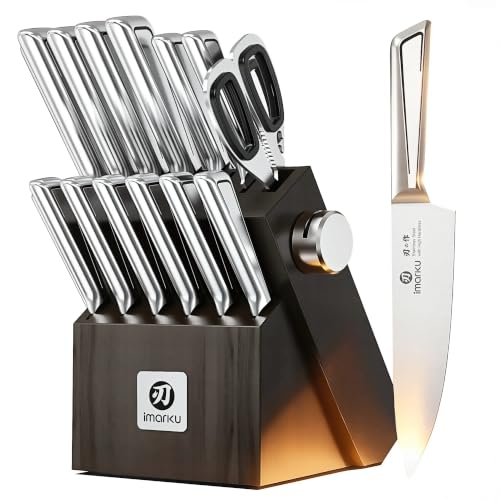
This imarku set makes a strong case for households starting from scratch or replacing a mismatched drawer of old knives. Its listed configuration covers the tasks that tend to appear across a normal week: an 8-inch chef’s knife for onions and proteins, a santoku for shorter chopping strokes, a bread knife, slicing knife, utility knife, paring knife, six serrated steak knives, and kitchen shears. That range is more useful than a high piece count built around several similar blades.
The hardwood block includes a pull-through sharpener, giving the set a simple maintenance path for busy cooks. The listing describes high-carbon stainless steel, full-tang construction, an ergonomic non-slip handle, and a stated 10 to 15 degree edge. Those details suggest a fine-edged Japanese-style setup, although the pull-through sharpener should be used according to its instructions rather than treated as a universal solution for every blade. Hand washing and drying remain the safer routine for preserving edge condition, despite the listed dishwasher-safe feature.
Pros
- Broad selection includes chef, bread, slicing, santoku, utility, paring, and steak knives.
- Integrated sharpener gives the set a convenient maintenance feature.
- Listed high-carbon stainless steel and a 10 to 15 degree edge suit fine kitchen prep.
- Full-tang construction and a contoured non-slip handle support controlled handling.
- Block storage keeps the main knives organized on the counter.
Cons
- A pull-through sharpener may be less suitable for cooks who prefer precise stone sharpening.
- The full block and six steak knives require more counter and storage space than a compact set.
This is the most balanced selection for a household that wants one purchase to cover daily cooking, entertaining, and basic maintenance. It may be excessive for a cook who already owns a bread knife or steak knives, and buyers with a strong preference for a small curated collection may prefer the three-piece VG10 set below. For a first kitchen, however, its mixture of useful blades and integrated storage is unusually practical.
To buy this product, click here.
2. Atumuryou Japanese Chef Knife Set 3 Pcs – Best Compact Damascus Set

Some cooks would rather own three purposeful knives than find room for a large block filled with blades they rarely touch. The Atumuryou set follows that compact approach with an 8-inch chef’s knife, 7-inch santoku, and 3.5-inch paring knife. Together, they cover broad chopping, shorter vegetable work, and peeling or small precision tasks without adding steak knives, shears, or specialized carving tools.
The available specifications identify a Japanese VG10 steel core, a stated hardness of 62 HRC, 67-layer construction, and a 12 degree per-side edge. The VG10 core and narrow listed angle point toward a fine cutting profile, while the Damascus pattern provides a distinctive visual finish. The product information does not establish that the layer count itself improves cutting, so the practical attraction is the focused knife selection and documented core steel. Stabilized wood and ocean-blue resin handles give the set a gift-oriented appearance, but the knives still need hand washing and careful drying.
Pros
- Compact three-knife selection avoids unnecessary duplication.
- Documented VG10 core and 12 degree per-side edge provide clear specifications.
- Chef’s knife, santoku, and paring knife cover common home preparation tasks.
- Full-tang handle construction is listed for all three knives.
- Stabilized wood and resin handles create a distinctive presentation.
Cons
- No bread knife, utility knife, shears, or storage block is included.
- The fine edge and stated 62 HRC hardness call for careful use and compatible sharpening.
This set fits a cook who wants a neat drawer or magnetic storage arrangement and already knows which three knife shapes get the most use. It is less convincing as a complete first kitchen purchase because bread and larger serving tasks require separate tools. Choose it for the documented steel and compact lineup, rather than assuming the decorative Damascus pattern alone predicts cutting performance.
To buy this product, click here.
3. HOSHANHO 7PCS Kitchen Knife Set – Best for Vegetable Preparation

The inclusion of both a 7-inch santoku and a 7-inch nakiri gives this HOSHANHO set a useful identity. A santoku offers an all-purpose Japanese-style profile, while a nakiri is shaped around vegetable preparation and push-cutting motions. That pairing should appeal to cooks who spend Saturday mornings turning peppers, cabbage, carrots, and herbs into meal-prep containers rather than relying exclusively on a curved chef’s knife.
The set also includes an 8-inch chef’s knife, 7-inch fillet knife, 6-inch utility knife, and 3.75-inch paring knife. Its blades are listed as 10Cr15CoMoV high-carbon stainless steel, with vacuum heat treatment, hardness up to 60 HRC, and a 15 degree edge. The double-sided acacia magnetic block allows quicker access than deep vertical slots, but its countertop footprint and blade-placement arrangement should suit the available workspace.
Pros
- Includes both santoku and nakiri profiles for varied vegetable work.
- 10Cr15CoMoV steel and a stated 60 HRC hardness are clearly identified.
- Fillet, utility, and paring knives extend the set beyond basic chopping.
- Double-sided magnetic block keeps blades visible and accessible.
- Pakkawood handles are listed with a reinforced construction.
Cons
- No bread knife or steak knives are included.
- Magnetic storage requires careful blade placement and more exposed countertop space.
This is a particularly sensible choice for vegetable-heavy cooking and for anyone who values seeing the blades rather than reaching into slots. A household that bakes frequently may miss a bread knife, while cooks who prefer conventional block storage may find the magnetic design less familiar. Its specialized knife mix gives it a clearer purpose than many sets with similar piece counts.
To buy this product, click here.
4. Yatoshi Professional Kitchen Knife Block Set – Best Traditional Block Layout
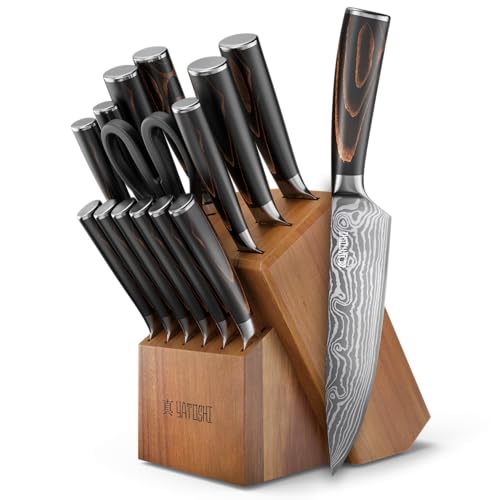
Yatoshi takes a familiar block-set route and gives it a Japanese-style edge specification. The listed collection includes an 8-inch chef’s knife, bread knife, slicing knife, 7-inch santoku, 5-inch santoku, 5-inch utility knife, 3.5-inch paring knife, six steak knives, and shears. That second, shorter santoku is a meaningful detail for cooks who prefer a more compact blade for smaller boards or quick lunch preparation.
The product information lists 7Cr17 high-carbon stainless steel at 57 to 58 HRC and a 15 degree edge. The hidden full-length tang, sloped bolster, and contoured Pakkawood handles are aimed at pinch-grip control. Its acacia block has deep slots and a non-slip rubber base, which favors conventional countertop storage over an exposed magnetic display. The large selection is useful for family meals, but it also means more blades to wash, dry, and eventually sharpen.
Pros
- Includes both full-size and compact santoku knives.
- Broad coverage includes bread, slicing, steak, and everyday preparation knives.
- Documented 7Cr17 steel and 57 to 58 HRC hardness provide useful material information.
- Sloped bolster and full-length tang support a controlled pinch grip.
- Acacia block includes deep slots and a non-slip base.
Cons
- The large collection may duplicate tasks for households that cook with only two or three knives.
- The supplied information does not list an integrated sharpener in the block.
Pick this set for a household that wants conventional block storage and a broad spread of daily and serving knives. The shorter santoku makes the set more flexible than a standard chef-and-santoku pairing, while the bread and slicing knives help with weekend meals. It is less suited to minimalists who would rather invest in a small number of individually chosen blades.
To buy this product, click here.
5. HOSHANHO 16PCS Knife Set – Best for Large Household Collections

This HOSHANHO set is aimed at the kitchen where several people cook, steak knives are used regularly, and a single chef’s knife cannot cover every serving task. The lineup includes an 8-inch chef’s knife, bread knife, and carving knife, plus a santoku, fillet knife, utility knife, paring knife, six steak knives, shears, a sharpener, and a block. That configuration is especially relevant for households that move from weekday chopping to roast dinners without changing their core equipment.
The blades are listed as Japanese 10Cr15CoMoV stainless steel with a stated hardness up to 58 HRC and a 15 degree edge. Pakkawood handles are paired with a ventilated block, while the included sharpening rod is intended for routine maintenance. The listing calls it a sharpener, but the supplied information does not establish the rod’s abrasive material or exact sharpening action, so buyers should avoid assuming it performs the same job as a whetstone.
Pros
- Includes chef, bread, carving, santoku, fillet, utility, and paring knives.
- Six steak knives make the set practical for shared meals.
- 10Cr15CoMoV stainless steel and a stated 58 HRC hardness are documented.
- Includes shears, a sharpening accessory, and block storage.
- Ventilation in the holder may help keep stored knives separated from a fully enclosed base.
Cons
- The 16-piece format creates a larger storage commitment than compact sets.
- The supplied information does not identify the sharpening accessory’s abrasive type or compatibility limits.
This set makes sense for a family kitchen, a new home, or a cook who wants carving and steak service covered in the same purchase. It is less attractive for a small apartment with limited counter space, and the included maintenance tool should be treated as a convenience accessory until its exact design is confirmed. Its strength is breadth, not a tightly curated minimalist lineup.
To buy this product, click here.
6. HOSHANHO 7 Pcs Knife Set – Best Integrated Sharpening Design

This seven-piece HOSHANHO collection focuses on the knives many home cooks reach for repeatedly: an 8-inch chef’s knife, 8-inch bread knife, 7-inch santoku, 7-inch nakiri, 6-inch utility knife, and 3.75-inch paring knife. The knife mix is more focused than a 16-piece block and more complete than a three-piece set, especially for cooks who prepare vegetables and bake bread.
The product description identifies 10CR15MOV high-carbon steel, nine-layer composite forging, a 12 degree edge on both sides, and natural rosewood handles with an octagonal shape. Its 14 by 10-inch magnetic block includes a built-in sharpener. The layer count and pattern should be viewed as construction details rather than automatic proof of better cutting, while the sharpener remains a convenience feature that may not replace careful manual sharpening for every blade.
Pros
- Includes both nakiri and santoku knives for different vegetable-cutting styles.
- Contains a bread knife while avoiding steak-knife duplication.
- Lists 10CR15MOV steel, nine-layer construction, and a 12 degree double bevel.
- Rosewood octagonal handles provide a distinctive documented design.
- Magnetic block combines storage with a built-in sharpening feature.
Cons
- The 14 by 10-inch block needs a dedicated countertop area.
- No carving, fillet, steak, or kitchen-shear accessory is listed.
Choose this set for a focused home kitchen where vegetable prep, bread slicing, and everyday chopping matter more than entertaining with a full steak service. It offers a clearer role for each included knife than many larger sets. Buyers who need a fillet knife or carving knife will need to add one separately.
To buy this product, click here.
7. SANMEIHO Knife Set 16 pcs – Best Broad Knife Variety

SANMEIHO covers an unusually broad set of kitchen jobs: chef’s, bread, carving, santoku, filleting, utility, and fruit knives, along with six steak knives, a sharpener, shears, and a block. A cook who enjoys preparing fish one evening and carving a roast the next will find more dedicated shapes here than in a compact starter set.
The listing describes Japanese high-carbon steel, a 15 degree cutting edge, full-tang construction, triple-riveted Pakkawood handles, and a laser-engraved blade pattern. It specifically states that the set is not a Damascus knife set, which is useful clarification for shoppers comparing decorative finishes. Dishwasher use is not recommended, so hand washing and prompt drying should be part of ownership.
Pros
- Includes dedicated bread, carving, filleting, fruit, and steak knives.
- Full-tang, triple-riveted handle construction is listed.
- 15 degree edge specification provides a clear sharpening reference.
- Includes shears, sharpener, and block storage.
- The listing clearly distinguishes its laser pattern from Damascus construction.
Cons
- The large assortment may include more specialized knives than a small household needs.
- Dishwasher use is not recommended, requiring a more deliberate cleaning routine.
This is a sensible choice for cooks who value variety and want fish, carving, bread, and table service handled by separate blades. It is less suitable for someone seeking a tightly selected Japanese-style trio or a set with a documented named steel. The clear warning about the decorative pattern helps keep expectations grounded.
To buy this product, click here.
8. SYOKAMI 2026 Upgrade Kitchen Knife Set – Best for Limited Storage

Small kitchens often need a storage solution before they need another knife. SYOKAMI addresses that problem with a foldable magnetic acacia block that can stand on a countertop or be stored in a drawer. The six listed knives are an 8-inch chef’s knife, 7-inch santoku, 8-inch slicing knife, 8-inch bread knife, 6-inch utility knife, and 3.8-inch paring knife. This is a useful everyday spread without a tall, permanently fixed block.
The product information lists high-carbon stainless steel, hardness above 56 Rockwell, a 15 degree edge, full-tang wood handles, and open slots that can be brushed clean. The foldable holder is the defining feature, but storing sharp knives in a drawer still requires care so the blades do not contact loose utensils. A magnetic slot may hold a knife securely, yet the supplied details do not provide a specific weight capacity or installation specification.
Pros
- Foldable block offers more storage flexibility than a fixed countertop holder.
- Includes chef, santoku, slicing, bread, utility, and paring knives.
- Lists high-carbon stainless steel and a 15 degree edge.
- Open storage areas can be cleaned with a brush.
- Full-tang wood-handle construction is identified in the product information.
Cons
- The set does not include steak knives, carving knives, or kitchen shears.
- Drawer storage still requires a safe, organized location away from loose utensils.
Apartment cooks, renters, and families trying to keep sharp tools away from pets or children may appreciate the flexible holder. Its six-knife lineup is practical for daily meals, but larger households may miss table knives and a dedicated fillet blade. This set earns its place through storage versatility rather than an unusually broad knife collection.
To buy this product, click here.
9. SENKEN 7-Piece Damascus Kitchen Knife Set – Best for VG10 Damascus Construction
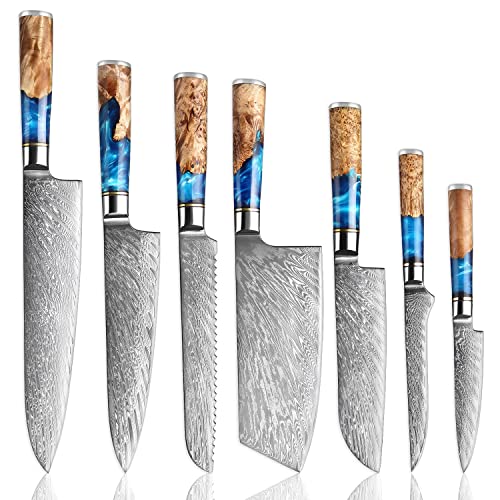
The SENKEN Tsunami collection is built around a more distinctive knife mix than the usual chef, santoku, and paring trio. It includes two chef’s knives, a cleaver, bread knife, utility knife, santoku, and paring knife. That combination may suit a cook who wants a second chef’s knife for different prep stations and occasionally uses a cleaver for ingredients that call for a broader blade.
The supplied specifications identify Japanese VG10 steel, 67-layer Damascus construction, a 15 degree double bevel, and blue resin burl wood handles. The Damascus layers create the patterned exterior, while the product description specifically identifies VG10 as the steel. There is no need to infer that the pattern automatically improves edge retention. The gift box doubles as storage, which is presentation-friendly but less convenient than a countertop block for rapid daily access.
Pros
- Documented VG10 steel core and 67-layer Damascus construction.
- Includes two chef’s knives, a cleaver, bread knife, santoku, utility, and paring knife.
- 15 degree double-bevel edge is clearly specified.
- Blue resin burl wood handles give the set a distinctive appearance.
- Gift-box storage suits presentation and gifting.
Cons
- The gift box may be less convenient for daily access than a dedicated block.
- The set does not list steak knives, shears, or a built-in sharpener.
This collection is best for someone who values named VG10 steel, a decorative Damascus exterior, and a broader prep assortment that includes a cleaver. It is less practical for a household that wants every knife visible and ready on the counter. Buyers should also match their sharpening method to the listed double-bevel edge and avoid treating the cleaver as permission to cut hard bones or other unsuitable materials.
To buy this product, click here.
Buying Guide
Evaluate the Knife Mix Before Counting Pieces
A set earns its place through useful coverage, not the number printed on the package. A chef’s knife, santoku, and paring knife can handle most daily prep, while a bread knife becomes valuable for anyone who regularly buys crusty loaves. Steak knives, shears, carving knives, and fillet knives add practical value when those tasks actually occur in your kitchen. Look for unnecessary duplication, such as multiple blades with nearly identical purposes, before treating a large set as the stronger purchase.
Match Blade Profiles to Your Cutting Motion
Chef’s knives and gyuto-style blades generally offer a curved profile that supports rocking and chopping. Santoku knives tend to provide a shorter, taller blade for compact work, while nakiri knives are associated with vegetable preparation and a flatter edge. A set containing both santoku and nakiri gives more choice for vegetable work, but it does not make either knife suitable for every task. Do not use a fine kitchen edge for hard bones, frozen foods, or jobs better suited to a dedicated heavy blade.
Check what the individual shapes actually do. This overview of Japanese kitchen-knife types can reveal whether a set adds useful coverage or several similar main knives.
Read Steel Claims With Precision
A named steel such as VG10 or 10Cr15CoMoV gives more information than a broad phrase such as “Japanese high-carbon steel.” The products in this guide use both named and general steel descriptions. Hardness figures can help describe the intended construction, but hardness is separate from toughness, corrosion resistance, ease of sharpening, and actual edge retention. A harder blade may require more careful sharpening and handling, while a stainless blade still benefits from prompt drying after washing.
Treat Damascus Patterns as Construction Details
Layer counts and visible patterns are attractive, particularly on gift-oriented sets, but they do not automatically establish sharper cutting or longer edge life. The Atumuryou and SENKEN sets identify VG10 cores, which is more useful than the pattern alone. SANMEIHO specifically describes its finish as laser engraved rather than Damascus. Compare the core steel, edge design, knife selection, and maintenance routine instead of choosing solely by the appearance of the blade.
Check Handles, Edge Angles, and Care Requirements
Pakkawood, stabilized wood, rosewood, and resin handles each create a different ownership profile, but the available listing information does not provide complete handle dimensions or tested ergonomic results. Full-tang construction can support a continuous handle structure, yet it does not guarantee that every hand will find the shape comfortable. Edge angles are also product-specific. A stated 12, 15, or 10 to 15 degree angle should not be casually changed with an incompatible sharpener.
A built-in sharpener is not automatically suitable for every included blade. Review Japanese-knife sharpening requirements before using it.
Plan Storage Before the Set Arrives
A wooden block needs counter space and regular cleaning around its slots. A magnetic block keeps blades visible and accessible, but it requires careful placement and a suitable location. A foldable block can help in a small apartment, while gift-box storage may work better for occasional use than daily cooking. Whichever style you choose, keep sharp edges separated from loose utensils and verify that the storage system suits the dimensions and number of included knives.
Best Japanese Knife Set FAQ
What knives should a Japanese knife set include?
A useful starter set usually includes a versatile chef’s knife or gyuto-style blade, a santoku or nakiri for shorter vegetable work, and a paring knife. A bread knife is valuable for frequent bakers. Larger sets may add slicing, carving, filleting, steak, and utility knives, but those additions are worthwhile only when they match your cooking habits.
Is a santoku better than a chef’s knife?
Neither is universally better. A chef’s knife often gives more length and a more pronounced curve for rocking motions, while a santoku can feel more compact for chopping and slicing on a smaller board. The best choice depends on the blade length, profile, handle, and cutting motion you use most often.
Does a Damascus pattern mean a knife is better?
No. A Damascus pattern can reflect layered construction or a decorative finish, but the pattern alone does not prove better sharpness, toughness, or edge retention. Check whether the listing identifies a core steel, such as VG10, and then compare the knife geometry, edge angle, handle, and maintenance needs.
Are Japanese-style knife sets made in Japan?
Not necessarily. “Japanese-style” may describe the blade profile, edge design, or marketing position rather than manufacturing origin. The supplied product information identifies Japanese-style designs and Japanese steel descriptions for several sets, but it does not establish that every knife was manufactured in Japan.
Can these knife sets go in the dishwasher?
Care guidance varies by product. The imarku listing describes its set as dishwasher-safe, although it also indicates that hand washing helps preserve the knives. SANMEIHO specifically does not recommend dishwasher use. Hand washing with mild dish soap, followed by prompt drying, is the more cautious routine for high-carbon stainless steel and wood-based handles.
Are the included pull-through sharpeners suitable for every knife?
Do not assume so. A pull-through sharpener or sharpening accessory may use a fixed angle or a particular abrasive, while different knives can have different edge geometries. Fine edges, double-bevel blades, and specialized knives should be maintained with a method compatible with the product instructions. A sharpening rod is also not automatically equivalent to a whetstone.
Which set is best for a small kitchen?
The SYOKAMI seven-piece set has a foldable magnetic acacia block that can be stored in a drawer when appropriate, making it a practical option for limited counter space. A compact three-piece set such as the Atumuryou collection takes less room overall, but it does not include a bread knife, shears, or storage block.
Final Verdict
The imarku 14-piece set is the strongest overall match for shoppers who want a complete Japanese-style kitchen knife collection without assembling each piece separately. Its useful knife range, block storage, stated fine edge, and integrated sharpener address the everyday needs of a new kitchen or a household replacing an inconsistent drawer. Hand washing remains the sensible care routine, and the block takes more space than a compact three-knife collection.
The Atumuryou set is the better alternative for a focused VG10 lineup with chef, santoku, and paring knives, while the HOSHANHO seven-piece magnetic set is more compelling for vegetable-heavy cooking because it includes both santoku and nakiri profiles. Buyers who need steak knives and carving coverage should look toward the larger HOSHANHO or SANMEIHO sets. Match the final choice to your cooking motions, storage space, and willingness to maintain a fine edge rather than choosing by piece count or blade pattern alone.
