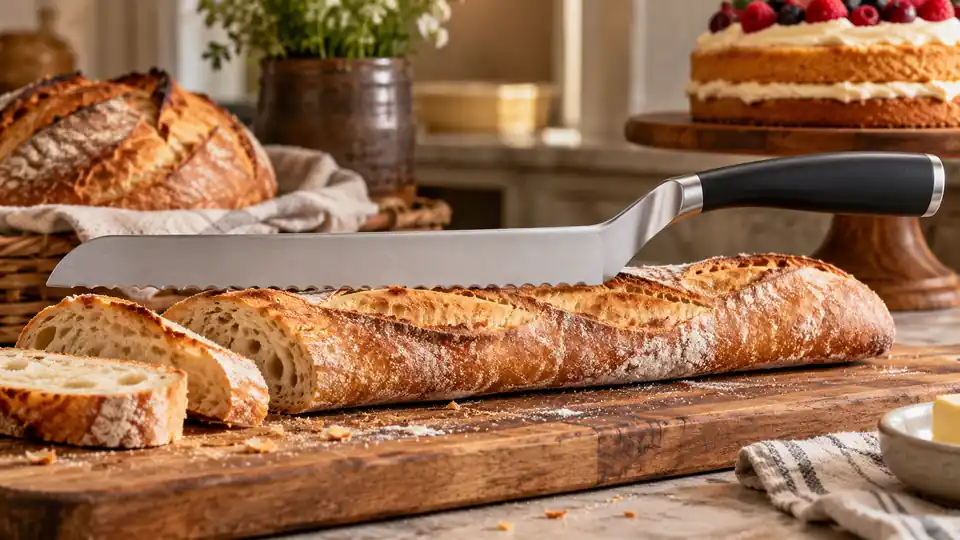
A good offset bread knife earns its place at the cutting board by solving two problems at once: its serrated edge works through a crisp crust without crushing the soft crumb, while the raised handle gives your knuckles more room above the board. That combination is especially useful for homemade sourdough, tall sandwich loaves, baguettes, cakes, bagels, and ripe tomatoes. A straight-handled bread knife can still slice well, but repeated cuts may leave your hand crowded against the board.
The main mistake is choosing by tooth count or blade length alone. A long blade can be useful for wide boules, yet awkward in a small kitchen. A short blade may feel nimble around cakes and compact loaves, but require extra strokes through a large sourdough round. Steel description, serration shape, handle material, finger clearance, care instructions, and sharpening options all influence ownership. Some shoppers want a dependable everyday knife, while others prioritize a resharpenable edge, a soft commercial-style grip, or a gift-ready presentation.
This comparison focuses on documented features that matter for offset bread slicing rather than repeating broad marketing claims. The Mercer Culinary M23890 stands out as the strongest all-purpose choice because it combines a 9-inch offset wavy edge, one-piece high-carbon Japanese steel construction, and a textured handle from an established kitchen-cutlery line. The alternatives below cover larger loaves, frequent baking, wet-hand control, resharpenable serrations, and compact cutting tasks.
Quick Answer
- Best Overall: The Mercer Culinary M23890 offers a practical 9-inch offset format, one-piece high-carbon Japanese steel construction, and a textured handle suited to routine bread, cake, tomato, and meatloaf slicing.
- Best for Resharpenable Serrations: The SYOKAMI 10.5-inch model is unusual among these choices because its listed serration spacing is intended to work with a standard honing rod, giving owners a stated maintenance path for the serrated edge.
- Best for Large Loaves: The PAUDIN 10-inch knife offers a longer cutting span, raised handle, carbonized bamboo grip, sheath, and gift box for bakers who regularly work with broad artisan loaves.
- Best for Wet-Hand Grip: The CAT CORA offset knife pairs a 9-inch serrated blade with a Santoprene handle and a fully sealed construction, making it a practical option for busy kitchen environments.
Best Offset Bread Knife Comparison Table
| Product | Best For | Blade Length | Construction or Grip |
|---|---|---|---|
| Mercer Culinary M23890 | Everyday bread and cake slicing | 9 inches | High-carbon Japanese steel, textured handle |
| SYOKAMI Offset Bread Knife | Resharpenable serrations | 10.5 inches | Full tang, triple rivets, wenge wood handle |
| PAUDIN Offset Sourdough Knife | Large loaves and gifting | 10 inches | High-carbon stainless steel, carbonized bamboo handle |
| CAT CORA Offset Serrated Knife | Wet-hand control | 9 inches | German steel, Santoprene handle |
| Dynamic Pro-Grip Offset Knife | Documented steel and hardness details | 9 inches | X50CrMoV15, Santoprene handle |
| Piklohas Resharpenable Knife | Crusty and soft loaves | 10 inches | Wavy edge, offset handle, hollow edge |
| Offset Bread Knife 10-Inch | Wide sourdough boules | 10 inches | X50Cr15MoV, Pakkawood handle |
| Mercer Culinary M22408 | Compact offset slicing | 8 inches | High-carbon Japanese steel, textured handle |
| BOLEXINO Offset Serrated Knife | Everyday multi-food use | 9 inches | Stainless steel, soft ergonomic handle |
The detailed reviews below put the blade length, handle clearance, steel information, care requirements, and intended cutting tasks into practical context.
1. Mercer Culinary M23890 Millennia 9-Inch Offset Wavy Edge Bread Knife — Best Overall

The Mercer Culinary M23890 has the kind of straightforward configuration that works for a broad range of home kitchens. Its 9-inch offset wavy edge is long enough for standard sandwich loaves, many homemade boules, cakes, and bagels without feeling as unwieldy as a very long blade. The teeth are intended to engage a firm crust or skin while leaving the softer interior less compressed, which is the central job of a bread knife.
Its one-piece high-carbon Japanese steel construction gives the knife a clear maintenance advantage over a poorly protected serrated blade, although the available information does not specify an exact alloy or hardness value. The Millennia handle uses textured finger points for additional grip security. That detail matters during the slow back-and-forth motion needed for a dense loaf, especially when crumbs, flour, or moisture are present. The offset shape also creates useful clearance between the hand and cutting board.
Pros
- 9-inch blade suits many everyday loaves without excessive reach.
- Offset profile provides useful hand and knuckle clearance.
- One-piece high-carbon Japanese steel construction is clearly documented.
- Textured finger points support a more secure grip.
- Wavy serrations suit bread, cake, tomatoes, fruit, and meatloaf.
Cons
- Exact steel designation and hardness are not provided.
- Hand washing and thorough drying are recommended instead of dishwasher cleaning.
This is the strongest general recommendation for shoppers who want one offset bread knife for weekend sourdough, weekday toast, and occasional cake work. It may be less appealing to someone who specifically wants a serrated edge that can be resharpened with a rod, or to a baker who routinely cuts exceptionally wide loaves and prefers a 10-inch blade. For most households, though, the balance between reach, grip design, and familiar maintenance is sensible.
To buy this product, click here.
2. SYOKAMI 2026 New Upgraded 10.5-Inch Offset Bread Knife — Best for Resharpenable Serrations

SYOKAMI takes a more specialized approach to the serrated edge. The product information lists 10.5 mm serration spacing intended to fit standard honing rods, so each tooth is presented as resharpenable. That feature deserves attention from frequent bakers who dislike treating a serrated bread knife as disposable. It does not mean every honing rod or technique will be suitable, but the knife at least offers a stated maintenance route that many ordinary bread knives lack.
The raised handle, front finger rest, full tang, and triple-riveted construction give this knife a more substantial design brief than a basic stamped kitchen tool. Its wenge wood handle has a textured surface and is described as moisture-absorbing, which may appeal to someone shaping dough and moving straight to slicing. The 10.5-inch blade offers generous reach for tall sourdough and broad loaves, while the dimpled surface is intended to reduce sticking. A longer, heavier-feeling design can require more storage space and deliberate control, so its strengths are most relevant to serious home bakers.
Pros
- Listed serration spacing is intended to support resharpening with a standard honing rod.
- 10.5-inch blade provides reach for large or tall loaves.
- Raised handle creates substantial clearance above the cutting board.
- Full tang and triple rivets are documented construction features.
- Front finger rest and wider serrations broaden its food-preparation use.
Cons
- Longer 10.5-inch format may be cumbersome in a compact kitchen.
- Wood handle care requires more attention than a fully synthetic grip.
This knife suits bakers who expect to use a serrated blade regularly and want a product with a documented resharpening concept. It is a less natural pick for someone who cuts a small sandwich loaf once a week and prefers a lighter, simpler tool. Buyers should also treat the honing-rod claim as a compatibility detail to follow carefully rather than assuming any rod will sharpen every tooth equally.
To buy this product, click here.
3. PAUDIN 10-Inch Offset Sourdough Bread Knife — Best for Large Loaves

A broad boule can make a short bread knife feel like a small saw in a big job. The PAUDIN answers that problem with a 10-inch serrated blade and a raised offset handle. That extra length gives the teeth more room to travel through a family-size loaf, while the elevated grip keeps the hand farther from the board during repeated slices. Its listed applications include sourdough, baguettes, brioche, bagels, cake, tomatoes, pineapple, and roasted meat.
The blade is described as high-carbon stainless steel, but no precise alloy designation or hardness value is supplied. The handle uses carbonized bamboo and is described as non-slip and dishwasher-safe, a combination that may appeal to cooks who want simpler cleanup than traditional wood normally allows. The included sheath and gift box add practical value for storage or presentation, though packaging should not outweigh the knife’s fit for the buyer’s cutting habits. A 10-inch bread knife needs a drawer, block, or sheath that can accommodate its full length.
Pros
- 10-inch serrated blade suits broad artisan loaves and large bagels.
- Offset handle provides useful knuckle clearance.
- High-carbon stainless steel construction is documented.
- Carbonized bamboo handle is listed as non-slip and dishwasher-safe.
- Sheath and gift box make storage and gifting more convenient.
Cons
- Exact stainless steel alloy and hardness are not specified.
- Long blade may be more reach than needed for small loaves or cakes.
The PAUDIN is a sensible choice for a household where bread baking is a regular ritual and large loaves appear on the counter with their crackling crusts still intact. It also makes sense as a gift because the presentation is addressed in the product information. Someone who wants a fully documented steel type or a resharpenable serrated edge may prefer another pick, while compact kitchens may favor the 8-inch Mercer.
To buy this product, click here.
4. CAT CORA 9-Inch Offset Serrated Bread Knife — Best for Wet-Hand Grip

The CAT CORA knife focuses on grip security through its offset Santoprene handle. Santoprene is a synthetic elastomer, and the listing describes the handle as soft, non-slip, and suitable for wet conditions. That can be useful in a busy kitchen where hands move between rinsing fruit, handling dough, and slicing bread. The 9-inch serrated blade remains manageable for everyday loaves, layer cakes, and bagels without demanding the long sweeping motion of a 10-inch model.
The product information identifies a high-carbon German steel blade and lists overall dimensions of 14 by 1.5 by 0.75 inches. It also describes a fully sealed handle and dishwasher compatibility, while recommending hand washing to help maintain the edge. The available data includes an NSF certification claim, but it does not provide detailed testing or certification documentation here, so that claim should be understood as a listed feature rather than independently verified in this guide.
Pros
- 9-inch blade offers a practical size for common bread and cake tasks.
- Santoprene handle is described as soft and slip-resistant.
- Offset geometry creates additional clearance above the board.
- High-carbon German steel is identified in the product information.
- Fully sealed handle and listed dishwasher compatibility simplify cleanup options.
Cons
- Hand washing is still recommended for edge care despite dishwasher compatibility.
- No exact steel designation or hardness value is supplied.
This model fits cooks who put a high value on a cushioned synthetic grip, especially if bread slicing happens alongside wet food preparation. It is less suited to shoppers seeking a wood handle, a long blade for extra-wide boules, or a clearly documented serration-sharpening method. The sealed handle and moderate blade length make it a practical everyday candidate rather than a specialized baking instrument.
To buy this product, click here.
5. Dynamic Pro-Grip 9-Inch Offset Bread Knife — Best for Documented Steel and Hardness

The Dynamic Pro-Grip is one of the few products in this group that supplies a specific steel designation and a stated hardness range. Its blade is listed as stamped German X50CrMoV15 steel alloy and heat treated to 56 plus or minus 1 HRC. That information does not prove how long the serrations will remain effective in a particular kitchen, but it gives shoppers more material detail than a general phrase such as stainless steel.
The knife also uses a Santoprene soft-grip handle with a seamless design. The product information lists laser-measured edge angles ranging from 12 to 16 degrees, though the supplied details do not clarify whether that figure refers to each side or the inclusive edge angle. That distinction matters, so buyers should avoid treating the number as a universal sharpening instruction. For an offset bread knife, the practical attraction here is the combination of documented construction, moderate 9-inch reach, and a grip material suited to repetitive slicing.
Pros
- Specific X50CrMoV15 steel designation is provided.
- Listed heat treatment includes a stated 56 plus or minus 1 HRC range.
- 9-inch blade length fits many standard bread and cake tasks.
- Santoprene handle is described as ergonomic and slip-resistant.
- Seamless handle design may reduce areas where food residue can collect.
Cons
- The available information does not clearly identify whether the stated edge angle is per side.
- Stamped construction may be less appealing to shoppers specifically seeking a forged knife.
Choose the Dynamic if material disclosure matters more to you than decorative presentation. It is a particularly interesting option for a shopper comparing general steel claims across bread knives, although hardness should be viewed as one construction detail rather than a promise of superior edge life. Bakers wanting a wood handle, longer reach, or an explicitly resharpenable serration pattern have clearer matches elsewhere in this roundup.
To buy this product, click here.
6. Piklohas 10-Inch Resharpenable Offset Bread Knife — Best for Mixed Loaf Textures

Piklohas targets the baker who moves between crusty sourdough, soft sandwich bread, bagels, tomatoes, and pineapple rather than using a bread knife for one narrow task. Its 10-inch serrated blade offers reach for larger loaves, while the offset handle gives the hand extra room above the cutting board. The listing also describes a double-sided hollow edge, which is intended to help food release and reduce sticking around moist bread or juicy produce.
The product’s strongest distinction is its stated resharpenable serrated edge. The listing says a regular honing rod can be used to restore cutting performance, but the available data does not describe the rod diameter, technique, or the exact construction of each tooth. That means the feature is promising for long-term ownership, yet it still calls for careful adherence to the product’s guidance. The gift box adds presentation value, while the 10-inch format remains more appropriate for substantial loaves than for tiny rolls.
Pros
- 10-inch blade provides useful reach for sourdough and baguettes.
- Offset handle improves clearance for repetitive board-level slicing.
- Listed serrated edge is intended to be resharpened with a honing rod.
- Double-sided hollow edge is designed to help food release.
- Gift box supports storage and baker-focused gifting.
Cons
- The available information does not specify the steel alloy or hardness.
- Honing-rod compatibility is described broadly without detailed sharpening instructions.
Piklohas makes the most sense for someone who wants a long bread knife with a stated maintenance path and broad food versatility. It may be excessive for a small household that mainly slices compact sandwich bread, and the absence of a documented steel designation may disappoint material-focused buyers. Still, the combination of offset clearance, long reach, and resharpening potential gives it a distinct position.
To buy this product, click here.
7. Offset Bread Knife 10-Inch Serrated Sourdough Knife — Best for Wide Wavy Serrations

This unnamed 10-inch model is aimed squarely at home bakers working with wide sourdough boules and artisan loaves. Its broad wavy serrations are described as biting into a crisp exterior while using less pressure on the softer interior. That design intent matters because pressing downward too hard can compress fresh bread before the teeth have time to pass through the crumb. The offset handle adds clearance, allowing a longer stroke without forcing the knuckles toward the board.
The blade material is identified as X50Cr15MoV stainless steel, a useful level of detail that is missing from several competing listings. The elongated handle is made from Pakkawood and shaped for a secure hold, according to the product information. The exact handle dimensions, weight, and hardness are not supplied, so those factors should not be assumed. A gift box is included in the described presentation, which may suit a bread-making enthusiast, but the central reason to choose this knife is its long blade and wide serration profile.
Pros
- 10-inch length suits wide loaves and longer cutting strokes.
- Wide wavy serrations are intended for crisp crusts and soft interiors.
- X50Cr15MoV stainless steel is specifically identified.
- Offset handle provides additional knuckle clearance.
- Pakkawood handle and gift box suit baker-focused presentation.
Cons
- Weight, hardness, and exact handle dimensions are not provided.
- There is no stated resharpening method for the serrated edge.
This knife is a good fit for the person whose cutting board regularly holds a large boule with a deep, crackly crust. It may be more knife than needed for small loaves, narrow cakes, or limited counter space. Buyers who prefer a detailed grip specification or a synthetic handle for simple cleanup should look toward the CAT CORA or Dynamic Pro-Grip instead.
To buy this product, click here.
8. Mercer Culinary M22408 Millennia 8-Inch Offset Wavy Edge Bread Knife — Best Compact Design

The M22408 shares the Millennia family’s basic approach with the Best Overall Mercer, but its 8-inch blade changes the balance of use. A shorter serrated edge can be easier to maneuver around small loaves, rolls, cakes, and tomatoes, and it takes up less room in a drawer or knife block. For someone who rarely buys large artisan boules, that compact reach may feel more sensible than carrying an extra inch of blade.
Like the larger Mercer, this model is listed with one-piece high-carbon Japanese steel and an ergonomic handle with textured finger points. The wavy edge is intended for foods with a firm exterior and tender interior, including bread, angel food cake, meatloaf, fruit, and tomatoes. The reduced blade length does mean that a large loaf may require more strokes or careful repositioning. Hand washing, rinsing, and complete drying are recommended, and dishwasher use is discouraged.
Pros
- 8-inch blade is convenient for compact loaves and smaller cutting areas.
- Offset design provides hand clearance above the board.
- One-piece high-carbon Japanese steel construction is documented.
- Textured handle points support a secure grip.
- Wavy serrations handle bread, cake, fruit, and tomato skins.
Cons
- Shorter blade may require extra passes through a large sourdough loaf.
- Hand washing and careful drying are recommended.
The M22408 is the practical choice for a smaller kitchen, a baker who works mainly with standard loaves, or anyone who prefers controlled reach over maximum coverage. It should be skipped by people who routinely slice wide boules and want one long, uninterrupted stroke. Compared with the 9-inch M23890, this is a specialized size preference rather than a different cutting category.
To buy this product, click here.
9. BOLEXINO 9-Inch Offset Serrated Bread Knife — Best for Broad Everyday Food Use

The BOLEXINO offers a familiar 9-inch offset format with a listed overall length of 14.5 inches. That proportion should suit everyday bread slicing while leaving enough reach for bagels, brownies, cakes, tomatoes, soft fruit, and roast beef. Its serrated stainless steel blade is described as rust-resistant and corrosion-resistant, though the exact alloy is not supplied. For a household that wants one knife to move between breakfast toast and afternoon cake, the broad application list is its central appeal.
The handle is described as soft and ergonomic, with balance between the thin blade and grip. Such a configuration may help during repeated sawing motions, but comfort remains personal and the available information does not include handle dimensions or weight. Care instructions call for washing with warm water and drying completely after use, with a warning against prolonged immersion. That is a useful reminder that corrosion resistance does not remove the need for basic drying.
Pros
- 9-inch blade length fits many standard bread and cake tasks.
- Offset profile provides useful hand clearance.
- Stainless steel is described as rust-resistant and corrosion-resistant.
- Soft ergonomic handle is intended to support a comfortable grip.
- Multi-food use includes bread, cakes, bagels, brownies, tomatoes, and roast beef.
Cons
- The exact stainless steel alloy and hardness are not identified.
- Extended soaking is discouraged, so the knife still needs prompt drying.
BOLEXINO is a reasonable fit for a general-purpose kitchen where the bread knife will be asked to handle more than bread. It is less compelling for buyers who want a documented steel specification, a wood handle, or a serration system explicitly intended for resharpening. The 9-inch size and offset profile keep it relevant, while its missing technical details explain why it ranks below the more fully specified options.
To buy this product, click here.
Buying Guide
Match the Blade Length to Your Loaves
For many households, an 8- or 9-inch blade is a practical middle ground. It can handle sandwich bread, rolls, cake, and ordinary homemade loaves without demanding much storage space. A 10- or 10.5-inch blade becomes more useful when the cutting board often holds a wide boule, large baguette, or tall artisan loaf. The extra reach can reduce the need to reposition the bread, but it also makes the knife longer to store and potentially less nimble around small foods.
Extra handle clearance helps only when the loaf and board are controlled. Use the steps for cutting crusty sourdough cleanly alongside the blade-length and offset measurements.
Look for Real Offset Clearance
An offset design raises the handle relative to the blade, creating space between your knuckles and the cutting board. That clearance is particularly helpful during repeated horizontal strokes through a crust. It does not remove the need for a stable cutting surface or careful handling, and the shape will not feel identical in every hand. Compare the listed handle design and overall length rather than assuming every product labeled offset has the same amount of elevation.
Understand Serration Maintenance
Most serrated bread knives are harder to sharpen than straight-edged kitchen knives because the teeth and valleys require more precise contact. The SYOKAMI and Piklohas listings specifically describe resharpening with a honing rod, while the other products here do not provide the same level of maintenance detail. That does not establish that the other edges are impossible to sharpen, but it does mean buyers should avoid assuming compatibility with a standard pull-through sharpener or ordinary flat stone.
Read Steel Claims Carefully
Several knives use broad phrases such as high-carbon Japanese steel, German steel, or stainless steel. Those descriptions communicate a general material category, but they do not provide a complete alloy specification or hardness profile. The Dynamic Pro-Grip lists X50CrMoV15 and a stated hardness range, while the 10-inch unnamed model identifies X50Cr15MoV. More detail can help comparison, but steel alone does not determine bread-slicing performance. Serration shape, blade alignment, handle clearance, and care remain significant.
Choose a Handle That Matches Your Kitchen Routine
Wood and wood-based handles can offer a traditional appearance, while Santoprene and other synthetic grips may be easier to manage around water and food residue. The PAUDIN listing describes a carbonized bamboo handle as dishwasher-safe, whereas Mercer recommends hand washing and careful drying. Follow the exact product guidance rather than applying one rule to every knife. A handle that looks attractive in a gift box still needs to suit your cleaning habits and available storage.
Plan Storage Before Buying a Long Knife
A 10-inch blade plus an offset handle may not sit comfortably in every knife block or drawer organizer. A sheath can help protect the blade and nearby utensils, but the supplied products do not all include one. Measure the storage space, account for the full knife length, and avoid leaving a sharp serrated knife loose in a crowded drawer. A compact 8-inch model may be the better practical choice if the larger knife would be difficult to store safely.
Best Offset Bread Knife FAQ
What does an offset bread knife do?
An offset bread knife places the handle above or behind the cutting line rather than directly in line with the blade. This creates extra space for the hand and knuckles while the serrated edge moves across a cutting board. The advantage is most noticeable during repeated slices through crusty bread, although the exact amount of clearance depends on the handle design.
Is a 9-inch or 10-inch bread knife better?
Neither length is universally better. A 9-inch knife is easier to maneuver around standard loaves, cakes, and smaller boards. A 10-inch knife gives more reach through wide sourdough boules and large artisan loaves. Choose based on the bread you usually buy or bake, plus the storage space available in your kitchen.
Can an offset bread knife cut cake?
Yes. A serrated edge can work well on cakes because the teeth engage the outer surface while limiting the downward pressure needed from a straight blade. The products in this roundup list cake among their intended uses. Use a light sawing motion and let the serrations do the cutting rather than pressing hard enough to compress a soft layer.
Can you sharpen a serrated bread knife?
Some serrated knives can be maintained with a suitably sized tapered rod, but compatibility depends on the tooth and valley dimensions. The SYOKAMI and Piklohas listings specifically describe resharpening with a honing rod. The other products do not provide equivalent instructions in the available information, so buyers should consult the product guidance before using a sharpening tool.
Are offset bread knives dishwasher-safe?
Care instructions vary. The PAUDIN and CAT CORA listings include dishwasher-related claims, while Mercer recommends hand washing and complete drying. Hand washing is generally the safer choice for preserving a knife’s edge and handle finish unless the exact product instructions clearly permit dishwasher cleaning. Do not leave any sharp knife soaking for a prolonged period.
What serration pattern is best for sourdough?
A serrated edge with teeth capable of engaging a firm crust is the key feature, but the supplied listings do not provide a standardized way to compare tooth spacing, depth, or cutting performance across all nine products. Longer blades and offset handles are often more relevant for large sourdough loaves because they provide reach and knuckle clearance. Choose a documented blade length that matches your loaves rather than relying on a general label.
Is high-carbon stainless steel the same as carbon steel?
No. High-carbon stainless steel is still intended to provide corrosion resistance through its stainless composition, while traditional carbon steel has different corrosion and maintenance characteristics. Several products here use broad high-carbon or stainless descriptions without naming the exact alloy. Do not infer a precise metallurgy or maintenance routine from the phrase high-carbon alone.
Final Verdict
The Mercer Culinary M23890 is the strongest overall match for most shoppers seeking an offset bread knife. Its 9-inch length stays useful across ordinary loaves, cakes, tomatoes, and bagels, while the one-piece high-carbon Japanese steel construction and textured Millennia handle provide clear, documented reasons for its ranking. It still needs hand washing and drying, and the available information does not identify the exact steel alloy or hardness, but its design avoids leaning on a single flashy specification.
Frequent sourdough bakers should look closely at the SYOKAMI if a stated resharpening route matters, or the PAUDIN and 10-inch unnamed model if large loaves are the daily challenge. The CAT CORA and Dynamic Pro-Grip are stronger candidates for shoppers who prefer synthetic grip materials or more detailed steel information, while the Mercer M22408 suits compact kitchens and smaller loaves. Match the knife to your bread size, storage space, cleaning routine, and willingness to maintain serrations, and the choice becomes much clearer.
