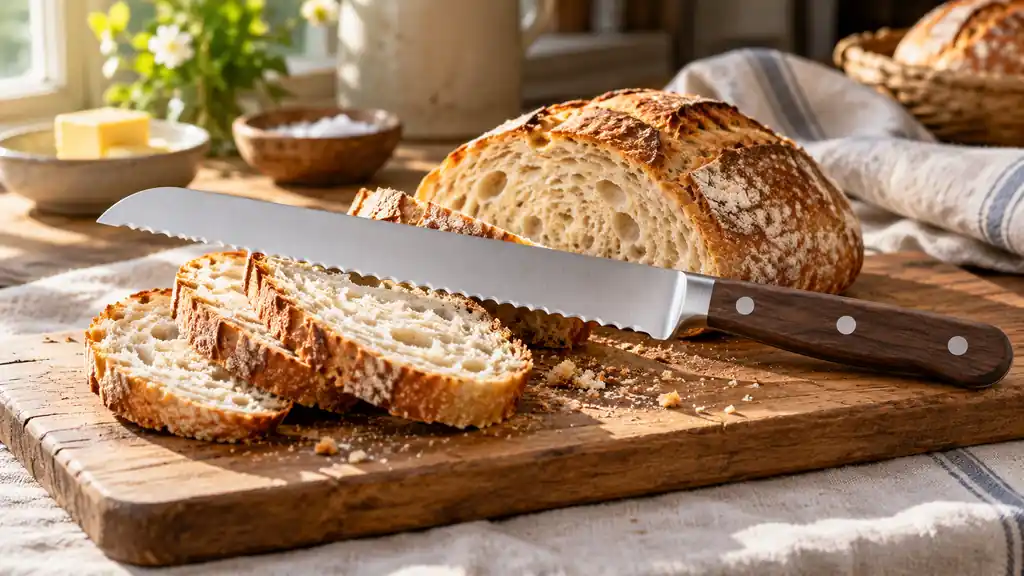
A bread knife earns its place when a crusty boule needs a clean pass, a soft sandwich loaf needs gentle handling, or a layer cake must be divided without turning the crumb into confetti. The right serrated blade bites into the firm exterior while leaving the tender center intact. Many buyers make the mistake of choosing by length alone, overlooking serration shape, handle clearance, cleaning instructions, and whether the edge can be maintained at all.
Blade length matters for large sourdough loaves, while a shorter blade can feel easier to control around small cakes and compact cutting boards. Wavy serrations generally offer a smooth slicing action, while deeper teeth can grip thick crusts more aggressively. Handle construction also changes the experience. Offset designs provide extra knuckle clearance, textured polymer handles can suit damp hands, and wooden handles bring a traditional feel but may require more careful cleaning. Stainless and high-carbon stainless steels also vary in their stated composition and care requirements, so a broad claim about “professional” steel tells you less than a documented specification.
The nine knives below cover different priorities rather than pretending one shape suits every kitchen. The Mercer Culinary Millennia is the strongest overall balance of length, handle design, wavy serration, and everyday practicality. Other picks favor compact loaves, resharpenable edges, large sourdough, premium steel descriptions, or easier storage and handling.
Quick Answer
Mercer Culinary M23210 Millennia is the Best Overall choice for most home kitchens. Its 10-inch wavy edge, one-piece high-carbon Japanese steel construction, textured handle, and tang-supported balance address the central requirements of bread slicing without adding unusual maintenance demands.
Victorinox Fibrox 10.25-Inch Bread Knife is a strong alternative for shoppers who prefer a lightweight stamped blade and a slip-resistant textured handle. Piklohas Resharpenable Bread Knife is the more specialized option for home bakers who value an offset handle and a serrated edge the listing says can be resharpened with a honing rod.
Best Bread Knife Comparison Table
| Product | Best For | Blade Length | Construction |
|---|---|---|---|
| Mercer Culinary M23210 Millennia | Everyday bread and cake slicing | 10 inches | Wavy edge, high-carbon Japanese steel |
| Orblue Serrated Bread Knife | Compact loaves and pastries | 8 inches | One-piece stainless steel |
| HOSHANHO Bread Knife | Documented Japanese high-carbon stainless steel | 10 inches | Serrated edge, listed 15-degree edge |
| imarku Stainless Steel Bread Knife | Lightweight metal-handle design | 10 inches | 2.3 mm blade, stainless handle |
| Piklohas Resharpenable Bread Knife | Home baking and resharpening | 10 inches | Offset handle, hollow edge |
| HENCKELS Forged Premio | Compact forged construction | 8 inches | German stainless steel, full tang |
| Victorinox Fibrox Bread Knife | Lightweight everyday handling | 10.25 inches | Stamped Swiss stainless steel |
| SYOKAMI Offset Bread Knife | Dense sourdough and board clearance | 10.5 inches | Offset handle, resharpenable serrations |
| WICKWILLOW 10-Inch Bread Knife | Large loaves and gift-ready presentation | 10 inches | X50CrMoV15, full tang |
The detailed reviews below look at how each blade length, edge pattern, handle, and maintenance requirement translates to actual bread, cake, and pastry preparation.
1. Mercer Culinary M23210 Millennia – Best Overall
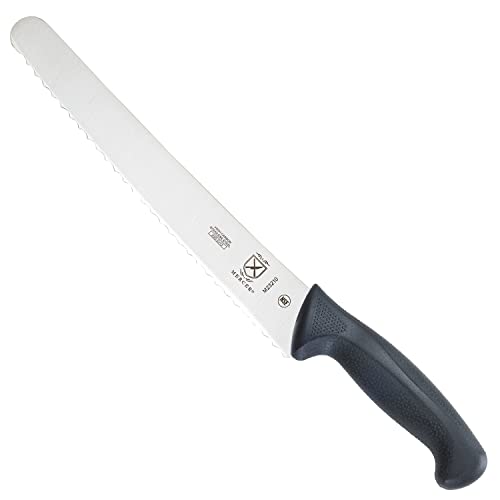
The Mercer Culinary Millennia combines the practical traits most bread knife shoppers need. Its 10-inch blade gives enough reach for a substantial loaf without moving into an awkwardly oversized format. The wide wavy edge is intended to pass through crusts and skins while limiting tearing in softer interiors, which suits sourdough, sandwich bread, tomatoes, fruit, meatloaf, and angel food cake.
The one-piece high-carbon Japanese steel construction keeps the design straightforward, while the tang is listed as a balance-supporting feature. Its black handle includes textured finger points that can provide useful grip feedback during a long slicing motion. This is a hand-wash knife, so it fits buyers willing to rinse, dry, and store it properly rather than treating a bread knife as disposable kitchen hardware.
Pros
- 10-inch blade suits full-size loaves and cakes.
- Wide wavy serration is suitable for crusty exteriors and soft centers.
- One-piece high-carbon Japanese steel construction keeps the design simple.
- Textured finger points offer additional grip guidance.
- Listed tang construction supports balance through the handle.
Cons
- The manufacturer recommends hand washing rather than dishwasher cleaning.
- The long blade may feel oversized for small cutting boards or compact loaves.
This is the broadest match for a household that slices bread several times a week and also wants one serrated knife for cakes, tomatoes, and soft-skinned produce. Buyers seeking dishwasher convenience or a specialized resharpenable serration should look elsewhere, but the Mercer’s combination of reach, grip features, and familiar wavy edge gives it the most convincing all-purpose profile in this group.
To buy this product, click here.
2. Orblue Serrated Bread Knife – Best Compact Option

An 8-inch blade can be a sensible choice for smaller kitchens, short loaves, and bakers who spend as much time slicing bagels and pastries as large boules. The Orblue pairs that compact blade with a five-inch handle, giving the knife a relatively contained footprint in a crowded utensil drawer. Its wavy edge is intended to grip hard crusts while preserving softer interiors.
The one-piece stainless steel construction has no plastic, wood components, or screws listed in the handle assembly. That can simplify cleaning and remove several points where food residue might collect. A rubber guard is included for the sharp tip, which is useful for drawer storage, although the knife still needs a secure location where the serrated edge cannot contact loose utensils.
Pros
- 8-inch blade is manageable for smaller loaves and work areas.
- One-piece stainless steel construction avoids separate handle fasteners.
- Wavy serrations suit bread, bagels, cake, and pastries.
- Rubber tip guard adds a storage option for the pointed end.
- Stainless steel construction is listed as resistant to rust and corrosion.
Cons
- The shorter blade may require repositioning on large boules or long baguettes.
- The available information does not identify a specific stainless steel grade.
Choose the Orblue for a compact kitchen or a bread routine centered on sandwich loaves, bagels, and cakes. Its short reach is a genuine advantage around a small board, yet it becomes a limitation once a loaf is taller or wider than the cutting path. The simple stainless construction also makes it attractive for users who prefer minimal handle upkeep.
To buy this product, click here.
3. HOSHANHO Bread Knife – Best for Documented Edge Geometry

HOSHANHO takes a more specification-focused approach than several knives in this selection. The listing identifies Japanese 10Cr15CoMoV high-carbon stainless steel and describes vacuum heat treatment, giving shoppers more material information than a generic “stainless steel” label. It also lists a 15-degree edge, although that figure should be read as a stated specification rather than independent proof of cutting performance.
The 10-inch serrated blade is aimed at homemade bread, baguettes, cakes, pastries, and bagels. That length gives a home baker enough span for a broad loaf while retaining a conventional bread-knife format. The ergonomic handle is described as supporting stability, but detailed handle dimensions and weight are not supplied, so shoppers with specific grip requirements should avoid assuming the shape suits every hand.
Pros
- 10Cr15CoMoV high-carbon stainless steel is specifically identified.
- 10-inch blade covers large loaves, cakes, and baguettes.
- Listed 15-degree edge specification adds useful technical detail.
- Suitable stated applications include bread, pastries, bagels, and cake.
- High-carbon stainless construction is described as corrosion resistant.
Cons
- Detailed handle dimensions and knife weight are not provided.
- The stated edge angle does not explain the serration maintenance method.
This knife suits buyers who want a modern serrated bread knife with a named steel and a stated edge specification. It is a more technical choice on paper than the Orblue, but the missing weight and handle measurements leave some ergonomic questions unanswered. For a baker focused on loaf length and material documentation, it is a credible alternative to the overall pick.
To buy this product, click here.
4. imarku Stainless Steel Bread Knife – Best Lightweight Metal-Handle Design

This imarku model stands out for the amount of construction information supplied with the listing. The blade is described as high-carbon stainless steel with 0.26% to 0.35% carbon and 12% to 14% chromium, heat treated to a stated HRC 53±1. Its 2.3 mm thickness gives shoppers a clearer sense of the blade format than a title alone would provide, while the 210-gram listed weight suggests a comparatively manageable long knife.
The stainless steel handle uses an anti-slip texture and is listed at 1.2 mm thickness. A single-bevel design is also mentioned, along with a 1-centimeter tip, so this is not simply an anonymous wavy blade. The laser-etched finish is described as helping reduce sticking. The knife is marketed for bread, cake, steaks, and fruit, although buyers should treat those broader applications as secondary to its central bread-slicing purpose.
Pros
- Blade carbon and chromium ranges are stated in the product information.
- Listed 2.3 mm blade thickness gives useful construction context.
- 210-gram weight is supplied for shoppers comparing handling.
- Textured stainless steel handle resists moisture-related surface concerns.
- 10-inch serrated blade suits large loaves and cakes.
Cons
- The single-bevel description may require more attention during sharpening.
- Metal handle construction may feel less familiar than polymer or wood.
Pick this imarku when documented dimensions and a metal handle matter more than traditional styling. The listed weight helps narrow the handling question, while the single-bevel detail deserves attention from anyone planning long-term edge care. It is a useful middle ground for bakers who want a substantial 10-inch knife without an especially elaborate handle system.
To buy this product, click here.
5. Piklohas Resharpenable Bread Knife – Best for Serration Maintenance

Most serrated bread knives are bought with the assumption that edge maintenance will eventually be difficult. Piklohas addresses that concern directly by stating that its serrated edge can be resharpened with a regular honing rod. That feature is the reason to select it, not its gift box or broad food list. Buyers should still verify that their existing rod fits the serration shape and use a method appropriate for the specific edge.
The 10-inch blade is paired with an offset handle that raises the hand above the board. That extra clearance can be useful during repeated slicing, especially when a loaf is tall or the cutting board is thick. Grooves on both sides of the blade are intended to reduce sticking with moist bread and fruit. The knife is aimed at sourdough, baguettes, sandwich bread, bagels, pineapple, and tomatoes.
Pros
- Listing states that the serrated edge can be resharpened with a honing rod.
- Offset handle increases clearance between knuckles and cutting board.
- 10-inch blade is appropriate for substantial loaves.
- Double-sided grooves are intended to reduce sticking.
- Food range includes bread, bagels, fruit, and tomatoes.
Cons
- Resharpening requires a compatible honing rod and suitable technique.
- Offset construction may feel less familiar than a conventional straight handle.
This is the pick for a baker who thinks beyond the first year of ownership. The resharpening claim gives the knife a maintenance path that many serrated models lack, while the offset handle helps during repeated board-level cuts. Skip it if you have no interest in maintaining serrations or prefer a compact, conventional profile.
To buy this product, click here.
6. HENCKELS Forged Premio 8-Inch Bread Knife – Best Compact Forged Construction

The HENCKELS Forged Premio offers a shorter bread-knife format with a forged bolster, full tang, and triple-riveted handle. Those construction details give it a more substantial Western-style profile than a simple one-piece stamped blade. The 8-inch length is convenient for smaller loaves, cakes, and kitchens where a 10-inch blade would spend much of its time crowding the board.
Its satin-finished blade is described as finely honed, and the German stainless steel construction is identified without a specific alloy designation. The curved handle and end cap add traditional knife-set styling. The listing also identifies the knife as dishwasher safe, a rare convenience in this group, although hand washing can still be a gentler approach for long-term appearance and edge care.
Pros
- 8-inch blade works well in compact preparation spaces.
- Forged bolster and full tang provide substantial construction details.
- Triple-riveted curved handle follows a familiar Western knife format.
- German stainless steel is identified as the blade material.
- Listing states that the knife is dishwasher safe.
Cons
- Shorter blade may be limiting for wide sourdough loaves.
- The specific German stainless steel grade is not provided.
The Forged Premio makes sense for a shopper who values traditional construction and a shorter blade over maximum reach. It is less suited to tall boules and long baguettes, where an extra two inches can reduce repositioning. Its dishwasher-safe listing adds convenience, while the unspecified steel grade leaves less material information than some newer competitors provide.
To buy this product, click here.
7. Victorinox Fibrox 10.25-Inch Bread Knife – Best Lightweight Everyday Option

Victorinox uses a 10.25-inch stamped Swiss stainless steel blade with a bolsterless edge. That construction allows the cutting edge to run through the available blade area, and the listing describes the blade as ice-tempered, high-carbon stainless steel. The length is a useful fit for large loaves, while the lightweight format is aimed at easy handling rather than a heavy forged feel.
The Fibrox-style handle is textured and slip resistant, including in wet conditions according to the product information. A home baker moving between flour, dough, and a damp sink may appreciate that surface treatment. Hand washing is recommended, and the listing states a lifetime guarantee against defects in material and workmanship. The bolsterless profile may also appeal to shoppers who prefer a less bulky transition near the handle.
Pros
- 10.25-inch blade reaches across large loaves and cakes.
- Stamped construction supports a lightweight handling profile.
- Textured Fibrox handle is intended to resist slipping when wet.
- Bolsterless edge allows use of the available cutting edge.
- Swiss manufacture and a stated lifetime defect guarantee are listed.
Cons
- Hand washing is recommended despite the stainless steel construction.
- Stamped construction may feel less substantial to shoppers who prefer forged knives.
This Victorinox is a strong choice for daily slicing where low hand fatigue and predictable grip matter. It is especially appealing for a baker who wants a long blade without a heavy forged bolster. A shopper looking for an explicitly resharpenable serrated edge or a named steel grade will find less information here, but the practical handle and blade format remain persuasive.
To buy this product, click here.
8. SYOKAMI Offset Bread Knife – Best for Board Clearance

SYOKAMI targets a specific frustration: cutting a tall loaf while keeping the hand clear of the board. Its raised offset handle lifts the grip, and the listing adds a front finger rest for control. That arrangement may be useful for repeated sourdough slicing, although the extra elevation can take a short adjustment period for anyone accustomed to a straight-handled knife.
The 10.5-inch blade gives broad coverage, and the product information states that each serration is intended to contact the board during a one-stroke cut. The serration spacing is listed as 10.5 mm and described as compatible with standard honing rods, giving this knife a defined maintenance route. A dimpled surface is intended to reduce sticking, while the full-tang, triple-riveted construction and wenge wood handle add substantial handle detail.
Pros
- Raised offset handle provides additional board and knuckle clearance.
- 10.5-inch blade suits dense sourdough and large loaves.
- Listing states that the serrations can be resharpened with a standard honing rod.
- Full tang and triple rivets are specified.
- Dimpled blade surface is intended to reduce food sticking.
Cons
- Offset geometry may require adjustment for users accustomed to straight handles.
- Wood handle care can require more attention than a molded polymer handle.
Choose SYOKAMI if hand clearance and long-term serration maintenance sit near the top of your list. It is a more specialized tool than the Mercer, with a raised handle and distinctive maintenance specification. Buyers who mainly slice small sandwich bread may find the 10.5-inch reach and offset profile unnecessary, while sourdough bakers could appreciate the extra clearance.
To buy this product, click here.
9. WICKWILLOW 10-Inch Bread Knife – Best for Named Steel Specification

WICKWILLOW is one of the few candidates here with a specific alloy designation and hardness range. The listing identifies German X50CrMoV15 stainless steel hardened to 56 to 58 HRC. That information helps buyers understand the stated construction, but it does not independently establish edge life or cutting quality. The knife uses rounded wavy serrations intended for sourdough, baguettes, ciabatta, sandwich loaves, pastries, and cakes.
The 10-inch blade is paired with a full tang and ABS handle. Full-tang construction extends the blade steel through the handle, while the polymer handle avoids the moisture concerns associated with untreated natural wood. The knife arrives in a gift box, which may appeal to shoppers buying for a home baker, but the practical decision remains the combination of blade length, serration pattern, and documented steel.
Pros
- X50CrMoV15 steel and a stated 56 to 58 HRC range are identified.
- Rounded wavy serrations are intended for crusty and soft loaves.
- 10-inch blade suits baguettes, boules, cakes, and pastries.
- Full-tang construction is specified.
- ABS handle avoids the maintenance concerns of natural wood.
Cons
- The listed hardness range does not establish measured edge retention.
- The product information does not describe a serration sharpening method.
This WICKWILLOW model is a good fit for shoppers who want a named German stainless steel and a conventional 10-inch format. Its ABS handle keeps care straightforward, while the lack of a stated sharpening system may matter to owners planning long-term maintenance. It is a polished alternative for large loaves and gifting, with less specialized ergonomics than the offset models.
To buy this product, click here.
Buying Guide
Match Blade Length to the Loaves You Actually Slice
A blade around 10 inches is a practical starting point for large sandwich loaves, baguettes, and sourdough boules because it can cross more of the loaf in one continuous motion. Shorter 8-inch knives such as the Orblue and HENCKELS can be easier to control around small cakes and narrow boards. A long blade is useful only if the cutting surface gives you room to guide it safely.
Look at Serration Shape, Not Only the Word “Serrated”
Serrated knives vary in tooth depth, spacing, and profile. Wavy edges are commonly intended to grip a crust while limiting tearing through soft bread. Wider or deeper teeth may feel more aggressive on thick crusts, while rounded waves can suit cakes and tender crumb. Product descriptions rarely provide enough detail for a precise performance prediction, so focus on the stated food applications and edge-maintenance information.
Maintenance depends on the tooth pattern. Follow the compatibility checks for sharpening serrated knives rather than using an unapproved plain-edge slot.
Give Handle Clearance a Practical Test
A straight handle works for many kitchens, but an offset design raises the hand above the board and can reduce contact between knuckles and the cutting surface. Piklohas and SYOKAMI use this approach. The trade-off is familiarity. A raised handle changes the angle of the hand and may feel unusual during the first few slices. Textured polymer handles generally require less care than natural wood, while metal handles offer a different grip surface altogether.
Read Steel Claims With Precision
Named alloys such as 10Cr15CoMoV, X50CrMoV15, and 5Cr15MoV provide more information than broad phrases such as “premium stainless steel.” Hardness figures can describe a stated material property, but they do not prove that one knife will keep cutting better than another. Serrated edges also have different maintenance needs from plain edges, so a documented sharpening route may matter more than a general claim about sharpness.
Plan for Cleaning and Storage
Several knives in this guide recommend hand washing, and drying after cleaning helps limit moisture exposure around the blade and handle. HENCKELS is listed as dishwasher safe, but buyers who want to preserve the appearance of a forged knife may still prefer gentler cleaning. A serrated edge should have protected storage, especially if the knife will sit in a drawer. A tip guard protects the point, but it does not make loose drawer storage automatically safe.
Decide Whether Resharpening Matters
Traditional serrated knives can be difficult to maintain because each tooth has a separate cutting surface. Piklohas and SYOKAMI specifically describe resharpening with a honing rod, while the other listings do not provide an equivalent method. Check the rod diameter and technique before assuming compatibility. If you prefer to replace a bread knife after the edge declines, a conventional model may be simpler than learning serration maintenance.
Best Bread Knife FAQ
What blade length is best for bread?
A 10-inch blade is a versatile choice for full-size sandwich bread, sourdough, baguettes, and cakes. An 8-inch blade can be easier to manage in a compact kitchen or with smaller loaves. The ideal length depends on the loaf width and the available cutting-board space.
Blade reach and technique work together. The method for slicing sourdough without compressing the crumb explains how to support a crusty loaf and let the serrations work.
Are wavy serrations better than pointed teeth?
Neither pattern is universally superior. Wavy serrations are often selected for a smoother slicing action across crust and crumb, while pointed teeth can provide a more aggressive grip. The product’s tooth spacing, blade thickness, and handle control also affect how suitable it is for a particular loaf.
Can a bread knife cut cake?
Yes. A serrated bread knife can divide sponge cake, angel food cake, and other soft baked goods when used with a controlled sawing motion. A long blade helps create an even path across a wide cake, while a clean, dry edge helps limit crumbs and sticking.
Can bread knives be sharpened?
Some can, but the method depends on the serration design. Piklohas and SYOKAMI state that their serrations can be resharpened with a honing rod. For other knives, the available product information does not specify a sharpening method. A standard flat sharpener is generally not a direct substitute for a tool that reaches the individual serrations.
Is a full tang important in a bread knife?
Full tang construction means the blade steel extends through the handle. It can contribute to a solid handle assembly, but it does not automatically make a bread knife sharper or more comfortable. Blade length, serration pattern, handle shape, and maintenance remain central to the purchase decision.
Should a bread knife go in the dishwasher?
Follow the product’s stated care instructions. HENCKELS lists its Forged Premio as dishwasher safe, while Mercer and Victorinox recommend hand washing. Hand washing and thorough drying are generally the safer routine for preserving the finish and handle over time, especially when the listing gives that instruction.
Final Verdict
The Mercer Culinary M23210 Millennia is the Best Overall bread knife because it brings together a useful 10-inch reach, a wavy edge suited to crust and crumb, one-piece construction, a textured handle, and listed balance support. It is a sensible fit for a household that slices bread, cake, tomatoes, and other soft-centered foods without wanting a highly specialized maintenance routine.
Victorinox is the better alternative for shoppers who prioritize a lightweight stamped blade and a textured slip-resistant handle. Piklohas and SYOKAMI deserve attention from bakers who specifically want offset clearance and a stated serration-resharpening path. HENCKELS is the compact forged choice, while WICKWILLOW and HOSHANHO provide more detailed steel specifications. Match the blade length to your loaves, check the handle against your cutting space, and treat maintenance instructions as part of the purchase rather than an afterthought.
