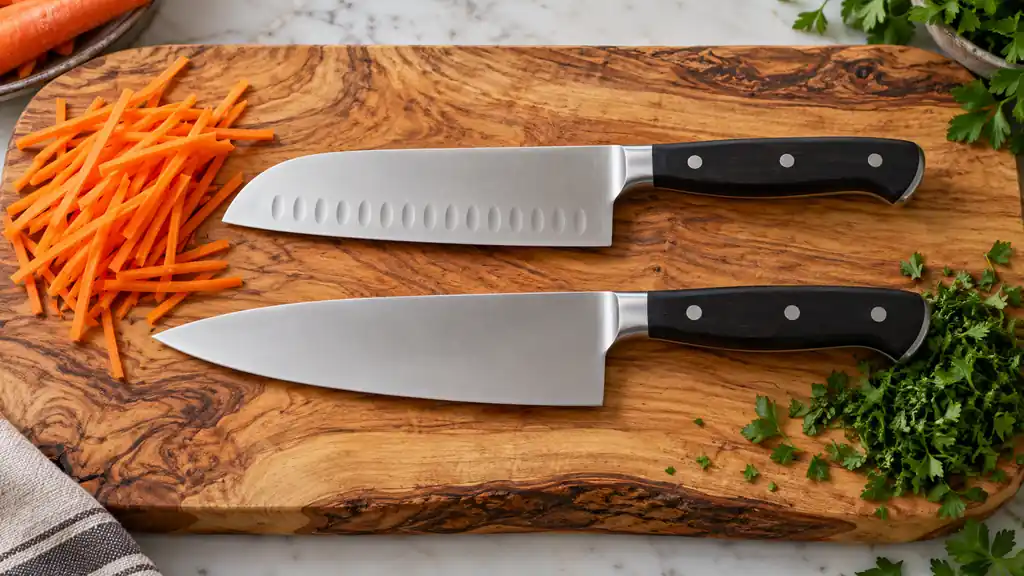
A santoku and a chef’s knife can handle many of the same everyday jobs, but their blade shapes favor different cutting motions. A santoku usually has a shorter blade, a relatively flat edge, and a rounded or downward-sloping tip. A Western-style chef’s knife is generally longer, has more curve along the cutting edge, and ends in a pointed tip.
Choose a santoku if you prefer compact handling and straight downward, push-cutting, or short slicing motions. Choose a chef’s knife if you want extra blade length, a useful point, and enough edge curvature for rocking cuts. Neither style is universally better, and individual models can depart from these general patterns.
Prefer the shorter, flatter profile described here? The santoku comparison brings together models with different lengths and handle designs; the cutting motion still matters more than the category name.
Santoku vs. Chef’s Knife at a Glance
| Feature | Santoku | Chef’s Knife |
|---|---|---|
| Common blade length | Approximately 5 to 7 inches | Approximately 8 to 10 inches |
| Edge profile | Relatively flat, sometimes with a gentle curve | More pronounced belly curvature |
| Tip | Rounded or downward-sloping spine with a less prominent point | Distinct pointed tip |
| Favored cutting motions | Push cutting, chopping, and short slices | Rocking, slicing, push cutting, and chopping |
| Board space | Works well in compact preparation areas | Benefits from a larger cutting board |
| Typical strengths | Vegetables, herbs, boneless meat, and portioning | Large ingredients, long slices, mincing, and detailed tip work |
| Potential limitation | Less reach and reduced tip utility | May feel large or cumbersome to some users |
These are category-level tendencies rather than fixed specifications. Blade length, thickness, weight, steel, edge geometry, and handle construction vary among manufacturers and individual models.
How Blade Shape Changes the Cutting Motion
A Santoku Favors Flatter Board Contact
The edge of a santoku is commonly flatter through the heel and center than the edge of a Western chef’s knife. This profile suits cuts in which the blade travels forward and down, or rises and falls with limited rocking.
That motion works well for tasks such as:
- Chopping onions and other medium-size vegetables
- Push cutting carrots, zucchini, and similar produce
- Slicing boneless meat into portions
- Cutting fish fillets into smaller pieces
- Making short, controlled cuts through herbs
A flatter profile can place more of the edge against the board at once. Technique still matters. If the blade is lifted insufficiently or the edge has developed low and high spots through uneven sharpening, thin vegetable pieces may remain attached at the bottom.
A Chef’s Knife Supports Rocking and Longer Strokes
A chef’s knife usually has more curvature toward the front of the edge. This curved section, often called the belly, lets the user keep part of the blade near the board while raising and lowering the handle. The resulting rocking action is useful for mincing herbs, garlic, and other small ingredients.
For the curved general-purpose option, compare chef’s knives for everyday cooking by length and handle layout as well as profile.
The longer blade also provides greater reach for slicing large produce, portioning sizeable cuts of boneless meat, and moving through an ingredient with fewer strokes. A chef’s knife can still make straight chopping and push cuts. Its curved profile simply gives it a wider range of comfortable motions.
Some chef’s knives have moderate curvature rather than a dramatic belly. Likewise, some santoku knives have enough curve for a limited rocking stroke. The actual edge profile matters more than the category name alone.
The Tip Makes a Practical Difference
The pointed tip of a chef’s knife helps with detailed work. It can trim connective tissue, open peppers, score ingredients, make small incisions, and guide precise slices. Its length also makes the front section useful for draw cuts through meat or produce.
A santoku usually has a spine that slopes down toward the cutting edge, creating a shape sometimes described as a sheep’s-foot profile. The resulting tip is still sharp, but it is less prominent and may provide less clearance for fine point work. This design keeps the overall blade compact and places much of the usable edge close to the board.
Neither tip should be twisted, pried sideways, or used to open packaging. Fine knife tips can bend or chip under lateral force, depending on their geometry and material.
Size, Weight, and Board Clearance
Shorter santoku blades can feel easier to maneuver in a small kitchen or on a compact cutting board. Their broad blade faces also provide useful knuckle clearance and can help guide food during a cut. Blade height varies, so a santoku label does not guarantee generous clearance for every hand or grip.
Compact handling is not determined by the name alone. The guide to choosing a chef’s-knife size explains how board space, reach, and grip interact.
A chef’s knife provides more cutting length, which can be helpful with cabbage, squash, melons, large onions, and long cuts of meat. The trade-off is a larger turning radius and a need for more board space. An extra-long blade can feel unwieldy to someone accustomed to short utility knives.
Weight cannot be predicted reliably from style alone. A santoku may be thin and light, or it may have substantial blade and handle construction. A chef’s knife may be heavy with a full bolster, or light with a thin blade and minimal bolster. Comfort depends on the complete knife, including handle shape, balance, blade height, and the user’s grip.
Which Knife Is Better for Common Kitchen Tasks?
Vegetables
Both styles are capable vegetable knives. A santoku’s compact size and flatter edge are well suited to repetitive push cuts and chopping. A chef’s knife offers more reach for large vegetables and more curvature for rocking through herbs.
Neither should be confused with a nakiri, a rectangular Japanese-style vegetable knife with no pointed working tip. A santoku remains a multipurpose knife rather than a dedicated vegetable pattern.
Meat and Poultry
Either knife can slice and portion boneless meat. The chef’s knife has an advantage where long slicing strokes or point work are helpful. A santoku can offer excellent control for trimming and portioning smaller boneless pieces, though its tip is less suited to intricate work.
These general-purpose knives are not substitutes for a meat cleaver or other blade approved for hard bones. Cutting through hard bone or frozen food can damage a thin edge. Poultry joints should be separated through the joint rather than struck through bone with an ordinary santoku or chef’s knife.
Fish
A santoku can portion fillets and perform routine fish preparation. A chef’s knife can do the same and offers a longer stroke on larger fillets. Neither has the narrow flexibility of many fillet knives, and neither duplicates the specialized geometry of traditional Japanese fish knives.
Herbs and Garlic
A chef’s knife works especially well for rocking over a pile of herbs. A santoku can chop or push cut herbs effectively, but trying to force a highly curved rocking motion with a flat edge may feel awkward. For garlic and small aromatics, either blade provides ample control with appropriate technique.
For a recurring herb task, mincing methods using knives, scissors, and mezzalunas help separate cutting motion from tool labels.
Steel and Edge Construction Depend on the Model
The terms santoku and chef’s knife describe blade styles, not a specific steel or level of hardness. Either type may use carbon steel, stainless steel, high-carbon stainless steel, laminated construction, or other established knife materials.
Geographic and stylistic labels also do not establish manufacturing origin. A Japanese-style santoku may be produced in many countries, while Western-style chef’s knives are made by manufacturers around the globe.
Most general-purpose santoku and chef’s knives have double-bevel edges, meaning the edge is ground from both sides. Bevel symmetry, edge thickness, and sharpening angle can still vary. A Japanese-style appearance does not indicate that a santoku has a traditional single-bevel edge.
Some santoku blades have hollowed scallops along their faces, often called a granton-style or hollow-edge treatment. These recesses may reduce contact between some foods and the blade face, but they do not guarantee clean food release. Blade finish, surface area, cutting technique, and the ingredient itself also affect sticking.
Sharpening and Maintenance
Sharpening requirements follow the knife’s actual edge construction rather than its category. Use the manufacturer’s documented angle when available. If that information is unavailable, preserve the existing bevel as consistently as possible instead of assigning an angle based solely on whether the knife is a santoku or chef’s knife.
Sharpening removes material to restore the cutting edge. Honing has a broader meaning that depends on the tool. A traditional steel may maintain an edge with limited abrasion, while ceramic and diamond rods can remove material. None of these tools should be assumed compatible with every knife.
A flatter santoku edge requires attention during sharpening. Uneven pressure can create a recurve or leave sections that no longer contact the cutting board. A curved chef’s knife requires the sharpening stroke to follow the belly toward the tip without rounding it excessively.
Care practices for either style include:
- Wash the knife by hand with mild dish soap and a nonabrasive sponge.
- Dry the blade promptly, especially if it contains corrosion-prone steel.
- Use wood, suitable plastic, or another knife-friendly cutting surface.
- Avoid glass, stone, ceramic plates, and other hard cutting surfaces.
- Store the edge so it cannot strike utensils or contact hands accidentally.
- Follow material-specific care instructions for the blade and handle.
Stainless steel resists corrosion better than many non-stainless steels, but it is not immune to corrosion. Moisture, salt, acidic residue, and prolonged neglect can still cause staining or damage.
How to Choose Between a Santoku and a Chef’s Knife
Your preferred cutting motion offers the clearest starting point.
A gyuto also fills a general chef’s-knife role, with model-specific differences in profile and construction. These gyuto knives provide a separate product comparison.
- Choose a santoku if you favor push cuts, straight chopping, compact blade control, and a relatively flat edge.
- Choose a chef’s knife if you use rocking cuts, prepare large ingredients, want longer slicing strokes, or frequently rely on the tip.
- Compare individual models if handle comfort, weight, blade height, or balance matters more than the profile category.
Hand size alone does not dictate the answer. A smaller hand may still control a long knife comfortably, while a user with a large hand may prefer a short, tall santoku. The available cutting-board space and the size of ingredients prepared regularly can be more informative.
Blade clearance also deserves attention. With the knife held in a normal working grip, the fingers should have adequate room above the board. Handle shape and blade height influence this clearance, so two knives of the same nominal length can feel quite different.
Can One Replace the Other?
For routine home preparation, either knife can serve as the primary general-purpose blade. Both can prepare vegetables, slice boneless meat, cut fish, and handle herbs. Skill and familiarity often matter more than the label on the blade.
The differences become more noticeable at the edges of their capabilities. A short santoku has less reach for large ingredients and less point utility for precise trimming. A chef’s knife requires more space and may feel cumbersome during small, repetitive cuts. Cooks who use both often select between them according to the ingredient and preferred motion rather than treating one as superior.
Frequently Asked Questions
Is a Santoku Sharper Than a Chef’s Knife?
Knife style does not determine sharpness. Sharpness depends on edge geometry, sharpening quality, steel condition, and maintenance. A santoku can have a thinner cutting geometry than a particular chef’s knife, but that comparison cannot be extended to every model.
Can You Rock Chop With a Santoku?
A santoku with some edge curvature can make a limited rocking cut. Models with very flat profiles are better suited to push cutting and chopping. Forcing a large rocking motion may leave part of the edge above the board and produce incomplete cuts.
Is a Santoku Suitable for Cutting Meat?
Yes, a santoku can slice and portion boneless meat. It should not be used as a bone cleaver unless the manufacturer specifically identifies that capability. A chef’s knife generally provides more blade length and a more useful point for trimming.
Do You Need Both Knives?
No. Either style can cover most everyday preparation. Owning both can be useful if you regularly switch between compact push cutting and long, curved slicing or rocking motions, but it is not a requirement for a functional kitchen.
The Practical Difference
A santoku emphasizes compact control, a flatter cutting edge, and push-oriented motions. A chef’s knife provides greater reach, more belly curvature, and a prominent point. Select according to how you cut, the ingredients you prepare, and how the individual knife fits your hand. Steel, sharpness, durability, and comfort must be assessed from the specific knife rather than inferred from its category.
