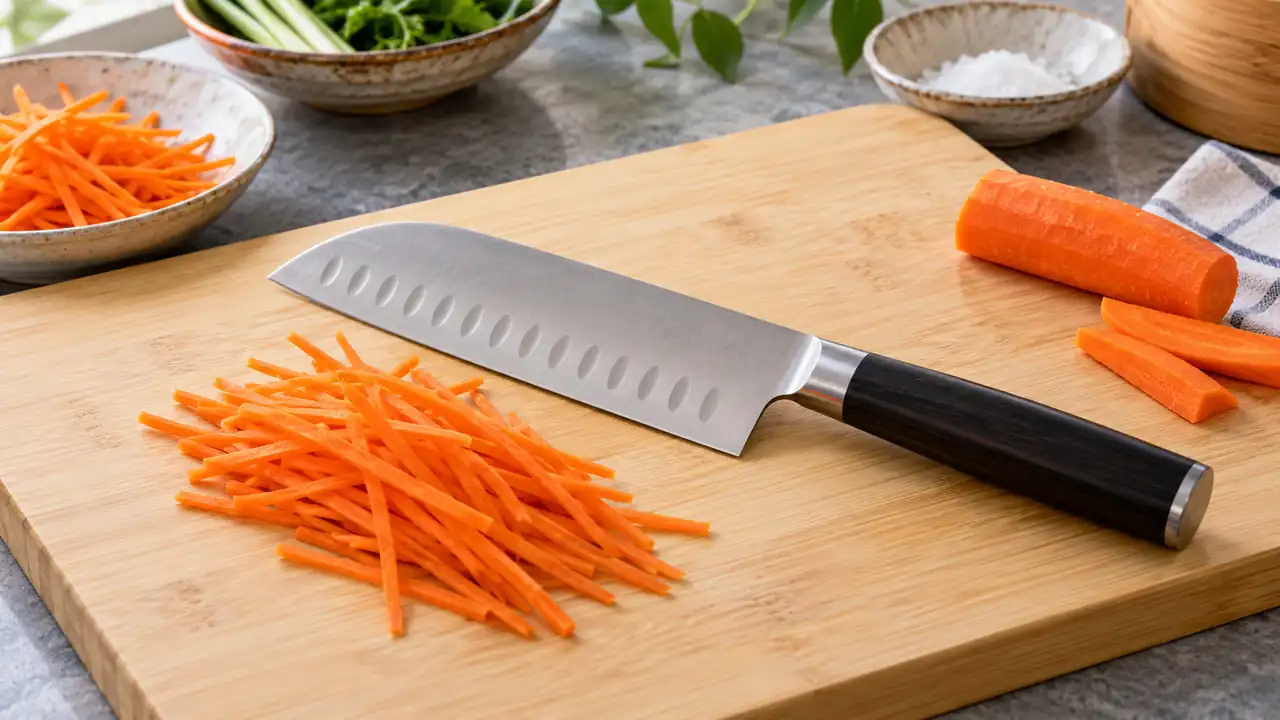
A santoku earns its place on a kitchen counter through a combination of a relatively compact blade, a tall cutting face, and an edge suited to slicing, chopping, and dicing. That shape is especially handy during the familiar dinner rush, when onions, carrots, herbs, boneless meat, and fruit all need attention on the same board. Buyers often make the mistake of choosing by appearance alone, assuming a Damascus pattern, a very sharp advertised angle, or a Japanese-sounding name guarantees the right knife for their habits.
The more useful questions involve blade length, edge design, steel information, handle construction, and care requirements. A 7-inch santoku gives plenty of room for everyday prep, while a 5-inch model can feel less cumbersome in a small kitchen or for smaller ingredients. Some knives in this group are made for careful hand washing, while others offer dishwasher compatibility. Different cooks also prioritize different traits. A home cook may value easy maintenance, while someone who slices vegetables paper-thin may prefer a thinner Japanese-made blade with a more specialized edge.
This comparison focuses on genuine santoku knives and weighs their documented construction against their intended kitchen role. The selection includes Japanese-made options, Western-style designs, compact knives, low-maintenance choices, and models with food-release features. Each review explains the practical trade-offs so you can choose a knife that fits your cutting board, grip, and maintenance routine.
Quick Answer
Shun Premier 7-inch Santoku is the strongest overall choice for shoppers seeking a Japanese-made knife with a VG-MAX core, hammered finish, 68 layers of Damascus cladding, and a contoured pakkawood handle. The MAC Professional 6.5-inch Santoku is a compelling alternative for cooks who want a slightly shorter made-in-Japan blade with dimples and a 2.5 mm construction. For simpler maintenance, the Victorinox Swiss Classic 7-inch Santoku stands apart with a lightweight design and listed dishwasher-safe construction.
Best Santoku Knife Comparison Table
| Product | Best For | Blade Length | Blade Design | Steel Information |
|---|---|---|---|---|
| Shun Premier Santoku | Japanese craftsmanship | 7 inches | Hammered finish | VG-MAX core |
| MAC Professional Santoku | Precision prep | 6.5 inches | Dimples | Sub-zero tempered steel |
| Wüsthof Classic Santoku | Western-style stability | 7 inches | Hollow edge | High-carbon stainless steel |
| HOSHANHO Japanese Santoku | Documented hardness | 7 inches | Double-side grooves | 10Cr15CoMoV, listed 62 HRC |
| HOSHANHO Damascus Santoku | Decorative layered construction | 7 inches | Grooved Damascus-style finish | 10Cr15CoMoV core, listed 62 HRC |
| Victorinox Swiss Classic Santoku | Easy care | 7 inches | Granton blade | Stainless steel |
| imarku Seamless Steel Santoku | Low-maintenance storage | 7 inches | Hollow edge | High-carbon stainless steel |
| Mercer Genesis Santoku | Forged German-style design | 7 inches | Taper-ground edge | High-carbon German steel |
| Wüsthof Gourmet Santoku | Compact prep | 5 inches | Hollow edge | High-carbon stainless steel |
The detailed reviews below look at how each blade shape, handle, steel description, and care requirement translates to everyday food preparation.
1. Shun Premier 7-inch Santoku Knife : Best Overall

The Shun Premier brings together the features that make a santoku appealing for detailed everyday prep. Its 7-inch blade is long enough for cabbage, larger onions, and boneless proteins without becoming as unwieldy as a longer chef’s knife. The listing identifies a VG-MAX core, 68 layers of Damascus cladding, and a 16-degree edge. Those details describe a purpose-built Japanese knife rather than a generic short chef’s knife, although they do not independently prove edge retention or cutting performance.
Its hammered tsuchime finish is intended to reduce drag and help food release from the blade, a useful detail when thin cucumber slices or sticky potato pieces gather around the cutting area. The contoured pakkawood handle is specified for both left- and right-handed users. Handcrafted construction and included free sharpening and honing support add appeal for owners who plan to keep one principal santoku for years. The trade-off is a hand-wash routine and a more specialized investment than simpler stainless models.
Pros
- VG-MAX core is specifically identified in the supplied product information.
- Seven-inch blade suits broad everyday slicing and chopping tasks.
- Hammered finish is intended to reduce drag and food sticking.
- Contoured pakkawood handle is described as suitable for both hands.
- Free sharpening and honing support is listed for the knife.
Cons
- Hand washing is required for proper care.
- The listing does not provide weight or detailed blade-thickness information.
This is the strongest fit for a cook who wants Japanese-made craftsmanship, a useful all-purpose length, and documented construction details in one knife. A dishwasher-dependent household may find the care routine inconvenient, while someone who mainly chops small herbs may prefer a shorter blade. For careful vegetable prep, boneless proteins, and regular slicing, the Shun has the most complete feature match in this group.
To buy this product, click here.
2. MAC Professional Series 6.5-inch Santoku : Best for Precision Prep
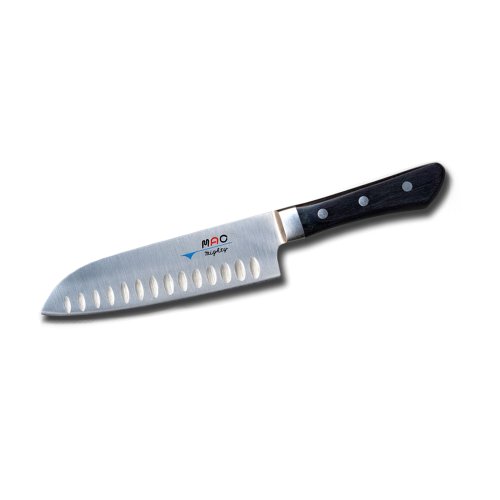
The MAC MSK-65 takes a slightly more compact approach than the 7-inch knives surrounding it. A 6.5-inch blade can be a welcome middle ground for cooks who want a real santoku profile without the extra reach of a full-size model. The supplied information lists a 2.5 mm blade and dimples along the blade. Those dimples are intended to reduce contact between food and steel, which can help during repeated slices of potatoes, zucchini, or soft proteins.
Made in Japan and fitted with sub-zero tempered steel, the MAC has a clear identity for shoppers who value Japanese production and a focused blade design. The available data describes a sharp edge, but it does not state a precise steel alloy, hardness value, handle material, or weight. That limits the amount that can be inferred about sharpening behavior or long-term edge retention. Hand washing is recommended, so this knife belongs beside a cook who is comfortable drying a blade after prep rather than leaving it in the dishwasher.
Pros
- Compact 6.5-inch santoku length supports controlled everyday prep.
- Made in Japan is explicitly listed.
- Dimples are intended to reduce food contact and sticking.
- 2.5 mm blade construction is documented.
- Sub-zero tempered steel is identified in the product information.
Cons
- Hand washing is recommended instead of dishwasher cleaning.
- The available information does not identify the exact steel alloy or handle material.
The MAC is a sensible choice for cooks who value a nimble length and a restrained design over decorative cladding. It may suit a smaller prep area better than a broad 7-inch blade, yet it still has enough working surface for routine vegetables and boneless meat. Shoppers wanting a clearly identified alloy, a dishwasher-safe construction, or a larger handle specification will find more useful information elsewhere.
To buy this product, click here.
3. Wüsthof Classic 7-inch Santoku Knife : Best Western-Style Design
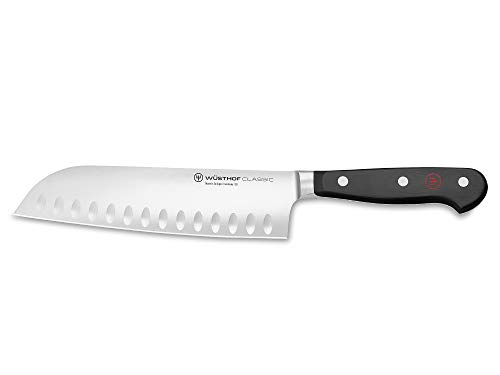
Wüsthof’s Classic Santoku is a useful choice for someone who likes the shorter, straighter cutting profile of a santoku but prefers the construction associated with a Western knife. The 7-inch blade is forged from a single piece of stainless steel, and the product information specifies a full tang, full bolster, and triple-riveted handle. That combination gives shoppers a familiar, substantial build for chopping vegetables, slicing meat, and preparing ingredients across a busy counter.
The blade is described as high-carbon stainless steel and the knife is made in Germany. A full bolster can add a pronounced transition near the handle, which some cooks appreciate for a secure grip and hand protection, while others prefer a more open heel for sharpening access. Wüsthof lists the knife as hand wash only. The available details do not state a precise alloy, edge angle, blade thickness, or weight, so its likely handling should be judged from the construction rather than assumed measurements.
Pros
- Seven-inch blade provides a practical santoku working length.
- Forged one-piece construction is documented.
- Full tang and full bolster offer a substantial Western-style build.
- Triple-riveted handle is specified for the Classic series.
- German manufacture and high-carbon stainless steel are listed.
Cons
- Hand washing is required.
- The full bolster may be less convenient for cooks who prefer unobstructed heel sharpening.
This model makes sense for a cook moving from a traditional chef’s knife toward a santoku without wanting an especially light or delicate feel. It is a particularly natural fit for chopping onions, mincing herbs, and slicing boneless meat with a stable grip. Those seeking a thinner Japanese-style blade or a lighter handle profile may prefer the MAC or Shun instead.
To buy this product, click here.
4. HOSHANHO 7-inch Japanese Santoku Knife : Best for Documented Hardness

HOSHANHO’s 7-inch santoku stands out because the listing provides more technical detail than many knives in this category. It identifies triple-layer laminated 10Cr15CoMoV steel and lists a hardness of 62 HRC. It also specifies a hand-sharpened 15-degree edge and double-side grooves. Those features give shoppers a clearer basis for comparison, although a listed hardness figure should not be treated as a complete prediction of toughness, edge life, or sharpening ease.
The African pakkawood handle is described as ergonomic and resistant to cracking from thermal expansion. In a kitchen where the knife moves from chopping cabbage to slicing fruit, the double-side grooves are intended to reduce resistance and food sticking. The product is presented for home and professional use, but the available information does not provide the exact weight, blade thickness, or country of manufacture. Hand washing and careful drying remain sensible habits for a knife with a wood-based composite handle.
Pros
- 10Cr15CoMoV steel is specifically identified.
- The listing provides a stated 62 HRC hardness value.
- Seven-inch blade covers common santoku preparation tasks.
- Double-side grooves are intended to reduce sticking.
- African pakkawood handle is documented.
Cons
- The stated hardness does not establish actual edge retention or toughness.
- Exact weight and blade thickness are not provided.
This is a good fit for shoppers who want more published specification detail before choosing a santoku. It offers a useful length and a handle material suited to regular kitchen work, while the 15-degree edge may appeal to cooks focused on precise slices. Those who want a known manufacturing origin or dishwasher-oriented care should look at another option in the ranking.
To buy this product, click here.
5. HOSHANHO Damascus 7-inch Santoku Knife : Best for Layered Blade Appearance

This HOSHANHO combines a 7-inch santoku format with a documented 10Cr15CoMoV steel core, listed 62 HRC hardness, and a natural olive wood handle. The product information also gives a 2.5 mm blade thickness and a 15-degree-per-side edge. That makes the knife easier to place within a real comparison than a model described only with broad terms such as premium steel. The Damascus-style exterior and grooves add visual character, though patterning itself should not be treated as proof of better cutting ability.
The grooved blade is intended to reduce contact with food, which can be useful during repeated slices of wet vegetables. The olive handle has an ergonomic arc, according to the listing, and the knife is packaged in a gift box. The stated core steel and hardness provide useful context, but they do not reveal every layer’s composition or establish how the edge will behave after repeated sharpening. As with other wood-handled knives, hand washing and prompt drying are prudent.
Pros
- 10Cr15CoMoV core steel is identified.
- The listing states a 62 HRC hardness value.
- 2.5 mm blade thickness and 7-inch length are provided.
- Grooves are intended to help food release.
- Olive wood handle offers a distinct alternative to pakkawood.
Cons
- The decorative layered appearance does not independently prove higher performance.
- Wood handle care requires more attention than a seamless metal design.
Choose this knife if the look of a patterned blade matters alongside a defined steel core and a full-size santoku shape. It should appeal to cooks preparing vegetables and boneless proteins who are comfortable maintaining a wood-handled knife. A shopper focused on simple cleanup or verified manufacturing origin may find the Victorinox or MAC easier to evaluate.
To buy this product, click here.
6. Victorinox Swiss Classic 7-inch Santoku Knife : Best for Easy Care

The Victorinox Swiss Classic is aimed at cooks who want a straightforward santoku for frequent prep rather than an ornate blade. Its 7-inch stainless steel blade has a Granton or fluted edge, with grooves intended to reduce friction and sticking. The product information also describes the knife as lightweight and balanced. Those traits may be helpful during a long session of slicing vegetables, although no weight measurement is supplied for a precise comparison with the other knives.
Its strongest practical distinction is listed dishwasher safety, a feature missing from many premium knives in this group. Hand washing may still help preserve sharpness and appearance, yet the stated compatibility suits shared kitchens where the cleanup routine is fast and informal. Victorinox identifies the knife as Swiss made and gives it an ergonomic handle. The available information does not state the blade’s exact alloy or edge angle, so shoppers should choose it for its handling and care profile rather than assumed metallurgy.
Pros
- Seven-inch blade suits general chopping and slicing.
- Fluted edge is intended to reduce sticking and friction.
- Lightweight design is specifically described.
- Dishwasher-safe construction is listed.
- Swiss manufacture and an ergonomic handle are identified.
Cons
- The exact stainless-steel alloy is not provided.
- The listing does not provide a measured weight or edge angle.
This is the practical choice for a busy household that wants a full-size santoku without a strict hand-wash ritual. It can handle routine vegetables, fruit, and boneless proteins while keeping the care instructions simple. Cooks who want a precisely documented edge geometry, Japanese-made construction, or a more distinctive handle will likely prefer one of the higher-ranked alternatives.
To buy this product, click here.
7. imarku 7-inch Seamless Steel Santoku Knife : Best for Low-Maintenance Storage
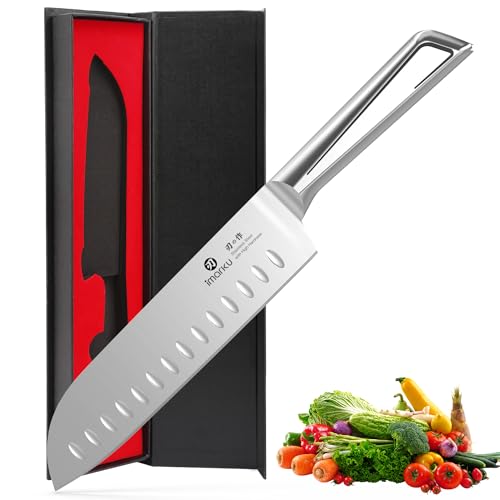
imarku takes a different route with a seamless stainless steel handle and a hollow-edge 7-inch blade. The handle is described as one integrated steel piece without wood, rivets, or open gaps. That construction has a clear cleaning advantage for cooks who dislike residue collecting around handle joints, especially after preparing raw poultry, oily ingredients, or wet vegetables. The listing also describes a double-bevel edge and a 0.1-inch blade thickness.
The scalloped edge is intended to create small air spaces between food and blade, while the steel handle is listed as dishwasher safe. This makes the knife a natural fit for a household that values quick cleanup over traditional handle materials. The high-carbon stainless steel description does not identify a specific alloy, hardness, or manufacturing origin, and the solid metal handle may feel different from pakkawood or riveted designs. Those are meaningful unknowns for shoppers comparing refined handling characteristics.
Pros
- Seamless steel handle has no listed gaps or rivets.
- Seven-inch blade provides broad everyday capacity.
- Hollow edge is intended to reduce food sticking.
- Dishwasher-safe construction is listed.
- Blade thickness is provided as 0.1 inch.
Cons
- The exact stainless-steel alloy and hardness are not identified.
- Solid steel handle construction may appeal less to cooks who prefer wood or composite grips.
This knife suits apartment kitchens, shared households, and cooks who want fewer handle crevices to clean. It is especially practical after messy prep, where a smooth metal body can be rinsed and loaded according to the listed care guidance. Those who care more about Japanese manufacture, a known steel grade, or a traditional handle will find the Shun, MAC, or HOSHANHO options more informative.
To buy this product, click here.
8. Mercer Culinary Genesis 7-inch Santoku Knife : Best Forged German-Style Option

The Mercer Genesis offers a traditional-looking 7-inch santoku with precision-forged construction and high-carbon German steel. Its taper-ground edge is intended to support efficient cutting, while the product information highlights chopping, mincing, and dicing as primary tasks. That task list fits the santoku format well, from breaking down onions and shallots to shredding cabbage for a quick slaw.
The handle is described as ergonomic with a non-slip grip, including use with wet hands. That can be reassuring during vegetable prep or after rinsing the blade, but comfort remains dependent on hand size and grip style. Mercer recommends hand washing with mild soap, thorough rinsing, and drying, and specifically advises against the dishwasher or prolonged submersion. The listing does not state the exact German steel designation, weight, or blade thickness, so the knife is best judged by its construction and care instructions rather than assumed specifications.
Pros
- Seven-inch blade matches common santoku preparation tasks.
- Precision-forged construction is listed.
- High-carbon German steel is identified as the material category.
- Taper-ground edge is intended to improve cutting efficiency.
- Non-slip handle design is specified for wet-hand use.
Cons
- Dishwasher use and prolonged submersion are specifically discouraged.
- The exact German steel alloy and knife weight are not provided.
Mercer is a sensible match for a cook who likes a substantial forged knife and spends much of the week chopping, mincing, and dicing. Its care requirements are clear, making ownership straightforward for anyone prepared to wash and dry the blade by hand. A user seeking a lighter Japanese-style feel, more detailed steel information, or dishwasher convenience should look elsewhere.
To buy this product, click here.
9. Wüsthof Gourmet 5-inch Hollow Edge Santoku Knife : Best Compact Design

The Wüsthof Gourmet is the compact outlier in this group, with a 5-inch blade intended for cooks who prefer a smaller cutting tool. Its straighter edge profile and gradual rise toward the tip reflect the santoku’s push-cutting-friendly shape, while evenly spaced hollow indentations are intended to help food release. A short blade can be easier to maneuver around a small board, a useful trait for apartment kitchens or prep involving smaller quantities.
This model uses a thinner, laser-cut stamped construction and a polypropylene handle. The handle material is described as resistant to fading, discoloration, heat, and impact, and the knife carries a limited lifetime warranty according to the supplied information. Wüsthof lists the knife as hand wash only. The compact format gives up some blade height and reach compared with the 7-inch options, so a cook preparing large cabbage wedges or wide cuts of meat may find it restrictive.
Pros
- Five-inch blade suits compact workspaces and smaller prep tasks.
- Hollow edge is intended to help food release.
- Straighter edge profile supports santoku-style cutting motions.
- Polypropylene handle is designed to resist heat, impact, and discoloration.
- Limited lifetime warranty is listed.
Cons
- Short blade offers less reach for large ingredients.
- Hand washing is required.
This is the best fit for cooks who find 7-inch knives cumbersome or who regularly prepare modest portions on a small board. It can also serve as a comfortable secondary knife beside a larger chef’s knife. Shoppers wanting one santoku for large vegetables, broad cabbage cuts, or substantial proteins should choose a 6.5- or 7-inch model instead.
To buy this product, click here.
Buying Guide
Match the Blade Length to Your Cutting Board
Most of the leading choices here use a 7-inch blade, a versatile size for onions, peppers, herbs, boneless meat, and everyday vegetable prep. The MAC’s 6.5-inch length offers a slightly more compact alternative, while the Wüsthof Gourmet’s 5-inch blade is easier to manage when counter space is tight. A short knife can feel agile, but large ingredients may require extra passes and more repositioning.
Understand the Santoku Cutting Profile
A santoku generally favors a flatter edge than a Western chef’s knife, making push cuts and straight-down chopping feel natural. It still handles slicing and mincing, but it is less suited to a pronounced rocking motion than a deeply curved chef’s knife. Look for a blade that matches your habits. If your board work sounds like repeated taps and forward pushes, the santoku shape is likely a good fit.
The edge profile matters as much as the name. See how santoku and chef’s knives differ in use to relate the shape to your preferred cutting motion.
Separate Steel Facts From Marketing Claims
Some knives in this roundup identify a specific material, such as VG-MAX or 10Cr15CoMoV. Others use broader descriptions such as high-carbon stainless steel or high-carbon German steel. A named alloy gives more useful information, but it still does not reveal heat treatment, edge retention, toughness, or sharpening behavior by itself. A listed 62 HRC value should be treated as one specification rather than a complete quality verdict.
Choose Between Traditional and Low-Maintenance Handles
Pakkawood and olive wood handles provide a traditional appearance, while full-tang and riveted designs can appeal to cooks who prefer a substantial Western construction. The imarku’s seamless steel handle has fewer gaps to clean, and the Victorinox offers a listed dishwasher-safe design. Handle shape, material, and overall weight affect personal comfort, so avoid assuming that one construction suits every hand.
Plan for Cleaning and Sharpening
Most knives in this selection are listed for hand washing, and careful drying helps limit moisture exposure. The Victorinox and imarku are listed as dishwasher safe, yet the product descriptions do not establish that dishwasher cleaning will preserve the edge as well as gentler hand care. A santoku also needs periodic sharpening. Use a method compatible with the knife’s double-bevel edge, and avoid cutting frozen food or hard bones unless the product specifically supports those tasks.
Before maintaining a fine edge, check Japanese-knife sharpening and compatibility rather than assuming one angle or device suits every santoku.
Treat Decorative Finishes as a Secondary Feature
The Shun’s hammered finish and HOSHANHO’s Damascus-style appearance can add visual appeal and may be intended to reduce food contact. They should not be treated as automatic evidence of a sharper edge or superior steel. Focus first on blade shape, length, handle fit, documented material, and care requirements. The pattern should be the finishing touch rather than the reason to overlook an unsuitable size.
Best Santoku Knife FAQ
What Is a Santoku Knife Best Used For?
A santoku is suited to general kitchen preparation, especially slicing, chopping, dicing, and mincing vegetables, fruit, herbs, and boneless proteins. Its relatively flat edge supports push-cutting and straight chopping. It is less appropriate for cutting through bones, frozen food, or other hard materials unless the manufacturer specifically permits that use.
Is a 7-inch Santoku Better Than a 5-inch Model?
Neither length is universally better. A 7-inch blade offers more cutting surface for cabbage, large onions, and broad ingredients, while a 5-inch knife can be easier to control on a small board or for smaller portions. The Wüsthof Gourmet is the compact option here, while most of the other selected knives use a 6.5- or 7-inch format.
Are Santoku Knives Japanese Knives?
Santoku describes a Japanese-style knife shape, but the country of manufacture varies. The Shun and MAC listings identify Japanese manufacture, while the Wüsthof knives are identified as German-made. A knife can use a santoku profile without being made in Japan, so check the product information rather than relying on the style name.
Does Damascus Construction Make a Santoku Better?
Damascus or layered cladding can create a distinctive pattern and may serve a functional role when paired with a grooved or hammered surface. It does not automatically establish better edge retention, toughness, or sharpness. The HOSHANHO Damascus model identifies a 10Cr15CoMoV core, while the Shun identifies a VG-MAX core and 68 layers of cladding. Those details are more useful than the pattern alone.
Can Santoku Knives Go in the Dishwasher?
Care instructions vary by model. The Victorinox and imarku products in this selection are listed as dishwasher safe. The Shun, MAC, Wüsthof, Mercer, and HOSHANHO listings call for hand washing or provide hand-care guidance. Check the exact product instructions, and dry the blade after cleaning rather than leaving it wet in a sink or dishwasher.
What Cutting Motion Works Best With a Santoku?
The relatively flat edge is well suited to push cutting, straight chopping, slicing, and mincing. A santoku can rock slightly, but its profile usually favors lifting and moving the blade forward rather than making a deep rocking arc. If rocking is your dominant technique, a curved chef’s knife may feel more natural.
How Should a Santoku Knife Be Stored?
Store it in a knife block, on a suitable magnetic holder, or with a blade guard that fits its length and height. Avoid leaving a sharp knife loose in a drawer, where the edge can contact other utensils and hands can reach the blade unexpectedly. A sheath or guard can be particularly useful for the compact Wüsthof, while larger 7-inch knives require storage that accommodates their full blade dimensions.
Final Verdict
The Shun Premier 7-inch Santoku is the Best Overall choice because its documented VG-MAX core, 68 layers of Damascus cladding, hammered finish, 16-degree edge, and contoured pakkawood handle create the most complete match for a serious everyday santoku. It offers a useful full-size blade and Japanese-made construction, though the hand-wash requirement matters. The MAC Professional is the sharper alternative for shoppers who prefer a slightly shorter Japanese-made knife with dimples and a 2.5 mm blade.
For a Western-style forged build, the Wüsthof Classic is the natural alternative. The Victorinox is better suited to cooks who prioritize easy cleanup and a lightweight design, while the imarku’s seamless steel handle keeps maintenance simple. The Wüsthof Gourmet earns its place for compact prep, and the two HOSHANHO knives provide more detailed steel and hardness information than several competitors. Match the final choice to your board size, cutting motion, grip preference, and willingness to hand wash. A santoku works best when its geometry and care routine fit the person holding it.
