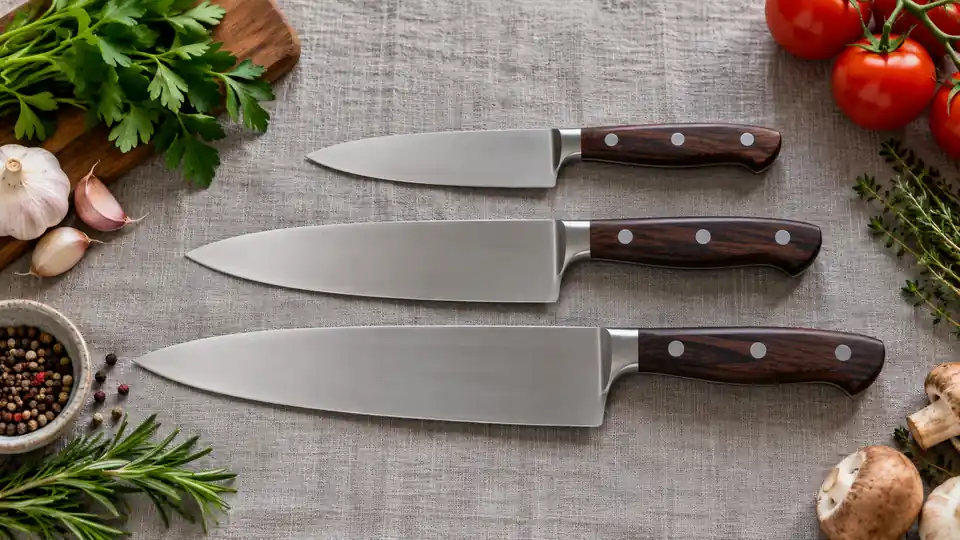
For most home cooks, an 8-inch chef’s knife is the most practical starting point. It provides enough blade length for large vegetables and long slicing strokes while remaining manageable on a typical cutting board. A 6- or 7-inch knife may offer better control in a small kitchen or for users who prefer a lighter tool. A 9- or 10-inch knife can handle more food per stroke, but it requires greater working space and may feel less agile.
The right size depends on your available counter space, cutting board, preferred grip, typical ingredients, and comfort with the knife. Hand size can influence handle comfort, but it does not determine the ideal blade length by itself.
A shorter blade is only part of the fit question. The chef’s knives for smaller hands guide also compares handling features, so use it alongside the size and workspace checks below.
Chef’s Knife Sizes at a Glance
| Blade Length | Typical Advantages | Possible Limitations | Often Suits |
|---|---|---|---|
| 6 inches | Compact, agile, and easy to maneuver | Shorter slicing reach and less clearance for large ingredients | Small kitchens, compact boards, and cooks who prefer a shorter blade |
| 7 inches | Balances maneuverability with useful cutting length | May still feel short for large produce or long slicing strokes | Cooks who find an 8-inch knife slightly cumbersome |
| 8 inches | Versatile length for common kitchen preparation | Can feel large on a cramped counter or shallow board | Many home cooks seeking one general-purpose knife |
| 9 to 10 inches | Long slicing stroke and greater capacity for large ingredients | Requires more space and careful tip control | Large cutting boards, high-volume preparation, and users comfortable with longer blades |
These descriptions are general. Two knives with the same listed blade length may handle very differently because of their weight, blade height, profile, thickness, balance, and handle shape.
Why an 8-Inch Chef’s Knife Is the Common Starting Point
An 8-inch blade is long enough to span many onions, potatoes, squash sections, and cuts of boneless meat. It also provides a useful edge length for chopping herbs, slicing produce, and mincing aromatics. At the same time, it is usually short enough for controlled tip work and routine preparation on a medium or large board.
For the general-purpose category, these everyday chef’s knives show how nominally similar lengths can come with different handles and profiles.
That does not make 8 inches universally correct. Someone using a narrow board in a compact apartment may have better control with a 6- or 7-inch knife. A cook regularly processing cabbage, melons, large bunches of greens, or substantial quantities of food may appreciate a longer edge.
How Each Chef’s Knife Length Changes the Experience
6-Inch Chef’s Knives Favor Maneuverability
A 6-inch chef’s knife can feel approachable because the tip remains relatively close to the hand. The shorter edge works well for shallots, garlic, small onions, fruit, and detailed trimming. It also fits more comfortably on a compact cutting board.
The trade-off is reduced reach. Large ingredients may require extra strokes, and the short blade may struggle to span a cabbage or melon section. A compact chef’s knife can also provide less knuckle clearance if its blade is shallow from spine to edge.
7-Inch Knives Offer a Middle Ground
A 7-inch chef’s knife adds working length without creating the same sense of reach as a larger model. It may suit users who feel restricted by a 6-inch blade but find a standard 8-inch knife awkward.
Some santoku knives and gyutos also appear near this size, although category names do not determine exact geometry. A santoku may have a flatter edge profile and a less pointed tip than a Western chef’s knife. A gyuto may resemble a chef’s knife in function, but its dimensions and construction vary by model.
8-Inch Knives Cover a Broad Range of Tasks
The 8-inch format is a useful general-purpose choice for vegetables, herbs, boneless meat, and many fruits. It offers enough length for efficient slicing while retaining reasonable control for smaller work.
Its versatility depends on blade shape as well as length. A curved belly supports rocking cuts, while a flatter section can work well for push cutting and chopping. Individual designs vary, so the profile should match the cutting motions you actually use.
9- and 10-Inch Knives Provide More Reach
A longer chef’s knife can make efficient slices through large ingredients and cover more food during chopping. The extra length also allows long drawing cuts through boneless meat.
More blade is not automatically more efficient. A long knife may bump into a backsplash, extend beyond a small board, or demand greater awareness of the tip. Weight and balance become particularly significant at this size. Users accustomed to compact knives may need time to develop comfortable control.
Blade Length Is Only One Part of Knife Size
The question “What size chef knife should I get?” usually refers to blade length, but several other dimensions affect fit and handling.
Blade Height Affects Knuckle Clearance
Blade height is the distance from the spine to the cutting edge. A taller blade can create more room between the handle grip and the cutting board, reducing the chance that knuckles contact the board during chopping. It also offers a broad surface for guiding food, though food should be moved with care rather than scraped aggressively with the sharp edge.
A shorter blade may feel nimble, but it can provide limited clearance for users with larger hands or high knuckles. Check clearance in your normal grip rather than relying on blade length alone.
Handle Dimensions Influence Control
A suitable blade can still feel wrong if the handle is too narrow, bulky, short, or angular for your grip. Handle comfort depends on hand shape, grip style, texture, and the transitions between the handle, bolster, and blade.
People who use a pinch grip hold part of the blade near the handle, which can make a longer knife feel more controlled. Those who hold primarily by the handle may perceive the same blade as having greater reach. Neither grip should be forced if it causes discomfort or poor control.
Weight and Balance Change How Length Feels
A light 8-inch knife may feel easier to maneuver than a heavy 7-inch knife. Balance also affects perceived size. A blade-heavy design may support chopping momentum, while a handle-heavy design can feel different during tip work and slicing.
Construction labels such as forged, stamped, or full tang do not establish how comfortable or balanced a knife will be. The complete design matters more than any single label.
Edge Profile Determines the Required Motion
Chef’s knives with pronounced belly curvature accommodate rocking motions. Flatter profiles favor push cuts, draw cuts, and controlled chopping. A longer curved knife may need additional board space so the tip and heel can move freely.
Profile also changes the motion. The santoku and chef’s-knife comparison explains why a shorter blade is not the only route to different handling.
Choose a profile that works with your preferred technique. Blade length cannot compensate for a shape that feels unnatural during routine cuts.
Match the Knife to Your Cutting Board and Workspace
A knife needs room to travel without striking surrounding objects or extending awkwardly beyond the work surface. The board should provide space in front of and behind the ingredient, with enough width for the full cutting motion.
- Compact board or limited counter: A 6- or 7-inch knife may be easier to control.
- Medium or large board: An 8-inch knife usually has enough room for general preparation.
- Large board with open counter space: A 9- or 10-inch knife becomes more practical.
Place the board on a stable counter. If it slides, secure it with a suitable nonslip mat or a damp towel laid flat beneath it. The board should remain stationary through the full cutting stroke.
Choose for Your Typical Ingredients
Your routine food preparation offers a better guide than occasional specialty tasks.
- Mostly garlic, herbs, small fruit, and modest vegetables: A 6- or 7-inch blade may provide sufficient reach.
- A varied mix of vegetables, fruit, herbs, and boneless meat: An 8-inch blade is a practical baseline.
- Frequent cabbage, melon, large squash, or high-volume preparation: A 9- or 10-inch blade may reduce the number of strokes, provided the workspace supports it.
An ordinary chef’s knife is intended for common food preparation rather than chopping hard bones, cutting frozen food, or twisting through dense materials. Those tasks can damage an edge, especially on thin or finely ground blades. Use a knife intended for the material and follow its manufacturer’s guidance.
How to Evaluate Size Before Making a Choice
If you can safely handle a display knife under staff supervision, evaluate it through controlled, unhurried movements. There is no need to touch the edge or make rapid cutting motions.
After deciding what dimensions fit, compare the chef’s knives under $100 within that requirement rather than letting price alone choose the size.
- Use your normal grip. Check whether the handle and blade junction create pressure points.
- Notice the tip position. The tip should feel predictable rather than remote or difficult to track.
- Check knuckle clearance. Hold the knife as if cutting on a board and see whether your knuckles would clear the surface.
- Simulate a slow cutting stroke. Confirm that the length and profile suit your preferred rocking, push-cutting, or slicing motion.
- Assess fatigue and control. A knife that feels impressive for a moment may become tiring if its weight or balance does not suit you.
- Consider your board at home. Compare the knife’s length with the usable area, nearby walls, appliances, and backsplash.
If direct handling is unavailable, review the complete dimensions rather than the blade length alone. Useful measurements include overall length, blade height near the heel, handle length, and weight. Measurements cannot establish comfort, but they provide a clearer picture than a size label.
Does Hand Size Determine Chef’s Knife Length?
Hand size matters most for handle fit and knuckle clearance. It has a weaker relationship with ideal blade length. A person with small hands may control a long, light knife comfortably, while someone with large hands may prefer a short blade paired with a roomy handle and tall heel.
Skill, grip, workspace, and cutting habits can outweigh hand dimensions. Avoid choosing a 6-inch knife solely because your hands are small or a 10-inch knife solely because they are large.
Can a Chef’s Knife Be Too Short or Too Long?
A knife is probably too short if it repeatedly requires sawing through ordinary ingredients, cannot span the foods you prepare, or leaves inadequate knuckle clearance. It may be too long if the tip is difficult to track, the blade crowds the board, or nearby objects interfere with the cutting stroke.
Discomfort also deserves attention. A different handle or blade height may solve the problem without changing blade length. Size should be assessed as a combination of dimensions rather than a single number.
A Practical Size Recommendation
Start with an 8-inch chef’s knife if you have a reasonably spacious cutting board and want one blade for varied daily preparation. Move down to 6 or 7 inches if compactness and close control are higher priorities. Consider 9 or 10 inches if you routinely cut large ingredients, have ample board space, and already feel comfortable controlling a longer blade.
The best fit is the shortest blade that handles your regular ingredients efficiently without feeling cramped, or the longest blade you can control comfortably without crowding the workspace. Blade height, handle fit, weight, balance, and edge profile should confirm the decision rather than being treated as secondary details.
