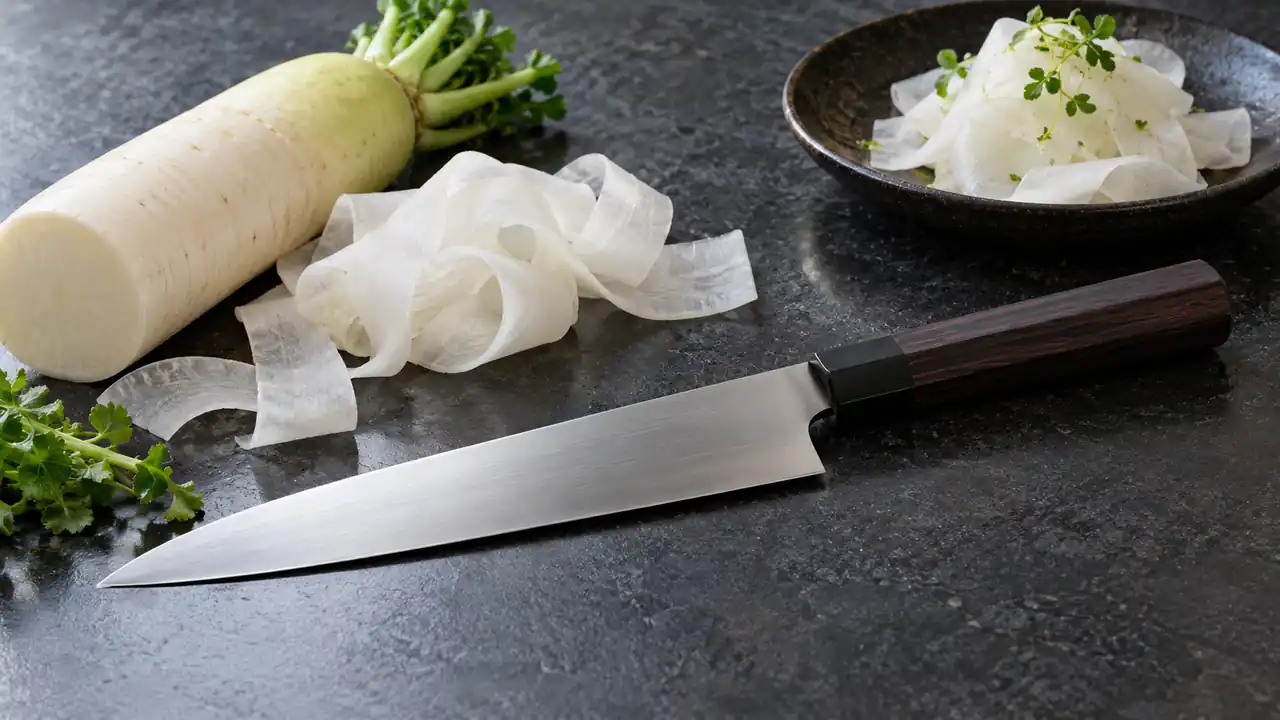
A gyuto is the Japanese answer to the all-purpose chef’s knife, with a pointed tip, a versatile double-bevel edge, and a profile suited to slicing, push cutting, chopping, and light rocking motions. That flexibility explains why home cooks often search for the Best Gyuto Knife when one blade needs to handle onions at lunchtime, herbs after work, and boneless meat for dinner. The challenge is separating useful geometry and construction from decorative Damascus patterns, vague steel claims, and oversized promises about sharpness.
Blade length, edge angle, steel, handle shape, and maintenance all affect the buying decision. An 8-inch blade is a practical middle ground for many kitchens, while a thinner 8.27-inch model may appeal to cooks who value precise vegetable and fish preparation. Harder steel can support a fine edge, yet it still requires sensible cutting-board habits and careful sharpening. A full bolster and resin handle may suit one grip, while an octagonal wa handle may feel more natural to another. The products below cover those different priorities without treating one gyuto design as universally superior.
The selection includes Japanese-made options, Japanese-style gyuto knives, layered stainless constructions, traditional-looking hammered finishes, and lighter precision-oriented designs. Product descriptions provide useful specifications, but claims about long-term edge retention and comfort should be treated as manufacturer information rather than independent test results. The comparison starts with the main distinctions, then examines each knife’s intended use, care requirements, and limitations.
Quick Answer
MITSUMOTO SAKARI 8-Inch Japanese Gyuto Chef Knife is the strongest overall choice for shoppers who want a clearly described 8-inch gyuto with a 9Cr18MoV core, three-layer construction, octagonal rosewood handle, and listed HRC 60±2 hardness. Its hammered and kurouchi-style finish also gives it a distinctive working surface.
Kimura Chef Knife is the clearest choice for buyers who specifically want a knife made in Japan. Its molybdenum stainless steel, 57 HRC heat treatment, POM resin handle, full bolster, and full-tang construction point toward a more conventional, durable format.
KAWAHIRO Japanese Chef Knife suits cooks who prioritize a lighter 180-gram body, VG10 core, 67-layer cladding, distal taper, and traditional ebony wa handle. Its documented geometry is especially relevant for controlled slicing and fine prep.
Best Gyuto Knife Comparison Table
| Product | Best For | Blade Length | Steel | Handle |
|---|---|---|---|---|
| MITSUMOTO SAKARI Gyuto | Overall balance | 8 inches | 9Cr18MoV, 3-layer | Octagonal rosewood |
| Kimura Chef Knife | Japanese-made construction | 8 inches | Chrome molybdenum stainless | POM resin |
| KAWAHIRO VG10 Damascus | Lightweight precision | 8.27 inches | VG10, 67-layer | Ebony wa handle |
| KAWAHIRO Hand-Forged VG10 | Fine cutting geometry | 8.27 inches | VG10, 3-layer | Octagonal wood |
| SHAN ZU 9-Layer Gyuto | Grip variation | 8 inches | 10Cr15MoV, 9-layer | G10 and rosewood |
| Black VG10 Damascus Gyuto | Heavier full-tang feel | 8 inches | VG10, 67-layer | Rosewood and ebony |
| Atumuryou Damascus Gyuto | Resin-wood handle | 8 inches | VG10, 67-layer | Stabilized wood and resin |
| Kai Seki Magoroku Akane | Easy-care ownership | 8.3 inches | Stainless composite | Heat-resistant resin |
| imarku Japanese Chef Knife | Moderate hardness | 8 inches | High-carbon stainless | Pakka wood |
The detailed reviews explain how these nine gyuto knives differ in construction, handling implications, edge care, and intended kitchen use.
1. MITSUMOTO SAKARI 8-Inch Japanese Gyuto Chef Knife – Best Overall

The MITSUMOTO SAKARI has the proportions most shoppers expect from an everyday gyuto. Its 8-inch blade is long enough for a large onion or a boneless chicken breast, yet it remains manageable on a standard home cutting board. The listed 9Cr18MoV core is enclosed in a three-layer San-Mai construction, giving buyers a clearly identified stainless blade format rather than an unspecified “Japanese steel” description.
Its octagonal rosewood handle is shaped to help establish a consistent grip direction, which may appeal to cooks who use a pinch grip for slicing and light rocking. The tsuchime hammered texture and dark forged finish are visually distinctive, although appearance should not be confused with measured cutting performance. A listed HRC 60±2 hardness suggests a relatively firm edge platform, so the knife deserves a suitable board and careful sharpening rather than rough treatment around bones or frozen food.
Pros
- 8-inch gyuto profile suits general vegetable, fish, herb, and boneless meat preparation.
- 9Cr18MoV core and three-layer construction are clearly identified.
- Octagonal rosewood handle supports directional grip control.
- Hammered surface may help limit broad food contact during slicing.
- Includes a sandalwood storage box.
Cons
- Wood handle and listed hardness call for careful hand washing and drying.
- Hammered finish does not independently prove better edge retention or toughness.
This knife makes the most sense for a cook who wants a traditional-looking gyuto with useful specifications and a balanced range of cutting tasks. Buyers who prefer dishwasher convenience or a polymer handle should look toward the Kai or Kimura instead. Keep the blade away from hard bones and frozen ingredients, and its conventional 8-inch format should fit many daily prep routines.
To buy this product, click here.
2. Kimura Chef Knife – Best Japanese-Made Option

The Kimura stands apart because the supplied information identifies it as made in Seki, Japan. That origin matters to shoppers specifically seeking a Japanese-made gyuto, although it does not by itself establish superior cutting performance. The 8-inch blade uses high-carbon chrome molybdenum stainless steel, with a stated 57 HRC heat treatment and a 15-degree hand-sharpened edge.
This is a more conventional construction than the decorative layered knives elsewhere in the selection. A POM resin handle resists the maintenance concerns associated with natural wood, while the full bolster and triple-riveted full tang create a familiar Western-style feel within a gyuto format. A cook moving from a European chef’s knife may find that transition easier than moving immediately to a lightweight wa-handled blade.
Pros
- Product information identifies manufacture in Seki, Japan.
- 8-inch gyuto blade covers chopping, slicing, and dicing.
- POM resin handle is practical for routine kitchen use.
- Full bolster and triple-riveted full tang provide a conventional structure.
- Listed 57 HRC hardness favors a balance of edge support and toughness.
Cons
- Full bolster may feel less natural to cooks who prefer a blade-forward pinch grip.
- Its 15-degree edge is less acute than several other knives in this group.
Choose the Kimura if manufacturing origin, familiar construction, and straightforward care carry more weight than a layered Damascus appearance. It is also a sensible bridge for someone accustomed to a heavier Western-style handle. Cooks seeking the thinnest documented geometry or a traditional octagonal wa handle have better matches among the KAWAHIRO models.
To buy this product, click here.
3. KAWAHIRO Japanese Chef Knife – Best Lightweight Precision Option

The KAWAHIRO combines an 8.27-inch gyuto blade with a listed 180-gram weight, creating a profile aimed at controlled, lower-effort preparation. That lighter specification may appeal during long sessions of slicing vegetables, portioning boneless fish, or trimming herbs, though actual comfort still depends on hand size, grip, and balance.
Its VG10 core is surrounded by 67 layers of Damascus cladding, and the listing gives a 60 to 62 HRC range. The more useful detail is the stated distal taper, which gradually narrows toward the tip. That geometry can support more precise tip work and reduce wedging in thin slices. An ebony octagonal wa handle with turquoise accents gives the knife a traditional Japanese visual language, while the wooden gift box adds storage and presentation value.
Pros
- Listed 180-gram weight favors a lighter handling style.
- 8.27-inch length provides useful reach for larger ingredients.
- VG10 core and 67-layer cladding are clearly specified.
- Distal taper is relevant to fine slicing and tip control.
- Traditional octagonal ebony handle and wooden box add practical appeal.
Cons
- Longer blade may feel awkward on small boards or crowded counters.
- Harder, thinner geometry requires careful use around hard ingredients.
This model suits a cook who enjoys a lighter Japanese-style gyuto and regularly performs detailed prep. It may be less suitable for someone who prefers the substantial feel of a full-tang Western handle. Treat the Damascus pattern as a finish around the VG10 core, not as proof that the knife will outperform every other blade with a similar layer count.
To buy this product, click here.
4. KAWAHIRO 8.27-Inch Hand-Forged VG10 Chef Knife – Best for Documented Cutting Geometry

This KAWAHIRO uses the same broad 210-millimeter class associated with many gyuto knives, but its listing provides unusually specific geometry. The stated distal taper runs from 3.55 millimeters at the spine to 0.09 millimeters near the tip. Those figures describe a blade that becomes dramatically finer toward the point, which is useful information for shoppers who care about tip work and reduced resistance during precise preparation.
The knife has a VG10 core in a three-layer construction and a listed hardness above 60 HRC. Its octagonal handle combines ebony, turquoise, and ruby wood, giving it a traditional wa-handled shape with decorative materials. The product information recommends hand washing, immediate drying, and avoiding bones, frozen foods, and other hard materials. Those restrictions are especially relevant because a fine tip and hard edge are better matched with controlled food preparation than forceful chopping.
Pros
- Published taper measurements provide more geometry detail than many listings.
- VG10 core and three-layer construction are documented.
- 8.27-inch length supports broad slicing strokes.
- Octagonal handle supports a defined grip orientation.
- Care instructions clearly address hand washing and hard ingredients.
Cons
- Fine tip geometry is a poor match for bones, frozen foods, and forceful tasks.
- Wood handle requires more care than a polymer alternative.
This is a strong fit for detail-oriented cooks who want a gyuto with published geometry and a clear care routine. It should be skipped by anyone seeking a rough-use utility knife for hard materials. Compared with the lighter KAWAHIRO above, this model emphasizes documented taper and three-layer construction rather than a listed 180-gram weight.
To buy this product, click here.
5. SHAN ZU 8-Inch Japanese Chef Knife – Best for Grip Material Variety

The SHAN ZU takes a familiar 8-inch gyuto size and pairs it with a handle that combines G10 at the front with rosewood toward the rear. That mixed construction may appeal to cooks who want a more textured contact area near the blade while retaining the visual warmth of wood. A brass pin adds a decorative element and contributes to the handle assembly, although appearance should remain secondary to grip preference.
The blade uses a listed 10Cr15MoV core within nine layers of high-carbon stainless steel. The product information gives a 62 HRC hardness and a 12-degree edge, specifications that point toward a fine cutting edge and a need for careful board selection. The hammered finish may reduce broad contact between food and blade face during some cuts, but it does not guarantee release with every ingredient.
Pros
- 8-inch blade size suits routine home preparation.
- 10Cr15MoV core and nine-layer construction are specified.
- G10 and rosewood provide two distinct handle surface materials.
- Listed 12-degree edge supports precise slicing tasks.
- Hammered finish gives the blade a distinctive working surface.
Cons
- Listed 62 HRC hardness and fine edge call for careful handling.
- Mixed handle materials may not suit cooks who prefer a uniform grip.
The SHAN ZU is a practical candidate for cooks who want an 8-inch gyuto with a more tactile handle design. It is less compelling for buyers who prioritize documented Japanese manufacture, since the supplied information describes Japanese steel and Japanese-inspired construction without identifying a manufacturing location. Use it for vegetables, herbs, and boneless proteins rather than hard cutting chores.
To buy this product, click here.
6. Black VG10 Damascus Gyuto – Best for a Heavier Full-Tang Format

This black-finish gyuto is aimed at buyers who want more structure and weight than a very light wa-handled knife provides. The listing gives a 209-gram weight, a 2.5 to 2.7-millimeter blade thickness, a 15-degree double edge, and a full-tang construction. Those details suggest a relatively substantial knife that may feel reassuring during repeated chopping, while the pointed gyuto tip still supports detail work.
A VG10 core sits beneath 67-layer Damascus cladding, and the stated hardness range is 58 to 60 HRC. The rosewood and ebony handle follows an octagonal Japanese-style shape. A leather sheath is included, which is useful for protected storage, but the knife still requires hand washing and prompt drying to preserve its finish and edge.
Pros
- 209-gram weight offers a more substantial alternative to lightweight gyuto designs.
- Full-tang construction provides a clearly documented handle structure.
- VG10 core and 67-layer cladding are identified.
- 2.5 to 2.7-millimeter blade thickness gives the profile more body.
- Leather sheath supports protected storage.
Cons
- Heavier construction may feel tiring to cooks who prefer nimble blades.
- Hand washing and drying are recommended for the finish and handle.
Choose this knife if you want a gyuto that occupies the middle ground between delicate precision and heavier chef’s-knife presence. It may suit cooks who chop frequently and like a more substantial spine, while buyers focused on the lightest possible handling should look at the KAWAHIRO 180-gram model. The 15-degree edge also makes routine, compatible sharpening an important part of ownership.
To buy this product, click here.
7. Atumuryou Japanese Chef Knife – Best Resin-Wood Handle

The Atumuryou follows the familiar 8-inch gyuto format and uses a stabilized wood and resin handle. That combination can be attractive to cooks who want wood’s visual character with a handle material described as slip-resistant and more stable than untreated natural wood. Comfort remains individual, but the handle format gives this knife a different ownership profile from the rosewood and ebony models in the group.
Its construction is listed as a VG10 core with 67-layer Damascus cladding and a 62 HRC hardness. The stated 12-degree edge is relatively fine, making the knife suitable for controlled slicing, vegetable prep, and boneless proteins. The listing also describes a hand-sharpened edge, though long-term sharpness claims should be treated as product claims rather than established results.
Pros
- 8-inch length is adaptable for everyday kitchen preparation.
- VG10 core and 67-layer construction are clearly listed.
- Stabilized wood and resin handle offers a distinct material combination.
- Listed 12-degree edge suits precise slicing work.
- Gift box supports protected presentation and storage.
Cons
- Fine edge and 62 HRC listing require careful use around hard ingredients.
- The supplied information does not identify a manufacturing location.
This model fits buyers drawn to Damascus styling and a resin-wood handle without moving to the heavier full-tang knife above. It is a less suitable pick for someone who wants a Japanese-made knife with an identified origin. Use a stable cutting board, avoid twisting through hard food, and plan for careful sharpening as the edge wears.
To buy this product, click here.
8. Kai Seki Magoroku Akane Gyuto – Best for Easy-Care Ownership

The Kai offers a different approach from the ornate layered knives. It is an 8.3-inch, 210-millimeter gyuto made in Japan with a stainless composite blade and a heat-resistant resin handle. The listed construction includes a molybdenum vanadium stainless blade steel and stainless matching material, giving buyers a clearly stainless-oriented option for routine cooking.
A three-step blade process is described, including smoothing the corners after cutting to reduce resistance. That language explains the intended geometry without requiring a decorative hammered surface or Damascus pattern. The handle is listed as dishwasher-safe, although the product information still advises prompt removal of dirt and moisture to reduce rust and discoloration. That care instruction matters because stainless steel is corrosion-resistant, not immune to neglect.
Pros
- Made-in-Japan origin is identified in the supplied information.
- 8.3-inch blade provides useful reach for larger prep tasks.
- Stainless composite construction suits shoppers seeking simpler maintenance.
- Heat-resistant resin handle is practical for busy kitchens.
- Three-step blade processing is described in functional terms.
Cons
- Product information does not provide a specific Rockwell hardness value.
- The handle is described as right-handed, although left-handed users may use it.
The Kai is a sensible choice for cooks who prefer a Japanese-made gyuto without a natural wood handle or elaborate cladding. It is also a useful option for a household where straightforward cleaning matters. Buyers who want a strongly traditional octagonal handle, stated edge angle, or Damascus appearance will find those details elsewhere in the ranking.
To buy this product, click here.
9. imarku Japanese Chef Knife – Best for a Moderate Hardness Profile

The imarku is an 8-inch gyutou-style chef knife with a high-carbon stainless blade and a Pakka handle. Its listed 56 to 58 HRC range is lower than the 60-plus figures attached to several layered knives here. Hardness alone does not determine quality, but this specification may interest cooks who prefer a less hard blade profile and a familiar all-purpose format.
The listing describes a carbon content of 0.6 to 0.75 percent and chromium content of 16 to 18 percent. It also identifies the knife as suitable for slicing, dicing, chopping, and general meat and vegetable preparation. The Pakka handle combines a wood-based frame with a finished surface, offering a different feel from resin or octagonal wa handles. Buyers should also note that the product information mentions possible logo variation between shipments.
Pros
- 8-inch blade length suits common home kitchen tasks.
- High-carbon stainless construction and composition ranges are provided.
- Listed 56 to 58 HRC profile may appeal to cooks avoiding very hard edges.
- Pakka handle offers a familiar composite-wood format.
- Product information includes a lifetime warranty statement.
Cons
- Handle shape and blade geometry are described less specifically than several competitors.
- Logo variation may mean the received appearance differs from product images.
This knife is a reasonable match for shoppers who want a conventional 8-inch gyuto-style blade and a moderate listed hardness rather than a very hard layered construction. It may be less appealing to collectors seeking a traditional wa handle or detailed distal taper. Review the care instructions supplied with the exact item, and use an appropriate cutting surface for routine prep.
To buy this product, click here.
Buying Guide
Match the Blade Profile to Your Cutting Motion
A gyuto is versatile because its pointed tip supports detail work while its belly can accommodate some rocking. A flatter or more tapered profile favors push cuts through carrots, onions, and herbs. A more curved profile may suit cooks who naturally roll the blade through mince or aromatics. Product listings rarely provide complete grind diagrams, so avoid assuming two knives with the same length will cut identically.
A gyuto fills a general-purpose role within a broader set of Japanese kitchen-knife shapes. Naming the recurring task is more useful than collecting several similar profiles.
Choose Blade Length for Your Board and Ingredients
An 8-inch gyuto is a practical starting point for many home kitchens. The 8.27-inch and 8.3-inch models in this selection add a little reach for large vegetables, cabbage, and broad slicing strokes. That extra length can feel crowded on a narrow board, particularly if the cook is still learning pinch-grip control. Measure the usable cutting area rather than choosing by blade length alone.
Read Steel Claims With Care
VG10, 9Cr18MoV, 10Cr15MoV, and molybdenum vanadium stainless are meaningful designations when they belong to the exact knife being considered. They still do not tell the entire performance story. Heat treatment, edge geometry, blade thickness, and sharpening quality also matter. A Damascus layer count describes the cladding or pattern structure supplied by the listing, not an automatic guarantee of superior cutting.
Balance Edge Fineness Against Toughness
The listed 12-degree and 15-degree edges may support precise cutting, yet fine edges deserve more careful handling. Do not use a gyuto on hard bones, frozen food, glass, or other unsuitable materials unless the manufacturer specifically supports it. A knife that is harder or thinner may reward controlled prep, while a more moderate construction can be less demanding for general household use.
Compare Handle Construction and Care
Octagonal wa handles guide grip orientation and give a traditional Japanese-style feel. Resin, POM, G10, Pakka, and stabilized wood offer different maintenance and surface characteristics. Natural wood generally deserves prompt drying, while a resin handle may be easier for a busy household. Full-tang and bolster construction can feel familiar to Western chef’s-knife users, but neither feature guarantees better balance for every hand.
Plan for Sharpening and Storage
A gyuto with a fine double-bevel edge needs a compatible sharpening method and a stable cutting board. Product descriptions in this group do not establish that every knife is suitable for every electric sharpener, so confirm the device’s angle and blade compatibility before use. Store the knife in a sheath, block, magnetic holder, or another arrangement that protects the edge and keeps the blade from moving loosely in a drawer.
The grind determines the maintenance approach. Follow the checks for sharpening Japanese knives by edge geometry before selecting an abrasive or guided setting.
Best Gyuto Knife FAQ
What is a gyuto knife used for?
A gyuto is a general-purpose Japanese-style chef’s knife. Its pointed tip handles detail work, while the main edge can slice vegetables, herbs, boneless meat, and fish portions. It is usually more versatile than a specialized single-task knife, but it should not be treated as a cleaver or bone knife.
Is an 8-inch gyuto a good starting size?
For many home cooks, an 8-inch blade offers a useful compromise between reach and control. It can handle everyday ingredients without occupying as much board space as a longer knife. Smaller kitchens and compact cutting boards may favor the 8-inch options, while cooks who prepare large vegetables may prefer the 8.27-inch or 8.3-inch models.
Are Damascus gyuto knives better?
Damascus describes a layered or patterned construction, but the supplied layer count alone does not establish superior cutting. The core steel, heat treatment, blade geometry, edge preparation, and care routine matter more to the actual buying decision. Select a Damascus gyuto for its documented construction and appearance, not for layer count alone.
Should a gyuto be washed in the dishwasher?
Check the exact product information. The Kai listing identifies a heat-resistant resin handle and dishwasher-safe characteristics, while several wood-handled knives recommend hand washing and prompt drying. Even corrosion-resistant stainless steel can stain or discolor when left wet or exposed to harsh conditions, so hand washing remains the safer routine for many gyuto knives.
Can a gyuto cut bones or frozen food?
These knives should generally be reserved for food preparation that matches their documented design. The KAWAHIRO listing specifically warns against bones, frozen food, and other hard materials. A gyuto’s pointed tip and relatively fine edge can be damaged by twisting or impact, so use a suitable boning or cleaving tool for harder tasks.
What handle is best for a gyuto?
There is no universal winner. Octagonal wood handles suit cooks who like a defined grip orientation, while POM, resin, G10, and Pakka handles may offer easier maintenance or a more familiar feel. Full bolsters and full tangs can appeal to Western-style knife users, but the best choice depends on hand size, grip habits, and cleaning preferences.
How should a gyuto be sharpened?
Use a sharpening method compatible with the knife’s double-bevel edge and stated geometry. The listed 12-degree and 15-degree edges should not be treated as interchangeable instructions for every sharpening device. A whetstone can provide control, while a guided system may help maintain a consistent angle. Avoid removing excess metal through an unsuitable sharpener.
Final Verdict
The MITSUMOTO SAKARI earns the Best Overall position because it combines a practical 8-inch gyuto profile with a documented 9Cr18MoV core, three-layer construction, octagonal rosewood handle, and stated HRC range. It offers a useful middle ground between ornate specialty presentation and conventional chef’s-knife construction. The Kimura is the better match for shoppers who specifically want a knife identified as made in Japan, along with a POM handle, full bolster, and full-tang format.
For lighter, more precision-focused preparation, the KAWAHIRO VG10 Damascus model brings a listed 180-gram weight and distal taper, while the second KAWAHIRO provides unusually detailed taper measurements and clear restrictions around hard ingredients. The Kai is the practical stainless and resin-handled alternative, and the SHAN ZU, Atumuryou, Black VG10, and imarku each offer different combinations of handle material, hardness, edge specification, and visual finish. Match the blade length to your board, choose steel and handle materials that fit your care routine, and treat every fine-edged gyuto as a precision kitchen tool rather than a substitute for a cleaver.
