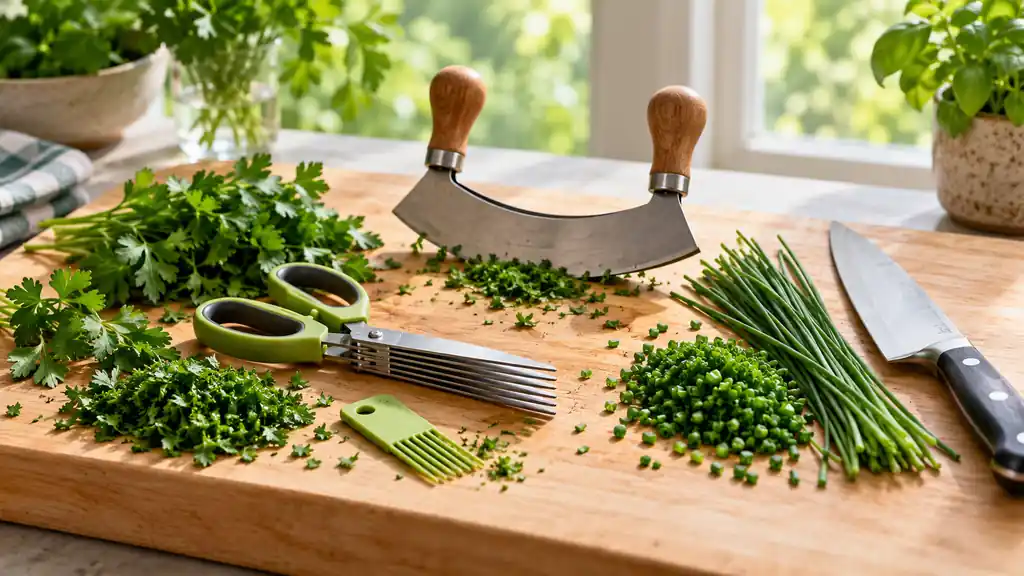
To mince herbs, wash and dry them, remove unsuitable tough stems, and cut a small quantity with a sharp tool until the pieces match the recipe. A chef’s knife handles many herbs on a board, scissors are convenient for small snips, and a mezzaluna uses a rocking cut. Stop when the texture is fine enough instead of repeatedly crushing the same pile.
For a few tender stems or a garnish, herb scissors for small batches may be convenient. A chef’s knife or mezzaluna suits a different cutting motion, so choose the method after deciding how fine the herbs need to be.
Prepare the Herbs Before Cutting
Separate sound leaves from wilted or damaged material. Rinse herbs as appropriate and dry them thoroughly before cutting. Excess surface water makes pieces cling to the tool and can turn a small mound into a slippery clump.
Remove woody stems from herbs such as rosemary and thyme. Tender stems may be useful in some recipes, but thick or fibrous pieces need a separate decision. Do not assume that every part of a bunch will soften or cut to the same texture.
The FDA’s produce guidance recommends rinsing before preparation and avoiding soap on produce. Keep the board and utensils separate from equipment that has not been cleaned after handling raw meat.
Match the Cut to the Recipe
“Chopped” and “minced” are useful descriptions, not universal measurements. A rough garnish can keep recognizable pieces, while a dressing or compound butter may need a finer, more even texture. A recipe that needs basil ribbons is asking for a different cut from one that needs finely chopped parsley.
Choose the stopping point before you begin. Repeated cutting adds handling without necessarily improving the result. If a sauce will be blended later, an elaborate fine mince may not serve a useful purpose.
Mince With a Chef’s Knife
- Make a small, manageable pile. Spread an oversized bunch into several batches rather than stacking it high.
- Give the herbs an initial cut. Hold them with fingertips clear of the edge and use controlled slices. Do not attempt to force a large mound under the blade.
- Reduce the pieces further. Use the motion suited to the knife’s profile. A curved chef’s knife can support rocking, while a flatter edge may favor short lift-and-cut movements.
- Regather safely. Put the knife at rest and use a scraper or another appropriate utensil to collect scattered pieces. Avoid wiping herbs from the edge with a finger.
- Check the texture. Stop when the pieces are fine enough for the dish. Do not continue merely to make every fragment identical.
A broad knife is useful for a larger amount of parsley or cilantro, but control depends on more than blade width. The everyday chef’s-knife comparison includes different shapes and lengths; the right choice should match both the food and the available board space.
Victorinox’s technique guide distinguishes mincing from chiffonade. For ribbons, stack a modest number of suitable leaves, roll them loosely, and slice across the roll. Keep the roll controlled and fingers away from the edge rather than compressing a large bundle.
Snip a Small Quantity With Scissors
Scissors can be useful for chives, a few tender leaves, or a garnish prepared close to serving. Keep the supporting hand away from the blade tips, and snip at a pace that lets you see what enters the cutting area.
Multiple blades produce parallel cuts, not a finished fine mince in every situation. Long leaves may still need a second controlled pass, while thick stems can resist the tool. Change the preparation rather than forcing the handles closed.
Clear trapped pieces only with the tool closed or positioned according to its instructions. Use the supplied comb or brush if appropriate, and keep fingers out of the spaces between blades. A garden snip used for harvesting is not automatically the same tool as a multi-blade kitchen herb scissors.
Use a Mezzaluna on a Suitable Surface
A mezzaluna moves a curved edge through the herbs with a rocking action. Place a small pile within the tool’s working area, use the intended handle positions, and keep both the tool and board stable. Do not put a hand among the herbs while the blade is moving.
These mezzaluna knives for rocking cuts show the different handle and blade layouts available. Some products are intended to work with a matching bowl or surface, so follow the specific setup instead of assuming every curved blade can be used in every container.
Board choice matters for every method. The guide to end-grain and edge-grain cutting surfaces explains two wood-board constructions; neither construction removes the need for a stable, clean work area.
When the Herbs Become Wet or Uneven
A wet pile can come from surface water, excessive handling, or continued cutting after the desired texture has been reached. Dry the next batch more thoroughly, reduce the amount being cut at once, and use a blade that enters the leaves without heavy pressure. Do not interpret visible moisture as proof that the tool is defective.
If large stem pieces remain among finely cut leaves, separate the stems earlier or prepare them differently. Repeatedly chopping the whole pile to break down a few resistant pieces can overwork everything else.
For a garnish, prepare the cut near the time it is needed. Clean and dry the tool after use, especially between parallel scissor blades, and follow its storage instructions. The useful result is a cut that fits the dish, not the finest mince a tool can produce.
