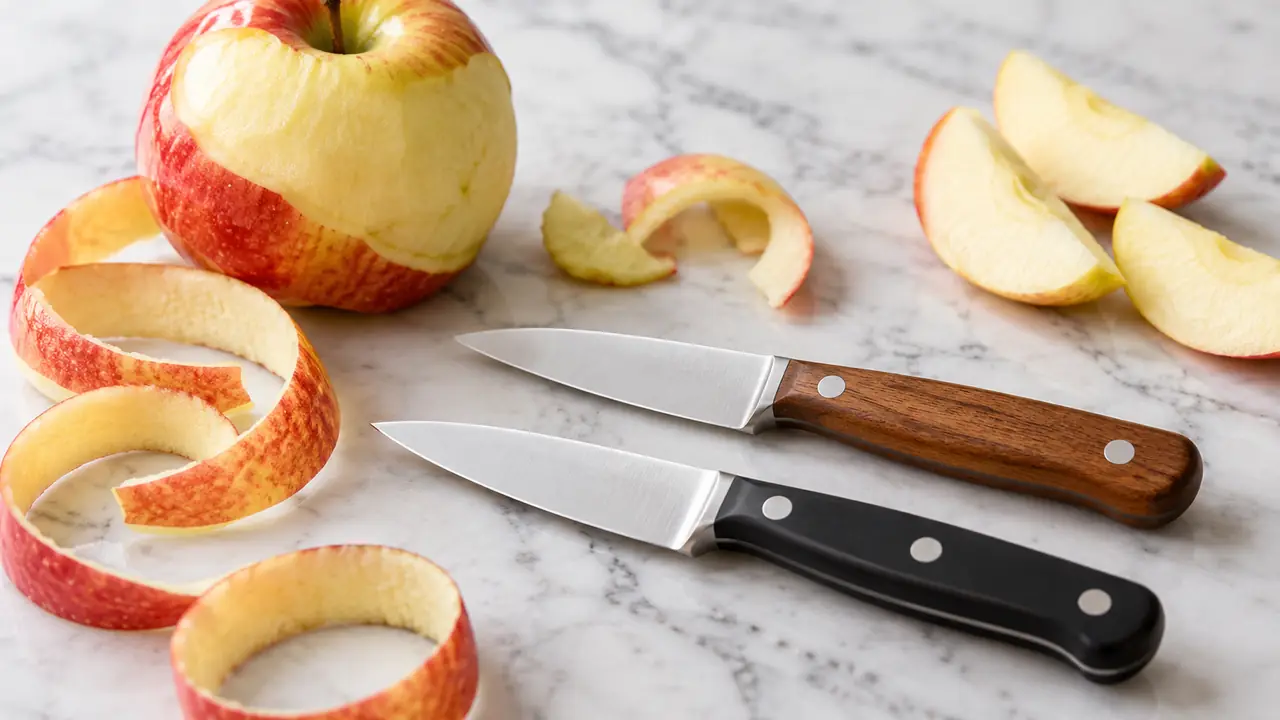
A paring knife earns its place beside the cutting board through small, precise jobs: peeling an apple, trimming green beans, coring a tomato, deveining shrimp, or shaping a garnish for a drink. The best paring knife should feel manageable during those close-up tasks, with a blade length that gives you control rather than unnecessary reach. A long chef’s knife can handle many ingredients, but it is awkward for work held in the palm or guided by fingertips.
Blade length, edge construction, handle texture, and cleaning requirements matter more here than flashy styling. A 3.25-inch blade favors tight control, while a 4-inch model gives extra reach for larger produce. Forged designs may include a bolster and full tang, while stamped knives can be lighter and easier to maneuver. Steel descriptions also need careful reading. A listing may identify high-carbon stainless steel or a named alloy, but that alone does not establish edge retention or overall cutting performance.
The nine knives below cover compact everyday tools, forged Western-style options, Japanese-style fruit knives, and a two-knife set for households that want different blade lengths. The Cuisinart C77TR-3PR is the strongest overall match because it combines a useful 3.5-inch size, high-carbon stainless steel, full-tang construction, a bolster, and a blade guard without adding unnecessary complexity.
Quick Answer
- Cuisinart C77TR-3PR: Best Overall for everyday peeling, trimming, and small produce preparation. Its 3.5-inch blade, full-tang construction, bolster, and included guard make it a balanced all-purpose choice.
- Henckels Forged Accent 2-Piece Set: Best for households that want both a 3-inch and a 4-inch paring knife for different levels of control and reach.
- HOSHANHO 3.75-Inch Paring Knife: Best for fruit preparation and buyers drawn to a Japanese-style profile, a pointed tip, a pakkawood handle, and a listed 10Cr15CoMoV blade.
Best Paring Knife Comparison Table
| Product | Best For | Blade Length | Construction or Steel |
|---|---|---|---|
| Cuisinart C77TR-3PR | Everyday kitchen tasks | 3.5 inches | High-carbon stainless steel, full tang |
| HOSHANHO 3.75-Inch | Fruit peeling and garnishes | 3.75 inches | 10Cr15CoMoV, octagonal handle |
| Henckels Forged Accent Set | Two blade-length options | 3 and 4 inches | Forged bolster construction |
| Victorinox Swiss Classic | Compact, wet-hand use | 3.25 inches | Straight edge, textured handle |
| WÜSTHOF Classic | Traditional forged design | 3.5 inches | High-carbon stainless steel, full tang |
| MAD SHARK | General-purpose precision work | 3.5 inches | German molybdenum-vanadium steel |
| imarku | Japanese-style handling | 3.5 inches | High-carbon stainless steel, pakkawood |
| Henckels Solution | Lightweight 4-inch reach | 4 inches | Precision-stamped blade |
| Mercer Culinary Millennia | Garnishes and intricate cuts | 3.5 inches | High-carbon Japanese steel |
The detailed reviews explain how each knife’s size, construction, handle, and care requirements affect everyday preparation.
1. Cuisinart C77TR-3PR Triple Rivet Collection 3.5-Inch Paring Knife – Best Overall

The Cuisinart C77TR-3PR lands in a practical middle ground for everyday prep. Its 3.5-inch blade is short enough for peeling and detail work, while still offering enough edge for trimming vegetables or slicing small fruit. The listed high-carbon stainless steel construction suits buyers who want a corrosion-resistant kitchen knife without moving to a more specialized maintenance routine.
Its forged extra-wide safety bolster and full-tang construction give the knife a more substantial Western-style build. Stainless steel rivets secure the handle, and the included blade guard provides a simple storage option in a drawer or utensil area. The bolster may appeal to users who like a defined transition between handle and blade, though it can limit how far some grips move toward the edge.
Pros
- Useful 3.5-inch length for peeling, trimming, and small slicing.
- High-carbon stainless steel is suited to routine kitchen use.
- Full-tang construction and stainless steel rivets support a durable handle connection.
- Forged bolster provides a defined grip transition.
- Included blade guard helps with protected storage.
Cons
- The wide bolster may feel restrictive for users who prefer a close pinch grip.
- The listing does not provide a specific steel grade or hardness value.
This is the best fit for a home cook who wants one conventional paring knife for a broad mix of small tasks. It is less compelling for someone seeking an especially thin Japanese-style blade or a minimalist, bolster-free handle. The blade guard adds practical value for drawer storage, while the full-tang build makes it a more substantial choice than many lightweight stamped knives.
To buy this product, click here.
2. HOSHANHO 3.75-Inch Paring Knife – Best for Fruit Preparation

This HOSHANHO model is shaped around controlled fruit and vegetable work. The listing identifies a 3.75-inch blade made from 10Cr15CoMoV steel, with a pointed tip suited to coring, garnishing, and tracing around irregular surfaces. It also lists a 60-plus Rockwell hardness rating and a 12-to-15-degree-per-side Honbazuke sharpening process. Those specifications describe a fine, precise edge, although they do not by themselves establish how long the edge will last in a particular kitchen.
An octagonal handle gives the knife a Japanese-style visual and handling direction. The shape may help users index the knife during careful cuts, while the compact blade keeps the working area close to the hand. Pakkawood adds a warm, traditional material choice, but buyers should still dry the knife promptly and follow the care guidance supplied with the product rather than treating the handle as maintenance-free.
Pros
- 3.75-inch blade offers control with slightly more reach than compact 3.25-inch models.
- Named 10Cr15CoMoV steel provides more information than a generic steel description.
- Pointed profile suits coring, peeling, and garnish preparation.
- Octagonal pakkawood handle supports a Japanese-style grip format.
- Listed hand-sharpened edge specification gives buyers a clear geometry reference.
Cons
- Pakkawood requires more careful cleaning and drying than a fully polymer handle.
- The listing does not document dishwasher suitability.
Choose this knife for close fruit work, cocktail garnishes, and users who prefer a compact Japanese-style handle. It may be less suitable for buyers who want a dishwasher-friendly tool or a traditional Western bolster. The more detailed steel and edge information is useful for shoppers comparing construction, but regular hand washing and appropriate sharpening remain part of ownership.
To buy this product, click here.
3. Henckels Forged Accent Two-Piece Paring Knife Set – Best Two-Knife Option

A two-piece set makes sense for households where one paring knife has to handle very different jobs. This Henckels package includes a 3-inch knife for close peeling and small produce, plus a 4-inch knife for extra reach around larger apples, potatoes, or vegetables. That distinction is more useful than a set that simply adds duplicate accessories.
Both knives use forged bolster construction, with a satin-finished blade described as finely honed for lasting sharpness. The set is listed as dishwasher-safe and suitable for peeling, coring, slicing, fruit, vegetables, and meats. Dishwasher compatibility can save time, although careful hand washing and drying generally give any sharp blade more controlled care over its service life.
Pros
- Includes two genuinely different blade lengths.
- 3-inch option favors close control for small produce.
- 4-inch option adds reach for larger ingredients.
- Forged bolsters provide a substantial Western-style construction.
- Dishwasher-safe listing offers convenient cleanup.
Cons
- Buying two knives may be unnecessary for shoppers who use one standard size.
- The listing does not identify a specific steel alloy or hardness value.
This set suits a busy kitchen where several people prepare food or where blade length changes from task to task. A solo cook with limited drawer space may prefer one 3.5-inch knife instead. The main advantage is flexibility: the shorter blade can handle delicate work, while the longer one gives the fingertips more room around larger produce.
To buy this product, click here.
4. Victorinox Swiss Classic 3.25-Inch Paring Knife – Best Compact Design

The Victorinox Swiss Classic keeps the format compact and straightforward. Its 3.25-inch straight-edge spear-point blade is well suited to peeling, trimming, and detail cuts where a short edge is easier to guide. A smaller blade can be especially useful for cooks who prepare fruit in the hand or work on a crowded cutting board.
The textured black handle is described as slip-resistant, including during wet-hand use, and the knife is listed as dishwasher-safe. Those details make it a practical choice for kitchens that prioritize quick cleanup and a secure surface over a decorative handle material. The available information does not identify the blade steel, so buyers who compare alloy designations will find less technical detail here.
Pros
- Compact 3.25-inch blade supports close, controlled cutting.
- Straight-edge spear-point profile suits common paring tasks.
- Textured handle is intended to resist slipping when wet.
- Dishwasher-safe construction simplifies cleanup.
- NSF approval is listed for the product.
Cons
- Short blade offers less reach around larger produce.
- The listing does not provide a specific steel designation.
This knife is a sensible match for cooks who prefer a small, light-feeling paring tool and do not need a long blade. It may feel limited beside a 3.75- or 4-inch knife when trimming larger vegetables. The handle and compact spear point keep the design approachable for everyday prep, while the dishwasher-safe listing reduces routine care demands.
To buy this product, click here.
5. WÜSTHOF Classic 3.5-Inch Paring Knife – Best Traditional Forged Design

The WÜSTHOF Classic is aimed at buyers who want a traditional forged Western-style paring knife. Its 3.5-inch blade covers the familiar range of peeling, trimming, herb work, and small slicing. The product is forged from a single piece of high-carbon stainless steel and uses a full tang, full bolster, and triple-riveted handle, giving it a construction profile suited to long-term kitchen ownership.
The full bolster creates a noticeable transition between handle and blade, which some cooks appreciate for grip definition and hand protection. It can also make sharpening the heel less convenient over time. WÜSTHOF recommends hand cleaning and avoiding glass, ceramic, and metal cutting surfaces, so this is a knife for buyers willing to give edge care some attention.
Pros
- 3.5-inch size handles common paring and trimming tasks.
- Forged from a single piece of high-carbon stainless steel.
- Full tang and triple rivets support the handle construction.
- Full bolster provides a defined hand transition.
- Manufacturer guidance clearly favors hand cleaning and suitable cutting surfaces.
Cons
- Hand washing is recommended rather than dishwasher cleaning.
- Full bolster construction may restrict some sharpening methods and grip styles.
This is a good choice for a cook who values traditional forged construction and plans to maintain the knife carefully. It is less fitting for a household that routinely puts every knife in the dishwasher or prefers a thin, lightweight blade with no bolster. The purchase case rests on construction and established handling design rather than extra accessories.
To buy this product, click here.
6. MAD SHARK 3.5-Inch Paring Knife – Best for Easy-Care Versatility

MAD SHARK’s 3.5-inch knife targets the broadest set of small kitchen jobs, including peeling, slicing, trimming, and fruit preparation. The listing identifies German molybdenum-vanadium steel and states that ice quenching produces a hardness above 58 HRC. That gives shoppers more construction information than an unspecified stainless-steel listing, although the stated hardness should not be treated as a direct measure of edge life.
The ergonomic 2.0 handle is intended to provide a secure grip and reduce hand fatigue, but comfort will still depend on hand size and grip style. This model is listed as dishwasher-safe and resistant to corrosion and stains, making it attractive for a kitchen where convenience matters. Hand washing remains a gentler routine for preserving a sharp edge and handle finish.
Pros
- Versatile 3.5-inch length suits peeling, slicing, and trimming.
- Named molybdenum-vanadium steel gives useful material context.
- Listed hardness exceeds 58 HRC.
- Ergonomic handle design emphasizes secure handling.
- Dishwasher-safe listing supports convenient cleanup.
Cons
- The listing does not provide the exact steel grade.
- Handle comfort cannot be assumed for every hand size.
This knife fits cooks who want a conventional size, an advertised corrosion-resistant build, and less concern about cleanup restrictions. Buyers seeking a named Japanese alloy or a wooden handle will find other options more informative. Its main trade-off is the gap between useful general specifications and the lack of a more detailed blade geometry description.
To buy this product, click here.
7. imarku 3.5-Inch Japanese High-Carbon Stainless Steel Paring Knife – Best Japanese-Style Handle

The imarku combines a compact 3.5-inch blade with a pakkawood handle and a stated Japanese high-carbon stainless steel construction. Its listed carbon content range and 58 HRC rating provide more detail than a broad “premium steel” label. The blade is described as taper-ground with a 9-to-15-degree edge per side, a specification that points toward controlled precision work such as peeling, mincing, and small vegetable cuts.
The pakkawood handle gives this knife a different character from the polymer-handled options in the lineup. It may appeal to cooks who prefer a warmer, more traditional surface, but the care instructions specifically say not to use a dishwasher. A satisfying heft is also claimed in the listing, though no measured weight is provided, so buyers should avoid assuming the knife will feel the same in every hand.
Pros
- 3.5-inch blade balances compact control with practical reach.
- Listed Japanese high-carbon stainless steel includes a stated carbon range.
- 58 HRC rating and taper-ground edge provide useful technical context.
- Pakkawood handle offers a distinct alternative to plastic handles.
- Lifetime satisfaction support is stated in the product information.
Cons
- Dishwasher use is specifically discouraged.
- Published information does not provide a measured knife weight or handle dimensions.
Select this model for a Japanese-style presentation, a wooden composite handle, and more detailed edge information. Skip it if dishwasher convenience is central to your routine or if you prefer a clearly documented weight. Its appeal is strongest for careful hand washing, fruit preparation, and cooks who enjoy a more distinctive handle than a standard black polymer design.
To buy this product, click here.
8. Henckels Solution 4-Inch Paring Knife – Best Lightweight Reach
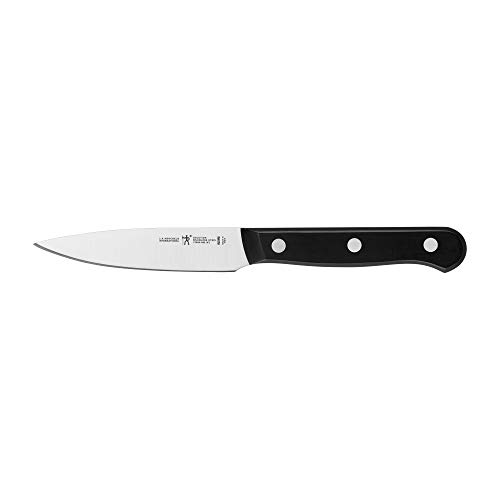
The Henckels Solution is the longest single-blade option in this group, with a 4-inch edge intended for peeling, coring, slicing, and general produce preparation. That extra length gives more cutting surface around larger apples, potatoes, and vegetables, though it can feel less nimble for tiny garnish work than a 3.25-inch knife.
Its precision-stamped, single-piece blade construction keeps the design lighter than the forged models listed above. The satin-finished blade is described as finely honed, and the product is listed as dishwasher-safe. Buyers get a straightforward work knife rather than a named steel or specialty Japanese profile, which may be precisely the point for routine meal preparation.
Pros
- 4-inch blade provides useful reach around larger produce.
- Single-piece stamped construction supports a lighter format.
- Suitable for peeling, coring, slicing, fruits, vegetables, and meats.
- Dishwasher-safe listing simplifies cleanup.
- Satin-finished blade is described as precision-honed.
Cons
- Longer blade may feel less controlled for very small detail work.
- The listing does not identify a specific steel alloy or hardness value.
This knife makes sense for cooks who often move between small produce and larger vegetables and want a light 4-inch option. It is less appealing for palm-held fruit peeling where a shorter blade gives closer control. The stamped construction and dishwasher listing keep ownership simple, while the lack of a named steel limits technical comparison with the Japanese-style alternatives.
To buy this product, click here.
9. Mercer Culinary M22003 Millennia 3.5-Inch Paring Knife – Best for Garnishes and Intricate Cuts

The Mercer Culinary Millennia is built around small, detailed tasks. Its 3.5-inch blade is listed for garnishes, seeding jalapenos, deveining shrimp, trimming beans, and other intricate cuts. That task list gives the knife a clear identity: it is aimed at controlled preparation rather than large-volume chopping.
The one-piece high-carbon Japanese steel blade is described as easy to maintain, while the handle uses textured finger points for grip and safety. Mercer recommends hand washing with mild soap, rinsing, and complete drying, and advises against dishwashers or prolonged submersion. This care routine is simple, but it does require more attention than a knife explicitly listed as dishwasher-safe.
Pros
- 3.5-inch length suits detailed kitchen preparation.
- High-carbon Japanese steel is identified in the product information.
- Textured finger points support a more secure grip.
- Task range includes garnishes, shrimp, beans, and small slicing.
- Hand-washing guidance is clear and practical.
Cons
- Dishwasher use is specifically discouraged.
- The listing does not provide a precise steel grade or hardness value.
This is a useful choice for cooks who regularly make garnishes, trim narrow vegetables, or prepare seafood in small portions. It may be less convenient for households that prioritize dishwasher cleaning. Compared with a bolster-heavy forged knife, the one-piece design keeps attention on finger control and detailed work, which is where this Mercer model has its clearest role.
To buy this product, click here.
Buying Guide
Match Blade Length to the Job
Most paring work takes place close to the fingertips, so a short blade is often easier to direct. The 3.25-inch Victorinox favors compact control, while 3.5-inch knives such as the Cuisinart, WÜSTHOF, imarku, MAD SHARK, and Mercer offer a middle path. A 3.75- or 4-inch blade gives more reach around larger produce, but it may feel less precise for tiny garnishes. Think about the ingredients that regularly land beside your board before choosing by length alone.
Understand the Blade Profile
A spear-point or pointed paring blade can help with coring, piercing, and detail work. A straight edge is useful for trimming and controlled slicing. Product listings do not always provide a complete grind or belly description, so avoid assuming that a knife with a Japanese-style label has the same geometry as every Japanese knife. The HOSHANHO fruit-focused models emphasize pointed tips and close produce work, while the Western-style forged knives emphasize a bolster and conventional handle transition.
A curved small blade and a straighter one serve different movements; the bird’s-beak and straight-paring comparison helps explain that choice.
Read Steel Claims Carefully
Named materials provide useful context, but they do not tell the entire performance story. The imarku lists high-carbon Japanese stainless steel and 58 HRC, while the HOSHANHO 3.75-inch model identifies 10Cr15CoMoV and a 60-plus HRC claim. MAD SHARK identifies German molybdenum-vanadium steel and a hardness above 58 HRC. These figures can help compare the available information, but they do not guarantee edge retention, toughness, or ease of sharpening.
Choose a Handle and Construction You Can Maintain
Forged, full-tang knives with bolsters, such as the Cuisinart and WÜSTHOF, provide a substantial traditional format. Stamped or one-piece designs, such as the Henckels Solution and Mercer Millennia, may be lighter and more direct. Pakkawood handles on the HOSHANHO and imarku models require more care than polymer handles. Grip texture matters around wet produce, but ergonomic claims remain personal because hands differ in size, reach, and preferred grip.
Plan for Cleaning and Storage
Several products are listed as dishwasher-safe, including the Victorinox, MAD SHARK, Henckels Solution, and Henckels Forged Accent set. Others specifically favor hand washing, including the WÜSTHOF, imarku, and Mercer Millennia. A blade guard, supplied with the Cuisinart, is useful for drawer storage. Regardless of the model, keep a sharp knife separated from loose utensils and dry it before storage to limit unnecessary moisture exposure.
Use a Suitable Cutting Surface
Small blades still need an appropriate cutting board. Hard surfaces such as glass, ceramic, and metal can be unsuitable for preserving a sharp edge, and WÜSTHOF specifically advises avoiding them. A stable board with a knife-friendly surface gives the edge a more forgiving place to meet the food. No paring knife should be treated as a tool for hard bones, frozen food, or other materials outside its intended kitchen role.
Best Paring Knife FAQ
What Blade Length Is Best for a Paring Knife?
A blade between about 3 and 4 inches covers most kitchen paring work. Choose around 3.25 inches for close control and palm-held fruit preparation, or move toward 4 inches for more reach around larger produce. The 3.5-inch size is a flexible middle option for many kitchens.
Is a Paring Knife the Same as a Petty Knife?
The terms can overlap in casual product listings, but a petty knife generally refers to a small Japanese utility knife, while a paring knife is a broader kitchen category. Product shape, blade length, edge design, and intended tasks matter more than the label alone. Check the actual specifications instead of assuming the names indicate identical construction.
Are High-Carbon Stainless Steel Paring Knives Rust-Proof?
No. Stainless steel generally offers improved corrosion resistance, but it is not immune to staining or rust. Wash and dry the knife promptly, avoid prolonged moisture, and follow the care instructions for the exact handle and blade materials.
Can These Paring Knives Go in the Dishwasher?
Some listings identify dishwasher suitability, including the Victorinox Swiss Classic, MAD SHARK, Henckels Solution, and Henckels Forged Accent set. The WÜSTHOF, imarku, and Mercer Millennia listings recommend or require hand care. Dishwasher use can expose knives to heat, detergent, movement, and moisture, so hand washing is usually the more controlled routine when the manufacturer allows it.
What Is a Paring Knife Used For?
Common jobs include peeling, coring, trimming, slicing small fruits and vegetables, removing blemishes, making garnishes, seeding peppers, and deveining shrimp. A paring knife is intended for precise food preparation. It should not replace a chef’s knife for large ingredients or a specialized boning knife for separating meat from bones.
Specialist small knives are optional additions. Consider the essential kitchen-knife roles before buying several tools for the same preparation.
Is a Full-Tang Paring Knife Better Than a Stamped Knife?
Neither construction is automatically better for every cook. A full-tang knife extends the blade material beneath the handle and often appears in more substantial forged designs. A stamped knife can be lighter and easier to maneuver. The right choice depends on grip preference, task control, maintenance, and how much handle weight you want.
How Should a Paring Knife Be Sharpened?
Use a sharpening method that suits the knife’s edge and follow the maker’s guidance where available. A paring knife can be maintained with the same general care principles as other double-bevel kitchen knives, but the short blade requires controlled passes and careful finger placement. Honing and sharpening are different processes, and a honing rod does not replace removing worn metal to create a new edge.
Final Verdict
The Cuisinart C77TR-3PR is the strongest overall choice in this group because its 3.5-inch blade fits the central paring-knife workload and its high-carbon stainless steel, full tang, bolster, riveted handle, and blade guard cover the practical details many home cooks need. It is a conventional, adaptable pick for peeling, trimming, coring, and small slicing without forcing the buyer into a specialized handle or maintenance routine.
Choose the Henckels Forged Accent set if two blade lengths would genuinely help your kitchen, or select the HOSHANHO 3.75-inch model if fruit preparation, a pointed Japanese-style profile, and a pakkawood handle are the priority. The Victorinox is the compact, easy-care alternative, while the WÜSTHOF suits buyers who prefer traditional forged construction and hand maintenance. Before buying, match the blade length to your ingredients, check the care instructions, and choose the handle format you can control comfortably during close work.
