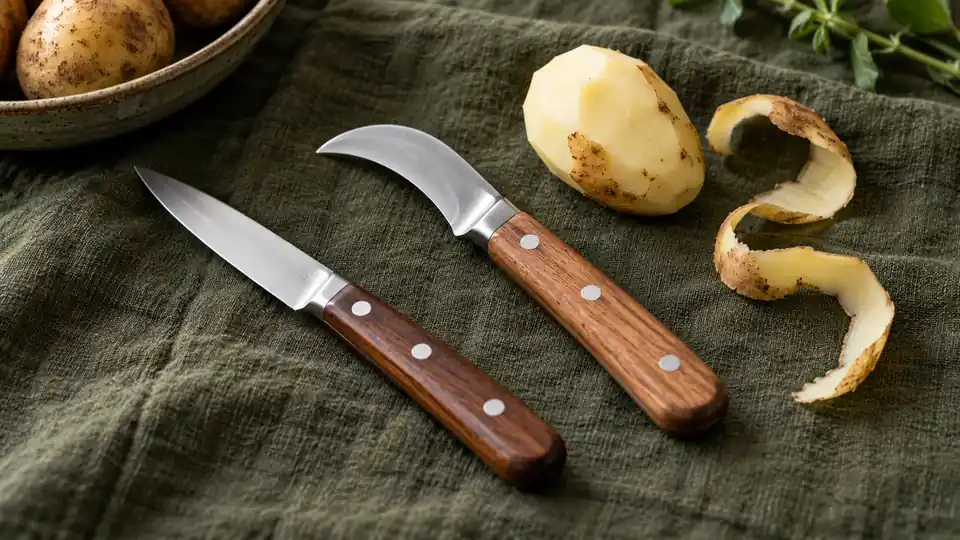
A bird’s-beak knife has a short, inward-curving edge that can follow rounded produce during peeling and shaping. A conventional straight paring knife is more adaptable to short slices, trimming, and other small cuts on a board. Choose according to the movement you need: a concave edge and a straighter edge do not contact food in the same way.
If rounded produce and close shaping work are your main tasks, compare bird’s-beak paring knives with the blade shape in mind. The explanation below shows why a straight paring knife remains more versatile for many small cuts.
The Curve Changes Where the Edge Meets the Food
The hooked tip of a bird’s-beak knife, also called a tourné knife, turns toward the cutting edge. That shape can bring a small area of edge into close contact with a rounded surface. It is useful for detailed shaping, but it does not provide the broad, relatively straight contact line of a typical paring blade.
A straight paring knife usually has a pointed tip and an edge that may be straight or gently curved. “Straight” here distinguishes it from the distinctly concave bird’s-beak shape; it does not mean every model has an identical profile.
Made In’s comparison of the two shapes identifies peeling and shaping as reasons for a bird’s-beak blade. Its product examples should not be treated as universal specifications for every small knife.
Compare the Task Before Comparing the Handle
| Task | Bird’s-beak profile | Straight paring profile |
|---|---|---|
| Following a rounded peel | The inward curve can maintain close local contact. | Works through short, controlled cuts but follows a different angle. |
| Shaping a small vegetable | Useful when the shape calls for curved, detailed cuts. | Useful for ordinary trimming and straight facets. |
| Small slices on a board | The concave edge may leave sections out of contact. | Usually a more straightforward profile. |
| General small-food preparation | A specialized addition. | Often the more adaptable first small knife. |
The table describes geometry, not a guarantee that one model performs every listed task better. Blade thickness, sharpness, tip shape, and handle fit can change the experience substantially.
Peeling and Shaping Rounded Produce
A curved blade can be useful when removing a thin strip of peel, trimming a rounded blemish, or shaping a small piece of produce for presentation. Small cuts limit how much material is removed at once. There is no need to make a long uninterrupted peel to use the tool successfully.
Control matters more than decorative results. Keep the cutting path clear of fingers and the body, and choose a supported position for the ingredient. If the movement requires pulling an exposed edge toward the holding hand, change the setup or use a different tool. A vegetable peeler may be a more convenient choice for routine peeling.
Not every kitchen benefits from a separate shaping knife. If the curved work rarely occurs, the additional blade may spend more time needing storage and care than solving a recurring problem.
Straight Cuts on a Board
For trimming, halving small produce, or cutting short pieces, a conventional paring blade is often easier to position. Its edge can meet the board along more of its length, and its tip does not hook into the food in the same way.
Compare straight paring knives for small cuts if that is your main use. A small knife still has limits: forcing it through a large ingredient or asking it to span a broad surface can make the work less controlled than using a suitable larger knife.
Citrus provides a useful example of a task with more than one method. Removing peel and releasing separate segments differs from tracing around fruit that remains in its skin. The guide to halving and sectioning a grapefruit separates those approaches rather than treating every curved blade as a grapefruit tool.
Length, Clearance, and Grip Still Matter
Look at the usable blade rather than only the advertised length. A deeply hooked tip reduces the straight reach available for a short slicing cut. A longer handle may feel easier to control for one person but crowd the work area for another.
Check whether the handle and bolster leave room for the grip and motion you intend to use. No “ergonomic” description can establish that a knife fits every hand. If a small food item cannot be held with adequate clearance, do not keep working merely because the knife is small.
A Concave Edge Needs an Appropriate Sharpening Route
A standard flat abrasive or fixed-slot sharpener may not contact the whole inward curve correctly. Running the blade through an unsuitable device can change the profile or leave areas untouched. Follow the knife maker’s instructions, and use professional service if the required method is unclear.
Cleaning and storage also depend on the particular construction. Hand washing, prompt drying, and protection from loose utensils are sensible starting habits, but do not infer dishwasher approval or a specific edge angle from the knife’s shape.
When One Small Knife Is Enough
For a first small kitchen knife, a conventional paring shape usually covers a wider spread of everyday tasks. Add a bird’s-beak knife when you can name the curved preparation work it will handle. Neither knife automatically replaces a utility knife, a petty knife, or a chef’s knife with different dimensions.
The broader guide to which kitchen knives you actually need can help place this decision in context. A useful collection is defined by recurring jobs, rather than by having one example of every blade shape.
