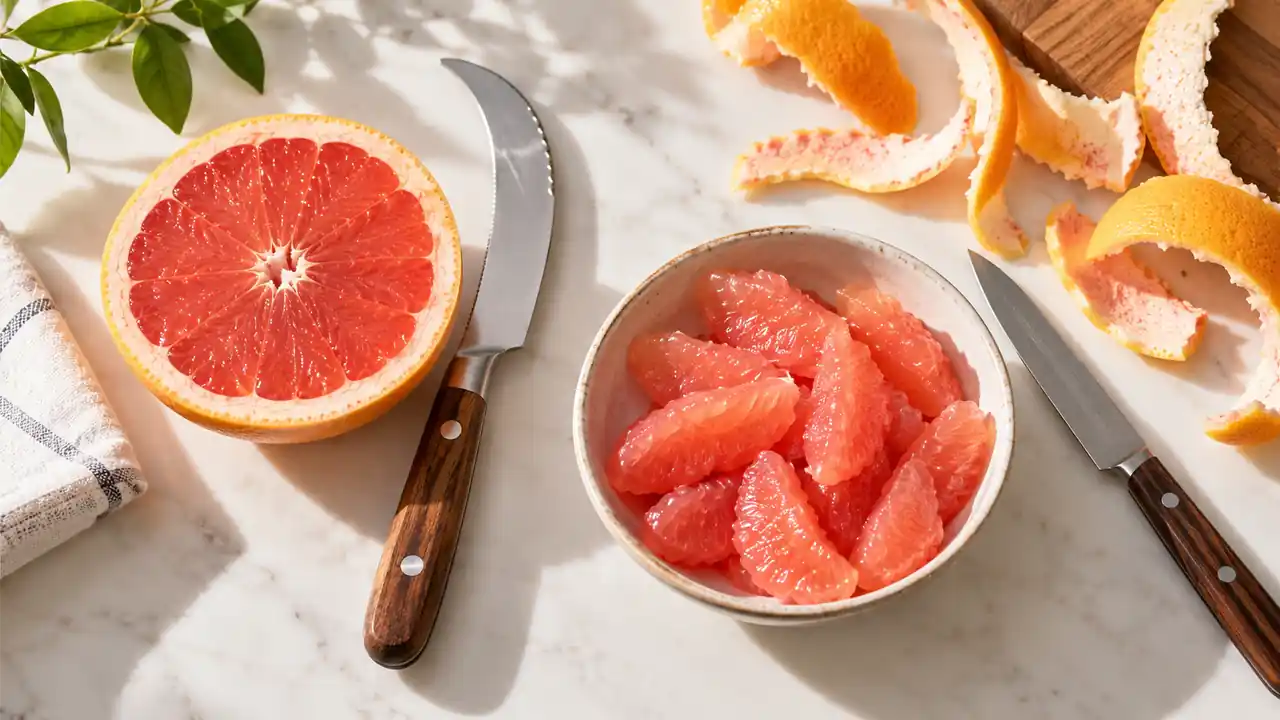
For a grapefruit served in its peel, halve the fruit and separate the flesh from the surrounding rind and membranes. For loose, membrane-free sections, remove the peel and white pith first, then cut beside the membranes to release each segment. These are different preparations: the first preserves a bowl-like half, while the second produces pieces for a salad or other dish.
For serving grapefruit in its peel, a purpose-built grapefruit knife can help separate flesh from the rind and membranes. Making peeled, separate sections is a different task and does not require the same tool.
Decide How the Fruit Will Be Served
A breakfast half needs the sections loosened enough to lift out with a spoon. There is no advantage in removing the entire peel if that is the presentation you want. Conversely, a bowl of loose segments is easier to prepare by peeling the whole fruit rather than trying to scoop every section from a half.
Round slices are another option. They keep the membranes and may retain the rind, depending on the recipe. They are quick to produce, but they are not the same result as peeled sections.
Prepare the Fruit and Board
Wash the outside before cutting, dry it, and use a clean board that stays in place. Even when the peel will be discarded, the knife passes through the outside. The FDA’s produce-cleaning advice explains why rinsing comes before peeling or cutting.
Set a bowl nearby for usable juice and keep a separate place for peel and membranes. A crowded board encourages the fruit to slide against scraps just when a controlled cut is needed. Do not try to hold a wet whole grapefruit above the bowl while making the initial cuts.
Loosen the Sections in a Grapefruit Half
- Halve the grapefruit across its middle. Put the fruit on the board and use a suitable sharp kitchen knife. Keep the holding fingers outside the cutting path.
- Rest a half cut-side up. If it rocks, stabilize the work position before continuing. Avoid cutting while the half is balanced in your palm.
- Separate the flesh from the rind. With a tool intended for the job, follow the inner boundary between the fruit and the white pith. Use small, controlled movements rather than forcing a deep circular cut.
- Release the sides of each section. Work beside the membranes so the fruit can be lifted with a spoon. Different grapefruit-knife designs have different cutting surfaces; use the part intended for this step.
- Check for seeds and remaining attachments. Remove seeds with a utensil. Put the cutting tool down before changing how the fruit is supported.
You do not need to remove every trace of membrane to serve a half successfully. If a section remains attached at its base, loosen it gently with the appropriate utensil instead of levering against the knife tip.
Make Separate, Membrane-Free Sections
A small, sharp straight-edged knife gives useful control for this method. The paring-knife comparison covers that general style of tool; a specialized grapefruit knife is not necessary for every way of preparing the fruit.
- Create a stable base. On the board, trim a small amount from the top and bottom so the fruit can stand securely.
- Remove the peel in strips. Work down the curve of the fruit, removing the outer rind and white pith in controlled passes. Turn the fruit between cuts, keeping the holding hand away from the blade’s path.
- Inspect the peeled surface. Trim remaining patches of pith without making deep cuts into the flesh.
- Lay the fruit in a stable position. Expose one segment clearly. Make a cut just inside one membrane, then a second cut beside the neighboring membrane to release the flesh.
- Transfer each segment to the bowl. Continue around the fruit, repositioning it as necessary. Work slowly as the remaining structure becomes smaller and less stable.
Do not pursue a perfect final segment if the remaining fruit can no longer be supported securely. The leftover membranes can hold juice without every last piece needing a knife cut. This preparation is reflected in Florida Citrus’s instructions for releasing grapefruit segments, which distinguish removing pith from cutting between the membranes.
Choose Slices or Wedges When That Is Enough
For a recipe that keeps the membranes, place the fruit securely on the board and make crosswise slices of the thickness required. To make wedges, halve it first, then cut each half into manageable portions on a stable cut face.
The result should suit how it will be eaten. Thin slices may be convenient for a garnish; peeled segments are easier to combine with other salad ingredients. There is no need to perform the more involved sectioning method when a simple wedge meets the recipe’s purpose.
Common Problems During Sectioning
- Too much white pith remains. Make an additional shallow trimming pass before releasing segments. Do not compensate by cutting deeply into every section.
- The flesh breaks apart. Reduce squeezing, support the fruit more securely, and choose larger sections. Very soft fruit may be better suited to pieces than a precise presentation.
- The knife snags on a membrane. Stop, change the approach, and check the edge. Forcing the knife can tear the fruit and lose control.
- Juice makes the board slippery. Pause to transfer juice and wipe the surface before continuing.
A grapefruit tool is useful only when its shape matches the preparation. For the broader distinction between a specialized utensil and an everyday knife, see which kitchen knives belong in a practical home collection. Finish by cleaning the tools and refrigerating prepared fruit promptly when it will not be served immediately.
