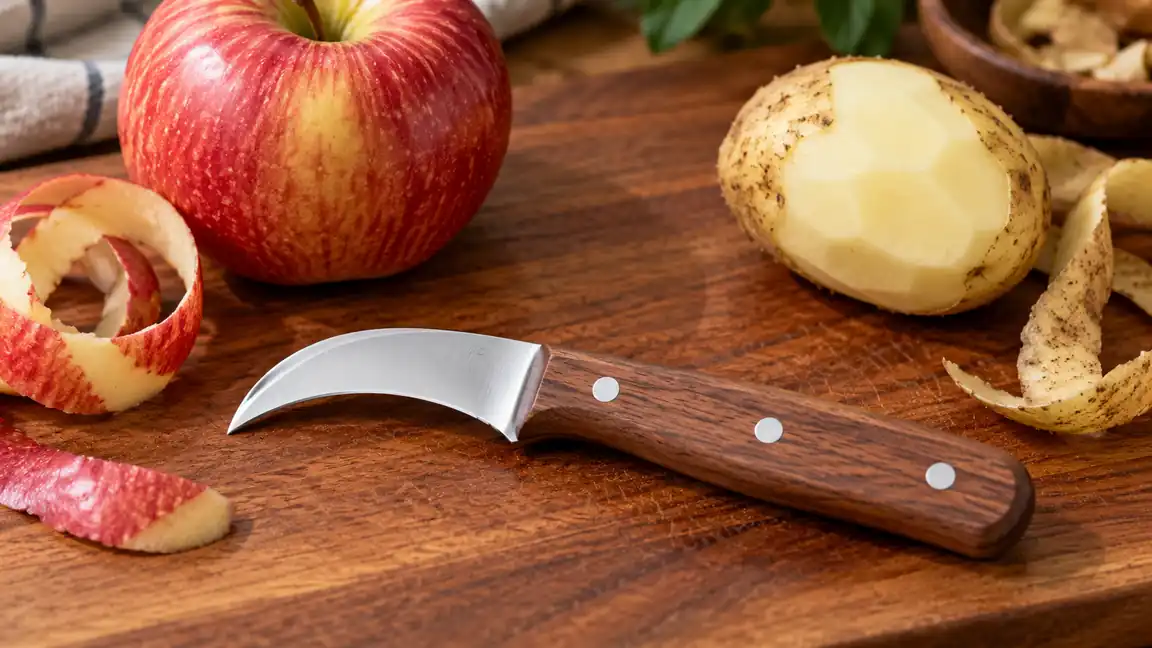
A bird’s beak paring knife earns its place beside a standard paring knife when the job involves curved surfaces, tight corners, or small decorative cuts. Its short inward-curved blade can follow the shape of an apple, potato, pear, citrus fruit, or shrimp more closely than a straight edge. That makes it useful for peeling thin strips, removing blemishes, coring, hulling, and shaping garnishes without taking away more flesh than necessary.
The main mistake is treating every small curved knife as interchangeable. Blade length changes how much control you have around small produce, while a longer 3.5-inch profile can be more useful for larger ingredients and shrimp preparation. Steel, edge angle, handle material, tang construction, and cleaning instructions also shape ownership. A compact Japanese-style knife may suit detailed garnish work, while a sturdier Western-style option may feel more familiar for everyday prep.
This guide compares nine genuine bird’s beak and tourné knives, including individual knives and two useful paring-knife combinations. The ranking favors documented blade design, relevant dimensions, construction, handle details, and maintenance requirements rather than branding alone. Different cooks will want different things from this specialized tool, so the strongest choice for decorative work may differ from the best fit for routine peeling or a mixed paring-knife drawer.
Quick Answer
Made In Cookware 3-Inch Bird’s Beak Paring Knife is the strongest overall match for shoppers seeking a purpose-built tourné knife with a documented 2.72-inch blade, 2.3 mm thickness, full-tang construction, and fully forged stainless steel build. Its thin blade is specifically suited to detailed fruit and vegetable work.
Shun Classic 2.5-Inch Bird’s Beak Knife is the leading choice for buyers who want a Japanese-made specialty knife with a VG-MAX core, Damascus cladding, Pakkawood handle, and documented 16-degree edge. For a more familiar German-style option, ZWILLING Twin Signature offers a 2.75-inch blade, stated 57 HRC hardness, and dishwasher-safe listing guidance.
Best Bird’s Beak Paring Knife Comparison Table
| Product | Best For | Blade Length | Construction |
|---|---|---|---|
| Made In Bird’s Beak, Truffle Black | Best overall | 2.72 inches | Forged stainless steel, full tang |
| Shun Classic Bird’s Beak | Japanese precision work | 2.5 inches | VG-MAX core, Damascus cladding |
| ZWILLING Twin Signature | Easy-care German-style prep | 2.75 inches | FRIODUR steel, full tang |
| MAC Chef Series | Lightweight detail work | 2.5 inches | 2 mm blade, Pakkawood handle |
| OAKSWARE Bird Beak Knife | Everyday curved peeling | 2.75 inches | X50CrMoV15, full tang |
| Huusk Black Bird’s Beak | Protected inward strokes | 2.7 inches | Japanese stainless steel, resin handle |
| 3.5-Inch Bird Beak Knife | Larger produce and shrimp | 3.5 inches | X50Cr15MoV, Pakkawood handle |
| WELLSTAR Bird’s Beak Knife | One-piece steel construction | 2.5 inches | DIN1.4116, stainless handle |
| CoquusAid Two-Knife Set | Mixed paring tasks | 2.75-inch curved knife | High-carbon stainless steel |
The detailed reviews below explain how each blade profile and handle design fits different kitchen routines.
1. Made In Cookware 3-Inch Bird’s Beak Paring Knife — Best Overall
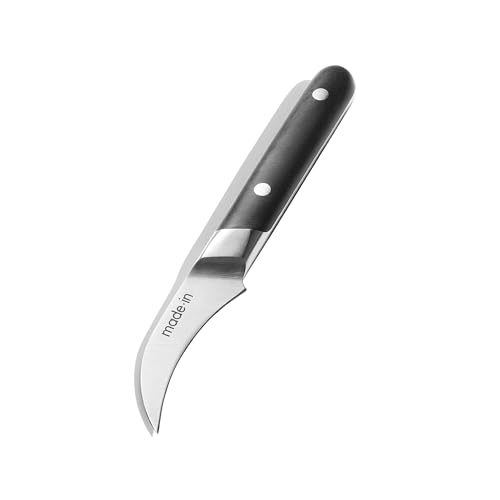
The Made In knife has the clearest specification set in this group for cooks who want a dedicated tourné tool. Its listed 2.72-inch blade is short enough for controlled work around berries, potatoes, and small vegetables, while the .87-inch blade height gives the curved edge useful contact with rounded surfaces. The 2.3 mm thickness also places it firmly in the category of a compact detail knife rather than a general-purpose paring blade.
Its fully forged stainless steel construction and full tang point toward a substantial, traditional build. The listed 58+ Rockwell hardness provides useful context for buyers thinking about edge maintenance, although hardness alone cannot predict cutting results or edge life. The ultra-thin blade is particularly relevant for hulling berries and shaping decorative vegetables, where a broad or thick edge can feel clumsy.
Pros
- Documented 2.72-inch blade suits controlled curved-surface work.
- Fully forged stainless steel construction.
- Full tang extends through the handle for structural continuity.
- Ultra-thin blade is suited to hulling and decorative cuts.
- Available with a truffle black handle finish.
Cons
- The compact, specialized blade is less useful for general slicing.
- The listing does not provide a specific stainless-steel alloy designation.
This is the most balanced recommendation for someone who wants one serious bird’s beak knife for tournée cuts, fruit preparation, and careful vegetable shaping. Its documented dimensions make the intended use easy to understand, and the full forged construction separates it from simpler small peelers. Buyers who prefer a very light knife or who mainly peel large produce may find a different profile more practical.
To buy this product, click here.
2. Shun Classic 2.5-Inch Bird’s Beak Knife — Best Japanese-Style Design

Shun’s compact 2.5-inch bird’s beak knife is aimed squarely at detailed fruit and vegetable work. The product information identifies a VG-MAX core with 68 layers of Damascus stainless-steel cladding, so the patterned exterior is tied to a documented layered construction rather than being presented as a vague decorative finish. Its short blade should give cooks close control for hulling, coring, and small garnish cuts.
The D-shaped Pakkawood handle is listed as suitable for both left- and right-handed users, which matters for a knife used with inward strokes and close fingertip control. A stated 16-degree edge is also relevant for sharpening decisions, although it should not be treated as a universal instruction for every sharpening system. Shun lists free sharpening and honing support, a useful ownership feature for buyers who prefer an established maintenance path.
Pros
- Compact 2.5-inch blade fits intricate fruit and vegetable work.
- VG-MAX core is specifically identified.
- 68-layer Damascus stainless-steel cladding is documented.
- D-shaped Pakkawood handle is listed for left- and right-handed use.
- Product information includes sharpening and honing support.
Cons
- The short blade offers limited reach on larger produce.
- Damascus construction and specialty design may be more than casual peelers need.
This knife makes sense for cooks who enjoy precise garnishes or want a Japanese-made specialty blade for a carefully equipped kitchen. The 2.5-inch length favors detail over reach, so a longer curved knife is more practical for shrimp or broad peeling strokes. Treat the stated edge angle as useful reference information, not proof of superior performance without matching maintenance.
To buy this product, click here.
3. ZWILLING Twin Signature 2.75-Inch Bird’s Beak Peeling Knife — Best for Easy-Care Prep
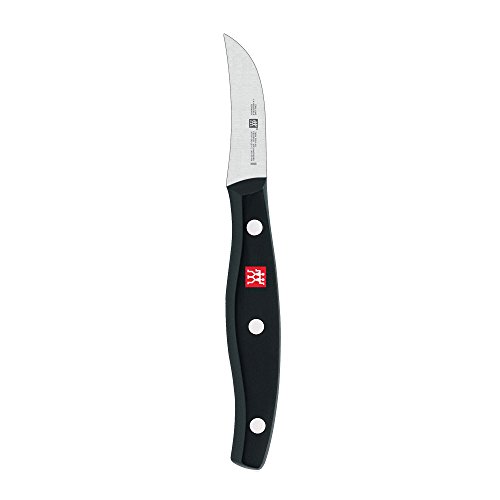
The ZWILLING Twin Signature sits in a practical middle ground. Its 2.75-inch curved blade offers more reach than the shortest 2.5-inch designs without moving far outside the compact tourné category. The product information lists special-formula German stainless steel, an ice-hardened FRIODUR blade, 57 Rockwell hardness, and a 15-degree edge per side.
Its full tang and bonded polymer handle give the knife a conventional Western-style construction. The handle material is less sensitive to moisture than natural wood, and the listing identifies the knife as dishwasher safe. That convenience still deserves sensible care with any sharp blade, but it gives this model an ownership advantage for households that prefer simpler cleanup. The curved profile remains specialized, so it will not replace a straight paring knife for every small cutting task.
Pros
- 2.75-inch blade provides a useful balance of control and reach.
- Stated 57 HRC hardness and 15-degree-per-side edge.
- FRIODUR ice-hardened German stainless-steel construction is documented.
- Full tang and bonded polymer handle support a familiar knife format.
- Listing identifies the knife as dishwasher safe.
Cons
- Polymer construction may appeal less to buyers seeking a wood handle.
- The curved edge remains less versatile than a straight paring blade.
Choose this model for routine peeling, coring, and garnish work where straightforward care matters. It is a sensible fit for a busy home kitchen that does not want a wood-handled specialty knife requiring extra attention. Cooks focused on traditional Japanese construction or a particularly thin blade may prefer Shun or Made In instead.
To buy this product, click here.
4. MAC Chef Series Bird’s Beak Peeling Knife — Best Lightweight Option

MAC keeps this knife focused and compact with a 2.5-inch blade and a listed 2 mm thickness. That combination is relevant for cooks who spend time removing blemishes, shaping small vegetables, or making short, careful peeling strokes. A thinner blade can leave more room for close work, though the supplied information does not establish a particular grind or cutting performance.
The Pakkawood handle adds a warm, composite wood appearance to a knife intended for precise hand control. MAC identifies the knife as made in Japan and recommends hand washing, with dishwasher use excluded in the supplied details. That care requirement is easy to understand, but it means this option belongs with cooks who are comfortable cleaning and drying a specialty blade after use rather than dropping it into the dishwasher.
Pros
- Compact 2.5-inch blade is suited to close detail work.
- Documented 2 mm blade thickness.
- Lightweight design is specifically listed.
- Pakkawood handle offers a stable composite grip material.
- Made-in-Japan construction is identified in the product information.
Cons
- Hand washing is recommended, and the knife is not dishwasher safe.
- The short blade gives up reach on larger fruits and vegetables.
The MAC is a good match for a cook who values a small, light tool and already follows careful knife-cleaning habits. It should be viewed as a dedicated peeling and shaping knife rather than a substitute for a conventional parer. Buyers wanting a full list of steel or hardness specifications will find the available information less detailed than the Shun, ZWILLING, or Made In listings.
To buy this product, click here.
5. OAKSWARE Bird Beak Paring Knife — Best for Everyday Curved Peeling

OAKSWARE uses a familiar 2.75-inch bird’s beak profile for apples, potatoes, round vegetables, coring, and small garnishes. The listed X50CrMoV15 stainless steel gives shoppers a specific alloy designation rather than a broad reference to premium steel. Its stated 15-degree-per-side edge is useful information for maintenance, although actual sharpening should follow equipment and maker guidance.
The full-tang handle includes three rivets, and the product description emphasizes a substantial feel. That construction may appeal to cooks who prefer a more traditional Western paring-knife format instead of a slim minimalist handle. The knife is hand-wash only, so it belongs in a routine where the blade can be cleaned, dried, and stored safely after use.
Pros
- 2.75-inch curved blade suits common round produce.
- X50CrMoV15 steel is specifically identified.
- Full tang and three-rivet handle construction are documented.
- 15-degree-per-side edge is listed.
- Bird’s beak tip supports small garnish and coring tasks.
Cons
- Hand washing is required for the stated care routine.
- The listing provides limited information about overall dimensions and weight.
This is a practical choice for someone who wants a conventional bird’s beak knife for everyday produce prep without moving to a more elaborate specialty design. The blade length is versatile within this category, while the full-tang handle gives it a traditional visual and structural character. It is less compelling for shoppers who prioritize dishwasher convenience or detailed Japanese-style construction information.
To buy this product, click here.
6. Huusk Black Bird’s Beak Paring Knife — Best for a Finger-Guard Handle
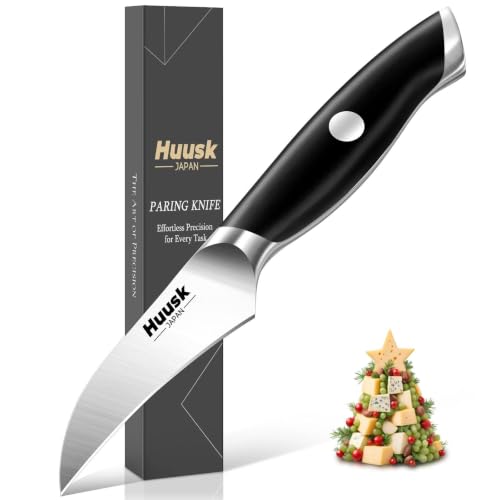
Huusk’s black-handled knife uses a 2.7-inch inward-curved blade for peeling, coring, trimming, and garnish work. The product information identifies Japanese stainless steel and a stated 59±1 HRC rating. That level of specification gives shoppers more context than an unnamed stainless-steel description, although it should not be read as a promise of edge life or cutting quality without independent testing.
The full-tang resin handle includes an integrated curved bolster described as a protective finger shield. For inward strokes around wet fruit or oily ingredients, that barrier may provide a useful separation between the fingers and blade heel. The handle is resin rather than wood, and the black finish gives the knife a contemporary appearance. Its compact length keeps it suited to small produce rather than large cutting jobs.
Pros
- 2.7-inch inward curve follows rounded produce.
- Japanese stainless steel and 59±1 HRC are listed.
- Full-tang resin handle construction is documented.
- Curved bolster provides a defined finger barrier near the blade.
- Useful for peeling, coring, trimming, and garnish work.
Cons
- The resin handle may be less appealing to buyers seeking wood or metal.
- Limited blade length reduces reach on larger ingredients.
Huusk is a sensible fit for cooks who place handle protection and a modern resin grip high on the list. The inward curve should be most useful around apples, potatoes, and similar produce, while the hooked tip can help with small blemishes. Buyers who prefer a lighter Japanese knife with a wood-composite handle may find MAC or Shun more aligned with their preferences.
To buy this product, click here.
7. 3.5-Inch Bird Beak Paring Knife — Best for Larger Ingredients and Shrimp

This knife breaks from the compact norm with a 3.5-inch curved blade. The extra reach is relevant for larger fruits, longer peeling strokes, and shrimp preparation. Its product description specifically mentions following the back of shrimp for butterflying and deveining, giving it a broader task range than a 2.5-inch tourné knife.
The blade uses X50Cr15MoV stainless steel, with a listed HRC 54 and an 18-degree edge on each side. Those details describe a stainless blade intended for controlled everyday prep, while the D-shaped Pakkawood handle gives the knife a fuller grip profile. A longer curved edge can be useful, but it also demands more care around small garnish work where a very short blade offers closer control.
Pros
- 3.5-inch blade adds useful reach for larger produce.
- Product information specifically supports shrimp deveining and butterflying.
- X50Cr15MoV steel is identified.
- HRC 54 and 18-degree-per-side edge are listed.
- D-shaped Pakkawood handle offers a defined palm-filling shape.
Cons
- Longer blade may feel less precise for very small garnish cuts.
- The supplied information does not state whether the handle is dishwasher safe.
Select this knife if your bird’s beak work includes shrimp, larger pears, or produce that makes a 2.5-inch edge feel cramped. It is a more task-specific alternative rather than a direct replacement for a tiny tournée knife. For berry hulling and miniature decorative cuts, Made In, Shun, or MAC provide more compact proportions.
To buy this product, click here.
8. WELLSTAR 2.5-Inch Bird’s Beak Paring Knife — Best One-Piece Construction

WELLSTAR takes a compact approach with a 2.5-inch curved blade and a solid stainless-steel handle. The available information identifies DIN1.4116 German stainless steel, HRC 56±2, and a 12-degree-per-side edge. Those details are useful for shoppers who want a clearly specified steel and edge geometry, though a narrower listed angle can require more careful sharpening compatibility.
The blade and handle are described as a one-piece stainless-steel construction, and the knife is supplied in a gift box. This format avoids a separate handle material and may appeal to cooks who value a uniform, moisture-resistant surface. Metal handles can feel different from resin, wood, or Pakkawood, so grip preference matters. The compact blade remains aimed at peeling, garnishing, and removing small blemishes.
Pros
- Compact 2.5-inch profile suits close detail work.
- DIN1.4116 stainless steel is specifically identified.
- Stated HRC 56±2 hardness and 12-degree-per-side edge.
- One-piece stainless-steel construction is documented.
- Gift-box packaging is included according to the listing.
Cons
- The all-stainless handle may not suit cooks who prefer a warmer grip material.
- The 12-degree-per-side specification calls for attention to sharpening-system compatibility.
WELLSTAR is a useful choice for buyers drawn to a seamless metal construction and a short blade for garnishes or blemish removal. It offers more technical information than several small specialty knives in this group. The narrow edge specification should encourage careful maintenance rather than casual use with an incompatible pull-through sharpener.
To buy this product, click here.
9. CoquusAid Two-Knife Paring Set — Best for Mixed Paring Tasks

CoquusAid is the most practical pick for someone who wants a bird’s beak knife alongside a conventional paring blade. The set includes a 2.75-inch curved knife and a 3.8-inch straight paring knife, so the buyer can switch between contour-following work and ordinary slicing, trimming, or chopping. That pairing is more useful than collecting two nearly identical curved knives.
The available description identifies high-carbon stainless steel, ergonomic nonslip handles, and a storage box suitable for drawer organization. It also mentions hollow dimples intended to help food release from the blade, although the information does not specify which blade carries that feature. The set is aimed at fruit and vegetable preparation, with garnish work included, but its additional knife means it takes more storage space than a single specialty tool.
Pros
- Includes both a 2.75-inch bird’s beak knife and a 3.8-inch straight paring knife.
- High-carbon stainless steel construction is identified.
- Nonslip ergonomic handle design is listed.
- Storage box supports drawer storage.
- Hollow-dimple food-release feature is included in the product description.
Cons
- Buyers seeking only a bird’s beak knife receive an additional blade they may not need.
- The supplied information does not identify the exact steel alloy or edge angle.
This set suits a cook building a small paring collection from scratch or replacing two separate tools at once. The straight 3.8-inch knife handles tasks that a curved bird’s beak edge does poorly, while the shorter knife remains available for rounded produce and garnish work. Choose an individual knife instead if drawer space is tight or you already own a dependable straight paring knife.
To buy this product, click here.
Buying Guide
Match the Curved Blade to the Cutting Task
A bird’s beak blade works through a different motion than a straight paring knife. The inward curve can follow the skin of an apple or potato while the pointed end handles eyes, blemishes, and small decorative cuts. A 2.5- to 2.75-inch blade generally favors close control, hulling, and garnish work. The 3.5-inch option in this guide offers more reach for larger produce and shrimp, but that extra length may feel less nimble around tiny ingredients.
The inward curve changes board contact and peeling control. The comparison of curved and straight paring blades explains when that specialization is useful.
Pay Attention to Blade Length and Thickness
Shorter blades keep the cutting area close to the hand, which can make small spherical fruit and vegetable work easier to manage. The Made In model lists a 2.3 mm thickness, while the MAC lists 2 mm. Those figures provide useful comparison points, but thickness alone does not reveal the complete grind or cutting geometry. Treat published measurements as part of the decision rather than a guarantee of performance.
Separate Steel Information From Marketing Language
Several knives list specific materials, including X50CrMoV15, X50Cr15MoV, DIN1.4116, VG-MAX, and Japanese stainless steel. A named alloy gives more useful information than a general phrase such as premium steel, but it still does not establish edge retention without knowing the complete heat treatment and geometry. Hardness figures should be read in the same careful way. They describe one material property, not the whole ownership experience.
Choose a Handle That Fits Your Maintenance Habits
Pakkawood, resin, polymer, and stainless-steel handles each create a different ownership profile. Wood-composite handles offer a traditional appearance, while resin and polymer can be easier to wipe clean. The WELLSTAR’s one-piece stainless construction has fewer separate handle components, while the OAKSWARE and several others use full-tang designs. Since detailed handle dimensions are not supplied for most models, avoid assuming that a listed ergonomic shape will suit every hand.
Check Cleaning and Sharpening Instructions
Some knives in this group are explicitly hand-wash only, including OAKSWARE and MAC. ZWILLING’s listing identifies its knife as dishwasher safe, while the supplied information does not establish a cleaning method for every model. A curved edge can be awkward to sharpen with a fixed-slot device, particularly where a specific edge angle is listed. The Shun’s 16-degree and WELLSTAR’s 12-degree-per-side descriptions should be treated as compatibility information, not as invitations to use any sharpener without checking its guidance.
Decide Whether You Need One Knife or a Pair
The CoquusAid set includes a curved 2.75-inch knife plus a 3.8-inch straight paring knife. That combination makes sense for cooks who want one blade for rounded surfaces and another for ordinary slicing. A single Shun, Made In, or ZWILLING is a cleaner purchase for someone who already owns a straight paring knife. Think about the tasks you actually perform rather than choosing a set based on the number of pieces alone.
Best Bird’s Beak Paring Knife FAQ
What is a bird’s beak paring knife used for?
It is intended for peeling and shaping rounded fruits and vegetables, removing blemishes, coring, hulling, and making small decorative cuts. The inward curve helps the blade follow a contour, while the pointed tip can reach tight spots such as potato eyes or citrus pith.
Is a bird’s beak knife the same as a tourné knife?
The terms are commonly used for the same general style of short, curved peeling knife. Tourné describes the French culinary technique of shaping vegetables, while bird’s beak refers to the hooked blade profile. Product naming varies, so check the actual blade shape rather than relying on the title alone.
Should I choose a 2.5-inch or 3.5-inch blade?
A 2.5-inch blade is generally better suited to close work such as hulling berries, peeling small produce, and creating garnishes. A 3.5-inch version offers more reach for larger fruits, longer peeling strokes, and tasks such as shrimp deveining. The shorter blade is usually easier to keep close to small ingredients.
Are bird’s beak knives suitable for left-handed cooks?
Check the handle and edge description for the exact product. The Shun listing specifically describes its D-shaped Pakkawood handle as suitable for both left- and right-handed users. Other listings do not provide the same explicit information, so a symmetrical handle or clearly identified ambidextrous design is preferable when handedness matters.
Can I sharpen a curved bird’s beak knife with a standard sharpener?
Compatibility depends on the sharpener and the knife’s edge design. A fixed-slot pull-through sharpener may not follow a short inward curve accurately, and it may not match a stated edge angle. Curved blades generally require a method that can reach the full edge without forcing the knife into an unsuitable guide.
Are these knives dishwasher safe?
Follow the exact product instructions. ZWILLING’s listing identifies the Twin Signature as dishwasher safe. OAKSWARE specifies hand washing, and MAC recommends hand washing and states that it is not dishwasher safe. The available information does not establish dishwasher guidance for every knife in this comparison, so avoid guessing for models without clear instructions.
Can a bird’s beak knife replace a standard paring knife?
It can cover some of the same small-prep tasks, but the curved profile is specialized. A straight paring knife is generally more convenient for trimming flat surfaces, slicing small ingredients, and making ordinary straight cuts. A two-knife set such as CoquusAid is useful for cooks who want both shapes available.
Final Verdict
The Made In Cookware 3-Inch Bird’s Beak Paring Knife is the best overall choice from this group because its intended purpose is clear and its key dimensions are documented. The 2.72-inch blade, 2.3 mm thickness, full tang, fully forged construction, and thin profile create a well-defined tool for tournée work, berry hulling, garnish cuts, and careful vegetable shaping. Shun is the strongest alternative for buyers who want a Japanese-made knife with a VG-MAX core, Damascus cladding, and Pakkawood handle.
ZWILLING is the more convenient choice for cooks who prefer a German-style knife with stated hardness, full-tang construction, polymer handling, and listed dishwasher suitability. MAC remains appealing for lightweight detail work, while the 3.5-inch curved knife makes more sense for shrimp and larger produce. Before buying, match blade length to your ingredients, check the cleaning instructions, and confirm that your sharpening method can accommodate a curved edge. The best bird’s beak knife is the one whose specialized shape matches the prep work you actually do.
