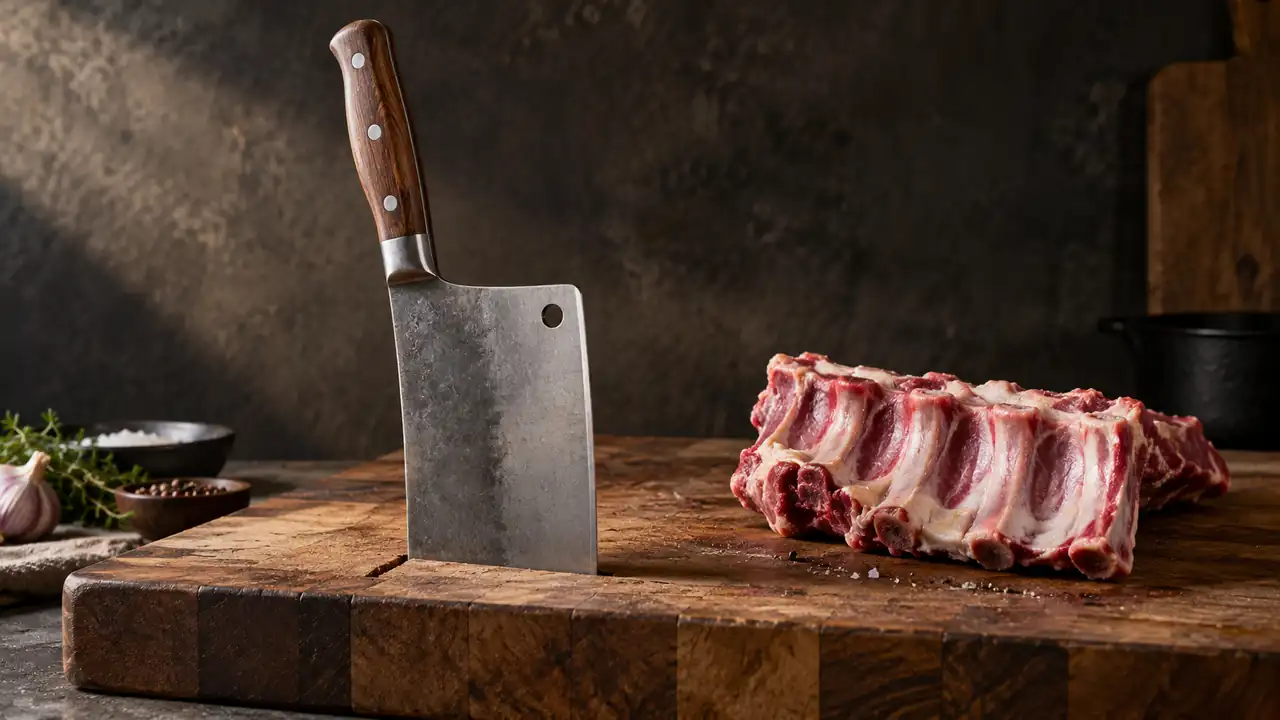
Breaking down poultry, trimming ribs, or separating joints calls for a different tool than a thin chef’s knife. A meat cleaver for cutting bone needs enough blade thickness, useful weight, and a handle that remains secure during controlled chopping. The right choice depends on whether you are preparing chicken and small poultry bones at home or handling denser cuts that demand a heavier butcher-style profile.
Blade length alone does not tell the full story. A broad 7-inch cleaver may offer better control on a crowded cutting board, while a 7.5-inch or 8-inch blade can provide more reach and mass. Edge geometry also matters. A knife with a fine double-bevel edge may handle vegetables and boneless meat more gracefully, while a thicker axe-style cleaver is better suited to repeated bone work. Steel descriptions vary widely, so maintenance needs, handle construction, and stated dimensions deserve as much attention as sharpness claims.
The nine products below cover compact kitchen cleavers, heavy butcher axes, and versatile models that bridge everyday food preparation with bone cutting. The Mueller leads the group because its 7-inch format, stated 18-degree double bevel, full tang stainless handle, and broad multi-use design create a well-rounded match for home users. Buyers who need more impact, easier portability, or a more refined everyday prep knife will find different strengths among the alternatives.
Quick Answer
The Mueller 7-Inch Meat Cleaver is the strongest overall choice for buyers who want a manageable kitchen cleaver with a stated 18-degree double-bevel edge, full tang construction, and a stainless steel handle. It is sized for poultry joints, ribs, brisket, and general prep without moving into the bulk of the heaviest butcher axes.
The MAD SHARK 7.5 Inch Meat Cleaver suits shoppers who prioritize mass and impact. Its listed 1.33-pound weight, 3.8 mm blade thickness, and broad 3.54-inch profile make it the more substantial option for denser bones and larger portions.
The SYOKAMI Meat Cleaver Chef Knife is the most versatile alternative for cooks who also want to slice vegetables, trim boneless meat, and strip herbs. Its listing describes separate slicing and bone-chopping zones, plus a wood handle, sheath, and herb stripper.
Best Meat Cleaver For Cutting Bone Comparison Table
| Product | Best For | Blade Details | Handle And Construction |
|---|---|---|---|
| Mueller 7-Inch Meat Cleaver | Overall kitchen use | 7 inches, 18° double bevel | Full tang stainless steel |
| ROCOCO Meat Bone Cleaver | Portable butcher-style work | 5 mm blade, 25° V edge | Full tang, wood handle, cover |
| HOSHANHO 7-Inch Cleaver | Mixed prep and lighter bone tasks | 2.3 mm, 15° per side | Japanese 10Cr15CoMoV steel |
| Kvlniqs Meat Bone Cleaver | Heavy chopping and outdoor use | 5.7-inch handle, 25° V edge | 30Cr13, teak, full tang |
| MAD SHARK 7.5-Inch Cleaver | Dense bones and larger cuts | 3.8 mm, 1.33 pounds | Full tang, ABS handle |
| SYOKAMI Meat Cleaver | Everyday versatility | 7.7 inches, two edge zones | Wood handle, sheath, herb stripper |
| Juvale 8-Inch Meat Cleaver | Long-blade kitchen prep | 8-inch stainless steel blade | Wood handle, hanging hole |
| 7-Inch Full Tang Butcher Knife | General-purpose home prep | 2.3 mm blade | Pakkawood, full tang |
| BLADESMITH 6.3-Inch Bone Chopper | Compact axe-style chopping | Thick blade, 7Cr17MoV | Pear wood, full tang |
The detailed reviews explain how each cleaver’s shape, construction, and maintenance requirements affect real kitchen use.
1. Mueller 7-Inch Meat Cleaver – Best Overall

The Mueller occupies a practical middle ground between a general kitchen cleaver and a dedicated butcher axe. Its 7-inch blade is broad enough for poultry joints, ribs, brisket, and vegetable preparation, while the available information lists an 18-degree double-bevel edge on both sides. That geometry suggests a knife intended to remain useful for slicing and chopping after the heavier work is finished, rather than a tool limited to splitting large bones.
A full tang stainless steel handle gives this model a continuous construction through the grip, and the handle itself is described as seamless stainless steel. That should appeal to cooks who dislike exposed joints or porous handle materials around raw meat. The listing also identifies a sharpened tip for scoring and detail work, plus a broad blade that can transfer chopped ingredients across the board. Hand washing is recommended for longer edge life, although the product information lists the handle as dishwasher safe.
Pros
- 7-inch blade suits poultry, ribs, brisket, and everyday chopping.
- Stated 18-degree double-bevel edge supports varied kitchen tasks.
- Full tang stainless steel handle offers a continuous construction.
- Broad blade can help scoop ingredients from the cutting board.
- Tip, edge, and blade width support scoring, mincing, and preparation beyond bone work.
Cons
- The listing does not provide a specific knife weight.
- Hand washing is preferable for edge care despite the dishwasher-safe handle description.
This is the cleaver for a home cook who might break down a chicken on Saturday and chop onions or squash on Sunday. It is less specialized than the heaviest axes here, so buyers regularly splitting very dense bones may prefer the MAD SHARK or BLADESMITH. For mixed kitchen use, however, the Mueller offers the clearest balance of size, stated edge geometry, and easy-clean construction.
To buy this product, click here.
2. ROCOCO Meat Bone Cleaver – Best Portable Butcher Design

The ROCOCO takes a more overt butcher-axe approach. Its listing describes a 5 mm-thick blade, a 25-degree V-shaped edge, and full tang construction paired with a wood handle. Compared with a thinner all-purpose cleaver, that thicker profile is aimed at controlled impact rather than delicate slicing. It is a sensible shape for poultry, ribs, and outdoor barbecue preparation where a substantial blade is more useful than a nimble chef-style edge.
The included Oxford cloth cover gives this model a portability advantage for camping, hunting, or outdoor cooking. That convenience comes with a maintenance responsibility. The product information specifically instructs users to clean and dry the knife after use, and a wood handle generally deserves more careful treatment than a seamless metal grip. The listing uses broad language about cutting frozen food and wood, but buyers should still reserve the edge for supported food-preparation tasks unless they accept the risk of damage.
Pros
- Listed 5 mm blade thickness suits heavy chopping applications.
- Full tang construction joins the blade and handle through the knife.
- 25-degree V edge is more substantial than a fine slicing edge.
- Oxford cloth cover supports transport and storage.
- Wood handle provides a traditional butcher-knife format.
Cons
- Wood requires prompt cleaning and drying after use.
- The thicker axe-style profile is less suited to fine slicing than a thinner cleaver.
Choose the ROCOCO if the knife will travel from the kitchen to a barbecue station or camp table. Its construction is oriented toward impact, and the cover is useful where a loose blade would be inconvenient. A cook seeking one cleaver for precise vegetable work may find the 25-degree edge and thick blade less agile than the Mueller or HOSHANHO.
To buy this product, click here.
3. HOSHANHO 7-Inch Cleaver – Best for Mixed Prep

HOSHANHO is the most chef-oriented knife in this selection. The published details list Japanese 10Cr15CoMoV stainless steel, a 2.3 mm blade thickness, and a 15-degree edge on each side. Those specifications point toward controlled cutting of meat, fish, vegetables, and poultry rather than repeated contact with large, hard bones. It belongs in this roundup because it is marketed as a meat chopper, yet its thinner construction makes the intended cutting range especially relevant.
The stated hardness is 58 plus or minus 2 HRC, but that figure should be read as a published specification rather than proof of measured edge retention. A relatively fine edge can be useful for clean prep, though it deserves more care around joints and bones than a heavy axe blade. The handle is described as ergonomic for extended use, while the maintenance instructions call for hand washing, thorough drying, and regular sharpening with a whetstone or suitable sharpener.
Pros
- 7-inch format provides useful control on ordinary cutting boards.
- Documented 10Cr15CoMoV stainless steel gives buyers a named steel designation.
- 15-degree-per-side edge favors precise slicing and vegetable preparation.
- 2.3 mm blade keeps the profile more versatile than a thick butcher axe.
- Published care instructions clearly call for hand washing and drying.
Cons
- The thinner 2.3 mm blade is less appropriate for very dense bone chopping.
- Regular sharpening is part of ownership.
This model fits a cook who wants a cleaver that can move between chicken preparation and a pile of vegetables without feeling overly specialized. It should be treated as a controlled chopping knife, not a substitute for a heavy bone breaker. If the work involves small poultry joints and frequent general prep, its finer edge may be more useful than the mass of a larger axe.
To buy this product, click here.
4. Kvlniqs Meat Bone Cleaver – Best for Outdoor Chopping

Kvlniqs uses the visual language of a compact kitchen axe, with a front-heavy profile and a blunt back section described for cracking tough bones. The product information lists a 25-degree V-shaped edge and 30Cr13 stainless steel. Its leverage-focused design is intended to let the blade’s forward weight contribute to the cut, which may appeal to someone preparing ribs or poultry at an outdoor barbecue rather than performing fine slicing at a kitchen counter.
The 5.7-inch natural teak handle is secured with three rivets, and the listing describes the blade and handle as forged together in a full tang design. That combination gives the knife a traditional appearance, but teak still needs to be cleaned, dried, and stored in a dry location. A light coating of oil is described for delivery, so wiping the blade before food preparation and following the care guidance is sensible.
Pros
- Front-heavy profile is aimed at leverage during forceful chopping.
- 25-degree V edge suits a substantial bone-cutting tool.
- 30Cr13 stainless steel is specifically identified.
- Three-rivet full tang construction supports a traditional butcher format.
- Teak handle and axe profile suit barbecue and outdoor preparation.
Cons
- Front-heavy construction may feel cumbersome for fine prep.
- Teak requires more care than a seamless stainless steel handle.
Kvlniqs makes the most sense for buyers who want an axe-like tool for ribs, poultry, and outdoor food preparation. It is less compelling as a single everyday knife for fine vegetable work. Keep the blade dry after cleaning, and use a stable cutting surface rather than treating the knife like a general-purpose camp hatchet.
To buy this product, click here.
5. MAD SHARK 7.5-Inch Meat Cleaver – Best for Dense Bones

The MAD SHARK is the most substantial cleaver in the selected group by its listed weight and blade thickness. The product details specify a 1.33-pound knife, a 7.5-inch blade, 3.8 mm thickness, and a 3.54-inch blade width. That combination places plenty of steel above the cutting board and gives the knife a broad working surface for moving ingredients after chopping. It is built around impact and reach rather than compact maneuverability.
The listing identifies 5CR15MOV German high-carbon stainless steel, a stated hardness of 56 or higher, and a full tang with an ABS handle. A shock-absorbing hole near the spine is described as helping manage impact. These are useful design details, though they do not establish how the knife will perform for every user or bone type. The handle is more tolerant of kitchen moisture than wood, and the product is listed as dishwasher safe, although cleaning and drying after use remain sensible for long-term care.
Pros
- Listed 1.33-pound weight gives this cleaver substantial chopping mass.
- 3.8 mm thickness is suited to heavier bone-cutting work.
- Broad 3.54-inch blade provides useful finger clearance and food-transfer space.
- Full tang and ABS handle avoid the maintenance demands of exposed wood.
- Shock-absorbing hole is included in the documented spine design.
Cons
- Its weight may be tiring for cooks who prefer light, fast knives.
- The large blade can feel excessive on small cutting boards.
For large poultry portions, dense bones, and users who deliberately want a heavy cleaver, MAD SHARK is the clearest specialist choice. A smaller cook or anyone chopping mostly vegetables may find the mass unnecessary. It also deserves a firm, stable board and controlled technique because a heavy blade can generate more impact than a lightweight kitchen cleaver.
To buy this product, click here.
6. SYOKAMI Meat Cleaver Chef Knife – Best Everyday Versatility

SYOKAMI divides the blade into two stated working zones. The front section is listed at 15 degrees per side for vegetables, herbs, and boneless meat, while the rear section is listed at 30 degrees per side for small bones and tougher ingredients. That arrangement makes this cleaver especially interesting for a cook who wants one knife for breaking down chicken, chopping firm vegetables, and preparing herbs without swapping tools every few minutes.
The 7.7-inch blade offers more reach than the Mueller, and the listing adds shock-absorbing holes, a gear-textured wood handle, a sheath, and a three-hole herb stripper. The wood handle has a tactile, traditional character, but it also means the knife should be dried carefully after washing. The Damascus pattern is an appearance feature in the supplied information; no core steel or layered construction is documented, so the pattern should not be treated as proof of superior metallurgy.
Pros
- Two stated edge zones separate slicing and small-bone tasks.
- 7.7-inch blade offers broad coverage for larger ingredients.
- Wood handle includes a textured anti-slip design.
- Sheath supports protected storage.
- Herb stripper adds a practical prep function.
Cons
- The wood handle needs careful drying after cleaning.
- The product information does not identify the blade steel or complete construction.
SYOKAMI is a strong fit for a cook who prepares chicken and vegetables in the same session and values extra functions. It is less suitable for someone seeking a dedicated large-bone breaker because its stated rear zone is intended for small bones. The two-edge layout is the reason to choose it, while the undocumented steel details are the main reason to keep expectations measured.
To buy this product, click here.
7. Juvale 8-Inch Meat Cleaver – Best Long-Blade Option

Juvale offers the longest listed blade in this group at 8 inches. That extra length can be useful for brisket, larger portions, and broad cutting-board work where a shorter blade requires repeated repositioning. The available product information describes a stainless steel blade and a wood handle, but it does not provide a blade thickness, edge angle, weight, or specific steel designation. Those omissions matter for buyers choosing a cleaver primarily for hard bone work.
The ergonomic wood handle is intended for extended handling, and an integrated hanging hole gives the knife a simple storage option. A wall hook or suitable storage point can keep an 8-inch cleaver accessible, though the blade should still be protected from contact with other tools. The longer profile makes Juvale a useful general butcher knife, but it may be less convenient in a compact kitchen than a 6.3-inch or 7-inch design.
Pros
- 8-inch blade provides reach for larger cuts.
- Stainless steel construction is identified in the listing.
- Wood handle offers a traditional cleaver format.
- Hanging hole supports straightforward storage.
- Designed for meat cutting, chopping, and vegetable preparation.
Cons
- Blade thickness, weight, edge angle, and exact steel designation are not provided.
- The 8-inch length may be cumbersome in a compact preparation area.
Juvale suits buyers who value reach and uncomplicated storage more than detailed technical specifications. It can make sense beside a large cutting board or in an outdoor kitchen, while shoppers wanting a clearly documented bone-focused build should look at the MAD SHARK, ROCOCO, or BLADESMITH. The wood handle also calls for prompt drying and sensible storage.
To buy this product, click here.
8. 7-Inch Full Tang Butcher Knife – Best General-Purpose Format
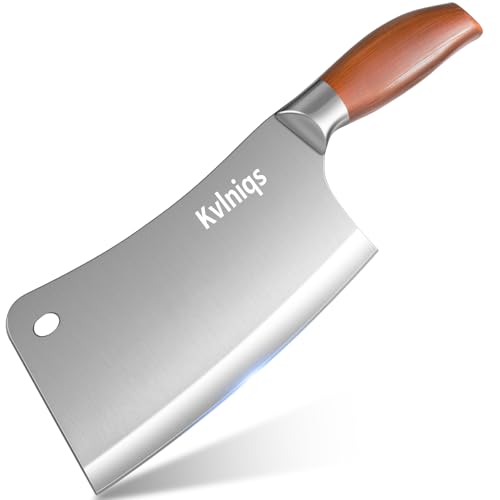
This 7-inch butcher knife takes a general-purpose approach, with a listed 2.3 mm blade thickness and high-carbon stainless steel construction. The product description positions it for cutting meat, poultry, fish, vegetables, bones, and garlic. The 2.3 mm measurement places it closer to a multipurpose kitchen cleaver than the thickest axe profiles in this guide, so it is best understood as a knife for moderate bone work alongside ordinary meal preparation.
The Pakkawood handle is described as ergonomic and non-slip, and the full tang construction is intended to extend the blade through the handle. The available details also mention a laser-tested edge and a 60-day refund policy. Since no edge angle, blade weight, or precise steel grade is supplied, buyers should judge it by its documented size and intended versatility rather than assuming it matches a heavier butcher axe.
Pros
- 7-inch length is manageable for everyday kitchen use.
- 2.3 mm thickness supports a broad range of preparation tasks.
- Full tang construction is clearly stated.
- Pakkawood handle is described as ergonomic and slip resistant.
- Suitable for meat, poultry, vegetables, fish, and moderate chopping.
Cons
- The thinner blade is less specialized for very dense bones.
- Exact steel grade, weight, and edge angle are not provided.
This knife is a reasonable match for a first cleaver in a home kitchen where chicken joints, vegetables, and boneless meat appear more often than large bones. Its dimensions are less intimidating than a 1.33-pound model, but that convenience comes with a narrower heavy-duty role. Choose it for flexibility, not for the most demanding chopping sessions.
To buy this product, click here.
9. BLADESMITH 6.3-Inch Bone Chopper – Best Compact Axe Profile

BLADESMITH is the shortest blade-focused option here, with a listed 6.3-inch bone-cutting blade and a thick axe-style profile. The product information identifies 7Cr17MoV carbon stainless steel and a stated hardness of 58 plus or minus 2 HRC. It also describes a V-shaped edge and a full tang pear wood handle. The compact blade can be easier to position on a smaller board, while the thick construction is aimed at chopping rather than delicate slicing.
The pear wood handle is described as ergonomic and intended to remain secure during meat preparation. As with the other wood-handled cleavers, cleaning and drying deserve attention. The listing also presents the knife as suitable for vegetables, garlic, mashed potato preparation, and outdoor hunting tasks. Those extra uses do not change its main identity as a compact butcher axe, and the available information does not provide a knife weight or exact blade thickness.
Pros
- 6.3-inch format suits smaller cutting areas.
- 7Cr17MoV steel is specifically identified.
- Stated 58 plus or minus 2 HRC hardness is provided.
- Thick axe-style profile is aimed at bone and tough-meat work.
- Full tang pear wood handle supports a traditional butcher design.
Cons
- The listing does not provide exact blade thickness or knife weight.
- Wood handle requires careful cleaning, drying, and storage.
BLADESMITH is worth a look for buyers who want a shorter, dense-looking cleaver rather than a long restaurant-style blade. It may be easier to control in a tight workspace, while the axe profile limits its appeal for fine slicing. The documented steel and hardness details give it more technical information than several similarly shaped alternatives, though they do not replace careful technique or regular maintenance.
To buy this product, click here.
Buying Guide
Match the Blade Profile to the Bone Work
A cleaver for chicken joints does not need the same profile as one intended for dense beef bones. Thicker blades and heavier bodies, such as those listed for the MAD SHARK and ROCOCO, are aimed at impact. Thinner 2.3 mm designs like the HOSHANHO and the 7-inch full tang butcher knife are more versatile for vegetables and boneless meat, but they deserve more careful use around hard material.
A thick meat cleaver and a thin Chinese vegetable cleaver are different tools. The nakiri and Chinese-cleaver comparison explains that important boundary.
Choose Length for Your Cutting Board
Blade length affects reach, clearance, and control. A 6.3-inch cleaver can feel easier to position on a compact board, while an 8-inch Juvale offers more coverage for large portions. Longer is not automatically better. Measure the usable space around your board and think about where the knife will be stored before choosing a broad 7.5-inch or 8-inch model.
Separate Edge Angle From Overall Strength
The supplied products use several different edge descriptions. Mueller lists an 18-degree double bevel, HOSHANHO lists 15 degrees per side, and the ROCOCO, Kvlniqs, and SYOKAMI describe heavier 25- or 30-degree working zones. A finer edge may be better for slicing and vegetables, while a more substantial edge can be a sensible choice for tougher chopping. Edge angle alone does not prove durability or cutting performance.
Read Steel Claims Carefully
Named steels such as 10Cr15CoMoV, 30Cr13, 5CR15MOV, and 7Cr17MoV provide more information than broad labels such as high-quality stainless steel. The HOSHANHO also lists a hardness range, while BLADESMITH provides a stated hardness figure. These details help describe the product, but actual ownership still depends on edge geometry, heat treatment, use, and sharpening.
Compare Handle Materials and Tang Construction
Full tang construction appears in many of these listings, but it does not guarantee a particular balance or comfort level. Stainless steel handles, such as the Mueller’s, are convenient around raw meat and moisture. Wood handles on the ROCOCO, Kvlniqs, SYOKAMI, Juvale, and BLADESMITH offer a traditional grip but require prompt drying. ABS and Pakkawood provide other maintenance and handling options.
Plan for Cleaning and Sharpening
Clean the blade after working with meat, dry it thoroughly, and store it where the edge will not contact other utensils. Several listings mention dishwasher compatibility or resistance to corrosion, but hand washing remains the more conservative approach for preserving an edge and protecting wood components. A cleaver also needs an appropriate sharpening method. Do not assume that a fine kitchen sharpener is suitable for every thick or specialized edge.
Use a Stable Cutting Surface
Bone chopping produces more impact than slicing vegetables. A stable board with enough room for the blade helps keep the cut controlled. Avoid using a cleaver on unsuitable hard surfaces, and keep fingers away from the blade path. If a product is marketed for frozen food, wood, or outdoor work, that claim should not be treated as a reason to ignore safe food-preparation practice.
Best Meat Cleaver For Cutting Bone FAQ
What blade length is suitable for cutting bone?
For home poultry preparation, a 6.3- to 7-inch cleaver is often easier to position and control. Longer 7.5- and 8-inch models provide more reach and blade surface for larger portions, but they also need more workspace. Length should be matched to the food being prepared and the size of the cutting board.
Is a heavy cleaver better for bone cutting?
Additional mass can contribute to chopping impact, which is why the MAD SHARK’s listed 1.33-pound weight and the thicker ROCOCO profile appeal to buyers seeking a heavy butcher tool. Weight can also increase fatigue and make the knife harder to control. The best choice depends on the user’s strength, technique, and typical bone size.
Can a thin kitchen cleaver cut bones?
A thinner cleaver may be suitable for small poultry joints when the product is intended for that use, but it should not automatically be treated as a large-bone breaker. The HOSHANHO’s 2.3 mm blade and fine edge make it more suitable for mixed food preparation than repeated heavy impact. Check the documented design before using a thin edge on hard material.
Are stainless steel cleavers maintenance free?
No. Stainless steel generally offers useful corrosion resistance, but it can still benefit from prompt cleaning and drying. The maintenance instructions for several products specifically call for drying after use. Wood-handled models need extra care because moisture can affect the handle over time.
What does full tang mean on a meat cleaver?
Full tang means the blade material extends through the handle area. It describes construction, not guaranteed balance, comfort, or cutting performance. A full tang cleaver can still differ significantly in weight, handle shape, blade thickness, and edge geometry.
Can I use a meat cleaver for vegetables?
Many cleavers are intentionally multipurpose. Broad blades can chop vegetables and move ingredients from the board, while finer edge zones can handle slicing. A thick butcher axe may feel awkward for delicate work, so a model such as the Mueller or SYOKAMI may be a better fit for cooks who want one knife for both meat and vegetables.
Should a meat cleaver go in the dishwasher?
Follow the exact product instructions, but hand washing and immediate drying are generally the safer maintenance approach for preserving the edge and protecting wood handles. The Mueller and MAD SHARK listings mention dishwasher suitability in specific ways, yet both still provide reasons to clean and dry the knife carefully.
Final Verdict
The Mueller 7-Inch Meat Cleaver is the best overall match for most home cooks seeking a meat cleaver for cutting bone. Its 7-inch size, stated 18-degree double bevel, full tang stainless steel handle, and broad multipurpose blade give it a useful balance between poultry work and everyday kitchen preparation. It is more approachable than the heaviest options without losing the core features expected from a bone-cutting cleaver.
Choose the MAD SHARK if dense bones, larger portions, and substantial chopping mass matter most. The ROCOCO is a practical alternative for a thick, portable butcher-axe format, while SYOKAMI is the better fit for cooks who want slicing, small-bone work, vegetable preparation, and herb stripping from one tool. Before buying, match blade thickness and weight to your actual cutting tasks, confirm that your board has enough room, and plan to clean, dry, store, and sharpen the cleaver according to its construction.
