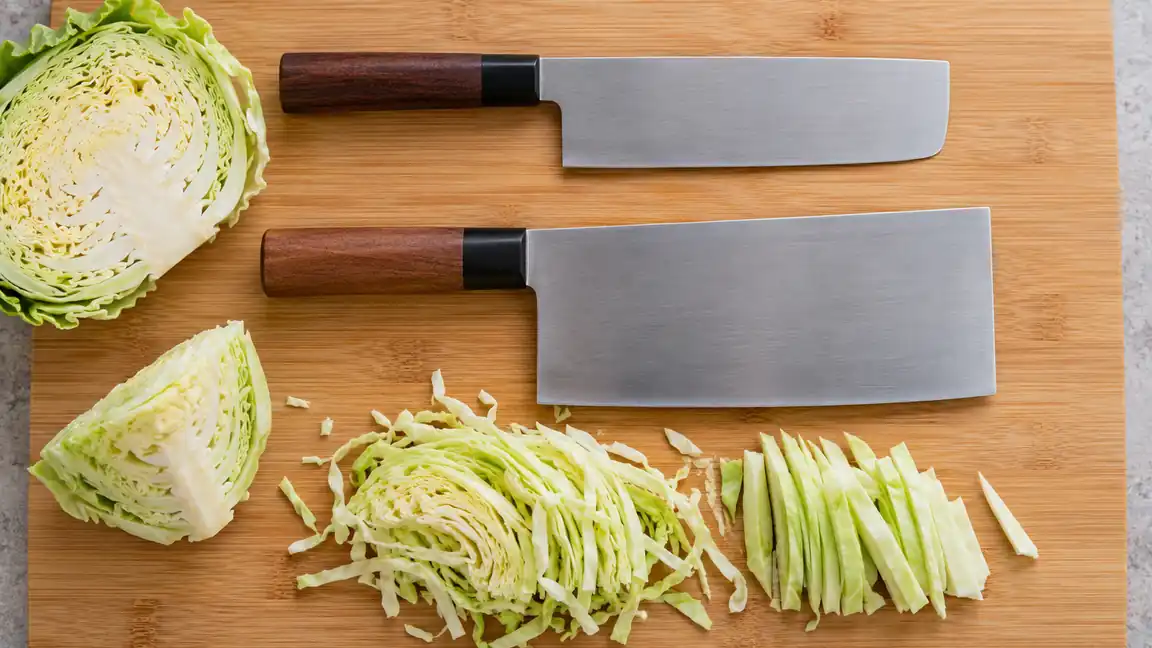
A nakiri is a compact Japanese-style vegetable knife with a thin blade, a mostly flat edge, and a squared tip. A Chinese cleaver is usually taller, longer, and more versatile, with enough blade area to slice vegetables, portion boneless meat, crush aromatics, and move chopped food. For focused vegetable preparation and precise board work, the nakiri is often the more manageable tool. For cooks who want one broad-bladed knife to handle a wider range of ingredients, a Chinese vegetable cleaver may be more suitable.
The word cleaver can cause confusion. A Chinese vegetable cleaver, often called a caidao, is different from a thick Western meat cleaver made for bones. Many Chinese cleavers have relatively thin cutting geometry and can be damaged by hard bones, frozen food, or forceful twisting.
For cooks whose work is mainly vegetables, these nakiri options for board work provide a useful starting point. The differences below explain when a broader Chinese vegetable cleaver makes more sense.
Nakiri vs. Chinese Cleaver at a Glance
| Feature | Nakiri | Chinese Cleaver |
|---|---|---|
| Primary role | Vegetable preparation | General preparation, especially vegetables and boneless ingredients |
| Blade shape | Rectangular with a squared or gently rounded nose | Broad and rectangular, often with a more defined front corner |
| Blade height | Moderately tall | Usually much taller |
| Edge profile | Mostly flat, sometimes with slight curvature | Varies from fairly flat to gently curved |
| Typical cutting motions | Push cutting, chopping, and controlled slicing | Chopping, push cutting, slicing, crushing, and scooping |
| Tip work | Limited by the rounded or squared nose | Front corner can handle some detailed cuts, depending on geometry |
| Weight and handling | Usually lighter and more compact | Usually heavier with greater blade presence |
| Food transfer | Useful blade area for moving chopped ingredients | Very large blade face works well as a scoop |
| Bone cutting | Generally unsuitable | Only suitable if the specific cleaver is made and approved for that task |
How Blade Geometry Changes Performance
The Nakiri Has a Thin, Vegetable-Focused Profile
A nakiri has a tall rectangular blade compared with a chef’s knife, but it remains compact beside most Chinese cleavers. Its edge is commonly fairly straight, helping a large portion of the cutting edge contact the board during a downward or forward push cut.
This profile works well for tasks such as:
- Slicing cabbage and leafy greens
- Dicing onions
- Cutting carrots, cucumbers, and zucchini
- Chopping herbs with controlled strokes
- Making thin vegetable slices
The thin blade can pass through firm produce with less wedging than a substantially thicker blade. Actual performance still depends on the grind, thickness behind the edge, edge condition, and overall construction. A knife labeled as a nakiri is not automatically thin or efficient.
Most nakiri knives have little belly compared with a Western chef’s knife. This favors push cuts and vertical chopping rather than pronounced rocking. Some models include enough curvature for a gentle rocking motion, but the squared nose limits the sweeping action available from a pointed chef’s knife.
The Chinese Cleaver Provides More Height and Blade Area
A Chinese cleaver has a deep blade that provides generous knuckle clearance and a large surface for guiding ingredients. The broad face can also collect diced vegetables from the board. Use the spine or flat of the blade for scraping and scooping rather than dragging the sharpened edge sideways across the cutting surface.
A thick tool intended for appropriate bone work belongs in a different category. These meat cleavers should not be confused with thin vegetable blades.
The blade’s size gives it more momentum during chopping, although technique should remain controlled. Its front corner may assist with scoring, trimming, or starting small cuts. It does not provide the narrow precision tip found on a chef’s knife or utility knife.
Chinese cleavers vary considerably. Thin vegetable slicers prioritize low cutting resistance. General-purpose cleavers may have somewhat more robust geometry for mixed preparation. Heavy bone cleavers have thicker blades and stronger edges for demanding butchery. These categories can look similar from a distance, so appearance alone does not establish safe use.
A Chinese Cleaver Is Usually More Versatile
The nakiri’s shape centers on vegetables. It can slice some boneless meat or fish, but its short, tall profile and lack of a pointed tip make it less convenient for trimming, piercing, or working around joints.
A thin or medium-weight Chinese cleaver can cover a broader selection of kitchen tasks:
- Preparing vegetables and herbs
- Slicing boneless meat across the grain
- Portioning fish fillets
- Crushing garlic or ginger with the blade face
- Mincing aromatics
- Transferring prepared ingredients
That versatility does not make every Chinese cleaver suitable for bones. A thin caidao should be treated as a slicing knife despite its cleaver-like appearance. Cutting through poultry bones, thick fish bones, frozen food, or hard shells requires a blade expressly made for such impact.
Cutting Technique Feels Different
A nakiri generally feels nimble during repetitive vegetable work. Its compact blade makes it easy to control short push cuts and straight chopping strokes. Keeping the edge nearly parallel to the cutting board helps prevent accordion cuts, where pieces remain connected because part of the edge failed to reach the board.
A Chinese cleaver asks the user to manage more blade height and, commonly, more weight. The broad blade can feel stable once the cook becomes familiar with it. A relaxed grip and controlled stroke are preferable to lifting the knife high and striking the board with excessive force.
Both styles provide ample knuckle clearance, although exact clearance depends on blade height, handle placement, grip, and cutting technique. Neither requires a particular grip for every user. The knife should feel secure without forcing the wrist into an uncomfortable position.
Food Release Depends on More Than Blade Width
Food can cling to either knife. Moisture and surface tension cause thin slices of potato, cucumber, and similar ingredients to stick to a broad blade face. A Chinese cleaver has more surface area, which can make sticking more noticeable, but its large face also makes ingredient transfer easier.
Food release is affected by several details:
- Blade grind and surface geometry
- Blade finish and texture
- Ingredient moisture
- Slice thickness
- Cutting speed and technique
Hollow-ground indentations, hammered finishes, or textured surfaces do not guarantee clean food release. The geometry behind the cutting edge often matters more than decorative surface features.
Steel and Edge Construction Vary by Model
Neither knife category determines steel quality, hardness, edge retention, or corrosion resistance. Nakiri and Chinese cleavers are available in carbon steel, stainless steel, and various clad constructions. Heat treatment and blade geometry also influence how an edge behaves.
Carbon steel can develop a patina and requires prompt cleaning and drying. Stainless steel offers greater corrosion resistance, but it can still stain or corrode under unfavorable conditions. Steel type alone does not reveal how sharp a knife will be or how long its edge will last.
Most everyday nakiri knives and Chinese vegetable cleavers use double-bevel edges, meaning the cutting edge is sharpened from both sides. Edge symmetry can vary. A nakiri should also be distinguished from an usuba, a traditional Japanese vegetable knife commonly associated with single-bevel construction and different sharpening requirements.
Sharpening and Edge Care
Sharpen either knife according to its actual edge configuration and the manufacturer’s guidance. Avoid assuming that every nakiri shares one standard angle or that every Chinese cleaver has a thick, durable edge.
Abrasive stones, guided systems, and compatible sharpening devices can restore a double-bevel edge. The tool must support the knife’s blade height, edge geometry, and intended angle. Fixed-angle or pull-through devices may be awkward for very tall blades, and a preset angle may not match the existing edge.
During routine use:
- Cut on a stable, knife-friendly board rather than glass, stone, or ceramic.
- Avoid twisting the edge while it is embedded in dense food.
- Wash the blade by hand and dry it promptly.
- Do not scrape the sharpened edge sideways across the board.
- Store the knife so the edge cannot strike other utensils.
- Sharpen when cutting performance declines rather than removing metal on an arbitrary schedule.
A traditional smooth honing steel may have limited value for some thin or hard edges. Ceramic and diamond rods are abrasive and can remove material. Compatibility depends on the knife, rod, technique, and manufacturer’s instructions.
Which Knife Fits Your Cooking Style?
Choose a Nakiri for Compact Vegetable Preparation
A nakiri makes sense for cooks who prepare large amounts of produce and prefer a light, controlled knife. Its smaller profile is convenient on limited counter space and may feel less cumbersome to someone unfamiliar with tall cleavers.
It is particularly useful if a chef’s knife or other pointed knife is already available for trimming, piercing, meat preparation, and detail work. In that setting, the nakiri can serve as a focused vegetable specialist.
Choose a Chinese Cleaver for Broad Utility
A Chinese vegetable cleaver suits cooks who value blade height, ingredient transfer, and a wider range of cutting tasks. It can function as the main preparation knife for vegetables, herbs, and boneless proteins, provided its construction matches those uses.
For the taller vegetable-focused format, compare Chinese cleavers by their intended preparation tasks rather than treating all broad blades alike.
Comfort is highly individual. Blade weight, handle dimensions, balance, and board size affect control. A tall cleaver also needs enough storage clearance and a sheath, block slot, or magnetic holder that safely accommodates its dimensions.
Can One Replace the Other?
There is substantial overlap in vegetable preparation. Both can chop greens, dice onions, slice firm produce, and transfer food with the blade face. A cook proficient with one can complete many of the same tasks performed with the other.
Before adding either specialist, check whether the job is already covered by a practical basic kitchen-knife collection.
The replacement is less complete beyond vegetables. A Chinese vegetable cleaver generally handles boneless meat, crushing, and large-scale ingredient transfer more comfortably. A nakiri usually offers a lighter, more compact feel for repetitive produce work. Neither replaces a heavy-duty bone cleaver unless its manufacturer specifically identifies it as suitable for bone cutting.
Key Distinction to Keep in Mind
The nakiri is a specialized vegetable knife built around compact size, thin geometry, and a mostly flat edge. The Chinese cleaver is a broader category whose members range from delicate vegetable slicers to heavy butchery tools. For general kitchen use, the relevant comparison is between a nakiri and a thin Chinese vegetable cleaver, not a thick bone cleaver.
Select the nakiri for nimble, vegetable-centered board work. Select the Chinese cleaver for greater blade height, food-transfer capacity, and versatility across vegetables and boneless ingredients. Whichever style you use, match the task to the specific blade’s construction rather than relying on its rectangular appearance.
