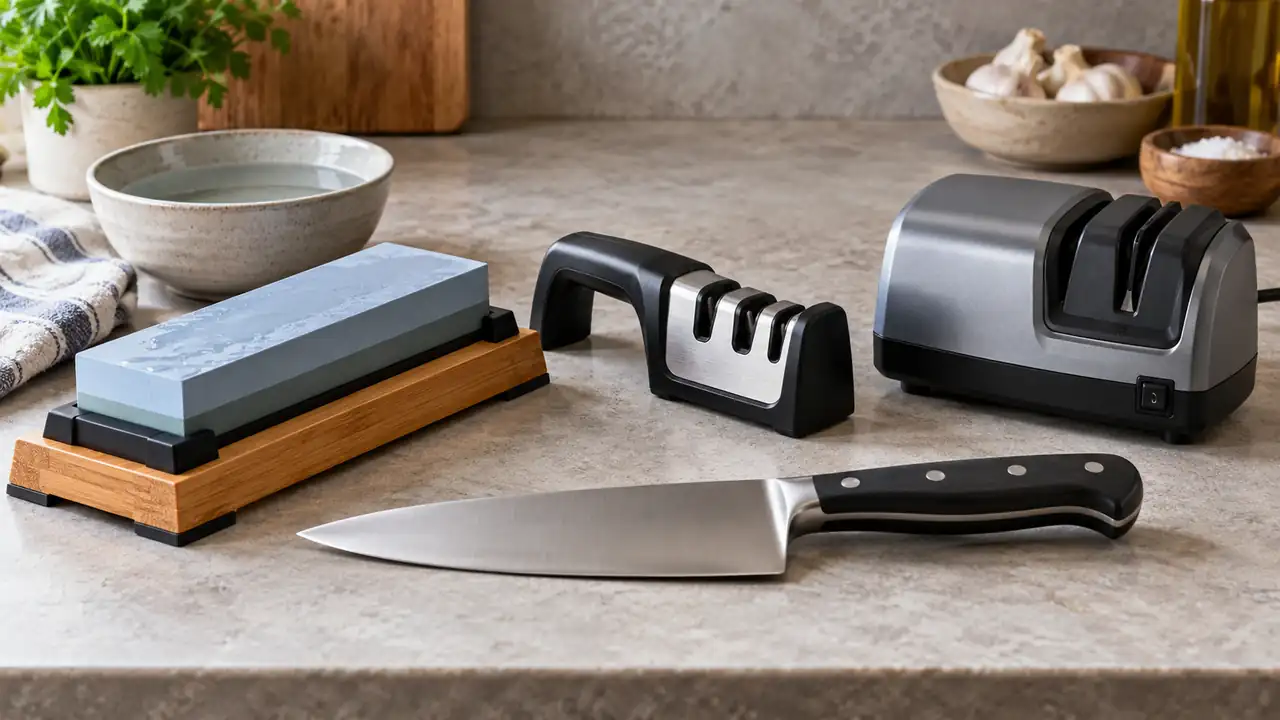
A dull kitchen knife turns a ripe tomato into a crushed mess, makes onions slip under the blade, and encourages more pressure than safe cutting requires. A good sharpener restores the working edge through abrasion, but the right tool depends on your knives, your preferred level of control, and whether you need to maintain straight edges, serrated blades, or both. Manual pull-through models are quick and compact, while guided systems offer more control over the sharpening angle.
A common mistake is choosing a sharpener based on the number of slots alone. A three-stage device may be perfectly suitable for ordinary double-bevel kitchen knives, yet unsuitable for serrated edges or knives that need a carefully controlled angle. Abrasive type, angle guidance, stability, cleaning, and compatibility matter more than flashy descriptions. Adjustable systems can suit several edge preferences, while electric sharpeners reduce physical effort but occupy more counter space and remove material quickly.
The nine products below cover everyday manual sharpeners, guided rolling systems, electric sharpening, and more controlled bench units. Different cooks will prioritize different features. A family kitchen may need fast maintenance and a stable base, while a knife enthusiast may prefer angle adjustment and multiple abrasive stages. The Chef’sChoice 15XV earns the strongest overall position for its electric convenience, diamond abrasive stages, angle guidance, and stated compatibility with straight and serrated knives.
Quick Answer
- Best Overall: Chef’sChoice 15XV EdgeSelect. Its electric three-stage system uses diamond abrasives, flexible angle guides, and a finishing stage for straight and serrated knives.
- Best for Controlled Sharpening: Work Sharp Precision Adjust Elite. Its adjustable 15 to 30 degree range, diamond plates, ceramic rod, and leather strop suit buyers who want a guided manual process.
- Best Rolling Sharpener: AIERLIAN Rolling Knife Sharpener. The magnetic support offers 15 and 20 degree positions, with diamond, ceramic, and leather finishing components.
Best Kitchen Knife Sharpener Comparison Table
| Product | Best For | Sharpening Method | Angle or Stages |
|---|---|---|---|
| Chef’sChoice 15XV EdgeSelect | Everyday electric sharpening | Electric diamond and polishing stages | 15 degree edge, 3 stages |
| Work Sharp Precision Adjust Elite | Detailed manual control | Diamond, ceramic, and leather | 15 to 30 degrees |
| AIERLIAN Rolling Sharpener | Rolling guided sharpening | Diamond and ceramic discs | 15 and 20 degrees |
| Sharp Pebble Precision Adjust | Adjustable pull-through sharpening | Three-stage manual system | 12, 15, 18, 21, and 24 degrees |
| RazorSharp Knife and Scissor Sharpener | Adjustable kitchen knife angles | Diamond-coated ceramic stones | 14 to 24 degrees |
| SHARPAL 191H | Serrated and straight knives | Tungsten carbide and ceramic | 3 stages |
| Orange Ninja Sharpener | Mixed straight and serrated blades | Carbide, diamond, and polishing slots | 4 stages |
| Kitchellence 4-in-1 Sharpener | Simple everyday maintenance | Diamond, sharpening, and polishing slots | 3 stages |
| Longzon 4-Stage Sharpener | Knives and scissors | Manual multi-slot system | 4 stages |
The detailed reviews explain how each sharpening method works, which blade types it supports, and where its limitations matter in an ordinary kitchen.
1. Chef’sChoice 15XV EdgeSelect Professional Electric Knife Sharpener – Best Overall

A kitchen knife sharpener needs to make angle control understandable, and the Chef’sChoice 15XV addresses that through spring guides that help position the blade during each pass. Its three-stage EdgeSelect arrangement uses diamond abrasives in the first two stages, followed by a flexible polishing system. The published design is intended to convert traditional 20-degree household edges to a 15-degree Trizor XV edge, so it is especially relevant for cooks seeking a finer, more acute edge on compatible double-bevel knives.
The electric format suits a busy kitchen where sharpening should take minutes rather than become a separate hobby. The listing states that first-time sharpening takes approximately one minute and resharpening takes about 10 seconds, although actual time depends on the knife and its condition. Serrated compatibility adds useful flexibility, since many manual slot sharpeners exclude bread and steak knives. At roughly 10 by 4.25 by 4.25 inches, it requires a dedicated cupboard or counter location, but its guided operation reduces the need to maintain a hand-controlled angle.
Pros
- Three-stage electric system combines diamond sharpening with a polishing stage.
- Flexible spring guides help maintain the sharpening position.
- Listed for both straight-edge and serrated knives.
- Designed to convert a traditional 20-degree edge to a 15-degree edge.
- Includes a stated three-year limited warranty.
Cons
- Electric format takes more storage space than compact manual sharpeners.
- The 15-degree conversion may not suit every knife or edge preference.
This is the strongest choice for a household with several ordinary kitchen knives and at least a few serrated blades. It makes sense for cooks who prefer guided electric operation over repeated hand passes. Buyers with delicate, unusual, or single-bevel knives should verify compatibility before use, since a fixed sharpening format can remove material in a way that does not match every blade design. It is also less appealing for someone who wants a quiet, portable tool kept in a small drawer.
To buy this product, click here.
2. Work Sharp Precision Adjust Elite Knife Sharpener – Best for Controlled Sharpening

The Work Sharp Precision Adjust Elite is aimed at buyers who want a more deliberate sharpening process than a basic pull-through tool provides. Its guide adjusts from 15 to 30 degrees, covering the published examples of Japanese-style kitchen knives, Western kitchen knives, hunting blades, and cleavers. The kit includes coarse and fine diamond plates, a ceramic finishing rod, a serrated blade rod, and a leather strop, giving the user several ways to refine an edge instead of relying on one fixed slot.
This bench-style format takes longer to set up, yet that extra structure can be useful when a knife has lost its edge unevenly or needs a consistent angle across both sides. The serrated rod and tri-brasive attachment broaden the system beyond ordinary straight blades. Buyers should still follow the product directions and match the selected angle to the knife rather than assuming a lower angle is always preferable. The system suits a cook who enjoys careful maintenance and wants one sharpening platform for kitchen, pocket, and hunting blades.
Pros
- Adjustable angle range spans 15 to 30 degrees.
- Includes coarse and fine diamond plates for staged sharpening.
- Includes ceramic and leather finishing components.
- Provides a dedicated ceramic rod for serrated blades.
- Works across several blade categories according to the listing.
Cons
- Bench-style setup is less immediate than a compact pull-through sharpener.
- More components require more storage and careful organization.
This is a good fit for someone who sees sharpening as routine knife care rather than a quick emergency fix. The angle range gives it an advantage over fixed three-slot tools, especially for a collection containing different blade types. A cook who only wants to restore one inexpensive chef’s knife may find the extra pieces unnecessary. The system is also better suited to users willing to read the instructions and work patiently through the stages.
To buy this product, click here.
3. AIERLIAN Rolling Knife Sharpener Kit – Best Rolling Sharpener

The AIERLIAN takes a different route from slot sharpeners. A rolling disc moves along the blade while a magnetic support offers 15 and 20 degree positions. The supplied information lists a 400-grit diamond disc for sharpening and a 3000-grit ceramic disc for refining, followed by a leather strop for finishing. That arrangement gives the user a visible, staged process and may appeal to cooks who want to understand how the edge is being worked rather than feeding a knife through enclosed slots.
The natural wood base and four listed N42 magnets are intended to hold the knife in position, while the angle supports guide the relationship between blade and abrasive. It is listed for steel knives of varying hardness, but the product specifically excludes serrated knives and scissors. A rolling sharpener also needs a suitable flat workspace and careful movement along the full edge. The result is a more hands-on tool than an electric machine, with a useful balance between guided alignment and user involvement.
Pros
- Offers two stated sharpening angles, 15 and 20 degrees.
- Combines diamond, ceramic, and leather finishing stages.
- Magnetic support is intended to stabilize the blade.
- Rolling design makes the sharpening movement visible and controlled.
- Includes components for both edge refinement and burr finishing.
Cons
- Not suitable for serrated knives or scissors.
- Requires more workspace and hand control than a small pull-through tool.
Choose this model if you want guided angle control without moving to an electric appliance. It is particularly suitable for straight-edge kitchen knives and for users who enjoy a slower, more tactile maintenance routine. A household built around bread knives, serrated steak knives, or scissors will need a separate solution. The 15-degree setting also deserves thoughtful use, since the narrow angle may not be the appropriate choice for every blade.
To buy this product, click here.
4. Sharp Pebble 5 Precision Adjust Knife Sharpener – Best Adjustable Pull-Through
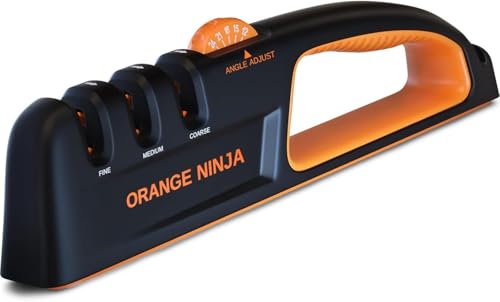
Sharp Pebble’s manual sharpener stands out through five selectable angles: 12, 15, 18, 21, and 24 degrees. That range gives it more flexibility than a basic fixed-angle sharpener, especially for a home cook maintaining several straight-edge knives. The three-stage design is intended to repair, sharpen, and polish. Its compact handheld construction keeps the process familiar for anyone who has used a pull-through sharpener before.
The angle options are useful only when applied thoughtfully. A lower setting removes the edge geometry toward a narrower profile, while a wider setting may better suit a knife that needs a more robust working edge. The listing clearly excludes serrated knives and scissors, so this is a straight-edge tool rather than a universal kitchen solution. Its ABS construction and ergonomic form keep storage simple, while the manual format avoids a power cord and gives the user direct control over the number of passes.
Pros
- Five selectable angles provide more adjustment than fixed-slot models.
- Three stages cover repair, sharpening, and polishing.
- Manual operation works without electricity or a large counter footprint.
- Suitable for kitchen, pocket, and hunting knives according to the listing.
- Ergonomic design supports straightforward hand use.
Cons
- Not intended for serrated knives or scissors.
- Manual passes require the user to follow the chosen angle and stage sequence carefully.
This sharpener is a sensible middle ground for a cook who wants angle choice but does not need a full bench system. It fits a drawer and can handle more varied straight-edge maintenance than a single-angle tool. Buyers with a serrated bread knife collection should select a different model, and those seeking maximum repeatability may prefer the Work Sharp or Chef’sChoice systems with more structured guidance.
To buy this product, click here.
5. RazorSharp Knife and Scissor Sharpener – Best for Adjustable Kitchen Angles

RazorSharp uses an adjustable knob to set an angle from 14 to 24 degrees, placing it between a fixed pull-through sharpener and a more involved guided system. Its listed abrasive components are diamond-coated ceramic whetstones, and the frame includes a sturdy handle with non-slip rubber grips. For a cook who wants to vary the edge setting on straight kitchen knives, the adjustment is the central attraction.
The design also includes a scissor-sharpening function, giving it a broader household role than models restricted to knives. That versatility does not make it suitable for every blade. The available information describes it for kitchen and professional knives, but does not establish compatibility with serrated edges, so serrated owners should seek confirmation before use. The frame is intended to keep the hand and knife stable, yet the user still needs to select an appropriate angle and avoid treating every knife as identical.
Pros
- Adjustable angle range covers 14 to 24 degrees.
- Diamond-coated ceramic sharpening surfaces are listed.
- Includes a scissor-sharpening function.
- Non-slip rubber and a sturdy grip support controlled use.
- Offers more angle flexibility than a basic fixed-slot sharpener.
Cons
- Serrated-knife compatibility is not established in the supplied information.
- Angle adjustment adds a step that users must set correctly for each knife.
This option suits a kitchen with several straight-edge knives and occasional scissor maintenance. It is a practical choice for someone who wants adjustment without the multiple attachments found in a full sharpening kit. A bread-knife owner should look elsewhere unless compatibility is confirmed, and a user who prefers a completely automatic process may find the adjustment and positioning more involved than an electric machine.
To buy this product, click here.
6. SHARPAL 191H Knife Scissors Sharpener – Best for a Stable Compact Base

The SHARPAL 191H focuses on stability through a suction base that activates on a smooth, flat surface. That feature changes the handling experience compared with a small sharpener that must be held in place while the other hand guides the knife. Its three stages use tungsten carbide for setting the edge, ceramic for honing, and a separate tungsten carbide blade for scissors. The listing also identifies compatibility with straight and serrated kitchen knives.
For a busy home kitchen, the compact body and suction switch can make setup quick. The suction function depends on the surface being smooth and suitable, so it should not be treated as a guarantee on every countertop. The system is also less angle-adjustable than the Sharp Pebble or Work Sharp. Its advantage lies in straightforward stability and broad blade coverage, making it useful for a drawer that contains a chef’s knife, a bread knife, and kitchen shears.
Pros
- Listed for straight, serrated, and kitchen knives.
- Includes a dedicated scissor-sharpening stage.
- Suction base is designed to reduce movement on smooth surfaces.
- Compact shape stores easily in a kitchen drawer.
- Uses separate tungsten carbide and ceramic stages.
Cons
- Suction performance depends on a suitable smooth, flat work surface.
- Does not offer the adjustable angle range found on guided systems.
This is a strong fit for cooks who value a stable footprint and mixed blade compatibility over angle customization. It makes sense in a family kitchen where several people may use the sharpener and where a secure base is helpful. A knife enthusiast seeking a specific edge angle should choose a more adjustable tool, while someone with a rough or uneven countertop should pay close attention to the suction requirement.
To buy this product, click here.
7. Orange Ninja Serrated and Kitchen Knife Sharpener – Best for Mixed Blade Types

Orange Ninja earns its place through a four-slot arrangement that includes coarse repair, medium sharpening, fine polishing, and a dedicated serrated slot. That combination addresses a familiar kitchen problem: the chef’s knife needs a new edge while the bread knife needs attention to its teeth. The ergonomic handle is listed for both left- and right-handed use, and the non-slip construction is intended to make the manual process easier to manage.
The tool is aimed at quick home maintenance rather than detailed edge geometry. Users should pull the blade through the slots rather than use a back-and-forth sawing motion, and the stages should be used in an appropriate sequence. The listing describes compatibility with kitchen, pocket, hunting, and serrated knives, but it does not provide adjustable angle settings. That makes the model approachable for routine care, while limiting its appeal for someone who wants to preserve a precisely chosen edge angle.
Pros
- Four stages include a dedicated serrated-blade slot.
- Separate coarse, medium, and fine stages support staged maintenance.
- Designed for left- and right-handed users.
- Listed for several kitchen and outdoor knife categories.
- Non-slip ergonomic construction supports manual use.
Cons
- No adjustable angle range is listed.
- Users must follow the specified pulling motion to avoid improper use.
This sharpener suits a household with both straight and serrated knives that wants one compact manual device. It is less appropriate for a cook who owns a knife with a carefully specified edge angle or who wants to control material removal closely. Its broad blade coverage is the reason to select it over a simpler three-slot model, while its fixed design is the main trade-off.
To buy this product, click here.
8. Kitchellence 4-in-1 Kitchen Knife Sharpener – Best for Simple Everyday Maintenance
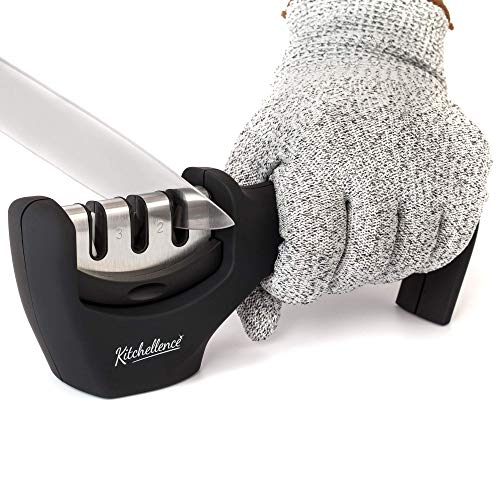
The Kitchellence sharpener keeps the process uncomplicated with three knife slots. The first uses a diamond sharpening rod to repair and straighten a damaged edge, the second restores the V-shaped edge, and the third polishes it. A non-slip base and included cut-resistant glove address basic handling concerns, while the symmetrical handle is intended for either right- or left-handed use.
This format is well suited to a drawer beside everyday chef’s and paring knives. It gives a new user a clear coarse-to-fine sequence without requiring electrical setup or angle selection. The supplied information does not identify a serrated-blade slot or adjustable angle system, so buyers with bread knives or specialized edges should choose accordingly. The ABS body keeps the tool compact, but the simple construction offers less process control than the rolling and bench systems higher in the ranking.
Pros
- Three stages cover repair, sharpening, and polishing.
- Non-slip base supports steady manual use.
- Includes a cut-resistant glove.
- Handle is intended for right- and left-handed users.
- Compact process is suitable for routine straight-edge maintenance.
Cons
- No serrated-blade slot or adjustable angle is listed.
- Offers less control than guided rolling or bench systems.
This model makes sense for a cook who wants a straightforward sharpener for ordinary straight-edge kitchen knives. It is easier to store and understand than a multi-component system, especially for occasional maintenance. Buyers with serrated knives, demanding angle requirements, or a desire to finish an edge with a strop should move up the list. The included glove is useful as a handling accessory, but it does not replace careful knife control.
To buy this product, click here.
9. Longzon 4-Stage Kitchen Knife Sharpener – Best for Knives and Scissors

Longzon adds a dedicated scissor slot to three knife stages, making it a practical household tool for more than one type of blade. The knife sequence includes coarse grinding, fine grinding, and precision grinding, while the non-slip base and included glove support the manual setup. The listing describes use with kitchen knives, scissors, and pocket knives, so the main appeal is broad household coverage in a compact body.
The four-stage layout is easy to understand beside a kitchen drawer, especially for someone who wants to repair a dull edge and then refine it. The supplied details do not identify a selectable angle or a serrated-knife slot, so this is better viewed as a general straight-edge tool with scissor support. Its ABS construction and slim profile should suit limited storage, but users still need to pull the blade through each slot correctly rather than treating the device like a honing rod.
Pros
- Includes three knife stages and a separate scissor stage.
- Non-slip base is intended to improve stability.
- Includes a cut-resistant glove.
- Listed for kitchen, pocket, and scissor use.
- Compact profile fits easily in a drawer.
Cons
- No adjustable angle system is listed.
- Serrated-knife compatibility is not established in the supplied information.
Longzon is a useful choice for a home that wants one basic sharpener for straight-edge knives and scissors. It is less compelling for someone with serrated bread knives or a collection that needs separate angle settings. Its value is functional coverage rather than fine control, so it belongs near the end of this list for buyers seeking a general kitchen accessory rather than a dedicated sharpening system.
To buy this product, click here.
Buying Guide
Match the Sharpener to Your Blade Edges
Start by listing the knives that actually need maintenance. Straight-edge chef’s, utility, and paring knives work with many manual and electric systems. Serrated bread and steak knives require a compatible slot, rod, or sharpening stage. The Chef’sChoice, SHARPAL, Orange Ninja, and Work Sharp options specifically address serrated blades in the supplied information, while several adjustable manual tools are restricted to straight edges.
Understand Fixed and Adjustable Angles
A fixed system reduces setup decisions, which is useful for quick household maintenance. An adjustable model gives more control, but the setting still needs to match the knife and intended use. Sharp Pebble offers five listed angles, RazorSharp spans 14 to 24 degrees, AIERLIAN provides 15 and 20 degree positions, and Work Sharp ranges from 15 to 30 degrees. Those numbers describe the guide settings supplied for each product, not a universal rule that one angle suits every knife.
Choose the Right Abrasive Sequence
Coarse abrasives remove more material while establishing or repairing an edge. Finer ceramic or polishing stages refine the result. Electric diamond stages, rolling diamond and ceramic discs, tungsten carbide slots, and leather strops each serve different roles. A sharpener with several stages may be useful for a neglected blade, while a frequently maintained knife may need only a lighter finishing step. Avoid using a coarse stage repeatedly when the knife only needs minor maintenance.
Decide How Much Control You Want
Electric sharpeners reduce hand effort and provide guided movement, but they require a power location and remove the user from some of the process. Pull-through tools are compact and fast, though their fixed slots offer less adjustment. Rolling and bench systems ask for more attention but expose the angle and abrasive sequence more clearly. Think about whether you want a quick task before dinner or a repeatable maintenance routine for several different knives.
If choosing between a stone and powered guides, review the whetstone-versus-electric comparison before prioritizing speed or convenience.
Check Stability and Workspace
A sharpener should remain steady while the blade passes through or across the abrasive. Non-slip bases, suction systems, magnetic supports, and bench frames address that problem in different ways. SHARPAL’s suction feature is intended for smooth, flat surfaces, while AIERLIAN uses a magnetic support. Measure the place where the tool will be used and stored, especially if you are considering an electric or bench-style system.
Plan for Serrated Knives and Scissors
Many kitchens contain more than one blade shape. If you own a bread knife, confirm that the sharpener has a serrated-compatible stage rather than assuming a standard slot will work. The same applies to scissors. SHARPAL, Orange Ninja, Longzon, and RazorSharp include or describe scissor-related functions to varying degrees, while the Sharp Pebble system explicitly excludes scissors. Compatibility should guide the purchase more strongly than the number of advertised stages.
Use Safety Accessories Correctly
Several manual sharpeners include a glove or protective design feature. A cut-resistant glove may provide an additional layer of protection, but it does not make sharpening risk-free. Keep the sharpener stable, pull the knife in the direction stated by the product instructions, and keep fingers away from the blade path. After sharpening, clean away filings according to the product directions and handle the newly sharpened knife carefully.
Best Kitchen Knife Sharpener FAQ
What is the best type of sharpener for most kitchen knives?
A guided manual or electric sharpener is usually easier for routine household maintenance than an unguided abrasive. The best type depends on your blade collection. A straight-edge-only kitchen may suit Sharp Pebble or AIERLIAN, while a household with serrated knives may benefit from Chef’sChoice, SHARPAL, Orange Ninja, or Work Sharp.
Are electric knife sharpeners suitable for every kitchen knife?
No. Compatibility depends on the edge style, sharpening angle, and device design. The Chef’sChoice 15XV is listed for straight and serrated knives, while other electric or manual systems may exclude serrated, ceramic, single-bevel, or unusual blades. Check the product instructions before using a sharpener on a specialized knife.
What is the difference between sharpening and honing?
Sharpening uses an abrasive to remove material and create a new edge. Honing usually refines or realigns an existing edge with a finer surface, although product terminology varies. A ceramic stage may perform a refining role, while a coarse diamond or carbide stage is intended for more substantial edge work.
First decide whether the edge needs light maintenance or actual restoration. The honing-versus-sharpening explanation separates those tasks.
Should I choose a 15-degree or 20-degree setting?
Neither setting is automatically correct for every knife. A 15-degree guide may suit a knife intended for a finer edge, while 20 degrees may provide a more robust working geometry for some household blades. Follow the knife or sharpener guidance, and avoid changing the edge angle casually on a blade that has a specialized design.
Can I sharpen a serrated bread knife with a regular slot?
Do not assume that you can. Serrated edges need a compatible rod, slot, or sharpening stage that reaches the individual teeth without flattening the profile. The Chef’sChoice 15XV, SHARPAL 191H, Orange Ninja, and Work Sharp listings include serrated-blade support, while Sharp Pebble is listed for straight-edge blades only.
How often should a kitchen knife be sharpened?
The interval depends on use, cutting board surface, edge condition, and the knife itself. Sharpen when the blade begins slipping through food or requires noticeably more pressure. Frequent light maintenance is generally different from repairing a visibly damaged edge, which may require a coarser stage or a more controlled system.
Can a knife sharpener also sharpen scissors?
Some models include a dedicated scissor slot, but the function is not universal. SHARPAL 191H, Longzon, RazorSharp, and several other listed products include or describe scissor support. Sharp Pebble specifically excludes scissors. Use the designated scissor feature rather than placing scissors in an ordinary knife slot.
Final Verdict
The Chef’sChoice 15XV is the strongest overall recommendation for a busy household that wants guided electric sharpening, diamond abrasive stages, a polishing stage, and listed support for straight and serrated knives. Its 15-degree conversion is a meaningful design choice, so buyers should confirm that it suits their blades before use. It also occupies more space than a drawer-sized manual tool.
The Work Sharp Precision Adjust Elite is the better alternative for hands-on control, with a broad angle range and several finishing components. AIERLIAN is a compelling rolling option for straight-edge knives, while SHARPAL 191H and Orange Ninja make more sense for kitchens with mixed straight and serrated blades. Match the sharpener to your actual knife collection, especially its edge styles and maintenance requirements, rather than choosing by slot count alone.
