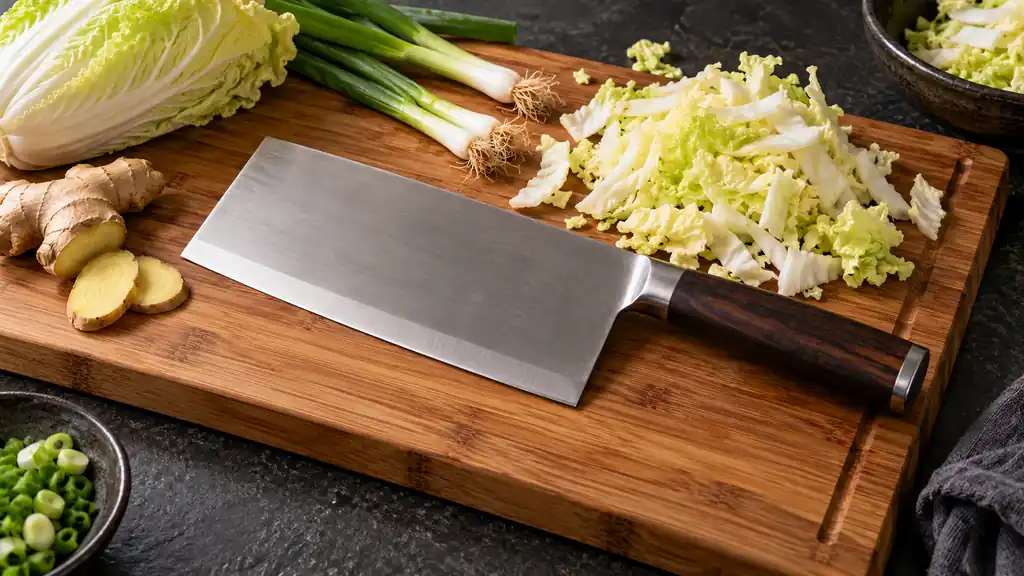
A Chinese cleaver is a broad kitchen knife built for controlled chopping, slicing, dicing, mincing, and ingredient transfer. Its tall blade gives you plenty of knuckle clearance and a wide surface for scooping chopped vegetables into a wok or bowl. The catch is that “cleaver” covers several very different tools. A thin vegetable cleaver belongs on a cutting board, while a heavier meat-oriented model may be better suited to poultry joints and softer bones. Choosing by appearance alone can leave you with a blade that is awkward for your cooking style.
Blade length, thickness, edge angle, steel, and handle construction deserve more attention than decorative Damascus patterns or dramatic marketing claims. A 7-inch blade can feel easier to guide through onions and greens, while an 8-inch model offers more reach for large cabbage, squash, or batches of meat. A stated hardness figure describes one property of the steel, but it does not by itself prove superior toughness or edge life. Maintenance matters too. Several knives here are intended for hand washing, drying, and periodic sharpening, and delicate edges should not be treated like heavy butcher tools.
The nine choices below cover vegetable-focused Chinese cleavers, meat-and-vegetable hybrids, Japanese-style designs, and more traditional broad-blade options. Different cooks will prioritize different details. A home cook may want a manageable blade and easy cleanup, while a frequent poultry preparer may prefer a more substantial construction. The Shun Premier leads the group for buyers seeking a refined vegetable cleaver, while the SHI BA ZI ZUO offers the strongest all-purpose match for many everyday kitchens.
Quick Answer
- Best Overall: SHI BA ZI ZUO 8-inch Professional Cleaver combines an 8-inch three-layer 80Cr13 construction, a wooden handle, a non-stick finish, and a broad multi-purpose profile for meat and vegetable preparation.
- Best Vegetable Cleaver: Shun Premier 7-inch Vegetable Cleaver is the more specialized choice, with a VG-MAX core, 68-layer Damascus cladding, hammered finish, and a documented 16-degree edge.
- Best for Bone and Poultry Preparation: Mueller 7-Inch Meat Cleaver emphasizes a stainless handle, double-bevel edge, and meat-oriented cutting tasks, although its intended use still calls for sensible control around hard bones.
Best Chinese Cleaver Comparison Table
| Product | Best For | Blade Length | Steel or Construction | Handle |
|---|---|---|---|---|
| SHI BA ZI ZUO Professional Cleaver | Everyday meat and vegetable prep | 8 inches | Three-layer 80Cr13 core construction | Rosewood |
| Mueller Meat Cleaver | Poultry, meat, and root vegetables | 7 inches | High-carbon German stainless steel | Seamless stainless steel |
| HOSHANHO 7-Inch Cleaver | Fine slicing and mixed prep | 7 inches | 10Cr15CoMoV stainless steel, listed at 58+2 HRC | Ergonomic handle |
| Shun Premier Vegetable Cleaver | Refined vegetable preparation | 7 inches | VG-MAX core with 68-layer Damascus cladding | Pakkawood |
| KYOKU Shogun Vegetable Cleaver | Protected storage and precise prep | 7 inches | VG10 core with Damascus blade | Triple-riveted G10 |
| HOSHANHO Japanese Meat Cleaver | High-hardness mixed kitchen work | 7 inches | 10Cr15CoMoV steel, listed at HRC 62 | Red sandalwood |
| HEZHEN 8-inch Cleaver | Large-board chopping and slicing | 8 inches | Three-layer 9Cr18CoMoV construction | Padauk wood |
| Shun Classic Vegetable Cleaver | Japanese-style vegetable cutting | 7 inches | VG-MAX core with 68-layer Damascus cladding | D-shaped Pakkawood |
| Mercer Culinary Chinese Chef’s Knife | Simple everyday Asian-style prep | Not provided | High-carbon German steel | Santoprene |
The detailed reviews explain how each blade’s construction, intended use, and maintenance requirements translate to everyday cutting tasks.
1. SHI BA ZI ZUO 8-inch Professional Cleaver — Best Overall

The SHI BA ZI ZUO earns the top position because its configuration fits the broadest interpretation of a Chinese cleaver. The 8-inch blade gives it useful reach for cabbage, large onions, leafy greens, and meat portions, while the listing presents it as suitable for slicing, dicing, mincing, and garlic crushing. Its three-layer construction uses an 80Cr13 high-carbon core with lower-carbon outer layers, giving shoppers a clearly stated material structure instead of a vague “stainless steel” label.
A non-stick coating and wire-drawing finish are aimed at reducing food adhesion, which can be handy when a mound of chopped scallions or cucumber begins clinging to the broad blade. The rosewood handle adds a traditional visual character and is described as anti-slip and anti-freezing. The full-tang construction is also listed as a stability feature. This is still a hand-wash-and-dry knife, and its meat capability should not be read as permission to attack dense, hard bones with uncontrolled force.
Pros
- 8-inch blade suits large vegetables and general kitchen preparation.
- Three-layer construction includes a documented 80Cr13 core.
- Broad profile supports slicing, dicing, mincing, and ingredient transfer.
- Rosewood handle provides a traditional grip material and shape.
- Non-stick finish may reduce food adhesion during repetitive prep.
Cons
- The 8-inch size may feel cumbersome on a small cutting board.
- The wooden handle and coated blade call for more careful cleaning than a fully stainless design.
This model makes the most sense for a cook who wants one broad knife for vegetables, herbs, meat, and everyday chopping rather than a highly specialized vegetable blade. Its longer edge and multi-purpose profile are useful during large meal preparation, such as breaking down a pile of greens before stir-frying. Buyers who mainly work with delicate vegetables and prefer a lighter Japanese-style edge may find the Shun or KYOKU more appropriate. For a general-purpose Chinese cleaver, however, the combination of size, stated construction, handle material, and intended applications is unusually well matched.
To buy this product, click here.
2. Mueller 7-Inch Meat Cleaver — Best for Poultry and Meat Preparation

Mueller takes a more meat-oriented approach than the vegetable cleavers in this group. Its 7-inch blade is listed for poultry, beef brisket, pork ribs, and dense root vegetables, so it suits cooks who expect their cleaver to move between a chopping board and a whole-chicken breakdown. The stated 18-degree double-bevel edge gives both sides of the blade a defined angle, a familiar arrangement for cooks who prefer straightforward sharpening rather than specialized single-bevel maintenance.
The seamless stainless steel handle is the practical talking point here. It avoids the exposed joint between a wood handle and blade, and the listing identifies the handle as dishwasher safe while still recommending hand washing for longer edge life. The wide blade can also work as a bench scraper for transferring chopped ingredients. That broad utility is useful after a fast prep session, though hard-bone work still requires controlled technique and a suitable cutting surface.
Pros
- 7-inch size offers a manageable compromise between reach and control.
- High-carbon German stainless steel is clearly identified as the blade material.
- Double-bevel edge is familiar for routine sharpening and general use.
- Seamless stainless handle is easy to wipe and listed as dishwasher safe.
- Wide blade can transfer chopped ingredients from board to pan.
Cons
- Its meat-focused design may be more knife than vegetable-only cooks need.
- Hand washing remains the better maintenance choice despite the dishwasher-safe handle claim.
Choose Mueller if poultry joints, brisket portions, and firm root vegetables appear regularly on the menu. It has a more utilitarian character than the patterned Japanese-style options, like a sturdy drawer tool brought out for a Saturday meal-prep session. A buyer seeking a lighter vegetable cleaver for paper-thin slicing may prefer a different profile, while someone who wants a simple stainless handle and meat-capable blade will find this one easier to justify.
To buy this product, click here.
3. HOSHANHO Cleaver Knife 7 Inch — Best for Fine Mixed Prep

This HOSHANHO is aimed at cooks who want a compact Chinese-style cleaver for a mix of vegetables, fish, chicken, and meat. The 7-inch blade is shorter than the two 8-inch options here, which can make a difference when a small board is crowded with garlic, ginger, and sliced peppers. Its listed 2.3-millimeter blade thickness gives shoppers a useful reference for the construction, although thickness alone does not reveal the complete grind or cutting feel.
The product information identifies Japanese 10Cr15CoMoV stainless steel and lists hardness at 58+2 HRC, along with a 15-degree edge on each side. Those details suggest a fairly defined double-bevel setup, but they should be treated as published specifications rather than a guarantee of edge life. The handle is described as ergonomic for prolonged use, and the smooth blade surface is intended to reduce residue adhesion. Regular hand washing, thorough drying, and periodic sharpening are specifically recommended.
Pros
- 7-inch format is suitable for cooks who prefer a more compact cleaver.
- 10Cr15CoMoV stainless steel is identified by name.
- Published 15-degree-per-side edge specification gives sharpening guidance.
- 2.3-millimeter blade thickness provides useful construction information.
- Intended for vegetables, fish, chicken, and other mixed preparation.
Cons
- The stated edge and hardness figures do not establish actual edge retention in every kitchen.
- Hand washing and drying are recommended, so it is less convenient for dishwasher users.
This is a sensible fit for a cook who values a shorter blade and wants one tool for weeknight prep. Picture a small apartment kitchen where a full 8-inch cleaver feels slightly oversized beside a compact board. The HOSHANHO’s documented edge angle and stainless construction make it easier to understand how the knife is intended to be maintained, while the absence of detailed weight information leaves some handling questions unanswered. Buyers seeking a more traditional wooden handle or a decorative Damascus finish will find those features elsewhere.
To buy this product, click here.
4. Shun Premier 7-inch Vegetable Cleaver — Best Refined Vegetable Design

The Shun Premier is the clearest specialist vegetable cleaver in this roundup. Its 7-inch blade is presented for cutting, slicing, and dicing large vegetables, so it should appeal to cooks who spend more time preparing cabbage, squash, carrots, and leafy greens than breaking down poultry. The VG-MAX core sits beneath 68 layers of Damascus stainless steel cladding, and the hammered tsuchime finish is intended to reduce drag and food adhesion.
A listed 16-degree edge gives this knife a more precise vegetable-prep orientation than a heavy meat cleaver. The contoured Pakkawood handle is described as suitable for left- and right-handed users, which broadens its appeal, although grip comfort remains dependent on hand size and technique. Shun also lists free sharpening and honing support, a useful ownership feature for someone who wants a defined maintenance path. The thin vegetable emphasis means this is not the first choice for hard bone work.
Pros
- Purpose-built profile suits slicing and dicing large vegetables.
- VG-MAX core and 68-layer Damascus cladding are clearly documented.
- Hammered finish is intended to reduce drag and food sticking.
- 16-degree edge specification helps define its precision-oriented design.
- Pakkawood handle is described as usable for both left- and right-handed cooks.
Cons
- Vegetable-focused design is less appropriate for heavy meat and bone tasks.
- Its premium construction requires more care than a basic utility cleaver.
For a serious vegetable cook, the Shun Premier has a compelling specification sheet. It is the knife that makes sense beside a wok station loaded with napa cabbage, bell peppers, and daikon, where controlled slicing matters more than brute force. The hammered finish and tall blade are practical features as well as visual details. Skip it if your definition of a cleaver centers on chopping through poultry joints, but choose it if refined vegetable preparation is the heart of your kitchen.
To buy this product, click here.
5. KYOKU Shogun Vegetable Cleaver — Best for Protected Storage
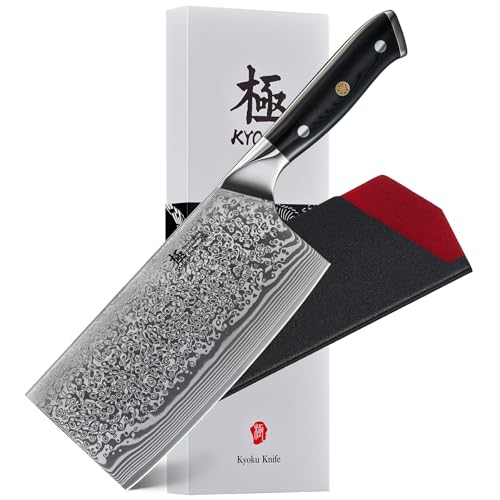
KYOKU’s Shogun Series cleaver combines a 7-inch vegetable-focused blade with a protective sheath and case. That storage package gives it a practical angle for cooks who move knives between kitchens, keep equipment in a crowded drawer, or simply want the edge covered between uses. The listing identifies a VG10 Japanese steel core, a Damascus blade, and a stated hardness range of HRC 58 to 60.
The product information also lists an 8-to-12-degree double-sided edge and a three-step Honbazuke finishing process. Those figures describe a narrow edge configuration, so sharpening equipment and technique should match the knife rather than relying on a generic pull-through sharpener. The triple-riveted G10 handle is described as resistant to heat, cold, and moisture. Its straight blade is intended for slicing meat and vegetable preparation, although the product’s vegetable-cleaver classification should keep expectations away from heavy bone work.
Pros
- 7-inch blade suits controlled vegetable and meat slicing.
- VG10 core and stated HRC 58 to 60 range are documented.
- G10 handle uses triple rivets and is described as moisture resistant.
- Sheath and case provide a clear storage and transport advantage.
- Double-sided edge specification gives a defined maintenance reference.
Cons
- The narrow listed edge may require careful sharpening compatibility.
- Vegetable-cleaver positioning limits its suitability for forceful bone chopping.
KYOKU is a good match for the cook who values organization as much as blade design. A protective case can be handy during a holiday visit, a cooking class, or a move where loose knives are a poor idea. The knife’s steel and edge details are more specific than many listings provide, though those same details make careless sharpening less attractive. It is a strong middle-ground choice for vegetable work, especially where covered storage matters.
To buy this product, click here.
6. HOSHANHO Japanese Meat Cleaver — Best for a High-Hardness Specification
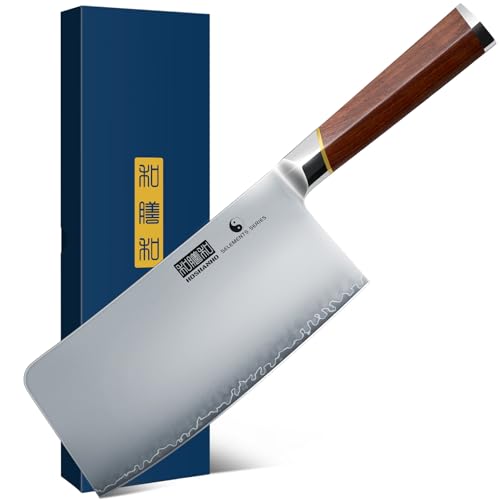
This second HOSHANHO cleaver takes a more meat-capable position while retaining a 7-inch format. It is listed for dicing vegetables, chopping herbs, slicing meats, and breaking down poultry, giving it a broad remit for cooks who want one blade near the center of the cutting board. The 15-degree double-bevel edge is a useful detail for sharpening, while the mirror-polished surface is intended to reduce food adhesion and simplify wiping.
The product description identifies Japanese 10Cr15CoMoV high-carbon steel and lists HRC 62 hardness. That is a notably specific claim, but hardness should not be treated as a complete scorecard for toughness, edge retention, or cutting performance. The red sandalwood handle is described as dense and crack resistant, with an ergonomic shape. Since the available information does not provide weight or exact blade thickness, buyers who are sensitive to heft will need to check the current listing before purchase.
Pros
- 7-inch blade offers a compact size for mixed meat and vegetable work.
- 10Cr15CoMoV steel and HRC 62 rating are supplied as specific product details.
- 15-degree double bevel gives a clear edge configuration.
- Red sandalwood handle provides a traditional wood construction.
- Mirror-polished surface is intended to limit food residue adhesion.
Cons
- The high hardness claim does not establish how the edge will behave under every cutting impact.
- Available specifications do not state the knife’s weight or blade thickness.
This cleaver suits a buyer who pays close attention to stated steel and hardness information and wants a traditional-looking handle. It could sit comfortably in a kitchen that moves from herb chopping to poultry preparation during the same meal, provided the user keeps hard materials within the knife’s supported role. Compared with the first HOSHANHO, this model leans more clearly toward meat preparation and uses red sandalwood rather than an unspecified ergonomic handle. That distinction makes it the more targeted pick for mixed meat work.
To buy this product, click here.
7. HEZHEN 8-inch Cleaver — Best for Large Cutting Boards

HEZHEN gives the shopper another full-size 8-inch option, with a three-layer composite construction built around a 9Cr18CoMoV steel core. The larger format can be useful when a recipe involves bulky vegetables or a broad pile of ingredients. Its intended role covers vegetables and meat, and the listing describes a 15-degree-per-side edge along with a series of processing steps aimed at reducing surface resistance.
The Padauk wood handle gives this cleaver a classic appearance and a rounded profile. Wood can be pleasant in a kitchen where knives are washed promptly and dried carefully, though the product information does not provide detailed handle dimensions or total weight. The listed hardness range of 58 to 60 HRC adds useful material information without proving how the blade will respond to every task. Its lifetime warranty claim is also part of the supplied product information, but buyers should review the current terms before relying on it.
Pros
- 8-inch blade provides reach for large vegetables and spacious cutting boards.
- Three-layer design includes a named 9Cr18CoMoV steel core.
- 15-degree-per-side edge specification supports a defined double-sided sharpening approach.
- Padauk handle offers a traditional wood construction and rounded shape.
- Intended for both vegetable and meat preparation.
Cons
- The larger blade may be less convenient in a tight prep area.
- Weight and exact handle dimensions are not provided in the available information.
HEZHEN is the choice for cooks who like a broad working surface and already have room for an 8-inch cleaver. Think of a large board covered with cabbage, carrots, and sliced pork, where the extra reach can reduce repeated repositioning. A smaller cooktop or narrow board may make the 7-inch models easier to control. The composite construction and named steel core give HEZHEN a solid information base, but careful hand washing remains sensible for its wood-handled design.
To buy this product, click here.
8. Shun Classic 7-inch Vegetable Cleaver — Best Classic Japanese-Style Option

The Shun Classic shares several important specifications with the Premier, but its identity comes from the Classic line and its D-shaped Pakkawood handle. It is a 7-inch vegetable cleaver intended for cutting, slicing, and dicing large vegetables. The VG-MAX core and 68-layer Damascus stainless cladding are stated directly, while the 16-degree edge gives the knife a clearly defined precision-oriented design.
This is a useful option for a cook who wants a vegetable cleaver with a recognizable Japanese-style construction and a handle profile that may feel more directional than a symmetrical round handle. Shun lists the handle as suitable for left- and right-handed users, yet the D shape still makes grip preference a personal matter. Free sharpening and honing support is included in the product description, which may matter to buyers who want a long-term care route. Like the Premier, it is better viewed as a vegetable knife than a bone chopper.
Pros
- 7-inch blade is sized for controlled vegetable preparation.
- VG-MAX core and 68-layer Damascus cladding are documented.
- 16-degree edge specification suits a precision-focused cutting role.
- D-shaped Pakkawood handle provides a distinct grip design.
- Listed sharpening and honing support adds ownership assistance.
Cons
- Vegetable-focused construction is not the right fit for heavy bone work.
- The D-shaped handle may not suit every grip preference despite its stated ambidextrous use.
The Shun Classic is aimed at the cook who sees a cleaver as a vegetable-prep instrument rather than a butcher’s blade. It would be at home beside a wok where onions, bok choy, and mushrooms are prepped in quick succession, with the tall blade helping transfer ingredients afterward. Buyers deciding between this and the Premier should focus on the handle design and hammered finish rather than assuming the shared core and cladding make them identical in use. The Classic is the simpler choice for those who prefer its D-shaped handle.
To buy this product, click here.
9. Mercer Culinary Asian Collection Chinese Chef’s Knife — Best Straightforward Everyday Option

Mercer’s Asian Collection knife is a straightforward choice for cooks who want a Chinese chef’s knife without a long list of specialized construction claims. The product information identifies a taper-ground, fine-stone-finished blade made from high-carbon German steel. It is listed for hard vegetables such as squash and thin or soft bones, giving it a broader role than a dedicated vegetable slicer while keeping the intended applications relatively clear.
The Santoprene handle is the most distinctive practical feature. Mercer describes it as offering grip and comfort with wet hands, an appealing detail during prep when rinsing vegetables or handling damp ingredients is unavoidable. The available information does not provide a blade length, steel grade, weight, or exact edge angle, so shoppers who want highly specified geometry will find the other options easier to compare. Hand washing with mild soap, rinsing, and thorough drying are specifically recommended.
Pros
- Taper-ground blade shape is identified rather than left entirely unspecified.
- High-carbon German steel is listed as the blade material.
- Santoprene handle is intended to maintain grip with wet hands.
- Product guidance covers hard vegetables and thin or soft bones.
- Hand-washing instructions are clear and practical.
Cons
- Blade length, steel grade, weight, and edge angle are not provided in the available information.
- It lacks the sheath, case, or stated layered construction found on several alternatives.
Mercer is a sensible pick for a practical home kitchen where the knife will be washed, dried, and returned to a drawer or block after ordinary prep. Its Santoprene handle gives it a different personality from the wood-handled choices, especially for cooks who regularly work with wet ingredients. It is less suitable for buyers comparing detailed metallurgy or precise edge angles, but its plain-spoken specification set can be refreshing. Choose it for uncomplicated daily work rather than decorative presentation.
To buy this product, click here.
Buying Guide
Match the Cleaver to the Cutting Task
Chinese cleavers are broad enough to look similar while serving different purposes. A vegetable cleaver generally favors slicing, dicing, push cutting, and ingredient transfer. Meat-oriented models place more emphasis on poultry, meat portions, and selected bone-related tasks. The Shun Premier and Shun Classic are clearly presented as vegetable cleavers, while Mueller and the second HOSHANHO are described for meat and poultry work. A shopper preparing bok choy and carrots every evening should not select a blade solely because it looks heavy enough for a butcher block.
Match the knife’s geometry to its intended job. The differences between nakiri and Chinese cleavers explain why a broad vegetable blade is not a substitute for a bone cleaver.
Choose 7 or 8 Inches Based on Your Workspace
The 8-inch SHI BA ZI ZUO and HEZHEN models offer more working edge and reach. That can be helpful with a large cabbage or a broad prep board, but the added length can feel awkward where counter space is tight. The 7-inch knives are easier to position around smaller ingredients and may appeal to cooks who prefer shorter strokes. Since the available data does not provide total weight for every product, blade length is only one part of the handling decision. Check the current product dimensions before buying if storage or board space is limited.
Read Steel Claims With Some Restraint
Several products provide named steels, including 80Cr13, 10Cr15CoMoV, 9Cr18CoMoV, VG10, and VG-MAX. That information helps distinguish one construction from another, but alloy name alone does not establish cutting performance. The HOSHANHO listings also provide hardness figures, and HEZHEN lists a hardness range. Hardness, toughness, corrosion resistance, sharpening effort, and edge retention are separate traits. A stated HRC value can inform comparison, but it should not be treated as a guarantee that one knife will outperform every other model in every kitchen.
Consider the Handle and Cleaning Routine
Wood handles on the SHI BA ZI ZUO, HOSHANHO, HEZHEN, and other models offer a traditional appearance, while Mueller uses a seamless stainless handle, Mercer uses Santoprene, and KYOKU uses G10. These materials create different maintenance routines and grip expectations. Mercer specifically addresses wet-hand grip, while several wood-handled knives call for hand washing and drying. A dishwasher-oriented household may prefer the stainless handle, though Mueller’s own guidance still favors hand washing for edge care. No handle material guarantees comfort for every hand size.
Plan for Sharpening and Safe Use
A cleaver’s edge should be maintained with a method appropriate to its construction and stated angle. The HOSHANHO models list 15 degrees per side, Mueller lists an 18-degree double bevel, and the Shun models list a 16-degree edge. These figures should not be mixed casually, and a generic sharpener may remove more material than intended. Use a stable cutting board, keep fingers clear of the broad edge, and reserve heavy impact for tasks the product specifically supports. Vegetable-focused blades should not be treated like tools for hard, dense bones or frozen food.
Best Chinese Cleaver FAQ
What is a Chinese cleaver used for?
A Chinese cleaver can handle many board tasks, including slicing vegetables, chopping herbs, dicing meat, mincing aromatics, and moving ingredients into a pan. The broad blade can also crush garlic or scoop food from the board. Its exact suitability depends on blade thickness and intended use. Vegetable cleavers are generally aimed at produce and controlled slicing, while meat cleavers may be listed for poultry, meat, and selected soft-bone work.
Is a Chinese cleaver the same as a meat cleaver?
No. A Chinese-style vegetable cleaver is typically a broad, tall kitchen knife used for produce and general preparation. A meat cleaver may have a heavier construction and a profile intended for poultry or bone-related tasks. The terms are sometimes used loosely in product titles, so read the listed applications carefully. The Shun models in this guide are specifically vegetable cleavers, while Mueller is more clearly positioned for meat and poultry preparation.
Should I choose a 7-inch or 8-inch Chinese cleaver?
Choose 7 inches if your cutting board or counter is compact, or if you prefer closer control around smaller ingredients. An 8-inch blade gives more reach for large vegetables and bigger batches. Length does not determine quality, and the best size depends on hand position, board space, and the food you prepare most often. If you routinely chop a full cabbage or large squash, the additional reach of an 8-inch option may be useful.
Can a Chinese cleaver cut through bones?
Some meat-oriented cleavers are listed for poultry joints, ribs, or thin and soft bones, but that does not mean every Chinese cleaver is suitable for hard bone chopping. Vegetable cleavers with more precision-focused edges should be kept away from forceful impacts unless the manufacturer specifically supports that use. Use controlled strokes and an appropriate cutting board. Dense bones, frozen foods, and uncontrolled striking can damage an edge or create a safety hazard.
Are Japanese-style Chinese cleavers made in Japan?
Not necessarily. “Japanese-style” may describe the steel, edge, or design approach rather than manufacturing origin. The Shun products in this guide are described as handcrafted in Japan, while other listings identify Japanese steel without establishing the production location of the complete knife. Separate brand origin, steel origin, design style, and manufacturing location when comparing products.
How should I clean a Chinese cleaver?
Follow the product’s care instructions, but hand washing with mild soap, rinsing, and immediate drying is the safest general routine for the knives in this guide. This is especially relevant for wood handles and blades with specialized finishes. Mercer specifically advises against placing its knife in a dishwasher or leaving it submerged. A dishwasher-safe handle does not necessarily mean the entire knife is the best candidate for machine cleaning.
Do Damascus layers make a cleaver cut better?
Layered cladding can provide a distinctive appearance and may surround a separate core steel, as described for the Shun and KYOKU models. Layer count alone does not prove superior sharpness, toughness, or edge retention. Cutting behavior also depends on the core steel, edge geometry, grind, heat treatment, and maintenance. Treat Damascus as one construction detail rather than a complete performance rating.
Final Verdict
The SHI BA ZI ZUO 8-inch Professional Cleaver is the strongest overall match for shoppers seeking one Chinese cleaver that covers everyday vegetable and meat preparation. Its 80Cr13 three-layer construction, broad 8-inch format, wooden handle, and non-stick finish give it a well-rounded specification set. It is a practical choice for a cook who wants to chop cabbage, mince herbs, slice meat, and transfer ingredients with one broad blade. The Mueller is the more targeted alternative for poultry and meat work, especially for buyers who prefer a seamless stainless handle and 7-inch format.
For vegetable-focused cooking, the Shun Premier is the leading specialist option, while the KYOKU adds a protective sheath and case for buyers who value covered storage. The HOSHANHO and HEZHEN knives offer clearly stated steel and edge details, while Mercer keeps the design simple with a Santoprene handle and a more modest specification set. Match the final choice to your board size, cutting habits, maintenance routine, and tolerance for specialized edges. A Chinese cleaver works best when its blade profile suits the food on your board, not when its appearance alone makes the decision.
