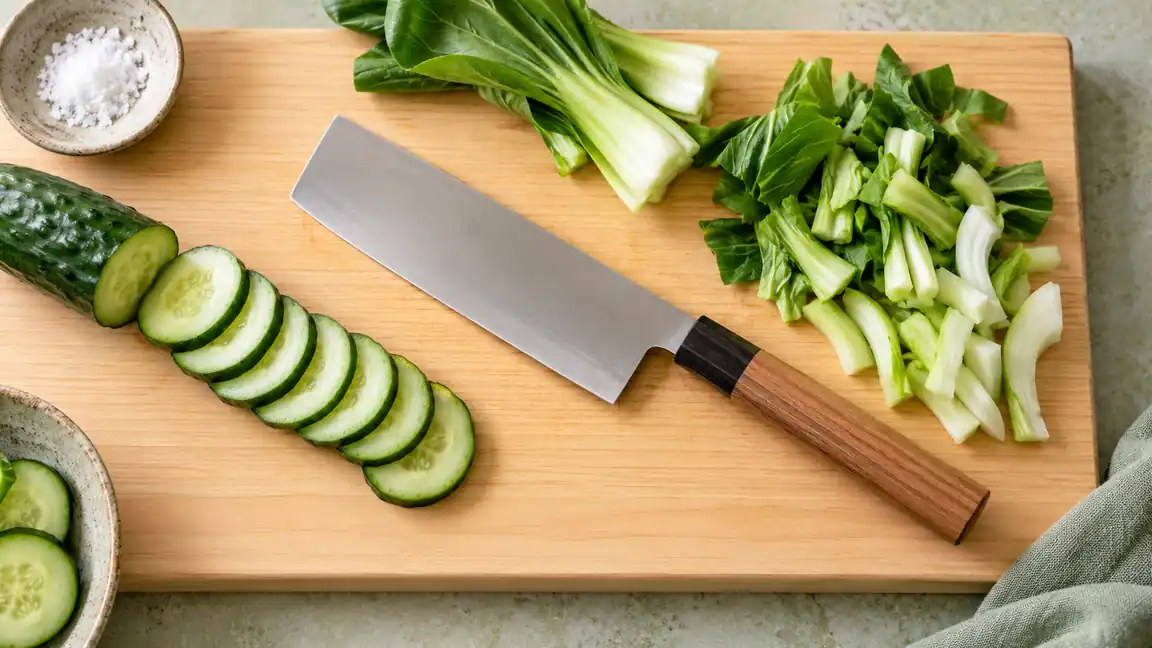
A nakiri earns its place in a kitchen through a simple promise: a tall, straight-edged blade that makes vegetable preparation feel organized rather than awkward. The rectangular profile suits push cuts, vertical chopping, slicing, and fine work on onions, carrots, cabbage, herbs, and leafy greens. Buyers often choose one after tiring of a curved chef’s knife that encourages rocking, or after finding that a narrow utility blade leaves too little board clearance for larger produce.
The common mistake is treating every knife labeled “Japanese” or “vegetable cleaver” as the same tool. Blade length, edge angle, steel designation, blade height, handle construction, and care instructions can create meaningful differences. A hard stainless steel blade may hold an edge well but require more careful sharpening, while a German-style nakiri may offer a more familiar forged construction and straightforward maintenance. A 7-inch blade gives broad coverage for meal prep, while a 5.5-inch model can be easier to control in a compact kitchen. Your cutting habits, hand size, maintenance routine, and preference for a decorative Damascus finish all matter.
This comparison focuses on genuine nakiri-style knives and weighs their documented construction against practical vegetable preparation. The Shun Classic is the strongest overall match for buyers who want a specialized Japanese vegetable knife with a documented VG-MAX core and handcrafted construction. Several alternatives make sense for different priorities, including shorter blades, German-style steel, textured handles, and more pronounced Damascus styling.
Quick Answer
The Shun Classic 6.5-inch Nakiri is the Best Overall choice because its specialized vegetable-knife design, VG-MAX core, Damascus cladding, D-shaped pakkawood handle, and stated 16-degree edge create a focused package for controlled chopping and slicing.
The HOSHANHO 7 Inch Nakiri is a strong everyday alternative with a documented 10Cr15CoMoV high-carbon stainless steel blade, 60 HRC listing, 15-degree edge, hollow-ground side features, and pakkawood handle.
The HOSHANHO 5.5 Inch Nakiri is the most compact option in this group. Its shorter blade uses the same listed steel family and 15-degree edge as the larger HOSHANHO, making it worth a look for smaller prep areas and detail-oriented cutting.
Best Nakiri Knife Comparison Table
| Product | Best For | Blade Length | Blade Profile | Steel |
|---|---|---|---|---|
| Shun Classic Nakiri | Specialized vegetable prep | 6.5 inches | Rectangular nakiri profile | VG-MAX core, Damascus cladding |
| HOSHANHO 7 Inch Nakiri | Everyday chopping | 7 inches | Hollow-side vegetable blade | 10Cr15CoMoV stainless steel |
| 67-Layer Damascus VG10 Nakiri | Fine vegetable cuts | 7 inches | Tall, straight edge | VG10 core, 67-layer cladding |
| imarku 7 Inch Nakiri | High-volume prep | 7 inches | Hammered hollow-edge design | High-carbon stainless steel |
| ZWILLING Gourmet Nakiri | German-style construction | 6.5 inches | Precision-honed nakiri edge | High-carbon NO STAIN steel |
| Milk Street Nakiri | Controlled home cooking | 6.75 inches | Broad, 2-inch-high blade | 1.4116 German steel |
| HOSHANHO 5.5 Inch Nakiri | Compact prep spaces | 5.5 inches | Hollow-side vegetable blade | 10Cr15CoMoV stainless steel |
| Mercer Genesis Nakiri | Traditional forged design | 7 inches | Taper-ground edge | High-carbon German steel |
| HOSHANHO Damascus Nakiri | Decorative Damascus styling | 6.5 inches | Rectangular grooved blade | 10Cr15CoMoV core |
The detailed reviews below look past blade appearance to explain how each knife’s geometry, steel, handle, and care requirements affect daily vegetable preparation.
1. Shun Classic 6.5-inch Nakiri Knife – Best Overall

The Shun Classic is the most purpose-built option in this selection. Its 6.5-inch blade is long enough for a full cutting board of vegetables while remaining more compact than many 7-inch nakiri knives. The rectangular profile is suited to the straight up-and-down and push-cutting motions that make a nakiri useful for onions, zucchini, cabbage, carrots, and herbs. The listing identifies a VG-MAX core, a 16-degree edge, and 68 layers of Damascus stainless steel cladding, giving shoppers more construction information than many generic nakiri listings provide.
The D-shaped pakkawood handle is listed as suitable for both left- and right-handed users, which gives it broader appeal than a strongly directional traditional handle. Its handcrafted Japanese construction and free sharpening and honing support add practical value for someone who wants a long-term knife-care path rather than a decorative blade for occasional use. This is still a specialized vegetable knife, so a cook who frequently rocks through herbs or cuts hard materials may prefer a different profile. For regular board work, however, the documented design is unusually focused.
Pros
- Specialized 6.5-inch nakiri profile for vegetable preparation.
- VG-MAX core with 68 layers of Damascus stainless steel cladding.
- Documented 16-degree edge supports a fine cutting profile.
- D-shaped pakkawood handle is listed for left- and right-handed use.
- Free sharpening and honing support is included with the product information.
Cons
- The specialized straight edge is less suited to pronounced rocking cuts.
- Its documented construction and handcrafted positioning may be more than occasional cooks need.
The Shun makes the most sense for a vegetable-focused cook who appreciates clear steel and construction details and is prepared to hand-wash and maintain a fine-edged knife. It may be excessive for someone who wants a rough-use all-purpose blade or routinely cuts through hard foods. Choose it over the other options for its focused geometry, documented core steel, and broader handle orientation rather than for the Damascus pattern alone.
To buy this product, click here.
2. HOSHANHO 7 Inch Nakiri Knife – Best for Everyday Chopping

The 7-inch HOSHANHO takes the familiar nakiri format and adds unusually specific listing information for its category. The blade is described as Japanese 10Cr15CoMoV high-carbon stainless steel, with a listed hardness of 60 HRC and a 15-degree edge. Those details do not prove a particular level of cutting performance, but they help buyers understand the intended design: a relatively fine double-bevel vegetable knife that should be maintained with an appropriate sharpening method.
Its scallop-shaped hollow features are intended to reduce food contact with the blade, a useful idea when preparing sticky potatoes, sliced cucumber, or dense squash. The 7-inch length offers a generous cutting surface for large onions and broad cabbage leaves. A pakkawood handle and stated ergonomic shaping round out the design. The product is also marketed for fruit, vegetables, and meat, but the nakiri profile remains most naturally suited to board-based produce preparation.
Pros
- 7-inch blade provides broad coverage for daily vegetable prep.
- 10Cr15CoMoV high-carbon stainless steel and a 60 HRC listing are clearly identified.
- Stated 15-degree edge supports controlled slicing and chopping.
- Hollow-side features are intended to reduce food contact.
- Pakkawood handle provides a documented composite wood-style grip surface.
Cons
- The longer blade may feel cumbersome on a small cutting board.
- The listing’s multipurpose claims do not make it a substitute for a dedicated meat knife.
This HOSHANHO suits cooks who want a full-size nakiri for batch preparation and prefer a stated steel and hardness specification. It is less compelling for someone with limited counter space or a strong preference for a shorter blade. Proper hand washing, drying, and compatible sharpening remain sensible practices for a fine-edged stainless knife, particularly because the listing does not establish dishwasher suitability.
To buy this product, click here.
3. 7-inch Damascus VG10 Nakiri Knife – Best for Fine Vegetable Cuts

This knife is aimed squarely at buyers who want a tall vegetable blade with a strong visual presence. Its straight edge and broad nakiri shape are suitable for chopping, slicing, julienning, and portioning produce. The listing identifies a Japanese VG10 core, 67-layer Damascus construction, a 62 HRC rating, and a hand-sharpened 12-degree edge. The specifications describe a fine cutting geometry, although the stated angle should be treated as a product claim rather than proof of universal sharpness or durability.
The natural wood and blue resin handle gives each knife a distinctive appearance while providing the listed grip material and ergonomic shape. That combination may appeal to someone buying a cooking gift or building a visually coordinated collection. The 7-inch blade offers useful reach for large vegetables, but the narrow edge angle means owners should use a suitable cutting board and avoid treating the knife as a hard-material cleaver. Damascus layering contributes to the pattern and construction description, yet it should not be mistaken for automatic proof of better edge retention.
Pros
- Tall, straight blade is purposefully shaped for vegetable preparation.
- VG10 core and 67-layer Damascus construction are documented.
- Listed 62 HRC rating and 12-degree edge provide clear specification points.
- Blue resin and natural wood handle gives the knife a distinctive finish.
- 7-inch length offers useful coverage for larger produce.
Cons
- The fine listed edge calls for careful use on an appropriate cutting surface.
- The decorative Damascus construction may matter less to buyers focused solely on function.
This is a good fit for a cook who wants a conventional nakiri profile paired with visible Damascus styling and stated VG10 construction. It may be a poor match for rough chopping, hard bones, frozen foods, or anyone unwilling to hand-wash and dry a fine kitchen knife. Its appeal rests on the combination of vegetable-focused geometry and documented materials, rather than on layer count alone.
To buy this product, click here.
4. imarku 7-inch Nakiri Knife – Best for High-Volume Prep
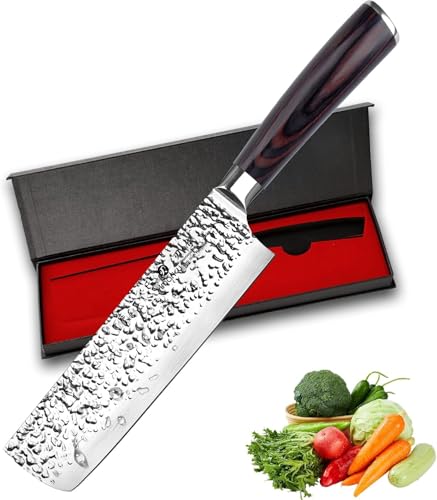
The imarku focuses on the small details that affect repetitive chopping. Its 7-inch blade has a listed 15-degree edge, hammered finish, and hollow-edge design. A hammered surface can reduce the visual flatness of a blade, while the hollow features are intended to limit food contact and drag. Those features are especially relevant during a large prep session involving potatoes, cucumbers, or firm squash, where slices can cling to a broad blade.
The full-tang construction and deep brown pakkawood handle are presented as balance and grip features. The listing also identifies a non-slip shape and a protective sheath, which may help with storage in a drawer or shared kitchen. The high-carbon stainless steel description is less specific than the alloy designations on some competing knives, so buyers who prioritize exact steel identification may prefer the Shun, VG10, or HOSHANHO alternatives. Hand washing is the stated care direction.
Pros
- 7-inch blade suits repeated chopping across a full cutting board.
- Hammered and hollow-edge features are intended to reduce sticking.
- Listed full-tang construction supports a conventional knife build.
- Pakkawood handle is described as non-slip and ergonomic.
- Protective sheath is included for storage.
Cons
- The listing does not identify a precise alloy designation for the high-carbon stainless steel.
- Hand-wash-only care requires more attention than a dishwasher-oriented knife.
The imarku is a sensible choice for cooks who prepare vegetables in large quantities and value food-release features, a sheath, and a familiar 7-inch format. It is less suitable for shoppers who want a fully documented steel specification or a compact blade for small boards. The practical trade-off is straightforward: useful handling and storage features, paired with less material detail than the most specification-rich knives here.
To buy this product, click here.
5. ZWILLING Gourmet 6.5-inch Nakiri Knife – Best German-Style Design

The ZWILLING Gourmet brings a German manufacturing and construction approach to the nakiri category. Its 6.5-inch blade is precision-forged from a single piece of high-carbon NO STAIN steel, according to the supplied product information. The ice-hardened FRIODUR treatment, precision honing, and laser-controlled edge are also listed. These details make the knife appealing to cooks who prefer a conventional forged Western-style handle and a brand with a broad cutlery range.
The three-riveted full-tang handle uses POM with stainless steel rivets. That arrangement provides a familiar silhouette and documented handle durability, while the 6.5-inch blade keeps the knife manageable for ordinary home boards. The listing describes the knife as dishwasher-safe, but hand washing and drying remain gentler practices for preserving an edge and handle over time. Its geometry is still nakiri-oriented, so it should be selected for chopping and slicing produce rather than aggressive cleaver work.
Pros
- 6.5-inch blade offers a manageable size for home kitchens.
- Single-piece forged construction is clearly identified.
- FRIODUR ice-hardening and laser-controlled edge are listed features.
- Three-riveted full-tang handle uses durable POM and stainless steel.
- Dishwasher suitability is stated in the product information.
Cons
- The listing does not provide a specific steel grade or hardness value.
- The Western-style handle may appeal less to cooks seeking a traditional Japanese handle.
Pick the ZWILLING for its familiar forged construction, moderate blade length, and handle design rather than for Japanese-style branding. It suits cooks moving from a Western chef’s knife to a flatter vegetable blade and may be easier to integrate into an established German-style collection. Buyers who want a documented Japanese alloy, a fine stated edge angle, or Damascus cladding have stronger matches elsewhere in this guide.
To buy this product, click here.
6. Milk Street 6.75-inch Nakiri Knife – Best for Controlled Home Cooking

The Milk Street nakiri uses a 6.75-inch blade, a useful middle ground between compact control and full-size chopping coverage. Its broad blade stands 2 inches high, according to the listing, giving the hand more clearance above the board and making it easier to guide straight cuts through vegetables. The embossed file pattern is intended to aid food release, while the rectangular shape keeps the knife aligned with the classic nakiri purpose.
The 1.4116 German steel construction offers a named alloy and a corrosion-resistant design direction, though the product still requires hand washing and immediate drying. The handle uses a dual-polymer core with a textured exterior, a detail aimed at keeping the grip secure when hands are wet or oily. The listing recommends sharpening at a 17-degree angle. That guidance is useful, but owners should use a sharpening method that can maintain the intended edge consistently rather than relying on an incompatible pull-through device.
Pros
- 6.75-inch blade balances detail work with broader vegetable cuts.
- 2-inch blade height provides useful knuckle clearance.
- 1.4116 German steel is specifically identified.
- Textured dual-polymer handle is intended for secure wet-hand handling.
- Listing provides a 17-degree sharpening recommendation.
Cons
- Hand washing and immediate drying are required by the care instructions.
- The 17-degree sharpening guidance may require more attention than a casual user expects.
This knife makes sense for a home cook who wants a broad, steady blade and a tactile handle without moving to a very long nakiri. It is especially attractive for cooks who value finger clearance and a named German steel. Skip it if dishwasher use is non-negotiable or if you prefer a very thin, aggressively angled Japanese-style edge. Its strengths are control and practical dimensions rather than ornate presentation.
To buy this product, click here.
7. HOSHANHO 5.5 Inch Nakiri Knife – Best Compact Design

A 5.5-inch nakiri changes the rhythm of prep. It occupies less space on a small board, turns more easily around a crowded work surface, and can feel less imposing during detail work such as trimming scallions or slicing a single shallot. This HOSHANHO uses the same listed 10Cr15CoMoV high-carbon stainless steel family and 60 HRC hardness specification as the larger HOSHANHO in this guide, along with a stated 15-degree edge.
The shorter blade comes with the same pakkawood handle concept and scallop-shaped hollow features. That gives the knife a consistent design language, but the reduced cutting length matters in practice. A cook preparing half a cabbage or several large eggplants may prefer the longer blade because fewer strokes are required. For a studio apartment, small board, or cook who values close control over sweeping cuts, the compact format is a meaningful distinction rather than a minor variation.
Pros
- 5.5-inch blade is well suited to compact cutting boards.
- 10Cr15CoMoV high-carbon stainless steel is identified.
- Listed 60 HRC hardness and 15-degree edge provide useful specifications.
- Hollow-side features are intended to reduce food contact.
- Pakkawood handle follows a compact, familiar design.
Cons
- Shorter blade covers less surface area for large vegetables.
- The product information does not provide detailed weight or handle dimensions.
Choose this version when control and counter space matter more than maximum blade coverage. It is a better fit for small kitchens, modest meal prep, and cooks who prefer shorter knives. Large-family batch cooking may expose its limitation quickly, especially with wide produce. The choice between this model and the 7-inch HOSHANHO should be based primarily on workspace and cutting volume, since the listed steel and edge specifications are closely related.
To buy this product, click here.
8. Mercer Culinary Genesis 7-inch Nakiri Knife – Best Traditional Forged Design
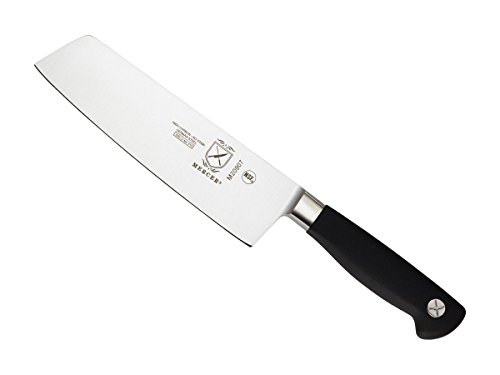
The Mercer Genesis keeps the focus on basic knife construction rather than decorative blade finishes. Its 7-inch nakiri blade is described as precision-forged from high-carbon German steel with a taper-ground edge. That edge treatment is relevant to vegetable work because it supports a gradual transition toward the cutting edge, although the listing does not provide a specific angle or hardness rating. The knife is intended for chopping, mincing, and slicing vegetables.
The ergonomic handle is listed as non-slip, including when hands are wet, and the product is positioned for both home and professional kitchen use. That does not guarantee comfort for every hand, but it gives the knife a practical orientation. Care instructions call for hand washing with mild soap, thorough rinsing, and drying, with no prolonged submersion or dishwasher use. The absence of a named alloy grade means this knife is better for shoppers who value a straightforward forged design than for buyers comparing detailed metallurgy.
Pros
- 7-inch blade provides broad coverage for vegetable preparation.
- Precision-forged construction is documented.
- High-carbon German steel and a taper-ground edge are specified.
- Non-slip handle is intended to remain secure with wet hands.
- Product purpose clearly includes chopping, mincing, and slicing vegetables.
Cons
- The listing does not identify a specific alloy grade or hardness value.
- Hand washing and careful drying are required for long-term care.
The Mercer is a sensible match for someone who wants a conventional forged nakiri from an established culinary cutlery line and does not need a Damascus pattern or stated Japanese edge angle. It may disappoint buyers who want extensive steel data or a highly stylized handle. Its strongest case is practical simplicity: a full-size vegetable blade, a taper-ground edge, and a grippy handle without unnecessary visual fuss.
To buy this product, click here.
9. HOSHANHO Damascus Nakiri Knife 6.5-inch – Best for Damascus Styling

This HOSHANHO combines a medium-length 6.5-inch nakiri blade with a visible Damascus construction and olive wood handle. The listing identifies a 10Cr15CoMoV core, a 62 HRC hardness claim, and a hand-sharpened 15-degree edge. It also lists a 2.5 mm blade thickness. Those specifications give a clearer picture of the knife than a generic “Japanese-style” label, though hardness and layer appearance should not be treated as automatic guarantees of edge life or toughness.
The rectangular blade includes grooves intended to reduce food contact, which may be helpful when slicing potatoes or other produce that tends to cling. The olive wood handle adds a natural material element and is described as ergonomic. Since wood requires sensible care around moisture, hand washing and prompt drying are prudent, even though the supplied information does not provide a detailed handle-maintenance schedule. The 6.5-inch length sits in a useful middle range, offering more board coverage than the compact HOSHANHO without the full reach of a 7-inch knife.
Pros
- 6.5-inch blade offers a balanced size for many home cutting boards.
- 10Cr15CoMoV core, 62 HRC listing, and 15-degree edge are documented.
- Grooved rectangular blade is intended to reduce food contact.
- Olive wood handle provides a distinctive natural material.
- Listed 2.5 mm blade thickness gives buyers an additional construction detail.
Cons
- Damascus patterning alone does not establish superior cutting performance.
- The wood handle calls for attentive hand washing and drying.
This knife is aimed at cooks who want a medium-length vegetable blade with decorative Damascus styling and a natural handle. Its 6.5-inch format may suit a board that feels crowded with a 7-inch knife, while its documented core and edge specifications offer useful comparison points. Buyers who prioritize a more established cutlery line, broader support information, or a Western-style handle may find the Shun, ZWILLING, or Mercer more suitable.
To buy this product, click here.
Buying Guide
Match the Straight Edge to Your Cutting Motion
A nakiri is built around a relatively flat cutting edge and a blunt or minimally pointed front. That shape favors push cuts, vertical chopping, and repeated forward-downward motions. Imagine preparing a mound of carrots for soup: the blade can travel straight through the pieces without the curved rocking path associated with many Western chef’s knives. If you naturally rock the blade from heel to tip, a nakiri may require a short adjustment period.
The straight profile also makes full contact with the board easier to achieve across a row of herbs or scallions. It is especially useful for cooks who want uniform vegetable pieces and a broad blade face for guiding food. A nakiri remains a kitchen knife, however, and should not be treated as a meat cleaver for bones, frozen foods, or other hard materials unless the product information specifically supports that use.
Choose Blade Length for Your Board and Produce
The 7-inch knives in this guide provide generous coverage for cabbage, large onions, squash, and batch preparation. They can reduce the number of strokes needed across a wide ingredient, but they also need more room to move. A crowded board can make a long blade feel awkward, particularly if the cook is working beside a bowl, sink, or another person.
The 5.5-inch HOSHANHO is more compact, while the 6.5- and 6.75-inch knives sit between small-space control and full-size reach. Blade length does not determine quality by itself. Select the size that leaves room for a secure grip, a stable board, and a clear path through the ingredient.
Read Steel Claims With Care
Several knives here provide named steels. The Shun lists a VG-MAX core, the Damascus VG10 model identifies a VG10 core, the Milk Street uses 1.4116 German steel, and the HOSHANHO models list 10Cr15CoMoV. The ZWILLING and Mercer descriptions use broader high-carbon German steel language without identifying a precise alloy grade. Named steel gives useful context, but it does not independently prove better cutting or edge retention.
Hardness figures deserve the same care. The HOSHANHO 7-inch and 5.5-inch models list 60 HRC, the Damascus VG10 model lists 62 HRC, and the HOSHANHO Damascus model lists 62 HRC. These are supplied specifications, not independent measurements. A harder blade can require more deliberate sharpening and may be less forgiving of misuse, while a softer blade can be easier to maintain. Geometry, heat treatment, edge preparation, and care all influence ownership.
Separate Decorative Damascus From Functional Geometry
Damascus patterns can make a knife look striking under kitchen light, but the pattern alone does not tell you how the cutting edge behaves. The Shun lists a VG-MAX core with 68 layers of Damascus cladding. Another knife lists a VG10 core with 67 layers, while the HOSHANHO Damascus identifies a 10Cr15CoMoV core. In each case, the core steel and edge design deserve more attention than the number of visible layers.
A decorative finish may matter if the knife will be displayed or given as a gift. For daily use, focus first on blade height, edge profile, handle security, maintenance, and the cutting motion you actually use. A plain forged knife can be a better fit than an ornate one if its dimensions suit your board and hand.
Check Handle Shape and Grip Requirements
Handle materials range from pakkawood and olive wood to POM and textured polymer. The Shun uses a D-shaped pakkawood handle and is listed for left- and right-handed use. The ZWILLING uses a three-riveted POM handle, while the Milk Street uses a dual-polymer handle with pronounced texturing. These differences affect the type of grip each knife invites, but comfort remains personal.
Look for a handle that leaves enough room for your fingers and allows a secure pinch grip without forcing the thumb or index finger against an uncomfortable transition. A textured handle may be useful around wet ingredients, while wood or pakkawood may appeal to someone who prefers a warmer surface. No listing can guarantee that a handle will suit every hand size.
Plan for Hand Washing and Sharpening
Several knives specify hand washing, rinsing, and drying. The Milk Street listing specifically says to wash by hand, dry immediately, and avoid the dishwasher. Mercer gives similar hand-care instructions. The ZWILLING listing states dishwasher suitability, but hand washing is still a gentler routine for a sharp kitchen blade and its handle.
Check the particular bevel before maintenance. The guide to sharpening Japanese knives explains why style names do not establish one universal angle.
Sharpening should match the knife’s edge and the owner’s equipment. The Milk Street listing gives a 17-degree sharpening recommendation, while other products list 12-, 15-, or 16-degree edges. A stated angle may refer to one side rather than the total inclusive angle, so do not assume that every sharpening device is compatible. Honing and sharpening are different jobs, and a honing rod will not replace removal of metal with an appropriate abrasive when the edge has genuinely dulled.
Best Nakiri Knife FAQ
What Is a Nakiri Knife Used For?
A nakiri is primarily used for preparing vegetables. Its tall blade, straight edge, and blunt front suit chopping, slicing, mincing, and push cutting. It works well with onions, carrots, cabbage, leafy greens, herbs, zucchini, and similar produce. It is less appropriate for bones, frozen food, and heavy cleaving unless the manufacturer specifically states otherwise.
A rectangular outline does not make every blade a cleaver for bones. The nakiri-versus-Chinese-cleaver comparison separates vegetable work from heavy cutting.
Is a Nakiri Better Than a Chef’s Knife for Vegetables?
Neither shape is universally better. A nakiri gives a flatter edge and broad blade for straight chopping, while a chef’s knife offers a curved profile and pointed tip for rocking cuts, slicing, and tasks that need a tip. Cooks who prepare vegetables with repeated push cuts may prefer the nakiri’s geometry. Someone who wants one knife for a wider range of techniques may prefer a chef’s knife.
What Blade Length Is Best for a Nakiri?
A 6.5- to 7-inch blade offers a useful balance for many home kitchens, with enough cutting surface for larger vegetables without becoming excessively long. A 5.5-inch nakiri can be easier to manage on a small board or in a compact kitchen. Consider your board size, typical produce, storage, and hand position rather than choosing by length alone.
Are Damascus Nakiri Knives Better?
Damascus construction does not automatically make a nakiri sharper, tougher, or longer-lasting. The core steel, edge geometry, heat treatment, handle, and maintenance matter more to everyday use. Damascus cladding can provide a distinctive pattern and may form part of the blade construction, but the layer count by itself is not a reliable performance measure.
Can a Nakiri Knife Cut Meat?
Many nakiri listings describe use with boneless meat, fruit, and vegetables. A nakiri can handle some slicing of boneless meat, but its main purpose remains vegetable preparation. It should not be assumed suitable for bones, joints, frozen meat, or other hard materials. A dedicated boning, carving, or meat knife is a better match for those tasks.
Should a Nakiri Knife Go in the Dishwasher?
Follow the exact product instructions. The ZWILLING listing states dishwasher suitability, while the Milk Street and Mercer listings direct owners to hand wash and dry the knives. Hand washing is generally the more cautious routine for maintaining a sharp edge and protecting handles. Never leave a sharp knife loose in a crowded sink, and dry it before storage.
How Do You Sharpen a Nakiri?
Use a sharpening method that matches the knife’s edge and the manufacturer’s guidance. The products in this guide list different edge angles, including 12, 15, 16, and 17 degrees. A guided system or whetstone can help maintain a consistent double-bevel edge, but the correct angle must be confirmed for the exact knife. Honing can realign an edge temporarily, while sharpening removes material to restore a dull edge.
Final Verdict
The Shun Classic 6.5-inch Nakiri is the Best Overall choice because it combines a specialized vegetable profile with the clearest premium construction story in this group. Its VG-MAX core, Damascus stainless cladding, 16-degree edge, D-shaped pakkawood handle, and stated support for both left- and right-handed users make it a well-rounded choice for cooks who want a dedicated nakiri and are willing to maintain it carefully.
The HOSHANHO 7 Inch Nakiri is the strongest everyday alternative for shoppers who want a full-size blade, listed 10Cr15CoMoV steel, 60 HRC specification, hollow-side features, and a 15-degree edge. Choose the HOSHANHO 5.5 Inch for a compact board, the ZWILLING for German-style forged construction, or the Milk Street for its broad blade and textured polymer handle. The Damascus VG10 and HOSHANHO Damascus models suit buyers who place greater value on visible layered styling and specified edge details, while the Mercer offers a more restrained forged design. Match the final choice to your board space, cutting motion, maintenance habits, and preferred handle before making the purchase.
