Carbon steel chef knives appeal to cooks who want a responsive edge, a distinctive blade character, and a more deliberate connection with food preparation. The difficulty is that many listings use “high carbon” to describe stainless steel rather than traditional carbon steel. That distinction matters. A high-carbon stainless blade generally offers more resistance to staining, while a true carbon steel blade usually demands closer drying and more careful storage. The products below are therefore evaluated as high-carbon stainless or carbon-focused chef knives based on the supplied specifications, rather than being presented as traditional non-stainless carbon steel without evidence.
Blade length, edge angle, handle construction, and maintenance requirements shape the daily experience more than decorative patterning alone. An 8-inch gyuto-style knife may suit a broad range of chopping and slicing, while a 7-inch santoku takes less room on a small cutting board. A 9-inch kiritsuke-style blade offers more reach but asks for better control. Buyers should also watch for vague steel descriptions, decorative patterns that are not structural Damascus, and listings that recommend avoiding bones and frozen food. Different cooks have different priorities, so this guide gives greater weight to documented steel, useful geometry, handle design, and practical care.
The strongest overall match is the HOSHANHO 9 Inch Kiritsuke because its listing identifies a 10Cr15CoMoV core, a stated 12 to 15 degree edge per side, a 2.5 mm blade, and a clear restriction against bones and frozen foods. It is followed by several 8-inch choices for everyday kitchens, plus compact and set-based alternatives for cooks who prefer a different working style.
Quick Answer
- HOSHANHO 9 Inch Kiritsuke: Best Overall for shoppers who want a longer Japanese-style chef knife with a documented 10Cr15CoMoV core and rosewood octagonal handle.
- SHAN ZU 8 Inch Damascus Chef Knife: Best for a documented 10Cr15MoV core, 67-layer construction, G10 handle, and stated 62 HRC hardness.
- Amazon Basics Classic 8-Inch Chef’s Knife: Best for a straightforward full-tang high-carbon stainless design with a semi-bolster profile and full blade access.
- imarku 7-Inch Santoku: Best Compact Option for cooks who prefer a shorter blade and hollow-edge santoku profile.
Best Carbon Steel Chef Knife Comparison Table
| Product | Best For | Blade | Steel | Handle |
|---|---|---|---|---|
| HOSHANHO 9 Inch Kiritsuke | Longer Japanese-style prep | 9 inches, 2.5 mm | 10Cr15CoMoV core | Rosewood octagonal |
| SHAN ZU 8 Inch Damascus | Layered blade construction | 8 inches, 2.2 mm | 10Cr15MoV core | G10 |
| PAUDIN 8-Inch Chef Knife | General kitchen prep | 8 inches, 2 mm | 5Cr15MoV stainless | Wood |
| Amazon Basics Classic | Simple full-tang design | 8 inches | High-carbon stainless | Forged stainless |
| MOSFiATA 8-Inch Chef Knife | Grip-focused handling | 8 inches | EN1.4116 stainless | Micarta |
| imarku 8-Inch Gyutou | Everyday gyutou work | 8 inches | High-carbon stainless | Pakka |
| imarku 7-Inch Santoku | Compact chopping | 7 inches, 2.5 mm | Japanese high-carbon stainless | Pakkawood |
| PAUDIN 3-Piece Set | Mixed knife collection | 8, 7, and 3.5 inches | 5Cr15MoV | Pakkawood |
| imarku 3-Piece Set | Chef, santoku, and utility tasks | Three knives | Japanese high-carbon stainless | Pakkawood |
The detailed reviews explain how each knife’s documented construction affects cutting style, care, and suitability for a carbon-focused kitchen.
1. HOSHANHO 9 Inch Kiritsuke Chef Knife – Best Overall
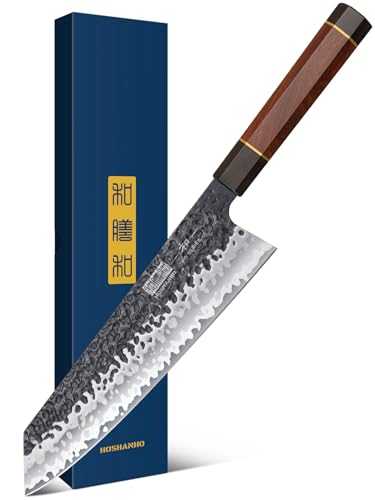
The HOSHANHO earns the top position because its supplied specifications speak directly to the main concerns behind this search. The listing identifies a 10Cr15CoMoV high-carbon steel core, layered construction, a 9-inch blade, and a 2.5 mm thickness. That gives shoppers more useful material information than a listing that simply says “premium steel.” The kiritsuke-style profile also provides a longer working edge for slicing larger vegetables, portioning boneless meat, and handling broad prep tasks on a spacious board.
The stated 12 to 15 degree edge per side is relatively specific, although it should be treated as a listing specification rather than proof of measured performance. The rosewood octagonal handle gives the knife a Japanese-style visual and provides an ambidextrous shape according to the product information. A longer blade can feel commanding in a roomy kitchen, while a crowded apartment counter may make the 9-inch format less convenient. The care instructions are clear: keep it away from bones and frozen foods, wash it by hand, and dry it fully.
Pros
- Documented 10Cr15CoMoV high-carbon steel core.
- Long 9-inch blade suits larger preparation tasks.
- Stated 12 to 15 degree edge per side.
- Ambidextrous octagonal rosewood handle.
- Care instructions clearly address hand washing and drying.
Cons
- The 9-inch length may feel cumbersome on compact boards.
- Manufacturer guidance excludes bones and frozen foods.
This is the best choice for a cook who wants a Japanese-style chef knife with a clearly identified core steel and enough length for substantial prep. It is less appealing for someone who prefers a short, highly maneuverable blade or routinely breaks down hard ingredients. The product is high-carbon stainless rather than verified traditional carbon steel, so buyers seeking a patina-forming blade should treat it as a close category match rather than an exact metallurgical substitute.
To buy this product, click here.
2. SHAN ZU 8 Inch Japanese Steel Damascus Chef Knife – Best Layered Construction
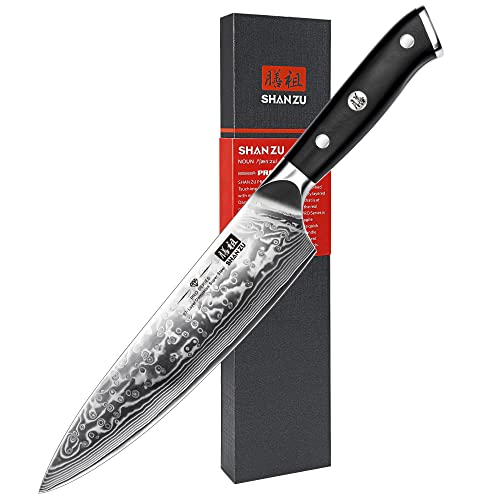
SHAN ZU is a strong alternative for cooks who want an 8-inch format and more detail about the blade’s layered construction. The product information identifies a 10Cr15MoV Japanese steel core, 67 layers, a 2.2 mm blade, and a stated 62 HRC hardness. Those details help separate this knife from listings that use a Damascus-style appearance without explaining the underlying blade. The pattern may add visual appeal, but the core steel and geometry are the more relevant points for cutting and maintenance.
The 8-inch blade is easier to manage than a 9-inch kiritsuke for many everyday tasks, and the listed 15-degree edge gives a clear reference for future sharpening. At 270 g, the knife has a stated weight that shoppers can compare with lighter Japanese-style models. Its G10 handle is described as solid and comfortable, though handle comfort remains dependent on hand size and grip technique. A 2.5 mm blade balances general-purpose utility with a less delicate profile than very thin specialty knives.
Pros
- Documented 10Cr15MoV core steel.
- Published 67-layer construction.
- Stated 62 HRC hardness and 15-degree edge.
- G10 handle resists the maintenance concerns associated with natural wood.
- 8-inch blade suits broad everyday preparation.
Cons
- The listed 270 g weight may feel substantial to cooks who prefer lighter knives.
- Damascus patterning should not be treated as proof of superior cutting performance.
Choose this knife if an 8-inch blade, a documented core, and a firm synthetic handle matter more than a traditional wood grip. The supplied data supports a high-carbon stainless interpretation, not a conventional reactive carbon-steel one. It also deserves careful edge maintenance because the stated hardness and 15-degree edge describe a specific geometry that should be matched by an appropriate sharpening approach.
To buy this product, click here.
3. PAUDIN 8-Inch Chef Knife – Best Traditional Everyday Format

The PAUDIN uses a familiar 8-inch chef knife format with a 2 mm blade, making it a practical candidate for cooks who want one main knife for vegetables, fish, chicken, and boneless meat. Its supplied material description is more modest than the top two choices: 5Cr15MoV stainless steel with a decorative waved pattern. The listing expressly says the pattern is not real Damascus, which is useful clarification. Buyers can judge the knife by its steel and dimensions rather than mistaking surface decoration for layered construction.
A 2 mm blade gives this model a relatively slim profile on paper, while the integrated wood handle creates a conventional kitchen-knife presentation. The product information describes hand polishing and an ergonomic balance, but it does not provide a hardness rating or a measured weight. That missing information limits precise comparisons with the SHAN ZU and HOSHANHO. Still, the standard length and broad task list make it easier to place in a typical home kitchen, where one knife may move from onions to herbs to boneless protein during the same meal.
Pros
- Versatile 8-inch chef knife profile.
- Documented 2 mm blade thickness.
- 5Cr15MoV steel is identified in the listing.
- Wood handle offers a conventional grip style.
- Listing clearly distinguishes the waved finish from real Damascus.
Cons
- The blade is high-carbon stainless rather than verified traditional carbon steel.
- No hardness or weight specification is supplied.
This PAUDIN suits a home cook who values a familiar 8-inch layout and wants a visually distinctive knife without relying on a false Damascus claim. It is less suitable for shoppers who require detailed metallurgical specifications or a documented harder core. Hand washing and full drying remain sensible habits for any high-carbon stainless knife, especially around the handle and blade junction.
To buy this product, click here.
4. Amazon Basics Classic 8-Inch Chef’s Knife – Best Straightforward Full-Tang Design

This Amazon Basics knife takes a less decorative route. The supplied information identifies an 8-inch high-carbon stainless blade, forged construction, full tang, three rivets, and a semi-bolster design. That combination gives shoppers a clear structural description without layered patterns or elaborate handle materials. The semi-bolster is particularly relevant because it leaves full blade access for chopping and sharpening, a practical advantage over designs that cover more of the heel.
The satin finish is described as resistant to stains, rust, and pitting, but that should not be confused with immunity to corrosion. Hand washing is specified, so it belongs in a kitchen routine where the knife is cleaned and dried rather than left wet in a sink or placed in a dishwasher. The listing does not identify a precise alloy grade, hardness, edge angle, or weight. Those omissions make it a less exact match for a technical carbon-steel comparison, yet the full-tang layout remains easy to understand for cooks who want a conventional chef knife.
Pros
- 8-inch blade fits common chef-knife tasks.
- Full-tang forged construction is documented.
- Three-rivet handle construction is listed.
- Semi-bolster leaves access to the blade heel.
- Hand-wash care requirement is clearly stated.
Cons
- The exact stainless steel designation is not provided.
- Hardness, edge angle, and weight are not listed.
This model is appropriate for someone who prefers a plain, conventional knife and does not need Damascus styling or a Japanese-style handle. It is a weaker fit for buyers who specifically want verified 10Cr15MoV, VG-10, or traditional carbon steel. Its broad, uncomplicated construction may be easier to understand than heavily marketed alternatives, provided the owner follows the hand-wash instruction.
To buy this product, click here.
5. MOSFiATA 8-Inch Chef’s Knife – Best Grip-Focused Option

MOSFiATA stands out through its handle and the clarity of its finish description. The knife uses EN1.4116 German stainless steel, according to the supplied information, with a full tang and triple-riveted Micarta handle. Textured finger points and a shaped grip are intended to support hand control, while the 8-inch blade keeps the knife within the common chef-knife range. This is a useful choice for cooks who pay close attention to handle material and want to avoid untreated natural wood.
The listing states a 16-degree edge per side and identifies the surface pattern as laser engraving rather than Damascus. That distinction prevents a decorative pattern from being mistaken for layered steel. The package also includes a finger guard, sharpener, and blade guard. These accessories may be useful, although the supplied information does not establish the sharpener’s exact mechanism or compatibility with every edge type. The knife itself remains the main purchase, and its 15 percent chromium claim supports a corrosion-resistant stainless interpretation rather than a reactive carbon-steel one.
Pros
- EN1.4116 steel designation is provided.
- Full tang and triple-riveted Micarta handle.
- Stated 16-degree edge per side.
- Laser-engraved finish is clearly distinguished from Damascus.
- Includes a finger guard and blade guard.
Cons
- The included sharpener’s exact compatibility is not documented.
- It is a stainless chef knife, not verified traditional carbon steel.
MOSFiATA makes sense for a cook who prioritizes a secure-looking composite handle and wants a conventional 8-inch blade with a stated edge angle. It may be less attractive to someone seeking a bare knife with fully documented sharpening equipment or a reactive carbon-steel patina. Use the supplied accessories cautiously and follow the knife’s intended food-preparation limits rather than treating the package as permission to cut hard materials.
To buy this product, click here.
6. imarku 8-Inch Gyutou Chef Knife – Best Everyday Gyutou

The imarku gyutou targets shoppers who want a Japanese-style all-purpose knife in a familiar 8-inch size. Its listing gives a carbon range of 0.6 to 0.75 and a hardness range of 56 to 58 HRC, along with 16 to 18 percent chromium. Those details point to a high-carbon stainless construction with a balance between corrosion resistance and general kitchen use. The gyutou designation also signals a chef-knife profile rather than a santoku or vegetable-specific blade.
The Pakka handle and 8-inch blade should suit cooks who move between slicing, dicing, chopping, and trimming boneless ingredients. The product information says it can cut meat away from bones, but that should not be read as approval for chopping through bones. The listing also mentions a brand upgrade, with logos and packaging potentially varying while the materials and construction remain described as the same. Buyers who care about visual consistency should be aware of that presentation detail before ordering.
Pros
- 8-inch gyutou-style chef knife profile.
- Published carbon and chromium ranges.
- Stated 56 to 58 HRC hardness range.
- Pakka handle is intended for extended kitchen use.
- Multipurpose shape suits vegetables and boneless proteins.
Cons
- Brand-upgrade packaging and logos may vary.
- The supplied information does not provide blade thickness or edge angle.
This knife is a sensible match for cooks who want a Japanese-style chef knife but prefer a conventional 8-inch working length. It is less suitable for shoppers seeking a highly specialized edge specification or verified traditional carbon steel. The published chromium range also makes it a more maintenance-forgiving candidate than a reactive carbon blade, although hand washing and drying remain prudent.
To buy this product, click here.
7. imarku 7-Inch Santoku Knife – Best Compact Option
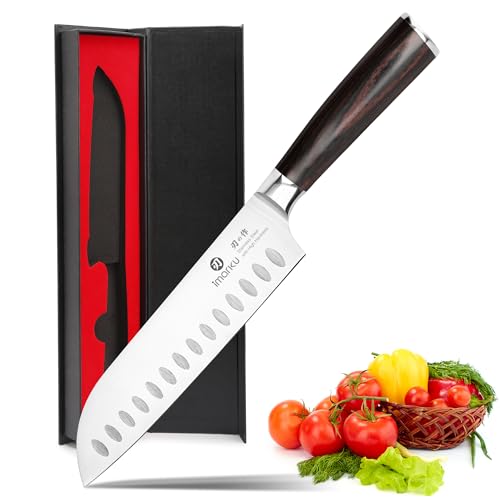
This imarku is the most compact knife in the ranking and the only santoku among the selected individual blades. A 7-inch blade can be easier to maneuver on a small board, especially during vegetable preparation where a shorter edge keeps the tip and heel within a tighter working area. Its 2.5 mm thickness gives the knife a more substantial published dimension than the 2 mm PAUDIN, while the hollow-edge design is intended to create small gaps between the blade and food.
The listing states a 15 to 18 degree edge per side and Japanese high-carbon stainless steel, plus a pakkawood handle. Those details make it a genuine alternative for cooks who prefer a flatter, compact chopping profile rather than a longer gyutou or Western chef knife. A santoku should not be treated as identical to a chef knife, however. Its shorter blade and different tip shape favor controlled chopping and slicing, while the 9-inch HOSHANHO remains better suited to larger ingredients and longer draw cuts.
Pros
- Compact 7-inch santoku profile.
- Documented 2.5 mm blade thickness.
- Stated 15 to 18 degree edge per side.
- Hollow edge may help reduce food contact with the blade.
- Pakkawood handle offers a composite wood-style grip.
Cons
- Santoku geometry is less suitable for cooks who prefer long rocking cuts.
- The exact alloy designation is not provided.
Select this knife for a small kitchen, a shorter reach, or a chopping-heavy routine centered on vegetables and boneless foods. Skip it if the goal is a large chef knife for broad produce, long slicing strokes, or heavy board work. The high-carbon stainless description makes it relevant to this roundup, though the available data does not establish traditional reactive carbon steel.
To buy this product, click here.
8. PAUDIN 3-Piece Kitchen Knife Set – Best Mixed Blade Selection

This set qualifies for cooks who want a chef knife supported by two smaller, more specialized companions. The supplied configuration includes an 8-inch chef knife, a 7-inch nakiri, and a 3.5-inch paring knife. That combination covers broad chopping, flatter vegetable preparation, and small trimming tasks without adding a santoku or multiple overlapping chef knives. For someone setting up a kitchen from scratch, the distinct blade roles may matter more than a single knife’s decorative finish.
The set uses 5Cr15MoV high-carbon stainless steel, a stated 56-plus Rockwell hardness, 2 mm blade thickness, and a listed 13-degree edge on two sides. The wave pattern is identified as decorative rather than real Damascus. Pakkawood handles provide a consistent material across the set, but each knife still needs hand washing and appropriate storage. The nakiri should be kept to vegetable work, while the paring knife handles smaller tasks that would feel awkward with the 8-inch blade.
Pros
- Includes chef, nakiri, and paring knives.
- Documented 5Cr15MoV steel.
- Stated 56-plus Rockwell hardness.
- Published 13-degree edge per side.
- Useful blade-size spread from 3.5 to 8 inches.
Cons
- It is a set of high-carbon stainless knives, not verified traditional carbon steel.
- The decorative wave pattern is not layered Damascus.
This set is a better match than a single chef knife for a cook who wants separate tools for vegetables and detail work. It is less compelling for a buyer who already owns a paring knife and nakiri or who wants the most detailed alloy information possible. The three-blade configuration is practical, but storage and sharpening must accommodate three different blade sizes and uses.
To buy this product, click here.
9. imarku 3-Piece Knife Set – Best Chef and Santoku Combination
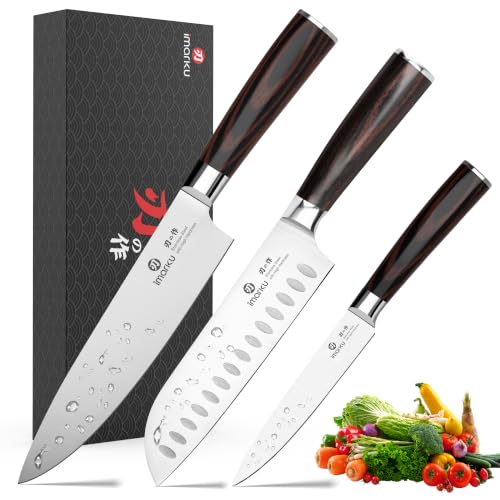
The imarku set takes a different approach from PAUDIN by combining an unspecified-length chef knife, a santoku, and a utility knife. This arrangement suits a cook who wants two general-purpose profiles plus a smaller blade for sandwiches, fruit, and compact preparation. The supplied information identifies Japanese high-carbon stainless steel, a stated 57 plus or minus 1 hardness score, and hand-polished 15-degree edges per side. Those details give the set a clearer edge specification than several individual knives in the pool.
Pakkawood handles and full-tang construction are listed, along with hand-wash care. The chef knife and santoku overlap somewhat, yet the two profiles can support different cutting habits. A cook who rocks through herbs may prefer the chef knife, while someone who chops vegetables with a shorter, flatter blade may reach for the santoku. The missing blade lengths limit a close size comparison, so this set ranks below the PAUDIN configuration for shoppers who need exact dimensions before buying.
Pros
- Includes chef, santoku, and utility knives.
- Stated 57 plus or minus 1 hardness score.
- Published 15-degree edge per side.
- Full-tang pakkawood handles are documented.
- Useful combination for cooks who alternate blade profiles.
Cons
- Individual blade lengths are not supplied in the available information.
- The chef knife and santoku have some overlapping kitchen roles.
This set is appropriate for a household that wants flexibility between a chef knife and santoku without buying each blade separately. It may frustrate shoppers who need exact dimensions, a specific alloy designation, or a single traditional carbon-steel knife. The listed hardness and edge angle are useful reference points, but they do not establish real-world edge retention without testing evidence.
To buy this product, click here.
Buying Guide
Confirm What “Carbon Steel” Means in the Listing
The central issue in this product pool is terminology. Most selected knives are described as high-carbon stainless steel, Japanese high-carbon stainless steel, or a named stainless alloy. That is different from a traditional non-stainless carbon steel blade. Stainless construction usually offers greater resistance to staining, while true carbon steel generally requires more attention after wet or acidic foods. A listing that provides a specific alloy, such as 10Cr15MoV, 10Cr15CoMoV, 5Cr15MoV, or EN1.4116, gives you more to work with than a generic “high-carbon” claim.
Material descriptions need context. The carbon-steel-versus-stainless-steel explanation separates corrosion care from claims about sharpness, hardness, and edge retention.
Match Blade Length to Your Cutting Board
An 8-inch chef knife is a practical middle ground for many kitchens, while the 9-inch HOSHANHO offers extra reach for large vegetables and longer slicing strokes. The trade-off is space. On a narrow board, a long blade can feel awkward near the edge of the counter. A 7-inch santoku is more compact and can suit smaller prep areas, but its profile does not provide the same long slicing path as a gyutou or chef knife.
Read the Edge Angle as a Maintenance Detail
Several listings provide an edge angle, including HOSHANHO at 12 to 15 degrees per side, SHAN ZU at 15 degrees, MOSFiATA at 16 degrees, and PAUDIN’s set at 13 degrees. These figures describe the listed edge geometry, not a guaranteed level of sharpness or durability. If you sharpen at home, use a method that can maintain the intended double-bevel angle without removing unnecessary steel. A hardness number does not replace careful technique.
Separate Decorative Patterns From Blade Construction
Damascus patterns can be attractive, but the visual surface is not automatically evidence of better edge retention. SHAN ZU supplies a layered construction description and identifies a core steel, while PAUDIN and MOSFiATA clarify that their visible patterns are decorative rather than true Damascus. Focus first on the core steel, blade thickness, edge geometry, and care instructions. A striking pattern should be treated as a secondary feature.
Choose a Handle That Fits Your Routine
Rosewood, G10, Micarta, pakkawood, and stainless constructions appear across this group. Natural wood can provide a traditional appearance, while G10 and Micarta avoid some concerns associated with untreated wood. Handle shape still matters more than material alone. An octagonal handle may suit users who like a defined grip, while a fuller Western-style handle may feel more familiar to cooks who use a pinch grip. The supplied listings do not provide enough verified dimensions to guarantee fit for every hand.
Plan for Hand Washing and Drying
Hand washing is specified or recommended across the products, and it is a sensible routine for high-carbon stainless knives. Rinse away food residue, use mild dish soap, dry the blade and handle, and store the knife where the edge cannot contact loose utensils. Avoid bones and frozen food unless the product specifically supports those tasks. A chef knife is intended for controlled food preparation, not for prying, twisting, or chopping through hard material.
Best Carbon Steel Chef Knife FAQ
Are These Traditional Carbon Steel Knives?
The supplied product information primarily describes high-carbon stainless steel or named stainless alloys. It does not establish that these knives are traditional non-stainless carbon steel blades. Buyers seeking a reactive carbon-steel knife should verify the exact alloy and construction before purchase rather than relying on the phrase “high carbon” alone.
Which Knife Is Best for General Kitchen Prep?
The HOSHANHO 9 Inch Kiritsuke is the strongest overall match in this group because its listing gives a specific core steel, edge range, blade thickness, handle style, and care restrictions. The SHAN ZU is a strong alternative for cooks who prefer an 8-inch blade and a G10 handle.
Is a 9-Inch Chef Knife Too Long for a Small Kitchen?
It can be. A 9-inch blade needs enough board length and open counter space for comfortable movement. A 7-inch santoku or standard 8-inch chef knife is usually easier to manage in a compact preparation area, although individual preferences and cutting habits vary.
Does Damascus Patterning Make a Knife Better?
No. Patterning alone does not establish superior sharpness, strength, or edge retention. SHAN ZU provides layered construction and a named core in the supplied information, which is more meaningful than appearance alone. PAUDIN and MOSFiATA identify their visible patterns as decorative rather than true Damascus.
Can These Knives Cut Bones or Frozen Food?
The HOSHANHO listing specifically says not to cut bones or frozen foods. Similar restrictions are sensible for ordinary chef knives unless the product information expressly supports those tasks. Hard materials can damage an edge or create a safety problem, so use a suitable cleaver or other purpose-built tool for demanding work.
How Should a High-Carbon Stainless Chef Knife Be Maintained?
Follow the supplied care instructions: wash by hand, avoid abrasive sponges, rinse thoroughly, and dry completely. Store the knife in a block, sheath, magnetic holder, or other arrangement that protects the edge. Stainless resistance reduces maintenance demands, but it does not make a knife immune to staining or corrosion.
Is a Santoku the Same as a Chef Knife?
No. A santoku is a distinct Japanese-style knife with a shorter, generally flatter profile and a different tip shape. It can handle many of the same ingredients, but it suits a different cutting rhythm. The imarku 7-inch santoku is useful for compact chopping, while the longer chef and gyutou knives provide more reach for slicing and larger ingredients.
Final Verdict
The HOSHANHO 9 Inch Kiritsuke is the Best Overall choice from the supplied products because it offers the clearest combination of documented 10Cr15CoMoV core steel, a stated edge range, useful blade thickness, and a distinctive but practical Japanese-style handle. Its length and restriction against bones or frozen foods define the trade-off. It suits cooks with enough board space who want a longer blade for controlled slicing and general preparation.
Choose the SHAN ZU if an 8-inch format, G10 handle, and documented layered construction matter more. The Amazon Basics Classic is the simpler full-tang alternative, while the imarku 7-inch Santoku is the better fit for compact chopping. Buyers seeking a complete collection should compare the PAUDIN and imarku sets, while remembering that every product here is supported as high-carbon stainless or a related stainless construction rather than verified traditional carbon steel. Confirm the alloy, follow the care instructions, and match blade length and profile to the food preparation you actually do.
