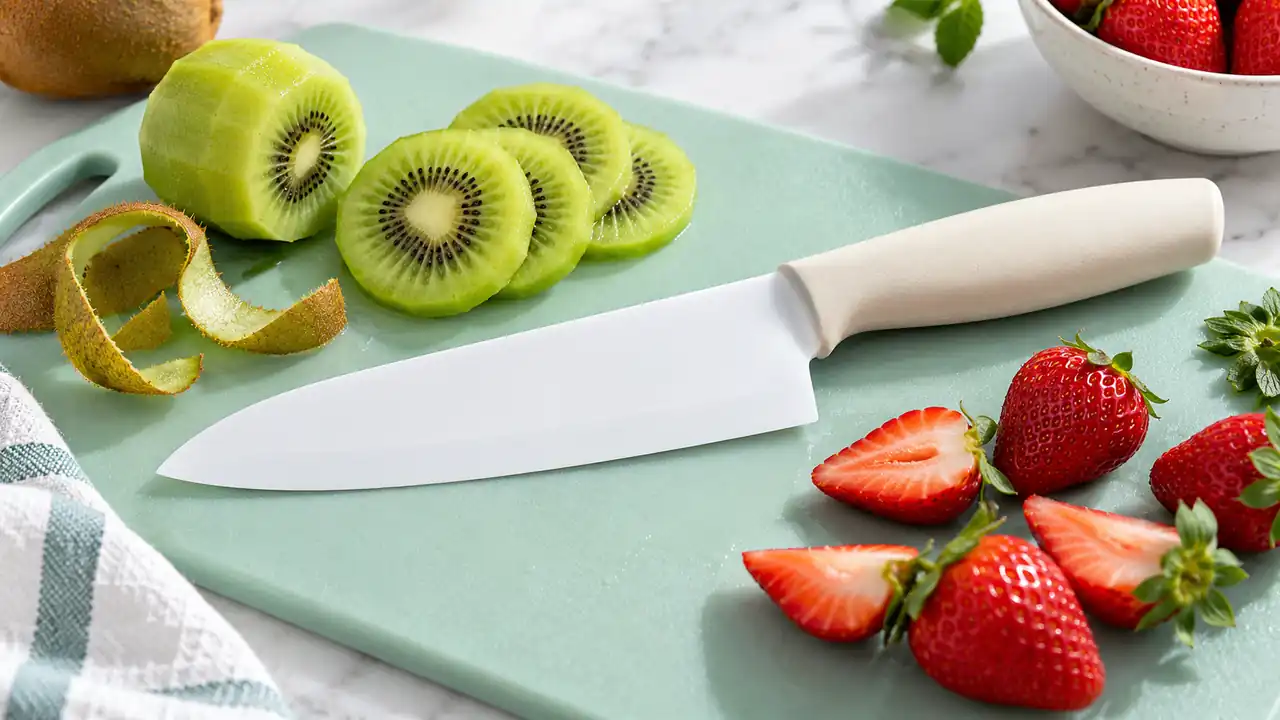
A ceramic chef knife appeals to cooks who want a very light blade, clean slicing through produce, and a cutting surface that will not rust or transfer a metallic taste to food. Ceramic is especially attractive for tomatoes, apples, citrus, zucchini, herbs, and boneless proteins, where a fine edge and non-reactive blade can make prep feel tidy and precise. The trade-off is equally important: ceramic blades are hard but comparatively unforgiving, so hard bones, frozen food, twisting, prying, and careless drawer storage can lead to chips or breakage.
The best choice depends on more than the word “ceramic” in a product title. Blade length affects control around a crowded cutting board, while a 5.5-inch santoku handles differently from a 7-inch or 8-inch chef-style blade. Sets can make sense for cooks who want several matching tools, although a single knife may be the better fit for a small kitchen. Hand washing, a suitable cutting board, protective storage, and compatible sharpening support also matter. A ceramic knife can stay useful for a long time when its limitations are respected.
This guide compares nine distinct ceramic knives and sets from the supplied product range. The Kyocera Revolution 5.5-inch Santoku leads the group because its compact Japanese-style profile, lightweight construction, non-reactive zirconia blade, and stated sharpening support create the most balanced fit for everyday home preparation. The other selections serve different needs, including larger blades, vegetable-focused prep, compact collections, and gift-ready sets.
Quick Answer
- Kyocera Revolution 5.5-Inch Santoku is the Best Overall choice for everyday slicing, dicing, and mincing when a compact ceramic blade is preferred.
- Kyocera Revolution Series 7-Inch Professional Chef’s Knife is the stronger alternative for cooks who want more blade length for larger vegetables and broader prep tasks.
- VegItPro 6-Inch Ceramic Santoku suits shoppers whose routine centers on vegetables and fruit, especially tomatoes and zucchini.
- Kyocera Revolution Two-Piece Set is a practical choice for adding a matching utility knife alongside a ceramic santoku.
Best Ceramic Chef Knife Comparison Table
| Product | Best For | Blade Length | Blade Style | Storage and Care |
|---|---|---|---|---|
| Kyocera Revolution Santoku | Everyday prep | 5.5 inches | Santoku, white ceramic | Hand wash, compatible Kyocera sharpening support |
| Kyocera Revolution Professional Chef’s Knife | Larger cutting tasks | 7 inches | Chef’s knife, black ceramic | Non-reactive blade, careful protected storage |
| VegItPro Ceramic Santoku | Vegetable preparation | 6 inches | Santoku | Rust-resistant ceramic, low-maintenance care |
| Rynal 7-Inch Ceramic Santoku | Longer santoku reach | 7 inches | Santoku with sheath | Protective sleeve, hand washing recommended |
| Rynal 7-Inch Upgrade Santoku | Lightweight storage | 7 inches | Rounded-tip santoku | Protective cover, dishwasher listed |
| Vos 8-Inch Ceramic Chef’s Knife | Long slicing strokes | 8 inches | Chef’s knife | Protection cover and gift box |
| Kyocera Revolution Two-Piece Set | Matched basic collection | 5.5 and 4.5 inches | Santoku and utility | Hand care required, ceramic blades |
| Kyocera Revolution Four-Piece Set | Multiple kitchen tasks | 3 to 7 inches | Chef’s, santoku, utility, paring | Individual blade care required |
| Vos Three-Piece Ceramic Set | Compact knife variety | 4 to 6 inches | Paring, santoku, chef’s | Sheaths included |
The detailed reviews explain how each blade length, profile, set configuration, and care requirement affects real kitchen use.
1. Kyocera Revolution 5.5-Inch Santoku Knife — Best Overall

A 5.5-inch santoku occupies a useful middle ground for home cooking. It is long enough for onions, tomatoes, peppers, herbs, and boneless meat, yet compact enough to feel manageable on a smaller cutting board. The Kyocera Revolution uses a white zirconia ceramic blade described as being ground with diamond wheels, and its non-reactive surface is intended to resist acids, juices, oils, and salts. That combination makes sense for cooks who move quickly from citrus to vegetables and prefer a blade that will not rust.
The lightweight construction is the main practical attraction. A cook preparing several salads or chopping a weeknight stir-fry may appreciate a blade that does not add much hand fatigue during repeated cuts. The santoku profile also favors controlled chopping, slicing, and mincing rather than forceful contact with hard ingredients. Kyocera lists hand washing and compatible electric sharpening or mail-in sharpening support, which gives this knife a clearer care path than many generic ceramic listings. It remains a delicate blade, however, and the supplied information specifically excludes hard or frozen food.
Pros
- Compact 5.5-inch santoku length suits everyday home preparation.
- Lightweight zirconia construction is useful during repeated chopping.
- Non-reactive ceramic resists rust and contact with acidic ingredients.
- Suitable for slicing, dicing, mincing, fruits, vegetables, and boneless meats.
- Published care information includes hand washing and Kyocera sharpening support.
Cons
- Hard or frozen foods are outside the stated intended use.
- Hand washing and protected handling are better choices than casual dishwasher use.
This is the strongest match for a cook who wants one ceramic knife for routine produce and boneless-protein preparation. Its shorter blade is easier to place on a compact board than an 8-inch chef’s knife, while the santoku shape offers a practical everyday cutting pattern. Buyers who regularly split squash, cut through joints, or use a rocking motion on dense ingredients should choose a different knife type, since ceramic requires a lighter touch. For most salad, sandwich, fruit, and weeknight meal prep, this Kyocera has the clearest balance of size, care support, and category relevance.
To buy this product, click here.
2. Kyocera Revolution Series 7-Inch Professional Chef’s Knife — Best for Larger Ingredients

The 7-inch Kyocera Revolution chef’s knife gives ceramic fans more reach than the compact santoku above. That extra length can be useful for halving larger vegetables, portioning boneless meat, and making longer slicing strokes through ingredients that feel cramped under a shorter blade. The black zirconia blade is described as non-reactive, so it shares the rust-resistant and low-metal-transfer characteristics associated with the other ceramic selections in this range.
Its shape is aimed at broader daily preparation rather than a narrowly specialized task. A larger blade can help when a cook is working through a pile of cabbage or several large tomatoes, although it also demands more clear space and careful tip awareness. The listing describes the knife as lightweight and intended for efficient daily prep, while also restricting use with hard or frozen foods. That distinction matters: “professional” in the product title should not be read as permission to use a ceramic edge for heavy-duty food breakdown.
Pros
- Seven-inch blade offers more working length for larger ingredients.
- Black zirconia ceramic is described as non-reactive and rust-resistant.
- Lightweight construction can suit extended vegetable preparation.
- Appropriate listed tasks include slicing, dicing, and boneless-meat preparation.
- Longer chef’s-knife format may appeal to cooks who prefer broader blade coverage.
Cons
- Its longer blade needs more cutting-board clearance than a compact santoku.
- Hard, frozen, and bone-in foods remain unsuitable according to the product information.
This option fits the cook who likes a longer chef’s-knife silhouette but wants ceramic’s non-reactive blade material. It makes more sense for a spacious work surface and larger batches than for a tiny apartment board. Skip it if your main priority is nimble control around small garnishes or if you often cut through hard foods. Compared with the 5.5-inch Kyocera, its advantage is reach rather than a different maintenance philosophy, so the decision comes down to workspace and preparation habits.
To buy this product, click here.
3. VegItPro 6-Inch Ceramic Santoku Knife — Best for Vegetable Prep

VegItPro positions this 6-inch ceramic santoku around fruits and vegetables, with tomatoes and zucchini named among its intended uses. That focus gives the knife a clear place in a ceramic chef knife comparison. Six inches is a practical length for cutting boards where a full-size blade feels bulky, while still offering more coverage than a small paring knife. The santoku format is suited to chopping, slicing, and dicing produce in a compact, controlled area.
The supplied information describes a rust-proof ceramic blade, a lightweight handle, and a surface intended to resist stains and odors. Those qualities can be useful for cooks who prepare brightly colored produce and want cleanup to stay simple. The listing also says the blade is made primarily with plant-based ingredients and identifies the product with vegetarian, vegan, plant-based, and animal-free standards. It does not provide a steel designation because this is a ceramic knife, and it does not document a specific sharpening angle or measured edge-retention result.
Pros
- Six-inch santoku length is well suited to vegetable-focused kitchen prep.
- Product information specifically names tomatoes and zucchini as intended foods.
- Lightweight construction is appropriate for repeated chopping and slicing.
- Ceramic surface is described as rust-proof and resistant to stains and odors.
- Clear plant-based positioning may appeal to shoppers seeking that product attribute.
Cons
- Its vegetable-focused format offers less reach than a 7-inch or 8-inch chef’s knife.
- The available information does not document a specific steel-style alloy or sharpening angle.
VegItPro is a sensible pick for a kitchen where the cutting board regularly fills with salad vegetables, fruit, and fresh side-dish ingredients. The 6-inch size can feel less cumbersome than a large chef’s knife, while the ceramic surface avoids the metallic contact some shoppers want to avoid with delicate produce. Buyers who need a knife for large roasts, hard squash, frozen food, or bones should look elsewhere. Its appeal lies in focused everyday produce work, not heavy-duty versatility.
To buy this product, click here.
4. Rynal 7-Inch Ceramic Santoku Knife — Best for a Longer Santoku Profile

Rynal’s 7-inch ceramic santoku is aimed at cooks who want a longer blade without leaving the santoku category. The listing describes a white zirconia blade, a soft black resin handle, an anti-slip finger bolster, and a fitted blade guard. It also lists a blade thickness of 0.06 inches and a weight of up to 0.22 pounds. Those published dimensions suggest a notably light, slim design, although the information does not establish how the knife will feel in every hand or on every cutting board.
The longer santoku format can cover a broad row of vegetables with fewer short strokes than a compact blade. A home cook preparing a large tray of peppers or slicing boneless chicken may appreciate that reach, while the protective sheath is useful for a drawer or picnic basket. The product information recommends hand washing and immediate drying despite listing dishwasher safety, a sensible approach for preserving the edge and handle. Hard, frozen, and bone-in foods are specifically excluded, as are prying and twisting motions.
Pros
- Seven-inch santoku blade provides more reach for larger batches.
- Published weight of up to 0.22 pounds indicates a lightweight design.
- Anti-slip finger bolster and resin handle are intended to support controlled handling.
- Protective sheath is included for storage.
- Non-reactive ceramic construction is described as rust-free and stain-resistant.
Cons
- The slim ceramic blade requires careful handling around hard or frozen ingredients.
- Hand washing and immediate drying are recommended despite the dishwasher-safe listing.
This Rynal suits a buyer who wants santoku geometry with more working length and a storage cover included. It can be a useful fit for everyday slicing and dicing when the cook understands that extra reach does not make ceramic suitable for forceful work. The 7-inch size may feel excessive on a very small board, and the supplied details do not document a sharpening system comparable to Kyocera’s stated support. Choose it for its length, lightness, and sheath rather than for unsupported claims about years of edge life.
To buy this product, click here.
5. Rynal 7-Inch Upgrade Ceramic Santoku Knife — Best for Protected Storage

This Rynal version shares the 7-inch santoku format with the earlier Rynal selection, yet its listing emphasizes a rounded tip, a fitted plastic cover, and gift-ready packaging. The product information also describes a 5-inch soft resin handle, a 0.06-inch blade, a blade depth of 1.8 inches, and a listed weight of up to 0.22 pounds. These details point toward a large but lightweight santoku intended for produce, boneless meat, and general prep.
A rounded tip can be appealing to a cook who prefers a less pointed profile for ordinary chopping, although the available data does not establish a particular cutting angle or grind. The supplied care information lists dishwasher safety but recommends hand washing and immediate drying. That recommendation is worth following for a sharp ceramic blade, especially when the included cover makes protected storage simple. As with other ceramic knives here, the product is not intended for bones, frozen food, prying, twisting, or side pressure.
Pros
- Seven-inch blade offers substantial coverage for vegetable and boneless-meat prep.
- Rounded tip gives the profile a distinct handling characteristic.
- Published dimensions include a 0.06-inch blade and 1.8-inch blade depth.
- Protective cover supports safer drawer storage.
- Lightweight resin-handled design is listed at up to 0.22 pounds.
Cons
- Its longer format may be awkward on a crowded or small cutting board.
- The listing’s dishwasher-safe claim is paired with a hand-washing recommendation.
This model is most interesting for a shopper who values a cover and a rounded-tip profile as much as the blade itself. It offers similar broad ceramic use to the other 7-inch santoku, so buyers should compare the exact listing and package details before ordering. Choose it for protected storage and the stated handle and tip design. A cook seeking a documented sharpening pathway or a shorter, more maneuverable knife should favor the Kyocera 5.5-inch option instead.
To buy this product, click here.
6. Vos 8-Inch Ceramic Chef’s Knife — Best for Long Slicing Strokes

An 8-inch chef’s knife provides the longest blade in this individual-knife group, making it the natural choice for shoppers who prefer broad slicing coverage. Vos describes this model as a zirconia ceramic knife for slicing, dicing, fruits, and everyday food preparation. A longer edge can be convenient for large tomatoes, melons, leafy greens, and boneless portions, provided the cutting board has enough room for controlled movement.
The knife is listed with a lightweight ergonomic design, a protective cover, and gift-ready packaging. The cover is a meaningful inclusion for ceramic because loose storage can expose the edge to knocks from other utensils. The product information also describes resistance to rust, odors, and stains, which keeps routine cleanup straightforward. It does not provide a precise weight, handle dimension, sharpening angle, or specific maintenance system, so buyers should treat the broad performance language as a category description rather than a measured result.
Pros
- Eight-inch length supports longer slicing strokes through larger ingredients.
- Zirconia ceramic blade is described as resistant to rust, odors, and stains.
- Lightweight handle design is intended for ordinary kitchen preparation.
- Protective cover is included for storage.
- Gift-ready packaging adds convenience for presentation or gifting.
Cons
- The long blade needs more workspace and careful tip control.
- The available information does not specify a sharpening method or exact knife weight.
Pick this Vos when reach is more valuable than compact control. It can suit a cook who regularly prepares large produce or prefers the familiar length of a traditional chef’s knife. The same length may feel cumbersome for small boards, quick garnish work, or users who prefer a santoku’s shorter profile. Its protective cover is useful, but the listing does not document a dedicated ceramic sharpening route, so storage and cautious technique deserve extra attention.
To buy this product, click here.
7. Kyocera Revolution Two-Piece Ceramic Knife Set — Best Matched Starter Set

A two-piece set can be a smarter starting point than buying several similar blades. This Kyocera package pairs a 5.5-inch Revolution santoku with a 4.5-inch utility knife, covering the main chopping knife and a shorter tool for smaller produce, sandwiches, trimming, and compact board work. Both blades use the brand’s proprietary zirconia ceramic construction according to the supplied information, and both are described as lightweight and non-reactive.
The set format is useful in a kitchen where one knife handles dinner vegetables while another stays available for fruit or quick lunch preparation. It also avoids the redundancy found in some larger sets, although the available information does not list a storage block or blade covers. Kyocera states that the blades are made in Japan and recommends use with boneless meats, fruits, and vegetables, while excluding hard or frozen foods. Hand care and the brand’s stated sharpening support remain part of the ownership picture.
Pros
- Includes two distinct useful sizes rather than several identical chef-style blades.
- Combines a 5.5-inch santoku with a 4.5-inch utility knife.
- Both blades are described as lightweight zirconia ceramic.
- Non-reactive surfaces are suited to acidic fruits and vegetables.
- Provides a coordinated starting collection from the Kyocera Revolution range.
Cons
- The package does not list a storage block or protective covers in the supplied details.
- Both knives share ceramic limitations around bones, frozen food, and forceful side pressure.
This set makes sense for a cook who wants two complementary ceramic knives without filling a drawer with specialty pieces. The shorter utility blade may be more comfortable than the santoku for small foods, while the larger knife handles routine chopping. Buyers who already own a suitable utility knife may gain more from the single 5.5-inch Kyocera. Buyers who need a paring knife, longer chef’s knife, or storage solution will need a different configuration.
To buy this product, click here.
8. Kyocera Revolution Four-Piece Ceramic Knife Set — Best for Multiple Kitchen Tasks
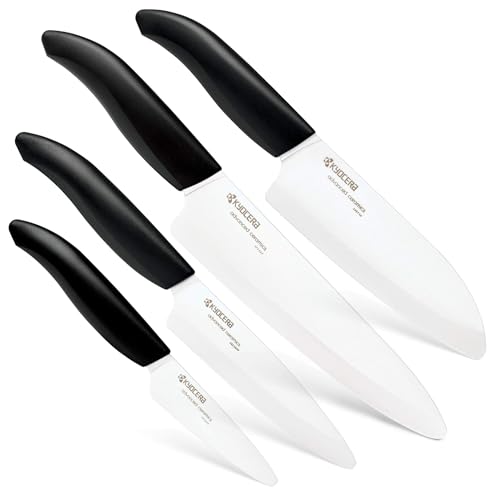
The four-piece Kyocera set covers a wider range of kitchen jobs than the two-piece package. It includes a 7-inch ceramic chef’s santoku, a 5.5-inch santoku, a 4.5-inch utility knife, and a 3-inch paring knife. That progression gives the user a large blade for broader prep, a medium everyday option, a utility size, and a small precision tool. For a household preparing everything from large salads to small garnishes, the variety is practical rather than decorative.
All four knives are described as non-reactive zirconia blades with lightweight construction. The different sizes still require individual care, since a 3-inch paring knife can be damaged by the same misuse as the larger blade. The set is more appropriate for a buyer building a ceramic collection from the start than for someone seeking one replacement chef’s knife. The supplied details do not identify a storage block or covers, so the eventual storage arrangement should be planned before purchase.
Pros
- Includes four distinct blade sizes for broad kitchen coverage.
- Seven-inch chef’s santoku provides more reach for larger ingredients.
- Five-and-a-half-inch santoku offers a compact everyday alternative.
- Four-and-a-half-inch utility and 3-inch paring knives cover smaller tasks.
- Non-reactive zirconia construction is consistent across the listed set.
Cons
- The supplied information does not list a storage block or individual covers.
- A larger collection requires careful storage and separate attention to each ceramic blade.
This is the most complete selection for a cook committed to using ceramic across several preparation jobs. The two santoku sizes prevent the user from relying on one blade for every ingredient, while the utility and paring knives fill smaller roles. It may be excessive for a minimalist kitchen or for someone who mainly wants one chef’s knife. Choose it for range and matching construction, then provide safe storage rather than placing the blades loosely in a drawer.
To buy this product, click here.
9. Vos Three-Piece Ceramic Knife Set — Best Compact Variety Set
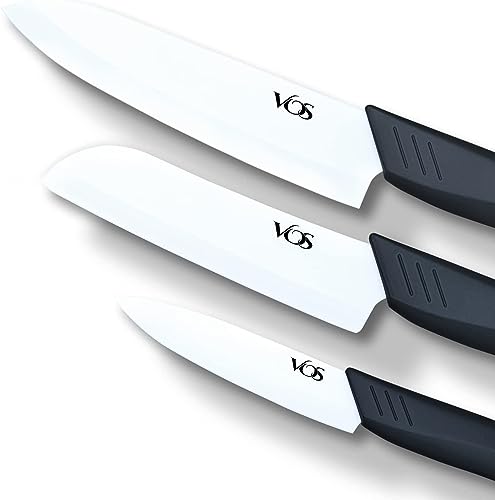
Vos takes a compact approach with a 6-inch chef’s knife, 5-inch santoku, and 4-inch paring knife. That combination gives a small kitchen three recognizable blade roles without adding an 8-inch knife or a second santoku. The set is aimed at slicing, cutting, and preparation across fruit, vegetables, and other ordinary foods. Each knife is described as lightweight and supplied with a protective sheath.
The shorter lengths may appeal to cooks who work on a modest counter or prefer less blade extending beyond the food. The 4-inch paring knife is especially useful for small produce and detail work, while the 5-inch santoku provides a compact chopping option. Vos also lists dishwasher safety and a lifetime guarantee, although careful hand washing remains a sensible routine for ceramic edges. The set’s main limitation is that the available product information does not document exact weights, sharpening compatibility, or a specific ceramic formulation.
Pros
- Includes chef’s, santoku, and paring profiles in one compact package.
- Blade lengths from 4 to 6 inches suit smaller preparation spaces.
- Protective sheath is included for each listed knife.
- Lightweight handles are intended to support comfortable everyday use.
- The listing includes a lifetime guarantee.
Cons
- The largest blade is only 6 inches, so it offers less reach for large ingredients.
- The available details do not identify a specific sharpening system or ceramic formulation.
This set is a good fit for a small household that wants role variety without a long chef’s knife taking over the counter. It also provides a straightforward gift format because the three blade types are easy to understand. Cooks who regularly handle large cabbage, melons, or broad cuts of boneless meat may prefer a 7-inch or 8-inch selection. Choose the Vos set for compact coverage, protective sheaths, and a mix of useful sizes.
To buy this product, click here.
Buying Guide
Match the Blade Profile to Your Cutting Style
A ceramic chef knife can use a chef’s-knife or santoku profile, and those shapes do not behave identically. The 5.5-inch and 6-inch santokus in this guide are compact options for chopping, dicing, and slicing across a manageable section of the board. The longer 7-inch and 8-inch blades offer more reach for larger produce. A santoku user who prefers short, controlled strokes may find a compact blade easier to place, while a cook preparing large vegetables may value a longer edge.
Do not assume a ceramic blade should be used with the same force or motion as a heavy Western chef’s knife. Ceramic products in this selection are described for fruits, vegetables, and boneless meats. Hard bones, frozen food, prying, twisting, and side pressure can place stress on the blade. If a recipe calls for breaking down poultry or splitting hard squash, use a suitable tool rather than risking a ceramic edge.
Choose Length Based on Your Cutting Board
Blade length changes both reach and control. A 5.5-inch santoku can be easier to manage beside a small sink or on a narrow board, while an 8-inch chef’s knife needs more room for the tip and handle. The Kyocera 7-inch knife and the Rynal 7-inch santokus sit between those extremes. Measure the usable portion of your board, then think about where your knuckles, ingredients, and knife tip will sit during a full stroke.
Shorter is not automatically safer or better. A blade that is too short may require repeated sawing motions through a large ingredient, while a longer blade may make small garnish work feel clumsy. The right length is the one that matches the foods prepared most often and leaves enough clearance for controlled movement.
Understand Ceramic Maintenance
Ceramic resists rust and does not require the same corrosion care as ordinary steel, but it still needs thoughtful handling. Several products here include covers or sheaths, and those accessories are useful because a ceramic edge should not knock against loose utensils in a drawer. Hand washing is the safer routine for the Kyocera knives, and Rynal recommends hand washing and drying despite listing dishwasher suitability.
Hardness does not remove the risk of chips from twisting or impact. The ceramic-versus-steel comparison explains that handling trade-off.
Use a stable cutting board and keep the blade away from hard surfaces. Place the knife down gently rather than dropping it into a sink. Ceramic can remain clean and low-maintenance in ordinary food preparation, yet its resistance to rust does not make it immune to chips or breakage from impact.
Check the Sharpening Path Before Buying
Sharpening is one of the clearest differences among the products. The Kyocera Revolution 5.5-inch listing identifies compatible Kyocera electric sharpening support or a mail-in sharpening option. That gives the buyer a stated route for future edge care. The other products do not provide the same detailed sharpening information in the supplied data.
A ceramic knife should not automatically be placed in a generic sharpener intended for conventional steel. Check compatibility with the exact model before using an abrasive device. Claims that a blade stays sharp for years should be treated as listing claims rather than guaranteed ownership results, since use, storage, cutting surfaces, and handling all affect the edge.
Decide Between One Knife and a Set
A single knife is often the cleaner choice for a cook who wants one everyday tool and already owns a paring or utility knife. The Kyocera 5.5-inch santoku provides that focused role. The two-piece Kyocera set adds a 4.5-inch utility knife, while the four-piece set adds chef’s, santoku, utility, and paring sizes. Vos offers a 6-inch chef’s knife, 5-inch santoku, and 4-inch paring knife in a smaller collection.
Count the actual roles rather than the number of pieces. A set is useful when each blade will earn drawer space. It is less useful when several knives overlap and storage covers or blocks are absent. Ceramic sets also require safe storage for every blade, not only the largest one.
Evaluate Handles Without Overstating Comfort
The supplied products use lightweight designs, resin handles, ergonomic descriptions, or anti-slip features. Those details may influence grip and fatigue during repeated prep, but comfort remains personal. Hand size, preferred grip, finger placement, and cutting board height all matter. The Rynal listings provide specific handle and weight information, while several Vos listings use broader ergonomic language without detailed dimensions.
Look for a handle that allows secure control without forcing your fingers against the cutting board. A lighter knife may feel easier during a long vegetable-prep session, yet some cooks prefer more mass for their cutting rhythm. There is no universal best weight, especially across different hand sizes and cutting habits.
Best Ceramic Chef Knife FAQ
Are ceramic chef knives suitable for everyday cooking?
Yes, provided everyday cooking mainly involves fruits, vegetables, herbs, and boneless meats. The products in this guide are described for slicing, dicing, mincing, and similar tasks. Ceramic is a poor fit for bones, frozen food, prying, twisting, and forceful side pressure, so a household that regularly performs those jobs should keep a suitable steel knife available.
Which ceramic knife size is easiest to control?
That depends on the cutting board and the user’s grip, but the 5.5-inch Kyocera santoku and 6-inch VegItPro santoku are the most compact main-blade options here. They provide more coverage than a paring knife while taking less space than the 7-inch and 8-inch models. A longer blade may be easier for large ingredients, so control should be judged alongside reach rather than by length alone.
Can ceramic knives go in the dishwasher?
Some listings in this selection mention dishwasher safety, including the Rynal and Vos products. The Rynal information still recommends hand washing and immediate drying, while Kyocera specifically lists hand washing. Hand washing is the more cautious routine because it reduces contact with other utensils and limits knocks against hard surfaces.
Do ceramic knives need sharpening?
They can eventually need edge maintenance, although the timing depends on use and handling. The Kyocera Revolution listing provides a stated compatible electric sharpener or mail-in sharpening support. The other selected products do not document an exact sharpening method in the supplied information. Do not assume a generic steel-knife sharpener is suitable for every ceramic blade.
What foods should not be cut with a ceramic chef knife?
Avoid hard or frozen foods, bones, and tasks that require prying or twisting. The product listings repeatedly identify those restrictions. Dense ingredients should be cut with controlled downward or slicing motions rather than forceful leverage. If a recipe requires splitting hard squash or cutting through joints, use a knife designed for that work.
Is a ceramic santoku the same as a ceramic chef’s knife?
No. Both can handle general kitchen preparation, but a santoku is typically a shorter Japanese-style profile suited to controlled chopping, slicing, and mincing. A chef’s knife usually offers a longer working edge and broader reach. In this guide, the 5.5-inch Kyocera santoku and 8-inch Vos chef’s knife illustrate that size and profile difference.
How should a ceramic knife be stored?
Use the included sheath or cover when one is supplied, and avoid leaving the blade loose in a drawer. The Rynal, Vos individual knives, and Vos set include protective storage components in the listed details. For Kyocera sets without a documented block or cover, arrange a secure storage solution before placing the knives into regular use.
Keep the edge separated from loose utensils and confirm holder compatibility. These knife-storage methods provide a useful framework for that decision.
Final Verdict
The Kyocera Revolution 5.5-inch Santoku is the Best Overall ceramic chef knife in this group. Its compact santoku profile suits ordinary chopping and slicing, its zirconia ceramic blade is described as non-reactive and rust-resistant, and the listing provides a clearer sharpening and care pathway than most competing products here. It is a particularly sensible choice for produce, herbs, fruit, and boneless meat on a small or medium cutting board.
Choose the Kyocera 7-inch Professional Chef’s Knife if longer reach matters, or the VegItPro 6-inch Santoku if vegetable preparation is the central task. The Kyocera two-piece set adds useful utility-knife coverage, while the four-piece set suits a household building a broader ceramic collection. Regardless of the selection, match the blade length to your board, use a suitable cutting surface, store the knife with protection, and keep hard, frozen, and bone-in foods away from the ceramic edge.
