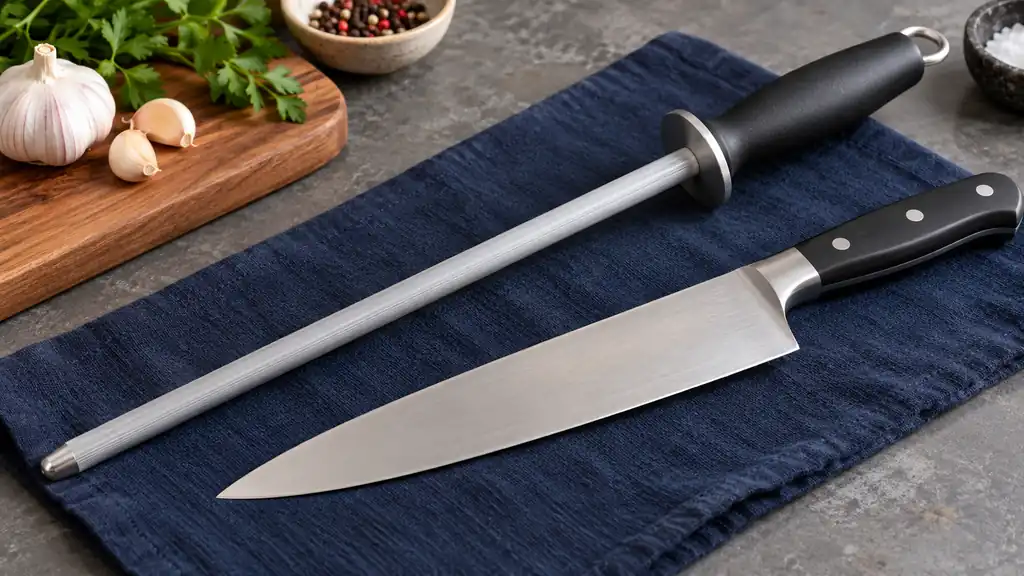
A honing rod earns its place beside a kitchen knife block because knife edges gradually curl or shift during ordinary chopping, slicing, and trimming. A few controlled passes can help realign that edge between full sharpening sessions, but the rod must match the blade and the user’s technique. A grooved steel rod, a fine ceramic rod, and an abrasive high-carbon steel rod do different work, so treating them as interchangeable is a common buying mistake.
Length, surface texture, handle security, and maintenance all matter. A 12-inch rod gives a longer chef’s knife more room for a continuous pass, while an 8- or 9-inch model is easier to store in a drawer or knife roll. Ceramic can provide a fine finishing surface, but it needs careful handling. Traditional steel is durable and familiar, although its grooves and hardness may be less suitable for delicate edges. The right choice also depends on whether you maintain Western-style knives, harder Japanese-style blades, serrated knives, or a mixed household collection.
The products below include ceramic, traditional steel, and fine abrasive rods, with options for beginners, compact kitchens, daily maintenance, and larger chef’s knives. Product descriptions support the listed materials and features, but a honing rod cannot repair a deeply damaged edge or replace proper sharpening. The comparison starts with a quick look at the nine selected options.
Quick Answer
Kimura Professional Ceramic Honing Rod is the strongest overall match for many home kitchens because its 10-inch ceramic surface, stated 1200-grit finish, ergonomic polypropylene handle, and hanging loop cover the main daily-maintenance needs without relying on a coarse steel surface.
Work Sharp Kitchen Ceramic Honing Rod is the more approachable choice for cooks who want angle guidance, while WÜSTHOF 9" Honing Steel suits buyers who prefer a traditional forged steel rod with a grooved surface, protective bolster, and compact length.
Best Honing Rod Comparison Table
| Product | Best For | Rod Length | Surface or Material |
|---|---|---|---|
| Kimura Professional Ceramic Honing Rod | Overall kitchen use | 10 inches | Ceramic, 1200 grit |
| Work Sharp Kitchen Ceramic Honing Rod | Guided daily touch-ups | Not stated | Ceramic with angle guidance |
| Messermeister Ceramic Sharpening Rod | Long ceramic finishing surface | 12 inches | Ceramic, 1200 grit |
| WÜSTHOF 9" Honing Steel | Traditional steel maintenance | 9 inches | Grooved high-carbon stainless steel |
| Utopia Kitchen Honing Rod | Basic steel maintenance | 12 inches | Nickel-chrome-plated carbon steel |
| Cutluxe 12" Honing Rod | Long chef’s knives | 12 inches | Carbon steel |
| HOSHANHO 12" Honing Rod | Fine abrasive steel use | 12 inches | High-carbon steel, fine sand surface |
| TUO Honing Rod | Compact, wider steel rod | 8 inches | High-carbon steel |
| Henckels Fine Edge Honing Rod | Simple everyday maintenance | Not stated | Fine-edge steel |
The detailed reviews explain how each rod’s surface, length, handle, and care requirements affect real kitchen use.
1. Kimura Professional Ceramic Honing Rod — Best Overall

Kimura’s 10-inch ceramic rod offers a balanced middle ground for a typical kitchen drawer. Its stated 1200-grit finish is fine enough for edge maintenance and light refinement, while the length gives a chef’s knife useful room for a base-to-tip pass. Ceramic is different from a traditional grooved steel rod because it provides a fine abrasive surface rather than relying solely on contact with the blade edge. That makes this rod relevant for cooks who want a finishing step between more involved sharpening sessions.
The polypropylene handle is described as ergonomic and non-slip, with a hanging loop for storage. That combination suits the familiar routine of preparing dinner, noticing a knife has lost some bite, and making a few careful passes before returning the rod to its hook. The product information also lists a single-piece ceramic construction, a full tang, a bolster, and a lifetime warranty. Ceramic still deserves careful handling because a hard rod can chip or break if dropped, but the construction details make this a well-rounded choice for mixed chef-knife collections.
Pros
- 10-inch length suits many chef’s knives.
- Stated 1200-grit ceramic surface supports fine edge maintenance.
- Non-slip polypropylene handle is suitable for controlled handling.
- Hanging loop simplifies storage near a knife block.
- Product information includes a lifetime warranty.
Cons
- Ceramic requires more care than a metal rod if dropped or struck.
- The listed angle guidance may not match every blade’s existing edge.
This is the most versatile selection for a home cook who wants a fine ceramic surface without moving to the longest rod in the group. It makes particular sense for chef’s knives and other double-bevel kitchen blades that need regular light maintenance. Buyers who prefer a nearly indestructible metal rod, or who need to straighten a severely damaged edge, should look elsewhere or use a proper sharpening system first.
To buy this product, click here.
2. Work Sharp Kitchen Ceramic Honing Rod — Best for Guided Touch-Ups

Freehand honing can feel awkward for a new user. The knife moves, the wrist changes angle, and a supposedly quick touch-up becomes a cautious little dance at the counter. Work Sharp addresses that learning curve with built-in angle guidance, according to the supplied product information. That feature gives beginners a physical reference for repeatable passes, which can be more useful than an elaborate explanation of angles alone.
The ceramic rod is listed for chef, santoku, paring, utility, and serrated kitchen knives. That broad compatibility makes it practical for a household with several blade shapes, although serrated knives still require careful attention to the individual teeth rather than ordinary flat-edge passes. Its intended role is quick edge realignment and refinement between full sharpening sessions. A cook who wants a compact routine before meal preparation may appreciate that clarity, while experienced users who already maintain an angle by hand may prefer a simpler rod with a larger exposed surface.
Pros
- Built-in angle guidance supports consistent positioning.
- Ceramic surface is intended for fine daily maintenance.
- Listed compatibility includes chef, santoku, paring, and utility knives.
- Product information includes serrated-knife use.
- Suitable for quick touch-ups between full sharpening sessions.
Cons
- The fixed guidance may feel restrictive to users with specialized edge preferences.
- Available information does not state the rod length or grit.
Choose this model if technique is your main obstacle. It is especially useful in a shared kitchen where several people may use the same sharpening tool and benefit from a consistent starting position. It is less compelling for someone who wants detailed material specifications or who regularly maintains unusual single-bevel edges, since the supplied information does not explain those restrictions.
To buy this product, click here.
3. Messermeister 12" Ceramic Sharpening Rod — Best for Long Ceramic Coverage

A 12-inch rod gives a long chef’s knife more working room, which can make a continuous base-to-tip motion easier to organize. Messermeister pairs that length with a ceramic core, a large round sharpening surface, and a stated fine 1200-grit finish. The broad round profile offers several contact positions as the knife moves, while the fine ceramic surface is aimed at honing and polishing rather than aggressive metal removal.
The soft-grip handle and hanging ring keep the design practical for a knife block area or wall hook. The product information describes the ceramic core as break-resistant, though that should not be read as permission to treat it like a metal bar. A longer rod can also feel excessive beside short paring knives or in a crowded drawer. Its clearest use case is a cook with full-size chef’s knives who wants a long, fine ceramic tool and has a secure place to store it.
Pros
- 12-inch length accommodates longer kitchen knives.
- Stated 1200-grit ceramic supports fine honing and polishing.
- Large round sharpening surface provides broad contact area.
- Soft-grip handle supports controlled handling.
- Hanging ring allows convenient storage.
Cons
- Long length takes more storage space than compact rods.
- Ceramic construction still needs protection from hard drops and impacts.
This is a strong alternative to the Kimura for cooks who value extra length and a large ceramic contact surface. It can suit a large chef’s knife collection especially well, provided the storage area can accommodate a 12-inch tool. Buyers with limited drawer space or a preference for angle guidance may find the Work Sharp more approachable.
To buy this product, click here.
4. WÜSTHOF 9" Honing Steel — Best Traditional Steel Design

WÜSTHOF’s 9-inch steel is aimed at cooks who want the familiar feel of a traditional honing rod. The listed construction uses high-carbon stainless steel forged from a single block and tempered to 58 HRC. The grooved surface is intended to support routine edge maintenance, and the product information says the steel is magnetic. That detail may help attract loose metal particles during use, although it does not turn the rod into a substitute for sharpening a blunt knife.
The 9-inch length is easier to control and store than a 12-inch model, especially beside a compact knife block or inside a smaller drawer. A textured slip-resistant handle, protective bolster, and lifetime warranty add practical value. The shorter rod gives less working length for very long blades, so cooks who maintain large chef’s knives may prefer a longer option. Its design is especially comfortable for users who already understand a steady honing motion and prefer metal over ceramic.
Pros
- Forged high-carbon stainless steel construction is clearly specified.
- 9-inch length is convenient for compact storage.
- Grooved surface suits traditional steel maintenance.
- Textured handle and protective bolster support secure handling.
- Product information includes a lifetime warranty.
Cons
- Shorter rod provides less working space for long chef’s knives.
- Traditional grooved steel may be less suitable for users seeking a fine ceramic finish.
This rod fits a Western-style knife block and a cook who wants a durable, straightforward steel rather than an abrasive ceramic surface. It is also a sensible option for someone who values a shorter tool that will not dominate the counter. Choose a ceramic rod instead if your priority is fine polishing or if your knife collection includes edges that call for gentler maintenance.
To buy this product, click here.
5. Utopia Kitchen Honing Rod — Best for Basic Steel Maintenance

Utopia Kitchen keeps the design familiar: a 12-inch carbon steel rod with nickel-chrome plating, a hanging hook, and an ergonomic grip. The length gives home cooks plenty of room for full-size chef’s knives, while the plated surface is intended to resist the rougher handling associated with a busy kitchen. The product information also mentions standard and serrated-edge knives, although serrated blades should be treated according to their tooth pattern rather than dragged across a conventional surface without care.
The handle is described as non-slip and suitable for right- or left-handed use, with a rubber bottom intended to help the rod stay stable during use. Maintenance is more involved than simply rinsing and leaving the tool beside the sink. The listing recommends wiping the rod with an oiled non-woven cloth and drying it fully after contact with water. That routine matters for a plated steel tool, particularly in a damp kitchen where careless storage can undermine the surface over time.
Pros
- 12-inch length works well with full-size kitchen knives.
- Carbon steel with nickel-chrome plating is clearly identified.
- Non-slip handle is listed for right- and left-handed users.
- Hanging loop supports space-saving storage.
- Product information includes use with standard and serrated edges.
Cons
- Requires careful drying and the listed oil-cloth maintenance routine.
- The available information does not state a grit or finer surface grade.
This model suits a household that wants a long, conventional steel rod and does not mind regular wipe-down care. It is a practical fit for standard kitchen knives, especially where a hanging loop is useful. Buyers seeking a documented fine grit, ceramic polishing surface, or built-in angle guidance should choose a different style.
To buy this product, click here.
6. Cutluxe 12" Honing Rod — Best for Long-Blade Coverage
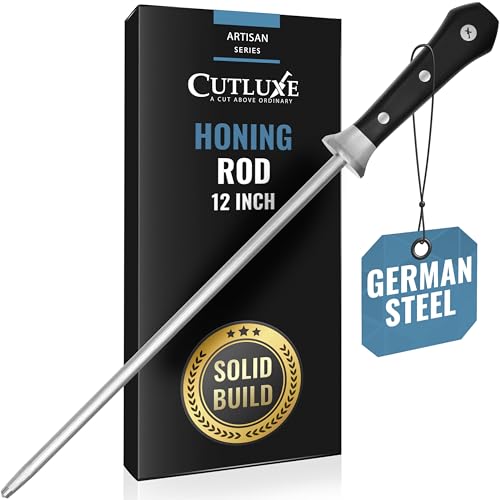
Cutluxe’s 12-inch rod focuses on length and straightforward edge realignment. The available information identifies a carbon steel rod and a non-slip pakkawood handle that is intended for either hand. For a cook who often reaches for a long chef’s knife, the extra rod length can reduce the need to crowd the blade into a short working area. It also gives the tool a more substantial presence beside a larger block or professional-style knife collection.
The handle material adds a warmer visual character than plain polymer, while the product listing describes the construction as resistant to rust, corrosion, bending, and breakage. Those are manufacturer or listing claims rather than independently verified test results, so normal drying and sensible storage remain appropriate. The rod’s role is maintenance, not full edge restoration. A knife that has lost its profile or developed chips will need a sharpening method capable of removing metal and reshaping the edge.
Pros
- 12-inch rod provides generous coverage for long kitchen knives.
- Carbon steel construction is clearly identified.
- Non-slip pakkawood handle is listed for either hand.
- Long format suits larger knife collections.
- Product information includes a lifetime warranty.
Cons
- Long length can be awkward in a small drawer or compact kitchen.
- The available information does not state a groove pattern or grit.
Choose this Cutluxe when rod length is your main priority and your knives are mostly full-size chef’s or carving-style blades. It makes less sense for someone who wants a compact travel tool or a fine ceramic finish with a published grit. The pakkawood handle also calls for ordinary care around standing water, even though the listing presents it as durable.
To buy this product, click here.
7. HOSHANHO 12" Honing Rod — Best for Fine Abrasive Steel Maintenance

HOSHANHO takes a more abrasive approach than a plain polished steel rod. The product information describes Japanese high-carbon steel, a fine sand surface, and fine grooves intended to help restore and straighten an edge. It also states a hardness of up to 62 HRC for the rod itself. That specification describes the honing tool, not the knife being maintained, and it should not be treated as proof of a particular knife’s edge retention or cutting performance.
The 12-inch length is useful for large chef’s knives, while the pakkawood handle is shaped for control and described as resistant to cracking and deformation. A vertical sharpening method is recommended in the product information, which may appeal to users who prefer to stabilize the rod and move the knife consistently. The surface may be more than a delicate edge needs, so buyers should match the tool to their blade construction and use light pressure rather than assuming a harder, more abrasive rod is universally better.
Pros
- 12-inch length gives long chef’s knives ample working room.
- High-carbon steel and a fine sand surface are specified.
- Fine grooves are intended to help realign the blade edge.
- Pakkawood handle provides a documented ergonomic design.
- Gift box and hanging-style kitchen use add practical convenience.
Cons
- The more abrasive surface may require greater care on delicate edges.
- Long length and pakkawood handle may be excessive for compact storage.
This rod suits a cook who wants a long steel tool with more surface texture than a basic smooth rod. It is most appealing for robust kitchen knives and users who are comfortable controlling pressure. Those maintaining thin or specialized edges should verify compatibility before making it their routine rod, because the supplied information does not define every blade restriction.
To buy this product, click here.
8. TUO Honing Rod — Best Compact Wide-Diameter Design

TUO takes a different path from the long rods above. Its 8-inch length is intended to fit inside a drawer, knife block, or knife roll without taking up much room, while the stated 0.48-inch diameter gives the rod a wider core than many conventional models. The listing says this provides 35 percent more surface area, a manufacturer claim that should be read as a design specification rather than an independently measured performance result.
The high-carbon steel rod is listed at 62 HRC, and the pakkawood handle has a non-slip ergonomic design. That combination gives the product a compact footprint without reducing the handle to a tiny travel accessory. It may be particularly handy for outdoor cooking equipment or a small apartment kitchen where a 12-inch rod is simply inconvenient. The trade-off is clear: short rods give less linear space for a full-size chef’s knife, so the user must pay closer attention to the pass and angle.
Pros
- 8-inch length fits drawers, blocks, and knife rolls more easily.
- Stated 0.48-inch diameter provides a wide working core.
- High-carbon steel and 62 HRC hardness are listed for the rod.
- Pakkawood handle offers a documented non-slip design.
- Product information includes a lifetime guarantee.
Cons
- Short length gives less room for long chef’s knives.
- Wider diameter and abrasive steel surface may require careful pressure control.
This is the most practical pick for limited storage, mobile cooking, or a knife roll. It makes sense for someone who would rather have a compact rod available than a longer one left at home. Large-knife users who prefer a single sweeping pass should select a 10- or 12-inch model instead.
To buy this product, click here.
9. Henckels Fine Edge Honing Rod — Best Simple Everyday Option

Henckels keeps this rod focused on routine blade maintenance between more comprehensive sharpening sessions. The product title identifies a fine-edge honing rod, while the description positions it for kitchen knives, BBQ tools, and everyday cutlery. That broad household orientation makes it easy to understand: this is a simple tool for the drawer or knife block, intended to become part of the regular cooking routine rather than a specialized sharpening setup.
The smooth polypropylene handle is described as secure and comfortable to grip, and a lifetime guarantee is included in the product information. The available specifications do not state the rod length, surface grit, or steel composition, so this model is less suitable for shoppers who want detailed material comparisons. Its appeal lies in the uncomplicated format and familiar brand category. Users still need to control the knife carefully, and a fine-edge rod will not replace a stone or other sharpener when the blade has become genuinely dull.
Pros
- Fine-edge design is intended for regular blade maintenance.
- Suitable for kitchen knives, BBQ tools, and everyday cutlery.
- Smooth polypropylene handle offers a simple secure grip.
- Easy to integrate into a routine knife-care setup.
- Product information includes a lifetime guarantee.
Cons
- The supplied information does not state the rod length.
- Material and grit details are less specific than those of the ceramic options.
This is a reasonable choice for a buyer who wants a familiar, uncomplicated fine-edge rod and does not need a published grit or specialty surface. It works best as part of a broader maintenance routine for ordinary kitchen and grilling knives. Readers comparing ceramic finishes, rod lengths, or documented steel construction will get more useful detail from the higher-ranked options.
To buy this product, click here.
Buying Guide
Distinguish Honing From Sharpening
A honing rod is primarily for maintaining or refining an existing edge. It can help reposition a slightly misaligned edge, but it does not automatically rebuild a heavily worn bevel or remove chips. If a knife remains dull after careful light passes, a whetstone, manual sharpener, or other appropriate sharpening method may be necessary. Keeping that distinction clear prevents excessive pressure and repeated passes from damaging the blade.
A smooth steel and an abrasive rod need not perform the same work. The distinction between honing and sharpening helps set appropriate expectations.
Choose Ceramic or Steel Based on the Surface
Ceramic rods such as the Kimura and Messermeister provide stated fine-grit surfaces. They are attractive for cooks who want a finishing or refining step, but ceramic deserves careful storage because impact can damage it. Steel rods offer a more traditional format. Their behavior depends on the surface, with grooved, fine-edge, and abrasive designs offering different contact characteristics. A polished or fine surface may be preferable for delicate maintenance, while a more textured rod calls for measured pressure.
Match Rod Length to the Knife
A 10- or 12-inch rod gives a full-size chef’s knife more room for a controlled pass. That does not make a long rod universally superior. Shorter models, including the 8-inch TUO and 9-inch WÜSTHOF, fit compact storage and can be easier to handle around a small counter. Select a length that works with the longest knife you expect to maintain while leaving enough room for safe positioning.
Look at the Handle and Storage Details
Non-slip polypropylene, pakkawood, and textured handles appear throughout this group. Handle comfort is subjective, so product descriptions should be treated as design information rather than a guarantee for every hand. A bolster or protective guard can help separate the hand from the working surface. Hanging loops are useful in kitchens where drawers are full, while an 8-inch rod may be preferable for a knife roll or narrow block.
Use the Rod With Controlled Pressure
Start with light pressure and a steady motion from the heel toward the tip. The knife’s existing edge angle matters, and forcing a different angle can create inconsistent contact. The Kimura listing provides a 15- to 20-degree range, but that instruction should not be applied blindly to every blade. Specialty knives, unusual edge geometries, and single-bevel designs may need a different maintenance approach.
Plan for Cleaning and Drying
Metal rods should not be left wet beside a sink. Utopia Kitchen specifically lists wiping the rod with an oiled non-woven cloth and drying it fully after washing. Ceramic rods generally require careful cleaning and drying as well, with the Green Elephant product information specifying hand washing, although that product was not included among the final nine. Follow the instructions supplied with the exact model and avoid assuming every honing rod is dishwasher-safe.
Best Honing Rod FAQ
What Does a Honing Rod Do?
A honing rod helps maintain an existing knife edge by realigning or refining it during regular use. It is different from a coarse sharpening abrasive, which removes more material to create a new bevel or repair substantial dullness. If the knife no longer responds to light maintenance, it may need a proper sharpening session.
Is Ceramic Better Than Steel for a Honing Rod?
Neither material is automatically better for every knife. Ceramic rods such as the Kimura and Messermeister have stated fine-grit surfaces suited to refinement, while steel rods provide a familiar, durable format with different surface textures. Ceramic requires careful handling around hard countertops, and steel requires appropriate pressure and cleaning.
What Rod Length Should I Choose?
A 10- or 12-inch rod is generally easier to pair with a full-size chef’s knife because it offers more working length. An 8- or 9-inch rod can be easier to store and control in a compact kitchen. Compare the rod with the longest blade you maintain, then choose the shortest length that still gives you comfortable room for the full motion.
Can I Use a Honing Rod on Japanese Knives?
Compatibility depends on the knife’s edge construction and the rod’s surface. Harder or thinner Japanese-style edges may require a fine ceramic rod and light pressure, while a coarse or strongly grooved steel may be a poor match. The supplied products do not establish compatibility with every Japanese knife, so check the knife and rod guidance before routine use.
Can a Honing Rod Sharpen a Completely Dull Knife?
A honing rod is unlikely to restore a completely dull or damaged edge by itself. Its main role is between-sharpening maintenance. A whetstone or another suitable sharpening system is more appropriate for substantial dullness, chips, or a blade that no longer cuts effectively after careful honing.
How Should I Store a Ceramic Honing Rod?
Store it where it cannot roll into a sink or strike another hard object. A hanging loop can keep it away from loose utensils, while a secure drawer position can work if the rod cannot move around. Ceramic is hard but can still be damaged by impact, so avoid tossing it into a crowded drawer.
Are Serrated Knives Suitable for a Honing Rod?
Some product listings describe compatibility with serrated knives, but serrated edges require attention to their individual grooves and teeth. A standard flat pass may not contact the edge correctly. Unless the manufacturer provides specific instructions, use a tool intended for serrated maintenance rather than assuming every honing rod is suitable.
Final Verdict
The Kimura Professional Ceramic Honing Rod is the Best Overall choice in this group because it combines a useful 10-inch length, a stated 1200-grit ceramic surface, a non-slip handle, a hanging loop, and clear everyday positioning. It suits cooks who want fine edge maintenance for common chef’s knives and prefer a ceramic surface over a traditional grooved steel. The Work Sharp is the better alternative for beginners who value built-in angle guidance, while the Messermeister is a strong choice for buyers who want a longer 12-inch ceramic rod.
For traditional steel maintenance, the WÜSTHOF is the most clearly specified compact option, and the TUO makes the most sense where drawer, block, or knife-roll space is limited. Long-rod buyers can look closely at Cutluxe and HOSHANHO, while Utopia Kitchen and Henckels keep the format straightforward for ordinary kitchen use. Match the rod to your blade length, edge construction, preferred surface, and storage habits, then use light controlled passes. A honing rod works best as part of regular knife care, not as a replacement for sharpening when the edge has genuinely worn away.
