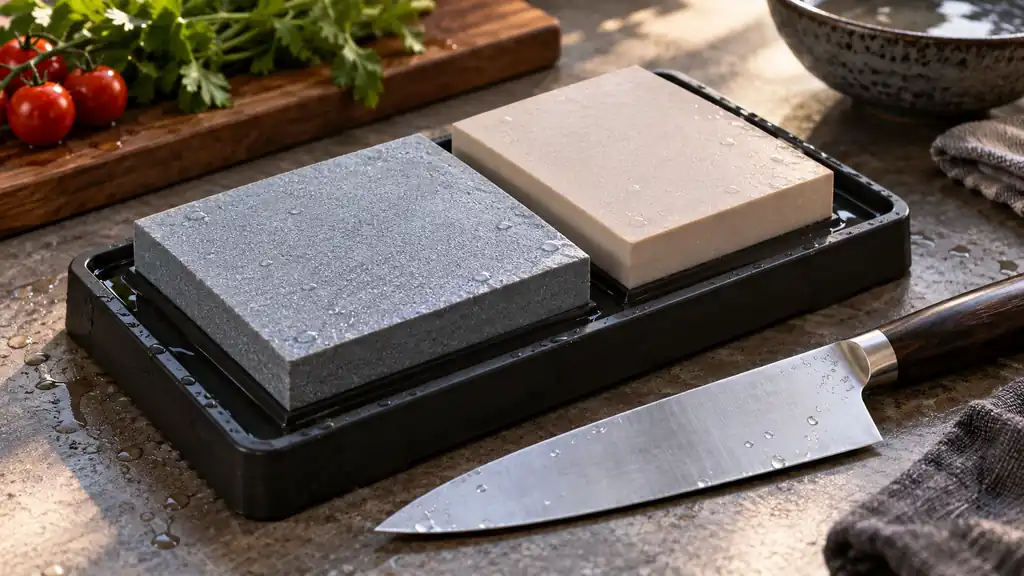
A water stone gives a cook more control than a pull-through sharpener because the abrasive surface works directly against the edge, allowing coarse repair, everyday sharpening, and fine finishing with the right grit. That flexibility also creates the main learning curve. A stone that is too coarse for routine maintenance can remove unnecessary metal, while a fine polishing side will struggle to repair a badly rolled or damaged edge. Buyers also overlook stability, soaking instructions, and the need to keep the stone reasonably flat.
For most kitchen knives, a useful setup pairs a medium sharpening grit with a finer honing or polishing grit. A coarse 400 side can help with a significantly dull edge, while 1000 grit is more practical for regular sharpening. Grits from 3000 to 8000 refine the scratch pattern, though they cannot replace sound angle control or burr removal. Water stones also suit different users differently. A beginner may value an angle guide and secure base, while an experienced sharpener may prefer more grit choices, a flattening stone, or a strop for finishing.
The products below cover simple two-sided stones, broader multi-grit kits, and beginner-oriented setups. The Sharp Pebble 1000/6000 kit is the strongest all-around choice for ordinary kitchen maintenance because its grit pairing is practical and its base and guide reduce setup friction. The larger four-grit kits make more sense for households maintaining several knives or repairing edges at different stages.
Quick Answer
- Best Overall: Sharp Pebble Whetstone Knife Sharpener, with a useful 1000/6000 grit combination, bamboo base, and angle guide for routine kitchen sharpening.
- Best Complete Kit: Intelitopia Complete Knife Sharpening Stone Set, which adds 400/1000 and 3000/8000 stones, a flattening stone, and a leather strop.
- Best for Everyday Maintenance: MITSUMOTO SAKARI 1000/3000 Grit Japanese Whetstone, a focused setup for cooks who want sharpening and moderate refinement without a large accessory bundle.
Best Water Stone For Knives Comparison Table
| Product | Best For | Grit | Abrasive Type | Base or Holder |
|---|---|---|---|---|
| Sharp Pebble Whetstone Knife Sharpener | Most home kitchens | 1000/6000 | Water stone, material not specified | Bamboo base |
| Intelitopia Complete Knife Sharpening Stone Set | Multiple sharpening stages | 400/1000 and 3000/8000 | Aluminum oxide corundum | Bamboo base, rubber bases |
| MITSUMOTO SAKARI Japanese Whetstone | Daily kitchen maintenance | 1000/3000 | White corundum | Bamboo base |
| BABOSTOW Knife Sharpening Stone | Beginners wanting a fine finish | 1000/6000 | Aluminum oxide | Bamboo base and silicone holder |
| Angerstone Premium Knife Sharpening Stone | General straight-edge tools | 1000/6000 | Not specified | Bamboo base and silicone base |
| MIDO Professional Abrasive Sharpening Stone | Edge repair and basic sharpening | 400/1000 | Silicon carbide | Acacia wood base and silicone base |
| 12-Piece Knife Sharpening Stone Set | Broadest accessory selection | 400/1000 and 3000/8000 | White corundum | Bamboo and rubber bases |
| 10-Piece Knife Sharpening Stone Set | Multi-stage sharpening with strop | 400/1000 and 3000/8000 | White corundum | Bamboo base and rubber holders |
| Amazon Basics Whetstone Set | Organized home setup | 400/1000 and 3000/8000 | Not specified | Bamboo base and silicone base |
The detailed reviews explain how each grit arrangement, abrasive material, base, and accessory package fits different sharpening routines.
1. Sharp Pebble Whetstone Knife Sharpener — Best Overall

A 1000/6000 combination covers the part of knife maintenance most home cooks actually face. The 1000 side is suited to restoring a dull everyday edge, while the 6000 side refines the scratches left by the coarser surface. That pairing avoids the clutter of a large kit when a household mainly needs to maintain chef knives, utility knives, paring knives, or similar straight-edge blades.
The included bamboo base and angle guide make the setup less intimidating for a first-time sharpener. The guide cannot replace controlled movement, and it should be used carefully with the knife’s edge design, but it can help a learner establish a repeatable position. Water-based operation keeps cleanup straightforward. A cook who usually reaches for a dull knife before dinner may appreciate the uncomplicated two-stage routine, while a collector with chipped edges may find the lack of a coarse repair grit limiting.
Pros
- Practical 1000/6000 grit pairing for routine kitchen sharpening and edge refinement.
- Includes a non-slip bamboo base for a more stable sharpening setup.
- Angle guide can help beginners practice a consistent blade position.
- Uses water rather than sharpening oil.
- Suitable for kitchen knives, pocket knives, scissors, chisels, and razors according to the supplied product information.
Cons
- No coarse grit is listed for substantial chips or major edge reshaping.
- The product information does not specify the abrasive material or stone dimensions.
This is the best fit for a home cook who wants one approachable stone for regular maintenance and a refined finish. It is less suitable for someone restoring neglected blades, where a 400-grit surface can save time, or for a sharpener who wants a dedicated flattening stone included. The 1000/6000 progression remains a sensible middle ground, especially for cooks who want a manageable setup beside the sink rather than a box of loosely related accessories.
To buy this product, click here.
2. Intelitopia Complete Knife Sharpening Stone Set — Best Complete Kit

Intelitopia is aimed at buyers who want a full sharpening path rather than a single dual-sided block. Its 400/1000 stone gives the user a coarse repair option and a medium sharpening surface, while the 3000/8000 stone moves into fine refinement. That range is useful for a kitchen with several knives in different conditions. A neglected cleaver may need the 400 side, while a regularly maintained chef knife may need only the 1000 or 3000 side.
The package also includes a flattening stone, leather strop, bamboo base, three non-slip rubber bases, and an angle guide. Those additions make the kit more versatile, but they create a longer learning path. Flattening matters because repeated sharpening can wear a water stone unevenly, and a strop serves a finishing and burr-removal role rather than replacing the abrasive work. The listed abrasive is aluminum oxide corundum, giving buyers more material information than several competing kits provide.
Pros
- Four listed grit levels cover repair, sharpening, refinement, and polishing.
- Includes a flattening stone for maintaining the working surface.
- Leather strop adds a separate finishing and burr-removal step.
- Aluminum oxide corundum abrasive is identified in the supplied information.
- Multiple bases and an angle guide support a more secure setup.
Cons
- The larger collection takes more storage space and requires more setup decisions.
- Fine 8000-grit polishing is unnecessary for many routine kitchen sharpening sessions.
Choose this kit if you maintain several straight-edge knives or want to learn a broader sharpening process over time. Someone who simply touches up one or two kitchen knives may find the extra stones and accessories excessive. Its strongest advantage is flexibility, though that flexibility rewards a user who understands which grit to use and when to flatten the stone.
To buy this product, click here.
3. MITSUMOTO SAKARI Japanese Whetstone — Best for Everyday Maintenance
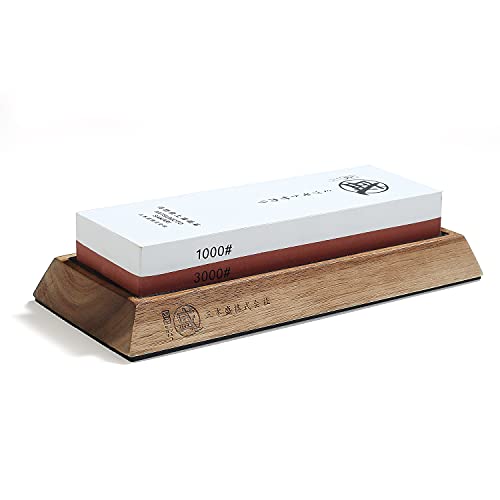
The 1000/3000 arrangement is deliberately focused. The 1000 side addresses the dullness that builds up during ordinary meal preparation, while 3000 provides a moderate finishing step for a smoother edge. It sits between a basic sharpening block and a more elaborate four-grit system. For a cook who sharpens a chef knife every so often and wants a cleaner cutting edge afterward, that is a sensible division of labor.
The supplied information identifies white corundum and describes a controlled water-absorption design intended to create a consistent slurry after soaking. It also lists a bonded dual-grit construction and a non-slip bamboo base. The stated 15° to 20° range is presented as a guide for maintaining a steady angle, though users should still account for their knife’s actual edge geometry. A small household may find this setup easier to store and remember than a kit with four abrasive surfaces.
Pros
- Focused 1000/3000 grit combination suits regular kitchen knife maintenance.
- White corundum abrasive is identified in the product information.
- Non-slip bamboo base helps keep the stone positioned during use.
- Bonded dual-grit construction combines sharpening and moderate honing in one block.
- Water-based operation avoids the need for sharpening oil.
Cons
- No coarse repair side is listed for heavily damaged edges.
- No flattening stone or angle guide is included in the supplied feature list.
This stone makes sense for cooks who already understand basic blade control or are willing to practice without a supplied guide. It is a weaker match for a first-time user seeking a fully guided kit, and its 3000 side is less focused on mirror-like polishing than an 8000-grit surface. Still, its narrower scope can be a virtue for everyday sharpening rather than a drawback.
To buy this product, click here.
4. BABOSTOW Knife Sharpening Stone — Best for Guided Beginners

BABOSTOW follows the familiar beginner-friendly formula of a 1000/6000 dual-sided stone, bamboo base, silicone holder, angle guide, and instructions. The 1000 side is the working surface for a dull kitchen knife, while 6000 is intended for refinement. That combination is broad enough for regular cooking knives without asking a new sharpener to choose among four or more abrasive stages.
The listed abrasive is aluminum oxide, and the base system uses both bamboo and silicone components to resist movement. Stability matters because a sliding stone can make angle control harder and turn a calm maintenance task into a hurried one. The supplied compatibility information excludes serrated and ceramic blades, so this is a straight-edge tool. A cook with a drawer full of ordinary chef, paring, or pocket knives gets a clear use case, while someone with serrated bread knives needs a different method.
Pros
- 1000/6000 grits cover common sharpening and finishing tasks.
- Aluminum oxide abrasive is identified.
- Includes bamboo and silicone components intended to reduce movement.
- Angle guide and instructions support first-time users.
- Water-based cleaning and operation are straightforward.
Cons
- Listed compatibility excludes serrated and ceramic blades.
- No coarse grit or separate flattening stone is included in the supplied feature list.
This is a reasonable choice for someone learning the basic two-stage process on straight-edge kitchen knives. It may be a poor fit for a household that needs to repair chipped edges or maintain ceramic blades. The 6000 side also asks the user to remove the burr carefully before polishing, since a fine surface cannot compensate for inconsistent technique.
To buy this product, click here.
5. Angerstone Premium Knife Sharpening Stone — Best for Multiple Straight-Edge Tools

Angerstone uses a 1000/6000 combination and adds a flattening stone, angle guide, towel, silicone base, and bamboo holder. The result is a fairly compact kit for a household that sharpens kitchen knives alongside scissors, chisels, garden tools, or straight razors. The broad compatibility claim applies to many straight-edge tools, but the listing specifically excludes serrated and ceramic blades.
The included flattening stone separates this kit from several other two-sided options. That accessory does not sharpen a knife. It helps restore a stone’s working surface after wear, which becomes more relevant as sharpening sessions accumulate. The available information does not identify the abrasive material, so buyers cannot compare its abrasive composition directly with the aluminum oxide and silicon carbide options in this roundup. The base and angle guide still give the kit a practical beginner orientation.
Pros
- 1000/6000 grit combination supports sharpening and fine finishing.
- Includes a flattening stone for stone-surface maintenance.
- Bamboo holder and silicone base are intended to improve stability.
- Angle guide can help users practice a repeatable position.
- Listed for kitchen knives and several other straight-edge tools.
Cons
- Not listed for serrated or ceramic blades.
- The abrasive material is not identified in the supplied information.
Pick this option if the flattening accessory matters and your tools are mostly straight-edged. A buyer seeking a documented abrasive composition or a coarse repair grit should look elsewhere. It is best viewed as a compact maintenance kit rather than a full edge-repair system for heavily damaged knives.
To buy this product, click here.
6. MIDO Professional Abrasive Knife Sharpening Stone — Best for Basic Edge Repair
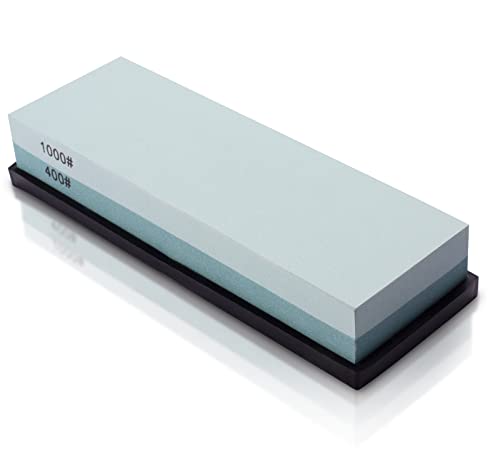
MIDO keeps the sharpening path simple with a 400/1000 two-sided block. The 400 side is suited to returning a worn edge toward a usable shape, while the 1000 side smooths the deeper scratches left by the coarse surface. That makes it more repair-oriented than the 1000/6000 stones above. A knife that has been ignored in a drawer may benefit from this starting point before moving to a finer stone.
The stone is listed as green silicon carbide and measures 7 by 2.25 by 1.125 inches. Those dimensions provide a clearly defined work area, while the acacia wood base and silicone holder are intended to keep the block from sliding. There is no fine polishing side, so the 1000 surface is the endpoint unless the user owns another finishing stone. The water-only process is convenient, but soaking and surface cleanup remain part of the routine.
Pros
- 400/1000 progression is useful for repair and everyday sharpening.
- Silicon carbide abrasive is identified.
- Listed dimensions make the stone’s working size clear.
- Acacia wood and silicone base components support a stable setup.
- Water operation avoids sharpening oil.
Cons
- No fine polishing grit is included.
- More substantial edge repair can require careful pressure control to avoid removing excess material.
MIDO suits a cook who values a coarse starting grit or wants a straightforward stone for dull household blades. It is less suitable as a complete one-stone finishing solution for someone who prefers a highly refined edge. Pairing it with a finer stone can broaden its usefulness, though that adds another purchase and another surface to maintain.
To buy this product, click here.
7. 12-Piece Knife Sharpening Stone Set — Best Accessory Bundle

This kit is built for buyers who want a broad sharpening station in one package. Its 400/1000 and 3000/8000 grit stones provide a coarse repair stage, everyday sharpening, and two levels of refinement. The accessory list includes a leather strop, polishing compound, flattening stone, angle guide, metal honing guide, bamboo and rubber bases, cut-resistant gloves, and a cleaning towel.
That collection can be useful in a busy kitchen where different knives arrive in different conditions. A heavily dulled edge may start at 400, while a regularly maintained knife may move from 1000 to 3000. The strop and compound are finishing accessories, not substitutes for proper sharpening. Buyers should also recognize that more pieces mean more storage and more chances to use the wrong guide or grit for a particular edge.
Pros
- Four listed grit levels cover repair through fine polishing.
- Includes flattening equipment for maintaining the stone surface.
- Leather strop and polishing compound add a separate finishing stage.
- White corundum abrasive is identified.
- Multiple stability and guidance accessories are included.
Cons
- The large accessory count may be excessive for basic household maintenance.
- Using several guides and grit stages requires more learning than a simple dual-sided stone.
This set belongs in the hands of a buyer who wants to explore sharpening beyond occasional touch-ups. It may frustrate someone looking for a quick, low-storage routine. The gloves and guides add practical support, but they do not remove the need to match the abrasive stage to the edge condition and to rinse and dry the equipment afterward.
To buy this product, click here.
8. 10-Piece Knife Sharpening Stone Set — Best for Strop-Based Finishing

The 10-piece set follows the same useful 400/1000 and 3000/8000 progression but takes a slightly different accessory route. It includes a leather strop, nagura stone, angle guide, cut-resistant gloves, cleaning towel, and non-slip support. The nagura stone is intended as part of stone maintenance, while the strop provides a separate finishing surface after abrasive sharpening.
For a cook maintaining a mixture of everyday stainless kitchen knives and hobby tools, the broad grit range gives more control than a single 1000/6000 block. The 400 side is for edges that need substantial correction, not routine passes on an already serviceable knife. White corundum is listed as the abrasive, and the product uses water rather than oil. Storage is the practical trade-off, particularly for a small kitchen where a compact dual-grit stone may be easier to keep accessible.
Pros
- 400/1000 and 3000/8000 surfaces support several sharpening stages.
- Includes a leather strop for final edge refinement.
- Nagura stone adds a dedicated maintenance accessory.
- White corundum abrasive is identified.
- Base, guide, gloves, and towel provide a structured setup.
Cons
- Requires more storage and maintenance than a basic two-sided stone.
- The product information does not specify stone dimensions.
This kit is a strong match for a user who wants to learn a fuller water-stone routine and values a strop. It is less appealing for someone who sharpens one knife a few times a year. Its multiple stages are useful only when the user understands that coarse repair, medium sharpening, fine polishing, and stropping perform different jobs.
To buy this product, click here.
9. Amazon Basics Whetstone Knife Sharpening Stone Set — Best Organized Home Setup

The Amazon Basics set includes two dual-sided stones, one with 400/1000 grit and another with 3000/8000 grit. That gives the user a full progression from edge repair to fine polishing, with a flattening stone included for surface maintenance. An angle guide and non-slip bamboo and silicone components keep the package oriented toward home users who want a defined station rather than a loose stone on a damp towel.
Its configuration resembles the broader multi-grit kits, though the available information emphasizes the organized base system and the included flattening stone rather than a leather strop or polishing compound. The 400 side should be reserved for edges that need meaningful correction, while 1000 and 3000 are more relevant to regular kitchen maintenance. The 8000 side is a fine finishing option, but it is optional for many cooks and will reward careful burr removal.
Pros
- Two dual-sided stones provide four listed grit levels.
- Includes a flattening stone for maintaining flat surfaces.
- Angle guide and silicone holder support a more repeatable setup.
- Non-slip bamboo base keeps the stones organized during use.
- Water-based stones rinse clean without sharpening oil.
Cons
- The product information does not identify the abrasive material.
- The four-grit arrangement may be more equipment than a casual sharpener needs.
This set fits a household that wants repair and finishing options from one organized package. It may be unnecessary for routine maintenance of a single chef knife, where a 1000/3000 or 1000/6000 stone is easier to manage. Buyers who place a high priority on documented abrasive composition should choose a product such as the Intelitopia, MITSUMOTO SAKARI, or MIDO instead.
To buy this product, click here.
Buying Guide
Match the Grit to the Edge Condition
Grit selection should follow the knife’s condition rather than the largest number printed on the box. A 400-grit surface is useful for substantial dullness, small edge damage, or reshaping work, but it removes material more aggressively than a 1000-grit surface. For a knife that still cuts but has lost bite, 1000 grit is usually the more sensible starting point among the products here. Grits around 3000 to 6000 refine the edge, while 8000 is a fine polishing option rather than a requirement for every kitchen knife.
Decide Whether You Need One Stone or a Full Progression
A 1000/6000 stone keeps the routine easy to remember: sharpen on one side, refine on the other, then clean the stone. A four-grit kit offers more control, particularly when one knife needs repair and another needs only light maintenance. That flexibility brings extra storage, soaking, drying, and surface-care duties. Before choosing a large set, think about whether you will actually use the coarse and very fine stages.
Check the Abrasive Material
Several products identify their abrasive. Intelitopia lists aluminum oxide corundum, MITSUMOTO SAKARI lists white corundum, BABOSTOW lists aluminum oxide, and MIDO lists silicon carbide. Other stones in the comparison do not specify the abrasive material in the available information. Grit numbers are useful, but identical numbers do not by themselves guarantee identical cutting behavior across different stone compositions. A documented material gives the buyer more information for comparison, though technique and maintenance still matter.
Look for Stability and Angle Support
A water stone needs a secure working position. Bamboo bases, silicone holders, and rubber supports can reduce movement across the counter, which is helpful while a learner practices a consistent angle. An angle guide can provide a reference, but it does not make every knife compatible or eliminate the need for controlled strokes. Single-bevel, serrated, ceramic, and unusually shaped blades require particular care, and several products here specifically exclude serrated or ceramic knives.
Plan for Flattening and Cleanup
Water stones wear unevenly with use. A hollowed surface can make it harder to maintain consistent contact across a blade, so a flattening stone is valuable for people who sharpen regularly. It is included with Intelitopia, Angerstone, the 12-piece set, and Amazon Basics among the reviewed choices. Water-based sharpening also means the stone should be rinsed and allowed to dry appropriately after use. Soaking instructions vary by product, and a splash of water during sharpening may still be needed.
Surface condition affects blade contact. The guide to checking and flattening a whetstone explains why a worn hollow needs attention.
Separate Sharpening From Stropping
A sharpening stone removes material to create or restore an edge. A leather strop is a finishing tool that can help refine the edge and remove residual burr material after sharpening. It does not replace a coarse or medium abrasive. The Intelitopia and larger accessory sets include strops, while the simpler stones focus on the abrasive block and base. Buyers should treat these as different stages rather than interchangeable accessories.
Match the Stone to Your Knife Collection
Most products here are intended for straight-edge kitchen knives and related tools. Serrated bread knives need a different approach because their teeth do not present a flat edge to the stone. Ceramic blades also require compatible equipment, and BABOSTOW, Angerstone, and TIDENBR’s supplied information specifically excludes ceramic or serrated blades. A water stone can serve chef knives, santoku knives, paring knives, and many pocket knives, but the edge geometry and blade material still determine the appropriate method.
A waterstone gives different control from a powered guide. The stone-versus-electric-sharpener comparison explains the learning and compatibility trade-offs.
Best Water Stone For Knives FAQ
What grit water stone is best for kitchen knives?
A 1000-grit surface is a practical starting point for a dull but intact kitchen knife. A finer 3000, 6000, or 8000 side can refine the edge afterward. A 400-grit surface is more appropriate for substantial dullness or edge repair, so it should not be the default for every sharpening session.
Is a 1000/6000 stone enough for most home cooks?
For many straight-edge kitchen knives, a 1000/6000 combination covers routine sharpening and fine refinement. It does not provide a coarse repair stage or a dedicated flattening stone, so users maintaining damaged or heavily neglected knives may prefer a broader kit.
Do water stones need to be soaked?
The products in this roundup are water-based, and several listings describe soaking before use. The required time varies by stone. Follow the instructions supplied with the exact product, then add water during sharpening if the surface begins to dry. Do not assume every water stone has identical absorption behavior.
What is the difference between sharpening and honing on a water stone?
Sharpening uses abrasive material to remove steel and restore an edge. Honing or polishing refines the edge after sharpening. A 1000-grit side generally does more corrective work than a 3000, 6000, or 8000 side, while a leather strop provides a separate finishing step.
Do water stones work with serrated knives?
A flat water stone is generally intended for a flat or regularly beveled edge. Serrated blades have recessed sections and teeth that a flat surface cannot contact consistently. Several products in the supplied information specifically exclude serrated blades, so check the exact compatibility statement before buying.
Do I need a flattening stone?
A flattening stone becomes more useful as sharpening sessions accumulate because water stones can wear unevenly. Occasional users may need one less often, while frequent sharpeners should pay closer attention to the working surface. Intelitopia, Angerstone, the 12-piece set, and Amazon Basics include flattening equipment.
Are higher grit numbers always better?
No. A higher grit creates a finer finish, but it removes less material and cannot efficiently repair a badly dull or damaged edge. A 1000-grit surface may be more useful than an 8000-grit surface for the first stage of everyday sharpening. The best progression depends on the knife’s condition and the finish you want.
Final Verdict
The Sharp Pebble Whetstone Knife Sharpener is the strongest overall match for most home kitchens because its 1000/6000 progression addresses ordinary sharpening without burying the user in accessories. Its bamboo base and angle guide add practical support, while the two grit levels keep the routine clear. It is not the choice for major edge repair or a full stone-maintenance station, but it offers the most balanced starting point for straight-edge kitchen knives.
Choose the Intelitopia set if you maintain several knives in different conditions and want coarse, medium, fine, flattening, and stropping options in one package. MITSUMOTO SAKARI is the cleaner alternative for cooks who prefer a focused 1000/3000 setup, while MIDO makes more sense for basic edge repair with a documented silicon carbide abrasive. The right water stone should match your knife collection, sharpening habits, storage space, and willingness to maintain the stone. A modest two-sided setup used carefully will serve many kitchens better than a larger kit that rarely leaves the cupboard.
