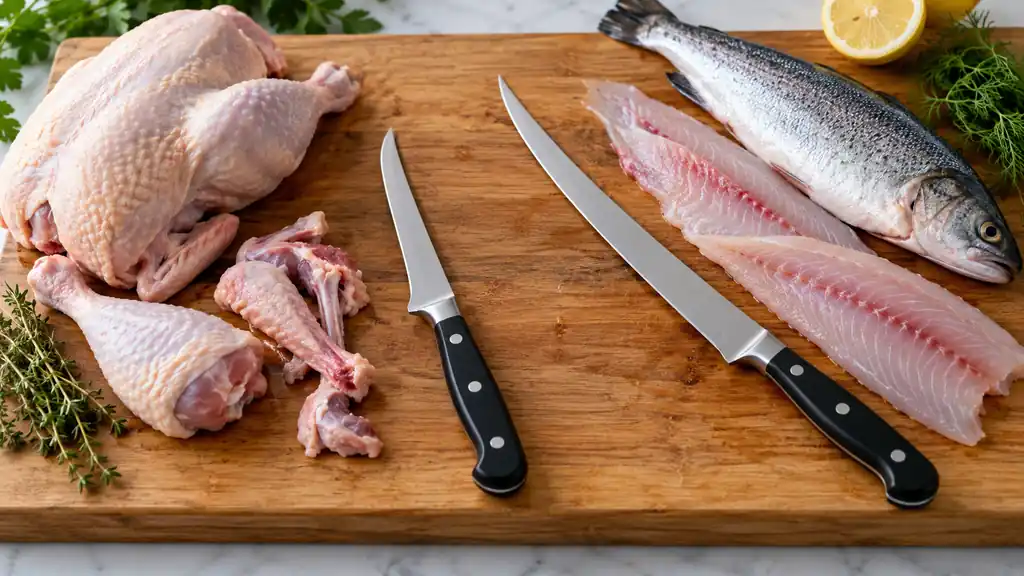
A boning knife is generally shorter and stiffer than a fillet knife, which is usually longer, narrower, and more flexible. The boning knife offers control while trimming meat from bones, separating joints, and removing connective tissue. The fillet knife bends along a fish’s skeleton and skin, helping remove a fillet with minimal waste.
The categories overlap. Flexible boning knives can handle some fish preparation, while stiffer fillet knives may work for light meat trimming. The better choice depends on the food, the amount of flexibility required, and the precision of the cut.
For meat and poultry work, start with the boning-knife comparison and check stiffness as well as length. The distinction below explains why that choice may differ from a flexible knife used for fish.
Boning Knife vs. Fillet Knife at a Glance
| Feature | Boning Knife | Fillet Knife |
|---|---|---|
| Primary use | Removing meat from bones, trimming fat and connective tissue, working around joints | Removing fish fillets, following the skeleton, and separating skin from flesh |
| Typical flexibility | Stiff to flexible, depending on the design | Usually more flexible |
| Blade shape | Narrow blade with a pointed tip; may be straight or curved | Long, narrow blade with a fine tip and gradual curve |
| Control | Firm response around joints and dense tissue | Smooth movement along ribs, skin, and delicate flesh |
| Best suited to | Poultry, pork, beef, lamb, and general meat trimming | Fish and other delicate seafood preparation |
| Hard-bone chopping | Generally unsuitable | Unsuitable |
How a Boning Knife Is Built
A boning knife has a slim blade that can reach into narrow spaces around bones and joints. Its pointed tip helps begin precise cuts, while the narrow profile reduces resistance as the blade moves through meat and connective tissue.
Blade stiffness varies considerably within this category. A stiff boning knife provides direct feedback and resists twisting while working through dense cuts of meat. A semi-flexible or flexible version follows curved bones more easily and can perform some fish-related tasks.
Straight and Curved Boning Blades
A straight boning blade supports controlled trimming and detail work. It can be useful for poultry joints and for removing silverskin from meat.
A curved blade creates more clearance between the handle and cutting surface. Its shape also supports longer slicing strokes around ribs or under skin. Neither profile is universally preferable, since blade shape should match the task and the user’s cutting technique.
What a Boning Knife Should Cut
Common uses include:
For precision work around poultry joints, compare boning knives for chicken; that is different from forcing a blade through bone.
- Removing meat from poultry carcasses
- Separating meat around ribs and other curved bones
- Trimming fat, membranes, and connective tissue
- Removing silverskin from tenderloins
- Working around joints with controlled cuts
- Shaping boneless portions of meat
Despite its name, a boning knife is primarily intended to cut around bones. It should not be used to chop through thick bones or frozen food unless its manufacturer expressly identifies that use. A meat cleaver, bone saw, or another purpose-built tool is more appropriate for heavy bone work.
How a Fillet Knife Is Built
A fillet knife typically has a long, thin blade that flexes under moderate pressure. This flexibility allows the edge to remain close to a fish’s ribs and backbone as the knife moves through delicate flesh.
For fish-focused work, the fillet-knife comparison helps check reach and flexibility against the task.
The narrow blade also turns more easily than a broad chef’s knife. During skin removal, the blade can travel nearly parallel to the cutting surface while the skin is held taut. A fine, pointed tip helps start cuts behind the gills, near fins, or along the backbone.
Flexibility differs among fillet knives. A highly flexible blade may suit small or delicate fish, while a firmer blade can offer greater control on larger, denser fish. Blade dimensions and stiffness should therefore be judged together rather than treating every fillet knife as identical.
What a Fillet Knife Should Cut
Typical tasks include:
A whole fish makes those differences concrete. The guide to filleting a salmon places blade control alongside rib and pin-bone removal.
- Removing fillets from a fish carcass
- Following the backbone and rib cage
- Separating fish skin from a fillet
- Trimming fins, belly tissue, and uneven edges
- Portioning delicate boneless fish
A fillet knife is not a substitute for a heavy knife when cutting through thick fish spines, hard joints, or frozen seafood. Excessive force can cause a flexible blade to slip, twist, or sustain edge damage.
Why Blade Flexibility Matters
Flexibility is the clearest practical difference in a boning knife vs. fillet knife comparison. A flexible blade can conform to the shape of fish bones, allowing shallow cuts that preserve more flesh. That same movement may feel imprecise against dense meat or tough connective tissue.
A stiffer blade transfers hand movement more directly to the cutting edge. This helps while guiding the tip around poultry joints or trimming a beef cut. Too much stiffness can make it harder to follow the contours of a fish skeleton without leaving flesh behind.
More flexibility is not automatically better. The appropriate amount depends on the size and texture of the food. It also depends on how much pressure is required. A blade that bends easily during gentle fish preparation may become difficult to control if pressed into dense tissue.
How Blade Length and Shape Affect Control
Boning knives tend to favor compact control. Their relatively short working edge makes small directional changes easier around joints, cartilage, and irregular bones. The hand remains close to the cutting area, which can help with detailed trimming.
Fillet knives favor longer slicing strokes. The extended, narrow edge can travel along a backbone or between skin and flesh without requiring repeated short cuts. Fewer strokes may leave a cleaner surface, provided the blade remains properly aligned.
The fine tip on either knife deserves careful handling. It is useful for precision, but it is not intended for prying, twisting joints apart, or contacting a cutting board with force.
Can One Knife Replace the Other?
A boning knife can fillet fish in some situations, particularly if it has a narrow, flexible blade. It may work adequately for firm fish or occasional preparation. A stiff boning knife is less able to follow ribs closely and may remove more flesh with the skeleton.
A fillet knife can perform light boning and trimming on tender cuts, but its flexibility becomes a limitation around dense joints or tough connective tissue. Pressing harder to compensate reduces control and increases the chance of slipping.
For cooks who prepare both meat and fish regularly, separate knives provide geometry suited to each task. Those who process fish rarely may find a flexible boning knife sufficiently versatile. A person who fillets fish frequently will usually gain more precision from a dedicated fillet knife.
Choosing Between a Boning Knife and a Fillet Knife
Match the blade to the food prepared most often:
- Choose a stiff boning knife for beef, pork, lamb, and work around firm joints or dense tissue.
- Choose a flexible boning knife for poultry, curved bones, lighter trimming, and occasional fish preparation.
- Choose a fillet knife for frequent fish processing, skin removal, and cuts that must follow ribs or a backbone closely.
- Choose a firmer fillet blade for larger or denser fish where excessive flex would reduce control.
Handle security also matters because meat and fish can make hands and work surfaces slippery. Look for a handle shape that permits a stable grip without forcing the wrist into an awkward position. Comfort and control depend on hand size, grip style, handle dimensions, and blade balance, so no single handle design suits every user.
Safe Cutting Technique
Place the food on a stable cutting board with a damp towel or nonslip mat underneath if the board tends to move. Keep the supporting hand clear of the blade’s path, and use controlled strokes rather than forcing the edge.
With either knife, let the narrow edge perform the cut. Heavy pressure can cause the blade to jump from a bone or deflect unexpectedly. If a joint will not separate with light, precise cutting, locate the natural gap in the joint rather than pressing through hard bone.
During fish preparation, wipe moisture and residue from the handle as needed. Keep the cutting area organized so the fine point does not strike utensils, the sink, or other hard objects.
Cleaning, Storage, and Edge Care
Wash the knife promptly with warm water and mild dish soap, following any care instructions supplied by the manufacturer. Avoid leaving it submerged where the blade is hidden from view. Dry the blade and handle thoroughly before storage.
Salt and moisture from seafood can promote corrosion, including on stainless steel under unfavorable conditions. Prompt cleaning and drying reduce that risk. Carbon steel blades require especially attentive moisture control and may develop a patina through use. Patina is different from active rust.
Store either knife so its narrow edge and fine tip are protected. A properly fitted sheath, suitable knife block, or secure magnetic holder can prevent contact with other utensils. Loose storage in a drawer can damage the edge and creates an avoidable injury hazard.
Sharpen according to the knife’s edge construction and manufacturer guidance. Flexible blades require light, controlled pressure during sharpening so the blade does not bend away from the abrasive. Sharpening removes metal to restore the edge, while honing rods vary in function. Smooth steels primarily maintain an edge, and abrasive ceramic or diamond rods can remove material. A honing rod cannot correct every dull or damaged edge.
Frequently Asked Questions
Is a boning knife sharper than a fillet knife?
Knife category does not determine sharpness. Sharpness depends on the condition and geometry of the cutting edge. A boning knife may use a more durable edge for contact near joints, while a fillet knife may have a fine edge suited to delicate slicing, but construction varies by model.
Can a fillet knife cut through fish bones?
It can pass through very small, soft bones during ordinary fish preparation, but it is generally unsuitable for cutting through thick spines or hard bones. Use a tool intended for heavier work rather than forcing a flexible blade.
Can a boning knife remove fish skin?
Yes, particularly if the blade is narrow and somewhat flexible. A dedicated fillet knife generally follows the skin more easily because its longer blade supports a shallow, continuous slicing motion.
Do both knives need flexible blades?
No. Flexibility is central to many fillet knives, while boning knives range from stiff to flexible. Dense meat and firm joints tend to favor greater stiffness. Fish and curved bones often favor more flex.
Which Knife Fits the Task?
A boning knife is the practical choice for trimming meat and navigating joints, especially where a firm, responsive blade improves control. A fillet knife is better suited to fish because its length, narrow profile, and flexibility help the edge follow bones and skin.
Neither blade is intended for heavy chopping or forcing through hard bone. Selecting the appropriate stiffness for the food, maintaining a secure grip, and keeping the edge sharp will matter more than the category name alone.
