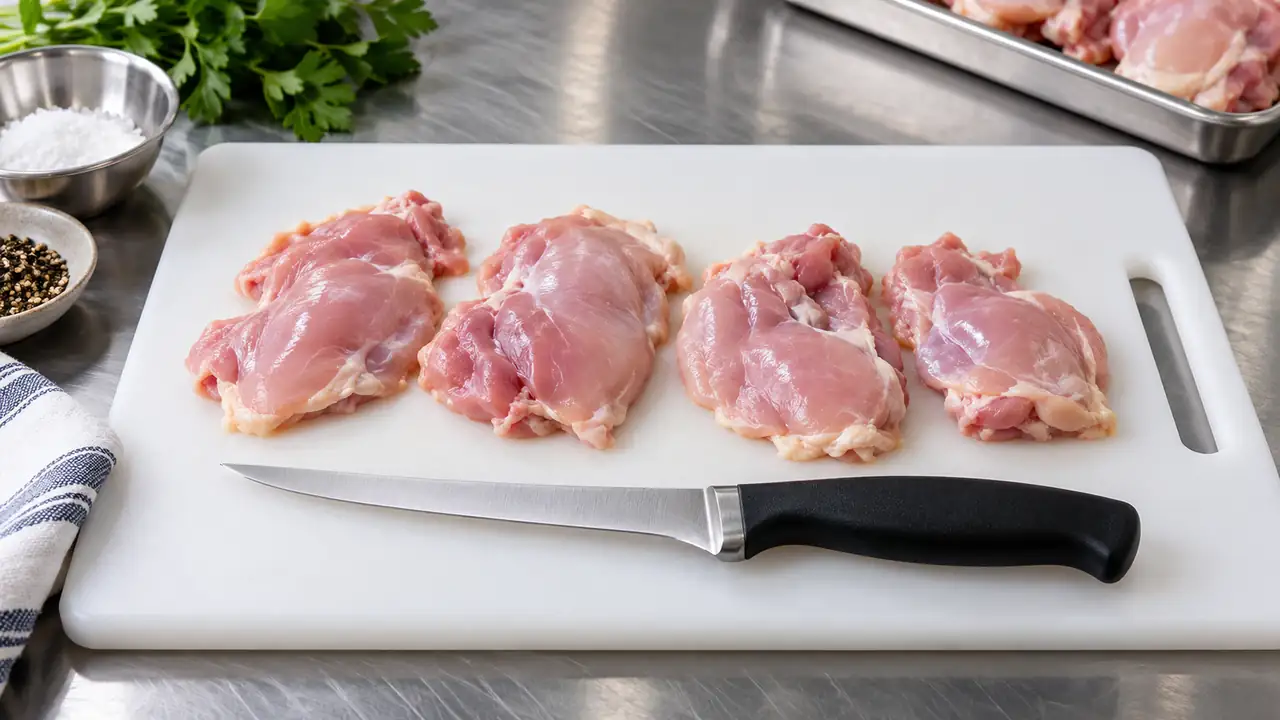
Breaking down a chicken is a different job from slicing vegetables or carving a roast. The blade needs to reach tight joints, follow the contours of the carcass, and separate meat from bone without forcing the edge through hard material. A good boning knife for chicken usually has a narrow 5- or 6-inch blade, a pointed tip, and enough curve or flexibility for controlled trimming. The wrong knife can feel clumsy around wings and joints, while an overly flexible fillet-style blade may wander when more control is needed.
Blade shape is only part of the decision. A curved profile can help with long trimming strokes, while a flexible blade can follow the rib cage and remove small pieces of meat cleanly. Handle texture matters when chicken juices make the grip slippery, and steel choice affects cleaning and corrosion care. Several products here list high-carbon stainless or Japanese steel, but those broad descriptions do not establish identical performance. For frequent poultry preparation, hand washing, complete drying, and safe storage remain as important as the initial sharpness.
This selection compares nine distinct options for home cooks, batch poultry preparation, outdoor processing, and buyers who want a broader meat-cutting kit. The Mercer Culinary Ultimate White curved knife earns the top position because its 6-inch poultry-friendly format, curved blade, textured handle, and straightforward care instructions create a balanced match for everyday chicken work. Other picks make more sense for flexible slicing, multiple knives, high-visibility handling, or a more decorative handle.
Quick Answer
- Best Overall: The Mercer Culinary Ultimate White 6-inch Curved Boning Knife offers a focused chicken-deboning format with a curved profile, high-carbon Japanese steel, and a textured handle.
- Best Premium Construction: The Cutluxe Curved Boning Knife adds a flexible 6-inch blade, full-tang construction, a pakkawood handle, and a listed 56+ Rockwell hardness.
- Best Compact Option: The Outdoor Edge 5-inch Wild Game Boning Knife is shorter, flexible, and fitted with a blaze-orange rubberized handle for controlled processing.
- Best Multi-Knife Choice: The VITUER set includes three curved 6-inch boning knives and three covers, which can be useful when separating knives by task or preparing several birds.
Best Boning Knife For Chicken Comparison Table
| Product | Best For | Blade Length | Flexibility or Profile | Handle |
|---|---|---|---|---|
| Mercer Culinary Ultimate White | Everyday chicken deboning | 6 inches | Curved | Textured ergonomic handle |
| Cutluxe Curved Boning Knife | Controlled trimming and repeated prep | 6 inches | Flexible, curved | Full tang pakkawood |
| Mercer Culinary Millennia Curved | Curved cutting with a professional-style handle | 6 inches | Curved | Textured black handle |
| Rondauno Boning Knife | Simple poultry and meat trimming | 6 inches | Boning profile | Textured ABS |
| Golden Bird Butcher Knife Set | Complete meat-processing setups | Multiple | Boning, skinning, and butcher blades | Non-slip handles |
| VITUER Boning Knife Set | Multiple poultry prep stations | 6 inches | Curved | PP handles |
| PAUDIN Boning Knife | Flexible poultry and fish trimming | 6 inches | Flexible | Pakkawood |
| Huusk Fillet Knife | Longer, flexible poultry and fish work | 7 inches | Flexible | Contoured wood |
| Huusk Curved Boning Knife | Wet handling and outdoor visibility | 6 inches | Curved | Textured orange handle |
The detailed reviews explain how each blade shape, handle, and construction choice affects chicken preparation, from breaking down a single bird to processing several at once.
1. Mercer Culinary Ultimate White, 6 inch Curved Boning Knife – Best Overall
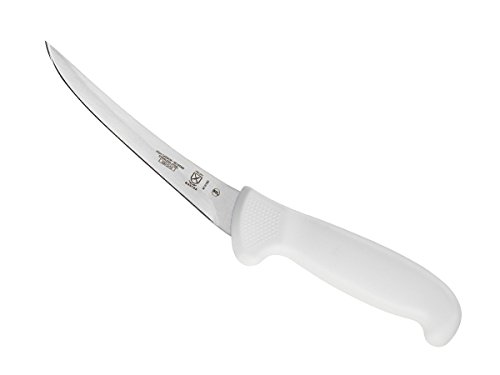
The Mercer Culinary Ultimate White is a strong match for the ordinary chicken-prep routine: breaking down a whole bird, trimming excess fat, and working around joints without carrying a long butcher knife to the cutting board. Its 6-inch curved blade gives the tip room to enter tight areas while the belly supports controlled strokes along breastbone and thigh contours. The available specifications identify high-carbon Japanese steel and a textured handle with finger points, though they do not provide a specific alloy designation or hardness value.
That restraint is part of the appeal. This is a focused tool rather than a knife overloaded with decorative claims. A cook preparing chicken for stock on a Sunday afternoon gets a manageable blade length, while someone portioning several birds can take advantage of the grippy handle and familiar curved format. Mercer recommends hand washing with mild soap, rinsing, and drying after use. That care routine matters because poultry moisture and residue should not sit on the blade or handle for long periods.
Pros
- 6-inch curved blade suits detailed chicken deboning and trimming.
- High-carbon Japanese steel is listed as easy to maintain.
- Textured finger points support grip control during wet preparation.
- Useful for chicken, ham, fish, fat, and sinew according to the product information.
- Clear hand-washing and drying guidance helps support long-term care.
Cons
- The available information does not identify a specific steel alloy or hardness rating.
- Hand washing is recommended, so it is a poor fit for buyers who require dishwasher cleaning.
This is the sensible starting point for a home cook who wants one dedicated chicken boning knife without stepping into a larger processing kit. Its curved shape should be more useful around joints than a straight utility knife, while the 6-inch length avoids the extra reach of a longer fillet blade. Buyers who want a full-tang handle, a listed edge angle, or several specialized knives will find stronger matches below, but everyday poultry work is where this Mercer is most convincing.
To buy this product, click here.
2. Cutluxe Curved Boning Knife, 6-inch – Best Premium Construction

Cutluxe takes a more detailed construction approach than the basic poultry knives in this group. The listing describes a flexible 6-inch blade made from high-carbon German steel, a full-tang structure, and a triple-riveted pakkawood handle. For chicken, that combination points toward a knife intended for repeated trimming where the user wants a narrow blade that can bend around contours but still has a firmly secured handle.
The published specifications also list a 14- to 16-degree edge per side and 56+ Rockwell hardness. Those figures describe the stated configuration, not a guarantee of how long the edge will last in every kitchen. They do give shoppers more information for sharpening and comparison than a general “high-quality steel” description. The handle’s laminated and polished surface may appeal to buyers who prefer a traditional-looking kitchen knife, but it still needs careful cleaning after contact with poultry juices.
Pros
- Flexible 6-inch curved blade is suited to deboning and trimming.
- Full-tang construction and triple rivets provide a documented handle structure.
- Pakkawood handle offers a traditional alternative to plain polymer handles.
- The listing provides a 14- to 16-degree-per-side edge specification.
- Published information includes 56+ Rockwell hardness and a lifetime defect warranty.
Cons
- Flexibility may provide less direct control for users who prefer a stiffer chicken boning blade.
- The wood-based handle requires more careful cleaning than a simple molded handle.
This Cutluxe is a good fit for cooks who want more construction detail and a handle that feels visually at home beside traditional kitchen knives. The flexible blade should suit trimming breast meat and following the rib cage, while the 6-inch size remains practical around wings and thighs. It may be excessive for occasional chicken preparation, and buyers who value the easiest possible sanitation may prefer Mercer’s molded-handle designs.
To buy this product, click here.
3. Mercer Culinary M23820 Millennia Black Handle, 6-Inch Curved Boning Knife – Best Curved Mercer Alternative

The Millennia M23820 closely follows the practical formula that makes a curved chicken knife useful: a 6-inch blade, a pointed working end, and a profile intended for separating meat from bone and trimming connective tissue. Its one-piece high-carbon Japanese steel construction is specifically listed, giving it a different construction description from the Ultimate White model. A cook working near a thigh joint or trimming a breast can use the curve to keep the cutting motion close to the bone instead of making broad, wasteful strokes.
The black handle has textured finger points and is described as ergonomic and non-slip. Those features are particularly relevant during poultry preparation, where a clean, dry grip can quickly become slick. Mercer advises hand washing and thorough drying, with no long soaking or dishwasher use. The available data does not state blade flexibility, so buyers should treat this as a curved boning knife rather than assume it has the same bending characteristics as a flexible fillet knife.
Pros
- Curved 6-inch profile is well matched to chicken joints and trimming.
- One-piece high-carbon Japanese steel construction is clearly identified.
- Textured black handle provides a practical grip feature for wet prep.
- Suitable for poultry, ham, fish, fat, and sinew according to the listing.
- Compact length is easier to maneuver than a long meat-processing blade.
Cons
- The supplied specifications do not state whether the blade is flexible, semi-flexible, or stiff.
- Hand washing and immediate drying are required for the recommended care routine.
This knife suits shoppers who like Mercer’s straightforward commercial-kitchen design but prefer a black Millennia handle. It is especially reasonable for cooks who want a curved blade with a little more construction emphasis than a basic stamped-looking option. Choose a documented flexible knife instead if following the rib cage is the main task, and avoid using any boning knife to chop through hard bones or frozen food.
To buy this product, click here.
4. Rondauno Boning Knife, 6-inch – Best Simple Poultry Tool

Rondauno keeps the design focused on the basics: a 6-inch boning blade, high-carbon stainless steel, and a textured ABS handle. For chicken, that combination covers the jobs most home cooks actually face, such as removing meat from a thigh bone, trimming loose skin, or cleaning up a breast after portioning. The listing states that the edge is hand sharpened to 15 degrees per side, which gives a useful reference for future sharpening without proving a particular level of edge retention.
The molded handle is a practical choice for a wet work area. ABS does not have the decorative character of pakkawood, yet its textured, slip-resistant surface is easier to view as a utility feature. The product information does not specify a curved or flexible profile, so this knife should be regarded as a general boning option rather than a specialized fillet blade. That distinction matters if your chicken routine involves long, sweeping cuts along the carcass.
Pros
- 6-inch length offers a practical middle ground for home poultry preparation.
- High-carbon stainless steel is identified in the product information.
- Textured ABS handle is suited to a messy, wet cutting environment.
- The listed 15-degree-per-side edge provides a sharpening reference.
- Its straightforward design avoids the extra bulk of a multi-knife set.
Cons
- The supplied information does not specify blade flexibility or a curved profile.
- There is no documented full-tang construction or exact steel designation.
Rondauno makes sense for a buyer who wants a dedicated chicken knife without a decorative handle or broader processing kit. It should be easier to clean and store than a wood-handled alternative, and its 6-inch format remains suitable for close work. Buyers who need a blade to flex around fish or the rib cage should look at Cutluxe, PAUDIN, or Huusk instead.
To buy this product, click here.
5. Golden Bird Butcher Knife Set – Best Complete Meat-Processing Kit
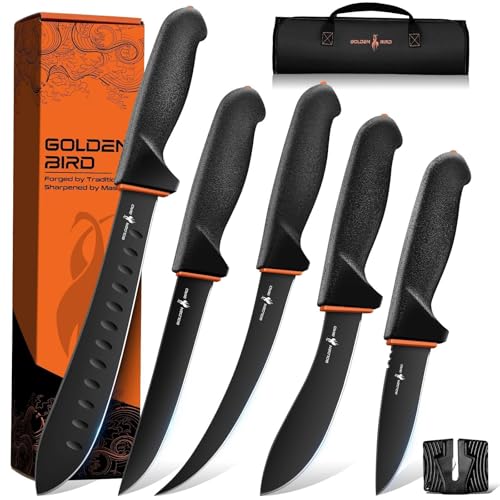
A single chicken does not require a full butcher kit, but larger poultry workloads can make multiple dedicated blades useful. The Golden Bird set includes an 8-inch butcher knife, specialized boning knives, skinning knives, a roll bag, and a built-in sharpener. That makes it more relevant to people who process several birds, handle other cuts of meat, or move between a kitchen, outdoor station, and storage area.
The set’s biggest advantage is task separation. A larger butcher blade can handle broader meat-cutting work, while a narrower boning knife can stay focused on joints and carcass contours. The available information describes German stainless steel and non-slip ergonomic handles, but it does not list the exact alloys, blade lengths for every included knife, or the sharpener’s mechanism and compatibility. Those omissions mean the buyer should treat the sharpener as a convenience accessory rather than assume it is appropriate for every edge in the roll.
Pros
- Includes specialized boning knives alongside butcher and skinning blades.
- Roll bag supports portable storage for outdoor or processing-room use.
- Non-slip handles are intended for wet and greasy meat preparation.
- The set covers more tasks than a single poultry knife.
- Included sharpener offers an on-hand maintenance option.
Cons
- The set occupies more storage space and costs more attention to maintain than one knife.
- The available information does not specify the sharpener type or exact compatibility with each blade.
This is the right direction for a buyer whose chicken preparation is part of a broader meat-processing routine. A person breaking down birds at a backyard station may appreciate having the correct blade nearby instead of reaching for one multipurpose knife. For an occasional kitchen cook, however, the extra knives and roll bag can become clutter, and a focused 6-inch boning knife will be simpler.
To buy this product, click here.
6. VITUER Boning Knife Set – Best for Multiple Prep Stations

VITUER approaches chicken preparation through quantity and organization. The package contains three curved 6-inch boning knives with differently colored handles and three knife covers. That setup can be useful for a household that separates knives by meat type, a small preparation team, or anyone who wants a covered knife ready for transport. The pointed tips and curved edges described in the listing are appropriate for entering joints and trimming close to bone.
The blades are listed as 3Cr13MoV German stainless steel with a stated hardness of 56±2 HRC. Unlike a vague “German steel” label, that gives a more specific material reference, although hardness alone does not predict edge life or overall toughness. The PP handles are designed for comfort and long cutting sessions, while the included covers add a useful storage layer. Three matching knives may be excessive for a single home cook, but the set has a clear purpose for repeated poultry work.
Pros
- Three curved 6-inch knives support separate poultry preparation tasks.
- Three included covers improve portable and drawer storage.
- The listing identifies 3Cr13MoV stainless steel and a 56±2 HRC range.
- Colored handles make it easier to distinguish knives during preparation.
- Pointed tips and curved edges suit trimming around chicken bones.
Cons
- Three similar knives may be unnecessary for a single-cook household.
- PP handle construction is more utilitarian than a full-tang wood-handled design.
Choose VITUER when organization matters as much as the individual blade. A cook preparing chicken, fish, and other meat can assign a color to each station, then cover the knives before storage. Buyers seeking one refined knife should skip the duplicated quantity, while those who value backup blades and individual covers may find the format unusually practical.
To buy this product, click here.
7. PAUDIN Boning Knife, 6 Inch – Best Flexible Pakkawood Design

PAUDIN is aimed at cooks who want a flexible blade for chicken, fish, skinning, trimming, and butterflying. The 6-inch format is short enough for detailed poultry work, while the listed flexible design should help the edge follow curved surfaces rather than digging into the meat. Its narrow profile is particularly relevant around breast meat and joints, where control and low waste matter more than brute force.
The product information identifies 5Cr15MoV stainless steel, a 56+ Rockwell hardness, a 15-degree-per-side edge, and a pakkawood handle. The blade also has a waved pattern, which the listing explicitly describes as a pattern rather than real Damascus. That distinction prevents the appearance from becoming a misleading performance claim. The handle offers a more traditional look, but it should still be washed and dried carefully after chicken preparation.
Pros
- Flexible 6-inch blade is suited to poultry, fish, skinning, and trimming.
- The listing identifies 5Cr15MoV stainless steel.
- 56+ HRC and a 15-degree-per-side edge are documented specifications.
- Pakkawood handle provides a traditional alternative to polymer.
- The patterned blade adds visual character without being presented as real Damascus.
Cons
- The flexible profile may feel less controlled for users who prefer a firmer blade around joints.
- Pakkawood requires more careful cleaning and drying than a basic molded handle.
PAUDIN is a sensible choice for a cook whose chicken preparation overlaps with fish filleting and delicate trimming. Its documented flexibility gives it a clearer role than a generic utility knife, while the 6-inch length keeps the working area manageable. It may be less appealing for heavy-duty processing or buyers who want the easiest possible handle sanitation, but it is well matched to careful, close-to-the-bone work.
To buy this product, click here.
8. Huusk Fillet Knife for Meat with Wood Handle – Best Longer Flexible Blade

Huusk’s 7-inch blade gives chicken preparation a little more reach than the 5- and 6-inch knives in this roundup. The listing describes a flexible fillet-style blade for meat, fish, poultry, skinning, butterflying, and trimming. That extra inch can help with longer strokes across a breast or carcass, though it also places more blade forward of the hand in tight joint work. Buyers should choose it for reach and flexibility rather than assume a longer blade is automatically easier to control.
The product information describes Japanese stainless steel, a hand-sharpened 15-degree edge, and a contoured wood handle. It does not provide a precise alloy designation or hardness value. The wood handle gives the knife a traditional appearance and may appeal to someone who wants a giftable presentation, but chicken prep calls for prompt hand cleaning and thorough drying. This is also a fish-oriented design, so its best chicken role is flexible slicing and trimming rather than forceful separation at hard joints.
Pros
- 7-inch flexible blade provides additional reach for larger poultry cuts.
- Listed for chicken, meat, fish, skinning, butterflying, and trimming.
- The 15-degree edge specification gives a useful sharpening reference.
- Contoured wood handle offers a traditional visual and tactile design.
- Thin, flexible format can suit detailed trimming where reach is useful.
Cons
- The longer blade may be less maneuverable around small chicken joints.
- The supplied information does not identify a precise steel alloy or hardness rating.
This Huusk is best for cooks who prepare chicken breasts, fish, and other ingredients with longer slicing motions. It is less compelling as a compact all-purpose poultry boning knife, especially for someone who works mainly around wings and small joints. Keep the edge away from hard bone and choose a shorter curved knife if close control is your first priority.
To buy this product, click here.
9. Huusk Curved Boning Knife, 6-inch – Best High-Visibility Handle

This Huusk returns to the compact curved format that suits chicken more directly. The 6-inch blade is described for deboning, trimming, and de-skinning, while the curved profile is intended to move around bones and joints. Its most distinctive feature is the bright orange handle. A high-visibility color can make a knife easier to locate on a busy counter or outdoor work surface, where a dark handle can disappear among trays and cutting boards.
The textured handle is described for wet or greasy conditions, and the blade has a titanium coating that the listing says is intended to resist corrosion. The available data does not state the underlying stainless-steel grade, flexibility, or hardness, so those characteristics should not be assumed. For chicken, the knife is a practical choice for buyers who value visibility and a curved cutting path, provided they follow normal hand-cleaning and drying habits.
Pros
- 6-inch curved blade is appropriate for chicken deboning and trimming.
- Bright orange handle is easier to spot in crowded or outdoor work areas.
- Textured grip is intended for wet and greasy preparation.
- Titanium coating is listed as a corrosion-resistance feature.
- Gift-box packaging may suit buyers purchasing a knife for a cook or outdoor enthusiast.
Cons
- The supplied information does not specify the underlying steel grade or hardness.
- Blade flexibility is not documented, limiting precise comparison with flexible fillet knives.
Huusk’s curved knife is a useful alternative for anyone who routinely works in a crowded kitchen, processing room, or outdoor setting and wants the handle to stand out. It has a more specialized visual design than the Mercer options, while the 6-inch length stays practical for poultry. Buyers who prioritize documented steel information or a stated flexible profile should select Cutluxe, VITUER, or PAUDIN instead.
To buy this product, click here.
Buying Guide
Match the Blade Profile to Chicken Preparation
A curved boning knife is useful when the cutting path follows a joint, thigh, or breast contour. The curve helps keep the working edge close to the bone during trimming. A flexible blade, such as the listed designs from Cutluxe, PAUDIN, and Huusk, can follow curved surfaces more readily, while a knife with unspecified flexibility should be evaluated as a general boning tool. Neither style should be used to chop through hard bones or frozen food.
Check the stiffness needed for the actual cut. The comparison of boning and fillet blades explains why extra flexibility is not always an advantage.
Choose a Practical Blade Length
Five to six inches is a useful range for most home chicken work because it gives the tip enough reach without making the knife unwieldy around wings and joints. The Outdoor Edge’s 5-inch blade favors compact control. Most Mercer, Cutluxe, Rondauno, VITUER, PAUDIN, and Huusk curved options use 6 inches. The 7-inch Huusk offers longer strokes but may require more room and attention around smaller pieces.
Separate Documented Steel Facts from Broad Labels
Some listings provide more material detail than others. VITUER identifies 3Cr13MoV, PAUDIN identifies 5Cr15MoV, and Cutluxe describes high-carbon German steel with a listed 56+ HRC value. Mercer describes high-carbon Japanese steel without giving an alloy designation. Huusk’s 6-inch curved knife lists a stainless-steel blade with a titanium coating, but the precise steel grade is not supplied. These differences affect how confidently a buyer can compare maintenance and sharpening characteristics.
Prioritize Grip Security and Cleaning
Chicken preparation can leave the handle wet or greasy, so textured surfaces and finger points have a practical role. Mercer, Rondauno, Huusk, and the Golden Bird set emphasize textured or non-slip grip features. Wood and pakkawood handles offer a different appearance but call for prompt cleaning and drying. The Mercer knives specifically advise hand washing, rinsing, and drying, and that type of care is a sensible default for every knife here unless the exact product instructions say otherwise.
Decide Whether You Need One Knife or a Set
A single 6-inch boning knife is easier to store and sufficient for most home cooks. A set becomes more reasonable when chicken preparation is part of a broader meat-processing routine. VITUER supplies three similar curved knives with covers, which supports task separation and backups. Golden Bird includes several different meat-processing blades and a roll bag, but it also introduces more storage and sharpening decisions. Match the quantity to the work rather than choosing a higher piece count automatically.
Use the Edge for Trimming, Not Force
Boning knives are made for separating meat, trimming connective tissue, and working around joints. They are not substitutes for cleavers or heavy butcher knives. Hard bone, frozen food, and twisting cuts can damage a narrow edge or reduce control. A stable cutting board, a secure grip, and deliberate strokes protect both the knife and the person using it. Afterward, remove poultry residue, rinse the blade, dry it fully, and store it where the edge cannot contact loose utensils.
Best Boning Knife For Chicken FAQ
What blade length is best for deboning chicken?
A 5- or 6-inch blade is usually the most manageable range for home chicken preparation. It offers enough reach for breasts and thighs while remaining easier to control around wings, joints, and smaller pieces. A 7-inch blade can help with longer trimming strokes, but it may feel less compact for detailed work.
Should a chicken boning knife be flexible?
Flexibility can help the blade follow the rib cage and other curved surfaces, particularly during trimming and filleting. A firmer curved blade may provide more direct control around joints. The right choice depends on the motion you use most. Do not assume a knife is flexible unless the product information states it.
Can I use a boning knife to cut through chicken bones?
A boning knife should separate meat from bone and work around joints, not chop through hard bones. Use controlled cuts along the bone instead of forcing the edge through it. Hard impacts can damage a narrow blade and create a less predictable cutting path.
Removing a backbone with shears differs from cutting around a joint with a knife. The chicken-spatchcocking method makes that distinction clear.
Is stainless steel better for chicken preparation?
Stainless steel is convenient for a food-preparation environment because it generally offers corrosion resistance, but “stainless” covers many different alloys. The VITUER and PAUDIN listings provide specific steel designations, while some other products use broader material descriptions. Cleaning and drying still matter, since stainless steel is resistant to corrosion rather than immune to every form of staining or damage.
What is the difference between a boning knife and a fillet knife?
Both can have narrow blades and may overlap in use, but a boning knife is generally selected for separating meat from bones, while a fillet knife emphasizes flexible slicing through fish or delicate meat. The products in this roundup include several flexible designs that can serve both roles. A curved, less flexible blade may be more appropriate for controlled chicken joint work.
How should I clean a chicken boning knife?
Follow the product instructions, and hand wash with mild soap when the listing recommends it. Rinse away poultry residue, dry the blade and handle completely, and avoid long soaking. Mercer’s supplied instructions specifically advise against dishwasher cleaning and prolonged submersion. Store the knife in a cover, block, roll, or another arrangement that protects the edge.
Are the sharpening angles listed for these knives universal?
No. Cutluxe lists 14 to 16 degrees per side, while Rondauno, PAUDIN, and the 7-inch Huusk list a 15-degree-per-side edge. Those are product-specific descriptions, not a universal rule for every boning knife. Use the manufacturer’s guidance where available, and avoid changing the edge aggressively without understanding the blade’s existing geometry.
Final Verdict
The Mercer Culinary Ultimate White 6-inch Curved Boning Knife is the strongest overall match for most chicken cooks. Its compact curved blade is directly suited to poultry work, the textured handle addresses a common wet-prep problem, and the high-carbon Japanese steel description gives it a clear place among everyday kitchen tools. The Mercer Millennia curved model is a close alternative for buyers who prefer its black handle and one-piece construction.
Cutluxe is the better choice for shoppers who want a flexible blade, full-tang construction, pakkawood, and more detailed listed specifications. PAUDIN offers a similar flexible direction with a 5Cr15MoV designation, while Outdoor Edge suits buyers who prefer a shorter 5-inch blade and high-visibility grip. For multiple birds or broader meat processing, VITUER and Golden Bird provide useful set formats. Match the blade length and flexibility to the way you cut, keep the edge away from hard bone, and choose the simplest knife that covers your actual chicken-preparation routine.
