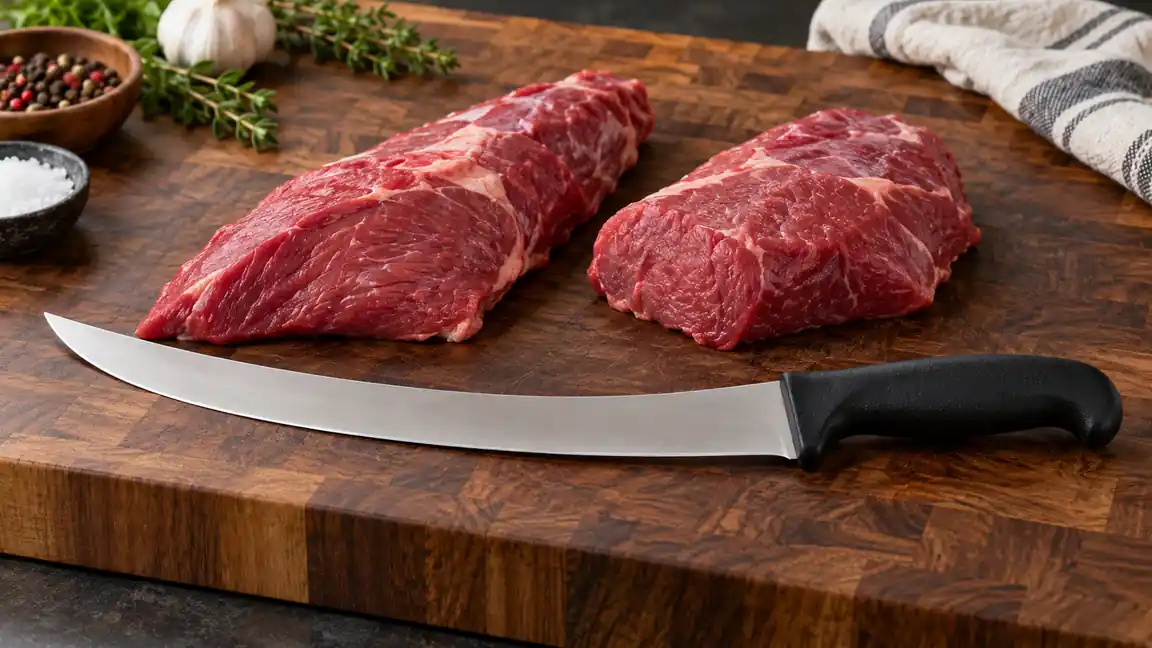
Breaking down a brisket, separating a roast, or trimming fat from a primal cut calls for a different tool from an everyday chef’s knife. A breaking knife uses a long, curved profile to follow the contours of meat, while its broad blade helps make controlled passes through larger sections. The right choice can make a crowded cutting board feel far less awkward, especially during a weekend barbecue or after bringing home a whole roast.
Many buyers focus on blade length alone and overlook the handle, cleaning routine, and intended cutting motion. An 8-inch knife can be easier to control in a compact kitchen, while a 10- or 12-inch blade can cover more surface in a single pass. Steel descriptions also need careful reading. “High-carbon” or “German steel” tells you something about the listing, but it does not provide a complete alloy specification or guarantee edge retention. Grip security matters too, since meat preparation often involves moisture, fat, and repeated cuts.
The products below include curved cimeter-style knives, shorter breaking knives, and one coordinated set for buyers who want separate blades for breaking, trimming, and slicing. The Victorinox Fibrox 10-Inch Curved Breaking Knife earns the top position because its blade length, wider profile, high-carbon stainless construction, wet-grip handle, and dishwasher-safe design form a particularly practical combination.
Quick Answer
- Victorinox Fibrox 10-Inch Curved Breaking Knife is the strongest overall match for general meat breaking, trimming, and portioning. Its 10-inch blade gives useful reach, while the Fibrox handle is intended to remain secure when wet.
- Cutluxe BBQ Butcher Knife suits buyers who prefer a full-tang construction, pakkawood handle, and a listed 14-16-degree-per-side edge.
- Cutluxe Butcher Knife Set is the practical choice for pitmasters who need a breaking knife alongside dedicated brisket and boning blades.
- Mercer BPX 8-Inch Breaking Butcher Knife offers a shorter format for controlled trimming and smaller prep areas.
Best Breaking Knife Comparison Table
| Product | Best For | Blade Length | Construction |
|---|---|---|---|
| Victorinox Fibrox 10-Inch | Best overall | 10 inches | High-carbon stainless steel, Fibrox handle |
| Cutluxe BBQ Butcher Knife | Full-tang handling | 10 inches | Forged German steel, pakkawood handle |
| SYOKAMI Butcher Breaking Knife | Detailed trimming and gift giving | 10.5 inches | Full tang, wenge wood handle |
| Victorinox Fibrox 8-Inch | Compact meat preparation | 8 inches | Stamped stainless steel, Fibrox handle |
| Cutluxe Butcher Knife Set | Multiple butcher tasks | 10-inch breaking knife included | High-carbon German steel, pakkawood handles |
| Mercer BPX 8-Inch | Short controlled cuts | 8 inches | Forged high-carbon German steel |
| HOSHANHO 12-Inch | Large roasts and briskets | 12 inches | Japanese high-carbon steel |
| Mercer Culinary BPX 10-Inch | Longer everyday butcher work | 10 inches | Forged high-carbon German steel |
| Kitchen Perfection 10-Inch | Portable barbecue prep | 10 inches | German steel, pakkawood handle, sheath |
The detailed reviews explain how the blade lengths, handle materials, construction, and care requirements translate to real meat-preparation tasks.
1. Victorinox Fibrox 10-Inch Curved Breaking Knife — Best Overall

A 10-inch curved blade gives this Victorinox enough reach for larger roasts without moving into the unwieldy territory of an extra-long slicer. The wider blade profile is intended to help separate large cuts into smaller roasts and portions, and the listing specifically connects that added blade mass with more uniform slicing and less tearing. That combination suits a home cook who may alternate between breaking down a roast on Saturday and portioning cooked meat the next day.
The high-carbon stainless steel blade is described as conical ground and ice tempered, although the supplied information does not identify a specific alloy or hardness rating. That means buyers can reasonably expect a stainless construction intended for routine kitchen use, but should not read the description as proof of a particular edge-retention level. The Fibrox Pro handle is textured and slip-resistant, including in wet conditions, while the knife is listed as dishwasher-safe and NSF approved. Those details make it especially practical for busy prep areas where cleanup and grip security matter as much as blade reach.
Pros
- 10-inch curved blade suits large roasts, primals, and general breaking work.
- High-carbon stainless steel construction is intended for repeated kitchen use.
- Conical grinding and ice tempering are listed as part of the blade construction.
- Textured Fibrox handle is designed for a secure grip in wet conditions.
- Dishwasher-safe design and NSF approval support frequent kitchen use.
Cons
- The 10-inch length may feel cumbersome on a small cutting board.
- The listing does not provide a precise steel designation or stated edge angle.
This is the most balanced pick for buyers who want one dedicated breaking knife rather than a specialized collection. It offers useful reach without requiring the 12-inch cutting space demanded by a larger brisket blade. Buyers who prefer full-tang construction, wood handles, or a documented sharpening angle may prefer the Cutluxe alternatives below. For routine trimming, splitting, and portioning with straightforward care, however, the Victorinox has a sensible feature mix.
To buy this product, click here.
2. Cutluxe BBQ Butcher Knife, 10-Inch Cimeter — Best Full-Tang Design

The Cutluxe takes a more traditional barbecue-oriented approach, pairing a 10-inch cimeter profile with a full-tang construction and triple-riveted pakkawood handle. A cimeter’s curve can help the user maintain a continuous slicing motion across meat, while the long edge gives room for trimming fat or separating sections without short, choppy strokes. The shape is well suited to brisket preparation, roast trimming, and other jobs where the blade needs to follow a broad surface.
The supplied product information lists forged high-carbon German steel and a stated hardness of 56+ Rockwell. It also lists a 14-16-degree-per-side edge and Granton-style recesses intended to aid slicing and release. Those are useful documented details, though they do not establish measured performance or guarantee a particular sharpening interval. The laminated pakkawood handle is triple-riveted and full tang, giving the knife a traditional visual character and a substantial construction. Buyers should still wash and dry the handle carefully rather than treating the wood-based material like a dishwasher-safe polymer.
Pros
- 10-inch cimeter profile fits brisket, roast, and general meat-cutting work.
- Full-tang construction provides a continuous blade structure through the handle.
- Triple-riveted pakkawood handle offers a secure, substantial grip design.
- Published information includes a 14-16-degree-per-side edge specification.
- Granton-style blade features are intended to assist clean release during slicing.
Cons
- The pakkawood handle requires more careful cleaning than a polymer handle.
- The listed steel description is broad and does not identify a specific German alloy.
This knife fits a barbecue setup where the same blade may move from breaking down a large cut to trimming and slicing it. Its full-tang and wood-handle construction will appeal to buyers who value a traditional butcher-knife presentation. A buyer who prioritizes dishwasher convenience or a lighter, less substantial handle may find the Victorinox more practical. The Cutluxe makes sense for users comfortable with hand washing and routine blade care.
To buy this product, click here.
3. SYOKAMI Butcher Breaking Knife, 10.5-Inch — Best for Detailed Trimming

The SYOKAMI combines a curved 10.5-inch cimeter blade with a tapered tip intended to assist work around bones and joints. That gives it a slightly more detailed role than a broad breaking knife alone. A cook trimming beef, separating poultry, or working around connective tissue may appreciate the pointed end, while the curved edge remains suited to larger meat surfaces. The listing also describes a thickness-measuring hole, a feature aimed at helping users portion steaks more consistently.
Its full-tang construction uses a wenge wood handle with triple rivets, and the product information describes an anti-fatigue curve and textured grip features. The wood is identified as FSC-certified, and the listing says it can absorb oil and moisture. That may help the handle feel secure during greasy preparation, but it also reinforces the need for attentive cleaning and drying. The listing states a 56+ Rockwell hardness and hand-polished blade, while the visible Damascus-style pattern should be treated as a finish detail rather than proof of superior cutting performance or a particular layered steel construction.
Pros
- 10.5-inch curved blade offers useful reach for meat breakdown and trimming.
- Tapered tip is suited to maneuvering around bones and joints.
- Full-tang, triple-riveted construction supports a sturdy handle assembly.
- Wenge wood handle and textured features provide a distinctive grip design.
- Thickness-measuring hole may help with more consistent steak portions.
Cons
- Wood handle care requires more attention than a fully synthetic handle.
- The decorative Damascus-style pattern does not document a specific layered steel construction.
This is a compelling fit for a buyer who wants a breaking knife with extra trimming capability and a presentation-oriented handle. It may be especially appealing as a gift for someone who enjoys barbecue and meat preparation. The 10.5-inch blade needs room to work, and buyers seeking simple sanitation or a less ornate knife may prefer Victorinox or Mercer. Its strongest distinction is the combination of long curved reach and a more pointed, detail-oriented tip.
To buy this product, click here.
4. Victorinox Fibrox 8-Inch Curved Breaking Knife — Best Compact Option

Not every kitchen has the counter space for a long breaking knife. This 8-inch Victorinox keeps the curved profile and wider blade concept while reducing the working length, making it easier to maneuver around a smaller cutting board. That shorter reach can be useful for trimming individual roasts, separating moderate-sized cuts, or working in a home kitchen where a 10- or 12-inch blade would extend beyond the comfortable preparation area.
The blade is described as stamped stainless steel with a high-carbon edge, and the handle uses Victorinox’s textured, slip-resistant Fibrox design. The listing identifies the knife as dishwasher-safe and NSF approved, which simplifies cleanup for users who prioritize convenience. A shorter knife will not cover as much meat in one pass, so it may require more repositioning on a large brisket. That is a practical trade-off rather than a flaw. The product makes its strongest case through control, manageable reach, and familiar sanitation features.
Pros
- 8-inch blade is easier to position on compact cutting boards.
- Curved profile remains suited to breaking, trimming, and portioning meat.
- Textured Fibrox handle is designed for grip security when wet.
- Stamped stainless construction keeps the design relatively straightforward.
- Dishwasher-safe and NSF-approved listing supports convenient cleanup.
Cons
- Shorter blade covers less surface per pass on large primals.
- The listing does not provide a precise steel grade or sharpening angle.
Choose this model for compact workspaces, moderate-sized cuts, or users who prefer a little more control over maximum reach. A pitmaster processing whole briskets frequently may find a 10- or 12-inch blade more efficient. For the cook who wants a specialized breaking knife without a large blade taking over the board, this 8-inch version is a sensible alternative to the top pick.
To buy this product, click here.
5. Cutluxe Butcher Knife Set — Best for Multiple Butcher Tasks
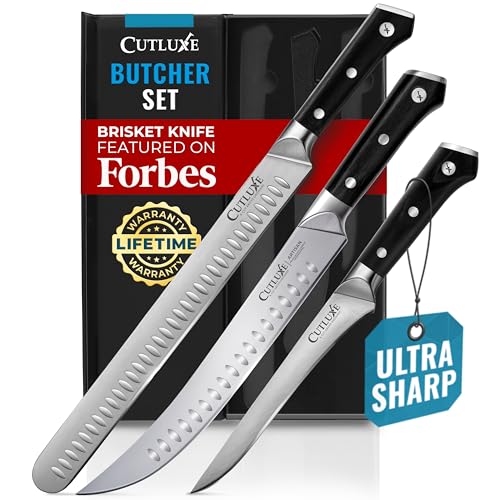
A single breaking knife can handle many meat-preparation jobs, but a three-piece set gives each task a more suitable blade. This Cutluxe collection includes a 12-inch brisket knife, a 10-inch breaking cimeter, and a 6-inch boning knife. That division is useful during a full barbecue session: the long blade can portion a cooked brisket, the cimeter can break down and trim larger cuts, and the shorter boning knife can work around joints and awkward contours.
The supplied information describes high-carbon German steel across the set and full-tang pakkawood handles. Since the exact steel alloy is not identified, those broad material terms should not be treated as a complete metallurgical specification. The real advantage here is task separation. A user can keep the narrow boning blade focused on detail work rather than asking one wide knife to perform every job. The set also takes more storage space and requires care across three wood-handled knives, so it makes most sense for people who regularly prepare substantial quantities of meat.
Pros
- Includes dedicated 12-inch brisket, 10-inch breaking, and 6-inch boning knives.
- Supports separate blades for portioning, breakdown, trimming, and bone work.
- High-carbon German steel is listed for all three knives.
- Full-tang construction and pakkawood handles provide a consistent set design.
- Useful configuration for barbecue sessions involving several meat-preparation stages.
Cons
- Three knives require more storage space and more cleaning than one blade.
- The wood-based handles call for hand care, and the steel alloy is not specified.
This set is for the pitmaster who regularly moves from primal breakdown to brisket slicing and trimming. It is less suitable for someone who only occasionally prepares a roast and wants a single compact tool. Buyers should also check that they have a safe storage plan before choosing a set of long blades. Its value lies in the distinct roles of the included knives, rather than in simply having more pieces.
To buy this product, click here.
6. Mercer BPX Breaking Butcher Knife, 8-Inch — Best for Controlled Short Cuts

The Mercer BPX 8-inch model is built around a shorter, manageable format for splitting, stripping, trimming, and slicing meat. Its precision-forged high-carbon German steel blade is described as ice hardened, and the mirror finish is intended to encourage smooth release from food. Those features address the practical annoyances that show up during repetitive prep, such as meat clinging to the blade or a handle becoming tiring to control.
The glass-reinforced nylon handle has a textured, ergonomic surface and is described as non-slip. Unlike some products in this roundup, Mercer gives clear care guidance: wash by hand with warm water and mild soap, rinse, and dry thoroughly. The knife should not go in the dishwasher or remain submerged for long periods. That restriction matters for buyers who value convenience above all else, but it also provides a straightforward maintenance routine that suits a dedicated prep knife.
Pros
- 8-inch blade offers manageable reach for trimming and smaller meat cuts.
- Precision-forged high-carbon German steel is listed as ice hardened.
- Mirror finish is intended to support smooth food release.
- Glass-reinforced nylon handle is textured and designed for non-slip handling.
- Published care instructions clearly explain hand washing and drying.
Cons
- Hand washing is required, so it is less convenient than dishwasher-safe options.
- Short blade length may require extra passes across large roasts or briskets.
This Mercer is a good match for cooks who prefer a shorter blade and do not mind hand washing. It can fit a smaller prep station more comfortably than the longer cimeters, while the synthetic handle avoids the moisture concerns associated with wood. Large-cut barbecue specialists may prefer the 10-inch Mercer or a longer Victorinox, but this model offers a controlled format for everyday trimming and meat preparation.
To buy this product, click here.
7. HOSHANHO Carving Slicing Knife, 12-Inch — Best for Large Cuts

A 12-inch blade is the specialist choice for users who routinely work with large briskets, roasts, turkeys, or hams. The HOSHANHO uses a curved profile and is described as suitable for meat cutting, trimming, and slicing. More length can help a cook cover a broad surface with fewer strokes, but it also demands a generous cutting board and careful control. In a small kitchen, the extra blade can feel like more tool than the task requires.
The listing describes Japanese high-carbon steel, heat treatment intended to balance hardness and toughness, and a hand-sharpened 15-degree edge. It does not provide a specific alloy designation, so the Japanese steel description should be read as a general material claim rather than a complete steel identity. The handle is described as non-slip and wear-resistant, and the blade-to-handle connection is intended to be easy to rinse and wipe dry. Buyers seeking a long knife for substantial cuts will find the format relevant, while cooks focused on small roasts may gain better control from an 8-inch model.
Pros
- 12-inch blade provides broad coverage for briskets, roasts, and hams.
- Curved profile supports meat slicing and trimming motions.
- Published information lists a 15-degree edge per side.
- High-carbon Japanese steel and heat treatment are part of the stated construction.
- Handle design is described as non-slip, wear-resistant, and easy to clean.
Cons
- Long length requires ample board space and careful storage.
- The listing does not identify the specific Japanese steel alloy.
This is the right scale for a barbecue setup where large cuts are common and long, continuous strokes are useful. It is less attractive for apartment kitchens, small roasts, or anyone who prefers a nimble blade. The stated 15-degree edge may interest buyers who like a defined sharpening reference, but it does not eliminate the need for compatible maintenance. Select it for reach first, since the 12-inch format is its defining advantage.
To buy this product, click here.
8. Mercer Culinary BPX Breaking Butcher Knife, 10-Inch — Best Longer Mercer Option

The 10-inch Mercer BPX keeps the same general construction approach as the shorter version but adds reach for larger cuts. Its blade is precision forged from high-carbon German steel and ice hardened according to the supplied product information. The mirror finish is intended to aid release, a useful feature during trimming when small scraps and fat can otherwise cling to the blade. The 10-inch size sits in a practical middle ground between compact control and long-blade coverage.
A textured glass-reinforced nylon handle provides a synthetic alternative to the wood handles found on several competing knives. That material is suited to users who want a durable grip surface without adding handle-specific wood care. Mercer specifies hand washing, mild soap, thorough drying, and no prolonged soaking. The knife therefore favors buyers who can maintain a simple routine after prep rather than those who expect to place every tool in the dishwasher.
Pros
- 10-inch length gives more coverage for large cuts than the 8-inch BPX.
- Precision-forged high-carbon German steel is described as ice hardened.
- Mirror finish is intended to promote smoother food release.
- Textured glass-reinforced nylon handle offers a synthetic grip surface.
- Curved butcher profile suits splitting, stripping, trimming, and slicing.
Cons
- Hand washing and thorough drying are required by the care instructions.
- Longer blade needs more board and storage space than the 8-inch model.
Pick this Mercer if you like the BPX construction and care guidance but need more working length. It is a practical choice for users processing medium-to-large roasts who want a synthetic handle and a dedicated butcher profile. The Victorinox 10-inch offers dishwasher convenience, while the Cutluxe brings a wood handle and stated edge angle. This Mercer occupies the straightforward, hand-wash-only middle ground.
To buy this product, click here.
9. Kitchen Perfection 10-Inch Butcher Breaking Knife — Best for Portable Barbecue Prep

This Kitchen Perfection knife is aimed at the cook who moves between a home kitchen, smoker, grill station, or barbecue gathering. The 10-inch curved cimeter blade is listed for breaking down, trimming, skinning, and slicing brisket, ribs, pork shoulder, and roasts. Its Granton edge is intended to support slicing and release, while the full-tang pakkawood handle uses triple rivets and a contoured shape. The combination gives it a broad range of meat-preparation uses in one knife.
The listing states high-carbon German steel, a 14-16-degree-per-side edge, and 56+ Rockwell hardness. Those specifications are useful reference points, but they remain supplied product claims rather than independent measurements. The included molded plastic sheath is the most distinctive practical accessory here. It can protect the edge during storage or transport, which is handy for a grill kit, though buyers should still ensure the blade is clean and dry before sheathing it. Recipe books and guides are included according to the listing, but the knife’s main purchasing distinction is the protective storage solution.
Pros
- 10-inch curved cimeter blade covers common brisket and roast tasks.
- Full-tang construction and triple rivets support the handle assembly.
- Pakkawood handle provides a contoured, traditional grip design.
- Published information includes a 14-16-degree-per-side edge and 56+ Rockwell claim.
- Included molded sheath supports safer transport and storage.
Cons
- Pakkawood requires careful hand cleaning and drying.
- The listed steel description does not identify a specific German alloy.
This knife makes the most sense for a barbecue enthusiast who wants a dedicated sheath for a travel kit or outdoor prep station. The sheath adds convenience that the other individual knives do not clearly include, but it does not replace proper cleaning before storage. Buyers who want a dishwasher-safe handle should look toward Victorinox, while those building a complete butcher setup may prefer the Cutluxe set. For portable 10-inch meat preparation, its accessory package is the key distinction.
To buy this product, click here.
Buying Guide
Match the Blade Length to the Cut
An 8-inch breaking knife is easier to position on a compact board and can provide more manageable control around smaller roasts. A 10-inch blade is a flexible middle choice for brisket, pork shoulder, and larger household cuts. A 12-inch knife can reduce the number of strokes across a broad brisket, but it needs more workspace and a secure storage plan. Blade length should follow the food you usually prepare, not a general assumption that longer is always better.
Look for a Curved Breaking Profile
Breaking knives commonly use a curved or cimeter-style edge to help the user follow the shape of meat. That profile suits trimming, separating sections, and making long slicing motions across roasts. A more tapered tip can add control around joints and bones, as seen in the SYOKAMI listing. These knives are intended for meat preparation, not for chopping through hard bones or frozen food unless the product specifically supports that use.
Read Steel Claims Carefully
High-carbon stainless steel, high-carbon German steel, and Japanese high-carbon steel are broad descriptions rather than complete alloy names. A listing that gives a precise steel designation offers more technical information than one that provides only a regional or marketing label. Hardness claims and edge-angle claims can help with comparison, but they do not prove edge retention or measured cutting performance. Geometry, sharpening, food contact, and maintenance all influence ownership.
Choose the Handle for Your Cleaning Routine
Fibrox and glass-reinforced nylon handles are practical options for buyers who prefer synthetic materials and straightforward sanitation. Pakkawood and wenge wood handles provide a different appearance and construction style, but they deserve careful washing and drying. A wet-grip claim does not mean a knife can be handled carelessly. Fat and moisture can still affect control, so a secure grip and a stable cutting board remain important.
Plan for Sharpening and Care
Several knives in this roundup provide a stated edge angle, while others do not. That information can help a sharpener maintain a similar bevel, but the correct equipment must suit the blade and edge design. Hand washing is specifically required for the Mercer BPX models, while the Victorinox listings identify dishwasher-safe construction. Regardless of the stated cleaning method, drying the blade after washing helps limit staining and keeps the storage area clean.
Decide Whether a Set Is Justified
The Cutluxe three-piece set is useful because its knives have separate roles. A 12-inch brisket knife, 10-inch breaking knife, and 6-inch boning knife can cover portioning, breakdown, and detail work more neatly than one general blade. A set takes more room and creates more maintenance tasks, so occasional roast preparation may justify a single knife instead. Think about the cuts you actually make before choosing extra blades.
Best Breaking Knife FAQ
What is a breaking knife used for?
A breaking knife is intended for separating large cuts of meat into smaller roasts, portions, and manageable sections. Its curved profile can help with trimming fat, following the contours of meat, and making longer slicing passes. Some models also have tapered tips that assist with work near joints and bones.
Is an 8-inch or 10-inch breaking knife better?
An 8-inch model generally takes less room and can feel easier to control around smaller cuts. A 10-inch model provides more reach and can reduce repositioning across a brisket or large roast. The better size depends on your cutting board, storage space, and usual meat portions.
Can a breaking knife cut through bones?
These knives are intended for meat, fat, connective tissue, and certain trimming tasks. They should not automatically be treated as bone cleavers. Hard bones and frozen foods can damage an edge unless the product specifically states that it supports such use. A boning knife is usually the more appropriate tool for separating meat around joints.
What is the difference between a breaking knife and a brisket knife?
A breaking knife is generally shaped for breaking down and trimming larger cuts, often with a curved cimeter profile. A brisket knife is commonly longer and oriented toward portioning or slicing a cooked brisket. Some products overlap in function, but a 12-inch slicing blade may be more useful for broad, even brisket portions than a shorter breaking knife.
Portioning a large cut and carefully removing hard fat are different jobs. The guide to controlled brisket trimming explains when a narrow trimming blade is preferable.
Are wood-handled breaking knives dishwasher-safe?
Do not assume so. The Cutluxe and SYOKAMI listings describe wood-based handles, while the supplied information does not establish dishwasher suitability for those products. Hand washing and thorough drying are the safer interpretation for wood or pakkawood handles. The Victorinox models in this guide are specifically listed as dishwasher-safe.
Does high-carbon steel mean a knife stays sharp longer?
High-carbon is a broad material description and does not independently establish edge retention. The specific alloy, heat treatment, blade geometry, edge preparation, cutting surface, and maintenance all influence how an edge behaves. A listing’s high-carbon claim should be treated as one comparison point rather than a guarantee of a particular sharpening interval.
How should a breaking knife be stored?
Store it in a knife block, drawer guard, sheath, or another arrangement that protects the edge and keeps the blade from moving loose in a drawer. The Kitchen Perfection model includes a molded sheath, which is useful for transport. Clean and dry the blade before covering it, especially after handling meat, fat, or moisture.
Final Verdict
The Victorinox Fibrox 10-Inch Curved Breaking Knife is the best overall choice for most buyers seeking one practical breaking knife. Its 10-inch reach suits large cuts without the added workspace demands of a 12-inch blade, and its textured Fibrox handle is intended to remain secure in wet conditions. The high-carbon stainless construction, curved profile, dishwasher-safe listing, and NSF approval create a well-rounded combination for regular household or commercial-style meat preparation.
The Cutluxe BBQ Butcher Knife is the stronger alternative for buyers who prefer full-tang construction, a pakkawood handle, and a listed edge angle. The Cutluxe three-piece set is the better match for serious barbecue preparation that calls for separate breaking, brisket, and boning blades. For compact work, the Victorinox and Mercer 8-inch models are easier to manage, while the HOSHANHO 12-inch knife favors large cuts and long slicing passes. Match the blade length to your board, choose a handle that fits your cleaning habits, and treat broad steel claims as useful clues rather than promises of performance.
