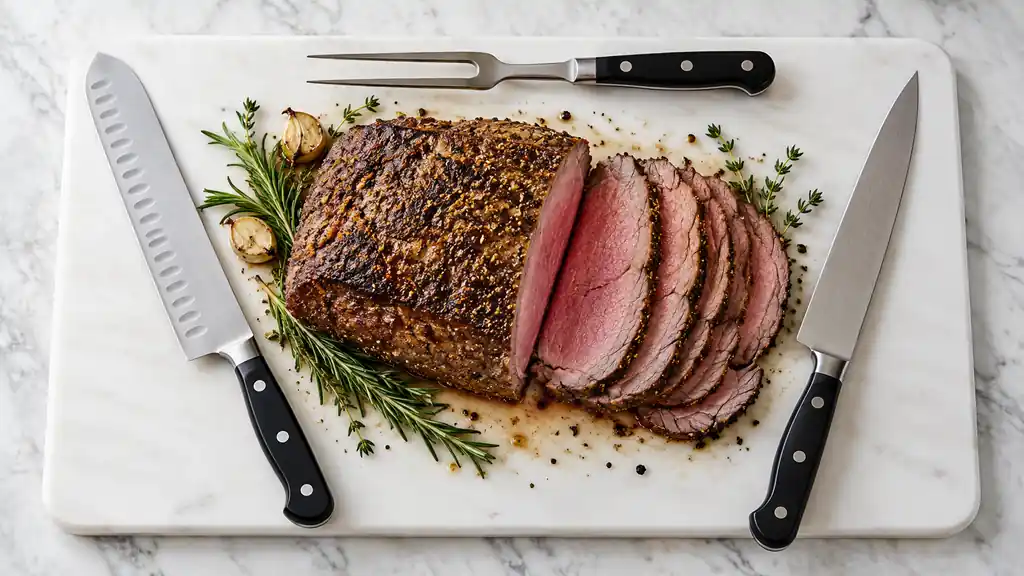
A slicing knife and a carving knife both cut cooked meat into portions, but their blade geometry favors different jobs. A slicing knife usually has a long, narrow blade that makes thin, clean slices with minimal sawing. A carving knife is generally broader and more rigid, often with a pointed tip that helps navigate around joints and separate meat from bones.
The categories overlap, and manufacturers do not always use the names consistently. Some knives are sold as “carving and slicing” models. The practical distinction lies in the blade’s shape, stiffness, tip, and intended task rather than the label on the packaging.
Need a longer blade for thin slices of cooked meat? These slicing knives for roasts and brisket illustrate the profiles discussed below, including differences in tip shape and blade length.
Slicing Knife vs. Carving Knife at a Glance
| Feature | Slicing Knife | Carving Knife |
|---|---|---|
| Primary use | Creating thin, even slices from boneless or mostly boneless foods | Portioning roasts and poultry, including work near bones and joints |
| Blade shape | Long and narrow | Typically wider and more substantial |
| Tip | May be rounded, blunt, or pointed | Commonly pointed |
| Flexibility | May have modest flexibility, depending on the model | Usually more rigid |
| Typical cutting motion | Long, smooth drawing strokes | Controlled slicing and maneuvering around bones |
| Suitable foods | Brisket, ham, smoked meats, terrines, and boneless roasts | Turkey, chicken, bone-in roasts, and cooked legs or shoulders |
How a Slicing Knife Is Shaped
A slicing knife has an elongated blade with less height than a typical chef’s knife. Its narrow profile reduces the amount of blade surface passing through the food. This can limit drag and help preserve the shape of delicate slices.
The long edge allows the user to cut through a wide roast in one or two controlled strokes. Fewer short strokes generally produce smoother surfaces than repeated back-and-forth sawing. This is especially useful for brisket, boneless ham, roast beef, smoked salmon, and other foods where presentation and slice thickness matter.
Tip designs vary. A rounded tip offers ample usable edge length without suggesting that the knife should be used for detail work around bones. A pointed slicing knife provides more versatility for trimming and starting precise cuts, although it may still be too flexible or narrow for prying at a joint.
What Do the Indentations on Some Slicers Do?
Some slicing knives have shallow oval depressions along the blade. These are commonly called a Granton edge, kullens, or hollow-ground indentations, depending on the maker’s terminology. They can reduce the area of direct contact between the blade and food, which may help some slices separate from the blade.
These indentations are optional. A smooth-sided slicer can perform very well, and the presence of hollows does not establish overall blade quality, sharpness, or edge retention.
How a Carving Knife Differs
A carving knife usually has more blade height, stiffness, and structural support than a dedicated slicer. Its pointed tip can enter narrow spaces and help the user follow the contours of a cooked bird or bone-in roast. The rigid blade provides predictable control as the cutting direction changes.
Carving knives remain thinner and narrower than many chef’s knives. They are built for controlled portioning rather than chopping, mincing, or applying heavy force. A carving knife can make attractive serving slices, but its shorter or wider blade may create more resistance than a dedicated slicer on a large boneless brisket or ham.
A carving fork is often paired with this knife, but the fork is a separate utensil rather than a defining feature. It can stabilize a roast and keep the guiding hand away from the edge. Pressing too firmly with the fork may release juices or damage a crisp exterior, so light, controlled pressure is preferable.
Where Their Uses Overlap
Either knife can portion many cooked meats successfully. The difference becomes more apparent at the edges of their intended roles:
- Boneless roast beef: Either style works. A slicer offers an advantage when consistently thin slices are the priority.
- Whole turkey or chicken: A carving knife provides better control around joints and curved bones.
- Brisket: A long slicer can cross a wide brisket with fewer strokes and less disruption to the bark.
- Bone-in ham: A carving knife is helpful near the bone. A slicer can be effective after the main sections have been removed.
- Smoked salmon or terrines: A narrow slicing blade can produce cleaner portions with less surface contact.
- Large boneless ham: A long slicer is usually the more efficient shape, particularly for thin serving slices.
Neither knife is meant to cut through hard bone. Use an appropriate bone-cutting tool for that task. Twisting a thin edge against bone can chip, bend, or otherwise damage the blade.
Blade Length, Flexibility, and Tip Shape Matter Most
Choose Enough Length for a Complete Stroke
The blade should be long enough to span most of the food without forcing the user into many short sawing motions. Large briskets and hams benefit from a longer slicer. A moderately sized carving knife may be easier to control around poultry joints or a compact roast.
Extra length is useful only if there is sufficient cutting-board space and the user can handle it comfortably. A longer blade also requires suitable storage that protects the entire edge and tip.
Match Stiffness to the Task
A small amount of flexibility can help a slicing blade follow the surface of a boneless cut. Excessive flex can feel imprecise around bones, while a very rigid blade may be less forgiving when making long, thin slices.
For poultry and irregular bone-in cuts, the steadier response of a carving knife is generally helpful. Flexibility varies among individual models, so the knife category alone does not reveal exactly how a blade will behave.
Select a Tip That Fits the Work
A pointed tip is useful for entering tight areas, separating joints, and tracing around bone. A rounded tip keeps the focus on long slicing strokes and reduces the chance of accidentally piercing or tearing the food during service.
A sharp point should never be used as a lever. Separate a joint by finding its natural connection and cutting through the soft tissue rather than forcing the blade through bone.
Which Knife Should You Use?
Use a slicing knife if the main goal is to cut large, mostly boneless foods into thin, uniform pieces. Its long edge and narrow blade are especially effective for brisket, ham, roast beef, and smoked fish.
Some cooks consider powered carving instead. These electric knives for cutting cooked meat involve their own operating limits and should not be treated as identical to a manual slicing blade.
Use a carving knife if the work involves cooked poultry, bone-in roasts, joints, or irregular contours. Its rigidity and pointed tip support more precise maneuvering as the blade changes direction.
A household that occasionally carves a roast may find one well-shaped carving knife sufficient for both roles. Frequent preparation of brisket, large hams, or other wide boneless foods gives a dedicated slicer a clearer purpose. Owning both is useful for specialized tasks, but it is not required for routine home cooking.
How to Slice Cooked Meat Cleanly and Safely
- Use a stable cutting surface. Place the board on a secure counter. If it slides, stabilize it with a suitable nonslip mat or a damp towel laid flat beneath it.
- Let the meat rest as appropriate. Resting helps retain juices during cutting. Suitable resting time varies with the food, its size, and the cooking method.
- Identify bones and joints. Plan cuts before placing the edge near a bone. Remove large sections from poultry before making serving slices when that approach offers better control.
- Position the guiding hand safely. Keep fingers away from the cutting path. A carving fork can hold larger foods steady without putting the hand close to the edge.
- Use long drawing strokes. Draw the blade smoothly through the food, using as much of the edge as practical. Avoid aggressive sawing or pressing straight down with excessive force.
- Cut across the grain where appropriate. Shortening long muscle fibers can make many cooked meats easier to chew. Grain direction may change across a large cut, so adjust the slicing direction as needed.
- Stop if the knife reaches hard bone. Reposition the blade and locate the joint or cut around the bone. Do not twist the edge to force progress.
Edge Style and Maintenance
Most Western-style slicing and carving knives use double-bevel edges, meaning both sides contribute to the cutting edge. Specialized slicers can use different grinds or asymmetrical geometry, so sharpening should follow the knife’s actual construction and any available manufacturer guidance.
A smooth-edged blade is straightforward to maintain with compatible sharpening equipment. Some meat slicers use serrations, particularly models intended for foods with firm crusts. Serrated blades require a sharpening method suited to the size and shape of their individual serrations. They should not be treated as ordinary plain edges.
Honing and sharpening serve related but distinct purposes. A suitable honing tool may maintain or refine an edge, while sharpening removes material to restore the edge geometry. Ceramic and diamond rods are abrasive and can remove metal. No rod should be assumed compatible with every blade or edge design.
Hand-wash the knife with mild dish soap, dry it promptly, and store it so the edge cannot strike other utensils. Stainless steel resists corrosion better than many non-stainless steels, but it is not immune to staining or corrosion. Care requirements also depend on the handle material and the manufacturer’s instructions.
Common Questions
Can a Chef’s Knife Replace a Carving Knife?
A sharp chef’s knife can carve poultry and portion many roasts. Its broader blade may create more drag, and its profile may be less convenient for thin slices or tight work around bones. It remains a practical substitute when carving is an occasional task.
Is a Slicing Knife the Same as a Bread Knife?
No. A bread knife typically has pronounced serrations that cut through crust without compressing the interior. Many slicing knives have plain edges intended for smooth cuts through meat. Some serrated meat slicers blur the visual distinction, but blade length and serrations alone do not make the categories identical.
Can a Slicing Knife Be Used on Raw Meat?
It can slice boneless raw meat, but it is poorly suited to many trimming and deboning jobs. A boning knife offers a shorter, more maneuverable blade for working around bones, removing connective tissue, and making detailed cuts.
Before-cooking fat removal is a different job from serving cooked slices. The brisket-trimming guide explains the controlled shallow cuts used at that earlier stage.
Do You Need a Carving Fork?
No, but a carving fork can stabilize a roast while keeping the hand clear of the blade. Tongs may work for some foods, provided they hold the item securely without placing the hand in the cutting path. Whichever tool is used, the food and board should remain stable.
The Practical Difference
A slicing knife favors long, clean cuts through boneless foods, while a carving knife favors controlled work around bones, joints, and irregular shapes. For brisket, ham, and thin roast-beef slices, the slicer has the more efficient geometry. For turkey, chicken, and bone-in roasts, the carving knife provides greater control. Blade length, stiffness, and tip shape are more reliable guides than the product name alone.
