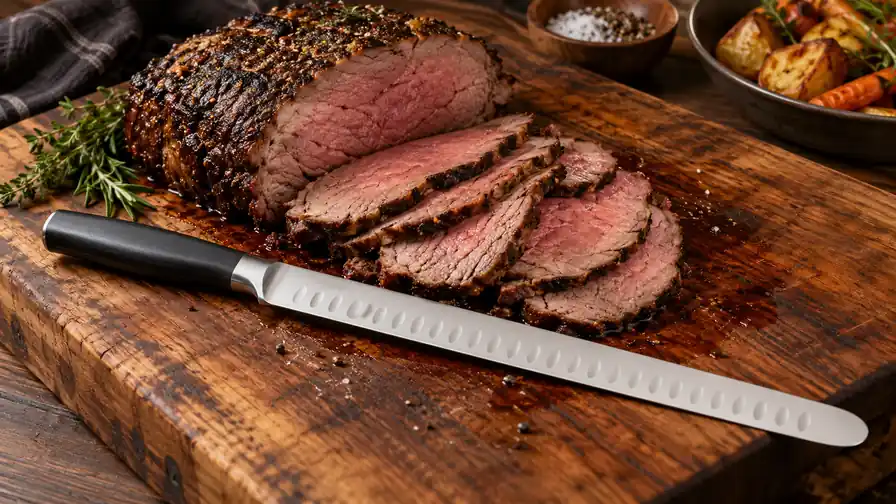
A slicing knife earns its place at the cutting board when a roast, brisket, turkey breast, or cured ham needs clean portions instead of ragged chunks. The long, narrow blade is built for a steady forward-and-back motion, helping you separate thin slices without pushing down through the food. That makes this category different from a chef’s knife, boning knife, or heavy cleaver, although some meat-preparation sets combine those tools for a broader workflow.
Blade length, edge design, handle security, and maintenance all deserve attention. A 12-inch blade gives you useful reach across a large brisket, while an 11-inch model may feel easier to manage around a smaller roast. Granton-style hollows can reduce contact between the blade and moist meat, but they do not replace a sharp edge or careful technique. Steel descriptions also vary widely, so a stated alloy or hardness figure should be treated as one part of the ownership picture rather than proof of superior cutting.
The right choice depends on whether you mainly carve holiday roasts, portion smoked brisket, trim meat before slicing, or want a matched set for the entire barbecue process. Some shoppers will prefer the straightforward handling of a Victorinox, while others will value the full-tang construction and accessory coverage offered by Cutluxe or HOSHANHO. The products below are ranked by their documented fit for slicing tasks, construction details, and practical versatility.
Quick Answer
Cutluxe Brisket Knife is the strongest overall match for shoppers who want a dedicated 12-inch meat slicer with a Granton edge, full-tang construction, pakkawood handle, sheath, and stated 14 to 16-degree-per-side edge. Its feature set suits brisket, turkey, roast, and similar large foods.
Victorinox Fibrox Pro Slicing Knife is a strong alternative for buyers who prefer a 12-inch Granton blade paired with a textured, non-slip Fibrox handle. The MAIRICO 11-Inch Slicing Knife is a practical choice for people who want a slightly shorter blade and explicitly described honing guidance.
Best Slicing Knife Comparison Table
| Product | Best For | Blade | Construction | Notable Feature |
|---|---|---|---|---|
| Cutluxe Brisket Knife | Overall meat slicing | 12 inches | High-carbon German steel, full tang | Granton edge and sheath |
| Victorinox Fibrox Pro | Controlled carving | 12 inches | High-carbon stainless steel | Fibrox non-slip handle |
| HOSHANHO Carving Knife | Japanese-style slicing | 12 inches | 10Cr15CoMoV steel, pakkawood | 15-degree edge |
| Cutluxe Carving Knife Set | Slicing and boning | 12-inch slicer, 6-inch boning knife | German steel, full tang | Two Granton-edge blades |
| MAIRICO Slicing Knife | Easy everyday carving | 11 inches | Stainless steel, full tang | Honing-friendly design |
| Victorinox Fibrox Straight Edge | Traditional straight-edge slicing | 12 inches | Stainless steel | Textured non-slip handle |
| Cutluxe Butcher Knife Set | Full barbecue preparation | 12-inch, 10-inch, and 6-inch blades | High-carbon German steel | Breaking, boning, and slicing tools |
| HOSHANHO Carving Knife Set | Expanded meat preparation | 12-inch, 10-inch, and 7-inch blades | 10Cr15CoMoV steel, pakkawood | Three specialized blades |
| SYOKAMI Brisket Knife | Decorative Japanese-style design | 12 inches | High-carbon steel, wood handle | Hollow dimples and full tang |
The detailed reviews explain how each blade’s length, edge style, handle, and included tools translate into real kitchen use.
1. Cutluxe Brisket Knife, 12-Inch | Best Overall

The Cutluxe Brisket Knife has the proportions most shoppers expect from a dedicated slicing knife: a long 12-inch blade, a narrow carving profile, and a Granton-style edge intended to reduce contact with moist foods. Its listed 14 to 16-degree-per-side edge gives buyers a useful reference for sharpening, while the high-carbon German steel is described as having a hardness of 56 or higher on the Rockwell scale. Those details do not guarantee edge life, yet they provide more technical information than a vague “premium steel” label.
Full-tang construction and a triple-riveted pakkawood handle give this knife a sturdy barbecue-oriented build. The included sheath is handy for a drawer, grill cart, or camping box, where a long exposed blade would be awkward to store. Picture a rested brisket on a large board, bark still crisp and juices collecting near the edge. A 12-inch slicer can cover a broad section in one controlled stroke, provided the board has enough room for the blade and the user keeps the motion level.
Pros
- 12-inch blade suits brisket, turkey, roasts, ribs, and similar large foods.
- Granton edge is intended to reduce friction and sticking during slicing.
- Full-tang, triple-riveted construction supports controlled handling.
- Listed 14 to 16-degree-per-side edge gives sharpening work a useful reference.
- Sheath and lifetime warranty add practical storage and ownership support.
Cons
- The long blade needs a spacious cutting board and suitable storage.
- The listing gives a general German-steel description rather than a specific alloy designation.
This is the most balanced pick for someone who wants one dedicated knife for weekend barbecue and holiday carving. The Granton edge, sheath, full tang, and documented edge angle create a coherent package. A shopper who prefers a shorter blade, a plastic handle, or a straight edge may find another option easier to match, but the Cutluxe is a strong starting point for large-cut slicing.
To buy this product, click here.
2. Victorinox Fibrox Pro Slicing Knife, 12-Inch | Best for Controlled Carving

The Victorinox Fibrox Pro takes a utilitarian approach to slicing. Its 12-inch high-carbon stainless steel blade has a long, narrow shape and a Granton design, with the listing explaining that the recessed areas create air pockets that help meat separate from the blade. That feature is particularly relevant for roast beef, turkey, ham, and other moist foods where slices can cling during a long pass.
The Fibrox Pro handle is textured and intended to remain secure when wet, a useful detail beside a carving board covered with juices. The round tip also gives the blade a less pointed profile than some carving knives. This is a straightforward tool for someone who values predictable handling over decorative materials. A cook carving a roast at the table may appreciate the familiar, low-fuss shape, while a barbecue enthusiast seeking a wood handle and storage sheath may prefer Cutluxe.
Pros
- 12-inch Granton blade is suited to thin slices from large cuts.
- High-carbon stainless steel offers a corrosion-conscious material choice.
- Textured Fibrox handle is intended to provide a non-slip grip when wet.
- Long, narrow shape supports a smooth slicing motion.
- Victorinox lists a lifetime guarantee against material and workmanship defects.
Cons
- The product does not include a separate sheath in the supplied information.
- The handle uses practical Fibrox rather than the wood or composite styling some buyers prefer.
This knife makes sense for households that want a dedicated slicer for occasional roasts and regular meat preparation without adding a specialized set. Its Granton blade gives it a clear advantage over a plain carving blade for sticky foods. Buyers who want a matching boning or breaking knife will need to purchase those tools separately.
To buy this product, click here.
3. HOSHANHO Carving Knife, 12-Inch | Best Japanese-Style Design

HOSHANHO’s single carving knife targets shoppers drawn to a Japanese-style presentation and a stated 15-degree edge. The blade uses listed 10Cr15CoMoV high-carbon steel, a more specific material description than the broad “German steel” wording found on several competing products. The supplied information also describes sub-zero treatment, although that claim should be read as a listed construction detail rather than independent evidence of edge retention or toughness.
The pakkawood handle adds a polished appearance while the long blade gives enough reach for brisket, turkey, and roast slicing. HOSHANHO also presents the knife as useful for large fruits such as watermelon, which reflects its broad blade length rather than making it a replacement for a chef’s knife. Imagine a large holiday ham or a watermelon split across a generous board. The reach is helpful, but the same length can feel cumbersome in a cramped kitchen or shallow sink.
Pros
- Specific 10Cr15CoMoV steel designation is supplied for the blade.
- Stated 15-degree edge is aimed at reducing cutting resistance.
- 12-inch length supports large roasts and briskets.
- Pakkawood handle provides a refined alternative to polymer handles.
- Broad food-use description includes meats and large fruits.
Cons
- The long blade may be excessive for small roasts and compact boards.
- The product description does not provide a separate sheath or detailed storage solution.
Choose this model for its Japanese-style materials language, stated edge angle, and decorative handle. It is especially appealing as a dedicated carving tool that will also serve at a holiday table. Buyers focused on easy-care practicality may favor Victorinox, while people who trim and break down meat will gain more from a set with additional blades.
To buy this product, click here.
4. Cutluxe Carving Knife Set | Best for Slicing and Boning
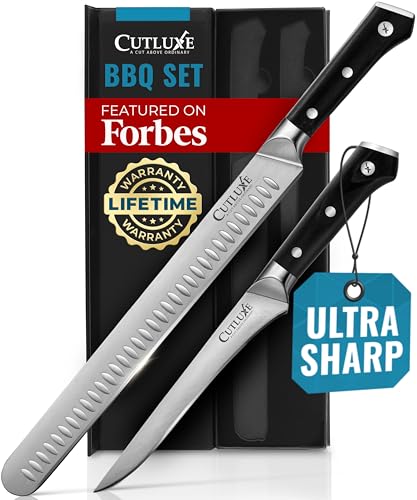
This two-piece Cutluxe set pairs a 12-inch brisket slicer with a 6-inch curved boning knife. That combination addresses two separate moments in meat preparation. The long blade portions cooked brisket, turkey, or roast, while the smaller blade is intended for separating meat from bone and trimming around contours. For a home cook who buys large cuts rather than pre-trimmed portions, the pairing is more useful than two similar carving blades.
Both knives are described as having Granton edges, full-tang construction, ergonomic handles, and high-carbon German steel. The slicer remains the central tool for this roundup, but the boning knife changes the ownership proposition by covering prep before the roast reaches the board. A weekend barbecue may begin with trimming and finish with thin slices. Having two distinct blade shapes can keep those jobs from becoming an awkward exercise with one oversized knife.
Pros
- Includes a dedicated 12-inch slicer and 6-inch boning knife.
- Granton edges are listed on both blades.
- Full-tang construction supports a consistent build across the set.
- Useful for trimming, deboning, and slicing meat.
- Lifetime warranty is listed for the German-steel knives.
Cons
- The set is less useful for shoppers who only need a carving knife.
- No storage block or detailed blade guard is listed in the supplied information.
This is a sensible choice for someone moving from supermarket cuts to larger roasts, ribs, or brisket. The 6-inch boning knife offers practical coverage without the extra breaking blade found in larger butcher sets. A buyer who already owns a good boning knife may get better value from a standalone slicer, but new meat-preparation cooks gain a more complete starting point here.
To buy this product, click here.
5. MAIRICO 11-Inch Brisket Slicing Knife | Best for Easy Maintenance

MAIRICO shortens the standard slicing format slightly with an 11-inch blade. That difference is modest, yet it can matter for cooks who work on medium-size boards or want a little less blade extending past a roast. The stainless steel blade has a listed Granton edge and is intended for brisket, ham, turkey, prime rib, pork loin, smoked salmon, and large fruits.
The product information gives unusually practical care guidance for this group. It describes the blade as easy to hone and recommends light alternating passes on a honing rod to help realign the working edge. It also states that the knife can withstand dishwasher cleaning, while recommending hand washing and prompt drying for the best edge life and appearance. That distinction is useful: dishwasher compatibility does not make machine washing the best routine for a sharp kitchen blade.
Pros
- 11-inch length offers a slightly more compact alternative to 12-inch slicers.
- Granton edge is intended to reduce tearing and sticking.
- Full-tang design and triple-riveted handle support steady control.
- Supplied care information discusses honing and hand washing.
- Lifetime warranty against material and workmanship defects is listed.
Cons
- The shorter blade provides less coverage across very large briskets.
- Stainless steel is described generally without a specific alloy designation.
MAIRICO suits a buyer who wants a dedicated meat slicer but prefers uncomplicated care instructions and a slightly shorter blade. It is also a reasonable fit for mixed household use, where the knife may appear for holiday turkey one week and ham or roast another. Pitmasters regularly portioning oversized cuts may prefer the reach of a 12-inch model.
To buy this product, click here.
6. Victorinox Fibrox 12-Inch Straight Edge Slicing Knife | Best Straight-Edge Option

This Victorinox uses a straight edge rather than the Granton pattern found on the Fibrox Pro above. That gives it a simpler blade surface for shoppers who prefer a conventional slicer and do not need the listed air-pocket design. The 12-inch length remains well suited to large roasts, turkey, ham, and brisket, where a long stroke can create more even portions than repeated short cuts.
The textured black handle is built around secure handling, including in wet conditions, while the Swiss-made construction and lifetime guarantee support long-term ownership. A straight-edge slicer can also be easier to understand for a household that already owns a honing or sharpening routine for plain blades. It does not include the friction-reducing Granton features of some rivals, so food release and blade contact will depend more on the knife’s edge and the user’s slicing motion.
Pros
- 12-inch straight edge suits large roasts and long slicing strokes.
- Textured handle is intended to remain secure when wet.
- Simple blade surface works for buyers who prefer a conventional slicer.
- Victorinox describes the knife as balanced and easy to handle.
- Lifetime guarantee against material and workmanship defects is listed.
Cons
- Straight edge lacks the listed food-release feature of a Granton blade.
- The supplied information does not identify a specific stainless-steel alloy.
Select this version if a traditional straight edge is more appealing than a dimpled blade. It is a particularly sensible match for buyers who already maintain plain-edge knives and want consistent handling across their collection. If moist brisket or roast beef tends to cling to your slicer, a Granton model may be a more suitable direction.
To buy this product, click here.
7. Cutluxe Butcher Knife Set | Best for Full Barbecue Preparation
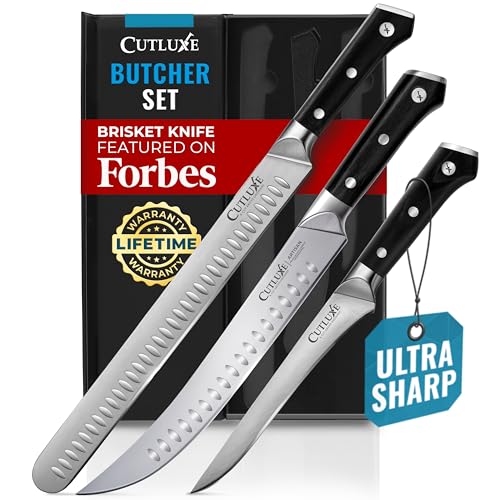
The three-piece Cutluxe set expands beyond slicing with a 12-inch brisket knife, a 10-inch breaking cimeter, and a 6-inch boning knife. Each blade has a distinct role. The slicer portions cooked meat, the cimeter is aimed at breaking down larger cuts, and the boning knife handles trimming and separation around bones. That division makes this set relevant to serious barbecue preparation rather than casual holiday carving alone.
High-carbon German steel, full-tang construction, and pakkawood handles are listed across the collection. The handles create a consistent visual and structural theme, while the assortment reduces the temptation to use a long slicer for jobs better handled by a narrower or curved blade. A three-knife collection also takes more storage space than a single slicer, and the supplied information does not list a block or wall rack, so buyers should plan a safe storage location.
Pros
- Includes slicing, breaking, and boning blades for separate meat tasks.
- 12-inch slicer directly suits brisket and roast portioning.
- 10-inch cimeter adds capability for larger raw cuts.
- Full-tang handles and high-carbon German steel are listed.
- Pakkawood handles provide a consistent grip style across the set.
Cons
- Three long or specialized knives require more storage space than a single slicer.
- The set may exceed the needs of cooks who buy trimmed, ready-to-cook meat.
This set is aimed at the person whose cutting board sees whole briskets, primals, ribs, and other substantial cuts. It offers the clearest workflow of the reviewed sets, although it makes less sense for a household that only carves cooked turkey twice a year. Plan storage before buying, especially for the 10-inch breaking blade and 12-inch slicer.
To buy this product, click here.
8. HOSHANHO Carving Knife Set, 3-Piece | Best for Multiple Meat-Cutting Tasks

HOSHANHO’s three-piece set includes a 12-inch carving knife, a 10-inch brisket knife, and a 7-inch fillet knife. The assortment is broader than a basic slicer and reflects a buyer who wants tools for carving, brisket work, and narrower preparation. The listing describes 10Cr15CoMoV Japanese high-carbon steel and a 15-degree edge for the carving knife, with hand-ground blades across the set.
Curved pakkawood handles are described as fitting the fingers and helping with extended cutting sessions. That is a design intention, not a universal comfort guarantee, since hand size and grip habits vary. The set also comes in gift-oriented packaging, which may appeal to someone assembling a barbecue station for a family member. Its main question is practical: will all three blades see regular use, or will the long carving knife do nearly every job?
Pros
- Three blade sizes cover carving, brisket slicing, and narrower preparation.
- 10Cr15CoMoV Japanese high-carbon steel is specifically listed.
- 15-degree edge information is supplied for the carving knife.
- Pakkawood handles offer a consistent design across the set.
- Gift box and multiple meat-focused blades suit a dedicated barbecue setup.
Cons
- The three-piece configuration takes more storage space than a standalone slicer.
- The listing does not provide detailed flexibility information for the 7-inch fillet knife.
This set works best for buyers who want variety and appreciate Japanese-style steel and handle design. It is less compelling for someone who needs one predictable blade for slicing cooked roasts. Before choosing it, check whether the 10-inch and 12-inch knives duplicate tools already in your collection.
To buy this product, click here.
9. SYOKAMI Brisket Slicing Knife, 12-Inch | Best Decorative Japanese-Style Option

SYOKAMI combines a 12-inch meat-slicing format with a wood full-tang handle and a Damascus-style pattern. The listing describes a high-carbon steel blade with a stated hardness of 56 or higher and double hollow dimples intended to reduce sticking. The pattern adds visual appeal, but the supplied information does not identify a layered construction or core steel, so appearance should be treated separately from documented cutting properties.
The handle includes a triple-rivet structure and a textured gear-like area intended to support grip, while the long narrow blade is also presented for ham, large fruits, bread, and layer cakes. Those extra applications reflect the knife’s reach, yet the blade remains specialized for long slicing motions rather than general chopping. It could make a handsome gift for someone who enjoys barbecue tools with a more styled presentation, provided they have safe storage for a long exposed blade.
Pros
- 12-inch blade suits brisket, ham, and other large slicing tasks.
- Hollow dimples are intended to reduce food contact and sticking.
- Full-tang wood handle uses triple rivets for structural support.
- Stated 56 or higher Rockwell hardness provides a documented reference point.
- Handle styling and gift packaging give it a distinctive presentation.
Cons
- The Damascus-style appearance is not accompanied by a documented layered construction.
- Long-blade storage and hand washing require planning.
SYOKAMI is a reasonable pick for buyers who want a visually distinctive slicer with a long blade and listed full-tang construction. It should not be selected solely for the patterned finish, since the available data does not establish that the pattern improves cutting. Shoppers who prioritize a specific steel designation or a matched meat-preparation set have clearer alternatives elsewhere in this ranking.
To buy this product, click here.
Buying Guide
Match Blade Length to the Food You Slice
A slicing knife should span enough of the food to make a controlled pass without forcing the user to saw repeatedly. The reviewed choices range from 11 to 12 inches, so the difference is small but meaningful. A 12-inch blade gives more coverage across brisket, turkey breast, and large roasts. An 11-inch knife may be easier to manage on a smaller board or with a modest-sized roast.
For cooked meat, profile and stroke length matter more than the label alone. The slicing-versus-carving explanation separates their overlapping roles.
Measure the usable space on your cutting board, including room for your guiding hand and the handle. A long blade can be helpful at a barbecue station with a broad board, while the same blade can feel awkward near a cramped countertop or shallow sink.
Choose Between Granton and Straight Edges
Granton-style blades have recessed areas along the edge. Product listings commonly describe these hollows as reducing friction or creating air pockets between the blade and moist food. That can be useful for roast beef, ham, and brisket, though it does not remove the need for a sharp, properly maintained edge.
A straight edge offers a simpler surface and may suit shoppers who already use conventional honing and sharpening tools. Neither design makes a slicer universally superior. Think about the foods you prepare most often and whether slices tend to cling to your current knife.
Read Steel Claims Carefully
The products here use broad material descriptions such as high-carbon German steel, high-carbon stainless steel, stainless steel, and the more specific 10Cr15CoMoV designation. A specific alloy label tells you more than a regional marketing phrase, but it still does not establish actual edge retention or toughness without further evidence.
Some listings provide a Rockwell hardness figure or an edge angle. Those details can help with maintenance decisions, yet hardness, wear resistance, toughness, corrosion resistance, and sharpening ease are separate characteristics. Keep the blade clean and dry, and follow the care guidance associated with the exact knife.
Evaluate the Handle for Wet Meat Preparation
Carving often happens near juices, grease, and damp towels, so handle security deserves attention. Fibrox, pakkawood, and wood handles appear across this selection. Texturing and shaping may support grip, but comfort depends on hand size, grip style, and the amount of time spent cutting.
Full-tang construction means the blade steel extends through the handle, according to the supplied product descriptions. It can support a sturdy build, but it does not automatically determine balance or comfort. Look for a handle that leaves enough finger clearance and feels manageable with the blade length you choose.
Decide Whether You Need a Set
A standalone slicer is enough for cooked roasts and brisket portioning. A two-piece set adds a boning knife for trimming around bones. A three-piece butcher set adds a breaking or secondary brisket blade for people who work with larger raw cuts.
Sets can be useful, but count the actual jobs each knife will perform. A household that buys trimmed meat may rarely use a cimeter or fillet-style blade. Also plan storage, since 10-inch and 12-inch knives need more room than ordinary kitchen knives.
Plan Cleaning and Storage
Long slicing knives should be washed according to the product guidance, dried promptly, and stored so the edge cannot contact loose utensils. MAIRICO specifically describes dishwasher compatibility while recommending hand washing for the best edge life and finish. That is a useful reminder that a knife’s ability to tolerate a dishwasher does not make it the preferred care method.
A sheath can simplify storage, as shown by the Cutluxe standalone knife. For products without a listed sheath or block, use a suitable knife drawer insert, rack, or other protective arrangement that fits the blade. Never leave a long sharp blade loose in a crowded drawer.
Best Slicing Knife FAQ
What blade length is best for brisket?
A 12-inch blade is a practical choice for large briskets because it covers more of the cut in a single slicing motion. An 11-inch model can work well for smaller briskets, roasts, and kitchens with less board space. The best length is the one you can control without the tip or heel crowding nearby objects.
Is a Granton blade better for slicing meat?
A Granton blade may reduce contact between the blade and moist food through its recessed areas. That can help slices separate from the blade during brisket, ham, or roast preparation. It does not guarantee better results, since edge condition, blade control, and cutting direction still matter.
Can a slicing knife replace a boning knife?
No. A slicing knife has a long blade intended for portioning cooked or prepared food. A boning knife is shorter and shaped for working around bones and contours. A set such as the Cutluxe two-piece option can cover both jobs more appropriately than forcing one blade to do everything.
Are Japanese-style slicing knives made in Japan?
Not automatically. “Japanese-style” can describe the design language, edge presentation, or steel description without establishing manufacturing origin. The supplied product information identifies Japanese-style characteristics for several knives but does not establish that every such product was manufactured in Japan.
Should a slicing knife be sharpened at a specific angle?
Use the angle supplied for the exact knife when one is provided. Cutluxe lists 14 to 16 degrees per side, while HOSHANHO lists a 15-degree edge for its carving knife. Those figures should not be transferred to every slicer, and per-side angles should not be confused with a total inclusive angle.
Can these knives go in a dishwasher?
Care instructions vary by product. MAIRICO’s listing describes dishwasher compatibility but recommends hand washing and prompt drying for the best edge life and appearance. The other supplied descriptions do not establish universal dishwasher suitability, so hand washing and immediate drying are the safer default unless the exact product guidance says otherwise.
Do I need a 12-inch slicer for turkey?
A 12-inch slicer is useful for a large turkey breast or whole roast, but it is not mandatory. An 11-inch blade can be easier to handle for smaller birds and tighter boards. Choose based on the size of the foods you prepare and the space available for a long slicing stroke.
Final Verdict
The Cutluxe 12-inch Brisket Knife is the strongest overall choice in this group because it combines the core features most relevant to meat slicing: useful length, a Granton edge, full-tang construction, a stated edge angle, a pakkawood handle, and a sheath. It is a focused tool for brisket, turkey, roast, and similar foods rather than a general-purpose kitchen knife, which is exactly why it ranks first here.
Victorinox offers a more utilitarian route, with the Fibrox Pro providing a 12-inch Granton blade and a textured handle, while MAIRICO is appealing for its slightly shorter blade and clearly described honing guidance. Buyers who trim and break down raw meat should step up to the Cutluxe two-piece or three-piece sets instead of paying for unused variety in a standalone knife. Match the blade length to your board, choose Granton or straight edge according to your food-preparation habits, and plan safe storage before bringing any long slicing knife home.
