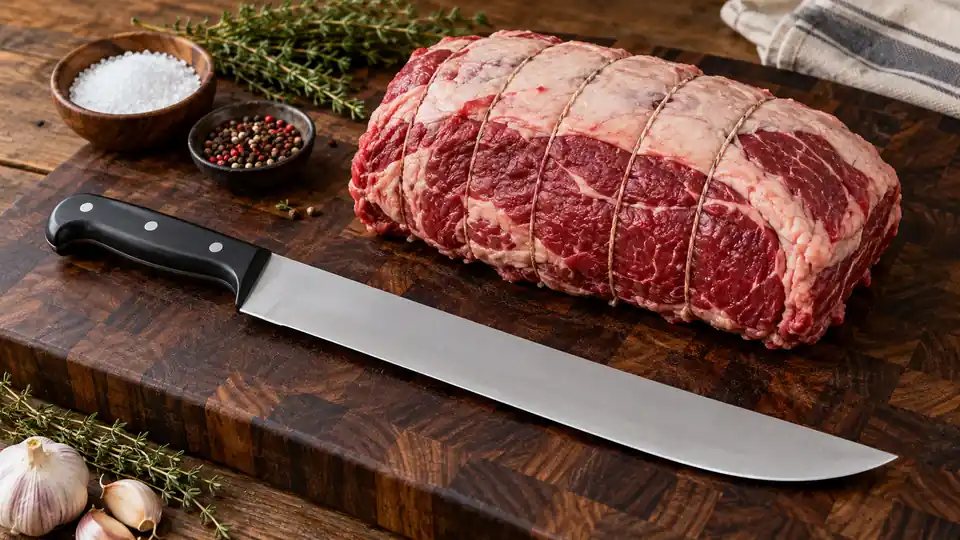
A butcher knife needs a different shape from an everyday chef’s knife. Breaking down brisket, trimming fat, separating meat around joints, and portioning large roasts call for a long or curved blade that can maintain contact with the cut. A short, narrow boning knife may be more precise around bones, while a broad cleaver is better suited to controlled chopping. The right choice depends on the work you actually do, rather than on blade size alone.
Common buying mistakes include choosing a long slicer for tasks that require a flexible tip, treating every “Japanese-style” blade as equivalent, or assuming a heavier knife will automatically offer better control. Steel descriptions also need careful reading. Several products here list high-carbon German or Japanese steel without naming a specific alloy, so their maintenance and sharpening characteristics cannot be compared as precisely as knives with a documented steel designation. Handle material, grip security, cleaning instructions, and the difference between a breaking knife and a cleaver matter just as much.
This selection covers individual cimeter and bullnose knives, long brisket blades, compact breaking knives, and sets that add boning or fillet tools. The Cutluxe 10-inch cimeter earns the strongest overall position because its curved profile, full-tang build, listed edge angle, and focused meat-preparation design suit a broad range of butcher work. Other choices make more sense for a complete BBQ kit, field processing, large briskets, or easier cleanup.
Quick Answer
- Cutluxe BBQ Butcher Knife — Best Overall: A 10-inch curved cimeter with a Granton edge, full tang, Pakkawood handle, and listed 14 to 16 degree-per-side edge. It is the most balanced individual knife here for breaking down, trimming, and slicing meat.
- Cutluxe Butcher Knife Set — Best Three-Knife BBQ Set: The 12-inch brisket knife, 10-inch breaking knife, and 6-inch boning knife cover the core stages of large-cut preparation without adding unrelated kitchen blades.
- Victorinox Fibrox 8-Inch Curved Breaking Knife — Best for Easy Cleanup: Its shorter curved blade, non-slip Fibrox handle, dishwasher-safe listing, and NSF approval make it a practical choice for routine meat preparation and commercial-style kitchen work.
Best Butcher Knife Comparison Table
| Product | Best For | Blade or Set | Construction |
|---|---|---|---|
| Cutluxe BBQ Butcher Knife | Overall meat preparation | 10-inch cimeter | German steel, full tang |
| Cutluxe Butcher Knife Set | Core BBQ tasks | 12-inch, 10-inch, and 6-inch knives | German steel, Pakkawood handles |
| SYOKAMI Butcher Breaking Knife | Controlled trimming and portioning | 10.5-inch curved blade | Japanese-style, full tang |
| Cutluxe Four-Piece Butcher Set | Meat and fish preparation | 12-inch, 10-inch, 7-inch, and 6-inch knives | German steel, Pakkawood handles |
| HOSHANHO Carving Slicing Knife | Large roasts and brisket | 12-inch curved blade | Japanese high-carbon steel |
| Cutluxe Bullnose Carving Knife | Long, controlled BBQ cuts | 10-inch bullnose blade | German steel, full tang |
| Victorinox Fibrox Breaking Knife | Routine breaking work | 8-inch curved blade | Stamped stainless steel |
| Victorinox Fibrox Granton Edge Knife | Larger butchering jobs | 10-inch straight edge | Stamped high-carbon stainless steel |
| SYOKAMI Butcher Knife Set | Mixed meat preparation | Cleaver, breaking, and boning knives | Japanese-style, full tang |
The detailed reviews below focus on blade shape, intended use, construction, handle design, and the trade-offs that separate an individual butcher knife from a multi-blade set.
1. Cutluxe BBQ Butcher Knife, 10-Inch Cimeter Breaking Knife — Best Overall

A cimeter earns its place on a butcher’s board through its curved cutting line. Rather than behaving like a straight carving knife, the Cutluxe 10-inch model gives the user a profile suited to breaking down, trimming, cutting, and skinning meat. That curve can help maintain contact through a long cut, while the Granton-style edge is listed as a way to reduce sticking as slices separate from the blade. The 10-inch length sits in a useful middle ground for brisket, roasts, and larger portions without reaching the extra-long format of a dedicated 12-inch slicer.
The construction is equally relevant. The product information lists high-carbon German steel, a 56+ Rockwell hardness rating, a full tang, and a triple-riveted Pakkawood handle. The listed edge is 14 to 16 degrees per side, which gives shoppers a documented sharpening reference, although it does not by itself prove edge retention or cutting performance. The handle is laminated and polished, and the listing includes a lifetime warranty against material or workmanship defects. For a home cook who wants one focused meat knife beside the grill, this combination is more coherent than a broad kitchen cleaver.
Pros
- Curved 10-inch cimeter profile suits breaking down, trimming, and slicing meat.
- Granton-style edge is listed to help reduce food contact with the blade.
- Full-tang construction and triple rivets support a secure handle-to-blade connection.
- Pakkawood handle provides a polished composite-style grip surface.
- Published specifications include a 14 to 16 degree-per-side edge and 56+ Rockwell hardness.
Cons
- The supplied information does not identify the exact German steel alloy.
- A curved breaking knife is less suitable than a cleaver for chopping through substantial bone.
This is the strongest single-knife match for shoppers who trim brisket, break down roasts, or prepare large cuts regularly. Its profile remains specialized, so a person seeking one knife for vegetables, herbs, and general prep would need a different blade shape. Hand washing and thorough drying are sensible habits for a knife with a Pakkawood handle, regardless of the listing’s rust and stain resistance claim. Buyers who want a focused butcher tool with a conventional full-tang format have a clear reason to choose it over a broad cleaver.
To buy this product, click here.
2. Cutluxe Butcher Knife Set, Brisket, Breaking and Boning Knives — Best Three-Knife BBQ Set
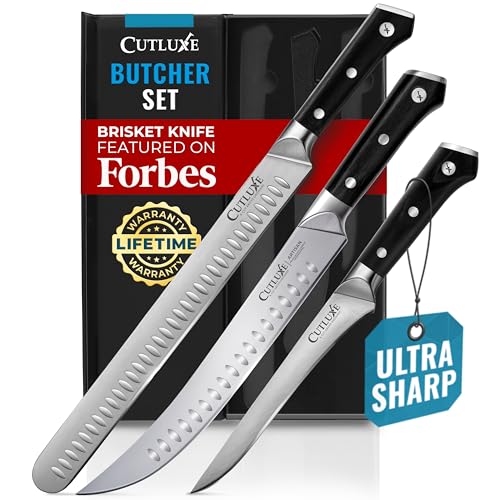
A whole brisket session often involves several distinct motions. A long slicing blade portions the cooked or trimmed cut, a curved breaking knife handles larger sections, and a shorter boning knife works closer to joints and connective tissue. This Cutluxe set reflects that workflow with a 12-inch brisket knife, 10-inch breaking cimeter, and 6-inch boning knife. The pieces are meaningfully different rather than three similar blades with small size changes.
All three knives are described as using high-carbon German steel and full-tang construction with Pakkawood handles. That consistency can be useful for a pitmaster who wants a similar grip style across the set, while the blade lengths give each tool a defined job. The set does not include a fillet knife, cleaver, or storage roll in the supplied information, so it is focused on brisket and meat preparation rather than broad game processing. It also requires more cleaning and storage space than a single cimeter.
Pros
- Includes dedicated 12-inch brisket, 10-inch breaking, and 6-inch boning knives.
- Blade selection covers long slicing, general breaking, and close bone work.
- High-carbon German steel is listed across the three knives.
- Full-tang construction is paired with matching Pakkawood handles.
- More task-specific than a single all-purpose butcher knife.
Cons
- Its 12-inch blade needs a long, clear cutting surface and suitable storage.
- The supplied information does not list a knife roll, block, or sharpening accessory.
This set suits buyers who already know they will use several blade shapes during BBQ preparation. A person who trims one roast a few times a year may find one cimeter easier to store and maintain. The set’s main advantage is workflow separation: the boning knife can stay close to detailed work while the long blade remains reserved for broad slices. It is a stronger purchase than a single knife for dedicated brisket preparation, while a field processor may prefer a kit that includes skinning tools.
To buy this product, click here.
3. SYOKAMI Butcher Breaking Knife for Meat Cutting, 10.5-Inch — Best Japanese-Style Breaking Design

This SYOKAMI blade takes a more decorative route without losing sight of its stated butcher role. The 10.5-inch curved cimeter is intended for beef, pork, poultry, cartilage, and fat trimming, while the tapered tip is described as useful around bones and joints. A small measuring-hole feature is listed for judging steak thickness, which may appeal to someone portioning steaks for more uniform cooking. It is a practical detail, though it does not replace a cutting board, ruler, or consistent technique for every cut.
The knife uses a wooden full-tang handle with triple rivets, gear-tooth grip details, and an anti-fatigue curvature according to the supplied product information. The blade is described as having a Damascus pattern and a 56+ Rockwell hardness rating. The pattern should be treated as an appearance feature unless the blade’s layer construction or core steel is documented. The listing also identifies FSC-certified wood for the handle. That combination gives the knife a gift-ready presentation, while the wood handle calls for attentive cleaning and drying rather than casual soaking.
Pros
- 10.5-inch curved profile is suited to meat breaking and trimming.
- Tapered tip offers more control for work near joints and bones.
- Full-tang, triple-riveted construction supports a durable handle connection.
- Listed thickness guide may help with more consistent steak portions.
- Wood handle and gift box provide a distinctive presentation.
Cons
- The supplied information does not identify the steel behind the Damascus-style pattern.
- Wood handle care is less casual than a fully synthetic handle.
This is a sensible pick for a buyer who wants a curved breaking knife with a Japanese-style visual treatment and extra attention to portioning. It is less compelling for someone who prefers a plain commercial handle or needs a knife that can be placed in a dishwasher. The pointed tip expands its trimming usefulness, but the knife remains a meat tool rather than a substitute for a separate boning knife. Choose it for the combination of curved cutting geometry, wood construction, and presentation rather than assuming the patterned surface proves superior metallurgy.
To buy this product, click here.
4. Cutluxe Four-Piece Butcher Knife Set with Brisket, Breaking, Boning and Fillet Knives — Best for Meat and Fish Preparation

Adding a fillet knife changes the purpose of a butcher set. This four-piece Cutluxe collection includes a 12-inch brisket knife, 10-inch breaking knife, 6-inch boning knife, and 7-inch fillet knife. That lineup reaches beyond BBQ brisket and into fish preparation, so it fits a household that alternates between large meat cuts and seafood. Each blade has a distinct length and task, which avoids some of the redundancy found in oversized knife bundles.
The available details describe high-carbon German steel, full tangs, and Pakkawood handles across the set. The consistent handle material may simplify grip expectations, but each blade still calls for a different motion. The long brisket and breaking knives need room for broad slices, while the fillet knife is intended for more controlled movement around fish. The data does not list flexibility for the fillet knife, so buyers should avoid assuming that it has the degree of flex required for every fish species or preparation style.
Pros
- Four distinct knives cover brisket slicing, breaking, boning, and fish filleting.
- 12-inch and 10-inch blades address large meat cuts without relying on one oversized knife.
- Includes a dedicated 7-inch fillet knife rather than treating a boning knife as its replacement.
- Full-tang construction and Pakkawood handles are listed throughout the set.
- Useful for households that prepare both meat and fish.
Cons
- The supplied information does not specify the fillet knife’s flexibility.
- Four specialized blades require more storage and maintenance than an individual butcher knife.
This set is a strong fit for a home cook with a varied preparation routine, particularly one who fishes or regularly buys whole fish alongside roasts. A brisket-only buyer can avoid paying for a fillet blade they may rarely touch by choosing the three-piece set above. The absence of a stated flex rating matters for fish work, so shoppers with precise filleting requirements should verify that detail before purchase. Its strength is breadth within meat and fish preparation, not general kitchen versatility.
To buy this product, click here.
5. HOSHANHO 12-Inch Carving Slicing Knife — Best for Large Briskets and Roasts

A 12-inch curved blade is aimed at the moment when a short knife starts to feel cramped across a brisket or roast. The HOSHANHO carving knife is described for brisket trimming, meat cutting, turkey, ham, and other large foods. Its length can help produce longer passes through broad cuts, which is useful when the goal is to keep slices consistent rather than repeatedly stopping halfway through the roast.
The supplied information lists Japanese high-carbon steel, a hand-sharpened 15-degree edge, and an ergonomic non-slip handle. “Japanese high-carbon steel” is a general material description rather than a named alloy, so it does not establish a precise sharpening or corrosion profile. The tightly joined blade and handle are described as easier to rinse and wipe dry. That simple maintenance approach may appeal after a messy BBQ session, while the long blade still needs a sufficiently large board and careful storage.
Pros
- 12-inch curved blade suits broad briskets, roasts, turkey, and ham.
- Listed 15-degree edge provides a clear published edge reference.
- High-carbon steel construction is paired with a non-slip handle.
- Long profile supports extended slicing passes across large food.
- Tight blade-to-handle connection is described as easier to clean.
Cons
- The long blade can be awkward on compact cutting boards or in crowded prep areas.
- The supplied information does not name the exact Japanese steel alloy.
Pick this knife if large roasts are the center of your preparation and a single long blade matters more than a set of specialized tools. It is less practical for small portions, tight bone work, or kitchens with limited storage. The 12-inch reach gives it a clear role beside the shorter Victorinox and Cutluxe breaking knives, but length should be matched to the board and food size. Its appeal comes from broad-slice coverage and a stated edge angle, not from an assumption that Japanese steel is universally superior.
To buy this product, click here.
6. Cutluxe 10-Inch Bullnose Carving Knife — Best for Controlled Long Cuts

The bullnose profile gives this Cutluxe knife a different feel from a pointed breaking blade. Its bulbous tip extends the usable cutting edge, while added front weight is listed to provide more power and control during large cuts. That shape is aimed at brisket, BBQ portions, trimming, and skinning, where a broad continuous edge can be more useful than a sharp point. The 10-inch length keeps it shorter than the HOSHANHO 12-inch model, making it easier to manage on a typical home cutting board.
Construction follows the brand’s other individual butcher knife in this group. The listing describes high-carbon German steel at 56+ Rockwell hardness, a 14 to 16 degree-per-side edge, full tang, triple rivets, and a laminated Pakkawood handle. These are useful documented details, but the steel alloy remains unspecified. The front-weighted design may appeal to shoppers who prefer the blade to contribute more of the cutting force, while people who favor a light, nimble tip may find the bullnose less versatile around joints.
Pros
- Bulbous bullnose tip provides a longer continuous cutting edge.
- Added front weight is intended for control during larger cuts.
- 10-inch length balances brisket reach with manageable board clearance.
- Full tang, triple rivets, and Pakkawood handle support a substantial build.
- Published edge specification is 14 to 16 degrees per side.
Cons
- Bulbous tip offers less pointed access for detailed work near bones.
- The exact German steel alloy is not supplied.
This is the better match for a buyer who likes a weighted front section and expects to make long, clean BBQ cuts. A person who frequently separates meat from joints may prefer the pointed taper of a cimeter or a dedicated boning knife. The bullnose design gives it a clear identity, so it is more than a duplicate of an ordinary carving knife. Select it for broad cutting contact and front-end weight, then maintain the edge with a method compatible with its double-bevel geometry.
To buy this product, click here.
7. Victorinox Fibrox 8-Inch Curved Breaking Knife — Best for Easy Cleanup

Shorter butcher knives have a practical advantage in compact kitchens. This Victorinox uses an 8-inch curved blade for breaking meat into smaller roasts and pieces, so it should be easier to position on a standard board than the 10-inch and 12-inch options. The product information also describes added blade weight to support uniform slicing and help prevent tearing. That makes the knife relevant to routine household preparation, where the user may move between smaller cuts instead of processing an entire side of meat.
The handle is textured Fibrox with a non-slip design intended to remain secure when wet. The listing identifies a Swiss-made stamped stainless steel blade, NSF approval, and dishwasher-safe construction. Those details separate it from the wood-handled options, although hand washing can still be preferable for preserving edge condition over time. Victorinox also lists compatible sharpeners separately, meaning the purchase does not include a sharpening tool in the supplied information.
Pros
- 8-inch curved blade is manageable for smaller roasts and home cutting boards.
- Textured Fibrox handle is listed as slip-resistant when wet.
- Stamped stainless steel construction keeps the knife relatively lightweight.
- Dishwasher-safe and NSF-approved according to the supplied product information.
- Curved breaking profile suits portioning meat into smaller roasts.
Cons
- Shorter reach is less suitable for very large briskets or wide roasts.
- Compatible sharpeners are listed separately rather than included.
This is a practical option for cooks who value simple cleanup, a shorter working length, and a synthetic grip. It lacks the extended reach of a 12-inch brisket knife and the multi-tool coverage of the sets, but that restraint is useful in a home kitchen. The curved profile keeps it relevant to real butcher work, while the handle and cleaning details make it less demanding than wood-handled alternatives. Choose it for everyday meat preparation rather than for the largest cuts or elaborate BBQ workflows.
To buy this product, click here.
8. Victorinox Fibrox 10-Inch Granton Edge Butcher Knife — Best for Larger Butchering Jobs

This Victorinox takes a straighter approach than the curved breaking knives above. Its 10-inch blade is described as hollow-ground with a straight edge, a built-in finger guard, and enough heft for larger pieces of meat. The Granton-style feature is intended to help with slicing, while the straight profile may suit a buyer who prefers a more direct push-and-pull motion across a cutting board. It is still a specialized butcher knife, not a general-purpose chef’s knife.
The blade uses stamped high-carbon stainless steel, and the Fibrox Pro handle is listed as non-slip even when wet. Victorinox describes the blade as conical ground and ice tempered, but the supplied information does not provide a named alloy or a measured hardness value. The knife meets NSF standards according to the listing and carries a lifetime guarantee against material and workmanship defects. Buyers who want a recognizable, washable commercial-style handle may prefer this construction over polished wood.
Pros
- 10-inch straight edge provides reach for larger pieces of meat.
- Granton-style blade feature is suited to slicing work.
- Built-in finger guard adds a defined hand-position feature.
- Fibrox Pro handle is listed as non-slip when wet.
- NSF certification and a lifetime material-and-workmanship guarantee are listed.
Cons
- Straight profile is less specialized for curved breaking motions than a cimeter.
- The supplied information does not identify the stainless steel alloy.
This knife makes sense for a buyer who wants a longer straight butcher blade with a commercial-style synthetic handle. A person who prefers a curved motion for separating meat may find the Cutluxe cimeter or Victorinox 8-inch breaking knife more natural for the intended task. Its finger guard, 10-inch reach, and Granton feature give it a distinct role among the individual knives. It is a straightforward choice for larger meat preparation without the extra blades and storage demands of a set.
To buy this product, click here.
9. SYOKAMI Butcher Knife Set with Cleaver, Breaking and Boning Knives — Best Mixed-Cutting Set

This SYOKAMI set takes a broader approach to butcher preparation by combining a cleaver, breaking knife, and boning knife. That trio separates heavy chopping, broad meat cutting, and close work around bones. The breaking knife is described as curved for beef, pork, and poultry, while the boning knife is listed with 20 degrees of flexibility. The cleaver adds a different cutting action, so the set can appeal to someone who processes mixed cuts rather than focusing exclusively on brisket slicing.
The handles use Wenge wood with gear-tooth grip details, and the knives are described as full tang with triple-riveted construction. The breaking knife information includes a 56+ Rockwell hardness claim, but the supplied details do not establish that every blade in the set shares the same hardness or steel characteristics. The product is described as Japanese style and high-carbon steel, without a named alloy or manufacturing-origin claim. Wood handles require sensible washing and drying, particularly after handling wet or fatty foods.
Pros
- Combines cleaver, breaking, and boning functions in one set.
- Curved breaking knife addresses meat slicing and fat trimming.
- Boning knife is listed with 20 degrees of flexibility.
- Wenge wood handles, full tangs, and triple rivets provide a consistent construction theme.
- Offers a wider range of meat-preparation motions than a single butcher knife.
Cons
- The supplied information does not provide separate steel details for every included blade.
- Wood handles and multiple blades require more careful cleaning and storage.
This set suits a buyer who wants a cleaver alongside specialized meat knives and has room to store several tools. It is less focused than the three-piece Cutluxe BBQ set for brisket alone, and the cleaver should not be treated as interchangeable with a thin slicing or boning blade. The value here is task separation: one knife can handle heavier chopping while another stays dedicated to breaking and a third works near bone. Choose it for breadth across meat preparation, not for the lightest or simplest setup.
To buy this product, click here.
Buying Guide
Match the Blade Profile to the Job
A cimeter or curved breaking knife is built around a sweeping cutting line, which suits separating meat, trimming fat, and working through larger sections. A straight 10-inch blade offers a different motion and may appeal to people who prefer a direct slicing path. A bullnose knife places more emphasis on a rounded front section and continuous edge contact, while a cleaver is a separate category intended for controlled chopping. Decide whether your regular task sounds like “slice across a brisket,” “work around a joint,” or “chop through a poultry section.” The answer points toward different geometry.
Choose Length by Food Size and Board Space
Long blades cover more of a brisket or roast in one pass, but a 12-inch knife needs a board with enough clearance at both ends. A 10-inch blade is often a more flexible middle ground for home BBQ preparation. An 8-inch breaking knife can be easier to control around smaller roasts and on compact boards. Length does not establish quality by itself. It changes leverage, storage, and the amount of blade that must be guided during a cut.
Separate Breaking, Boning, Filleting, and Chopping
A breaking knife is designed for larger meat sections, while a boning knife narrows the working area around joints and bones. A fillet knife is intended for fish, but its flexibility is not interchangeable with the stiffness or shape of every boning blade. A cleaver uses a broader blade and a different cutting action. Sets are worthwhile when these tasks occur in the same kitchen. If the routine is limited to trimming and slicing brisket, an individual cimeter may avoid unused pieces.
Read Steel Claims Carefully
The products in this group use broad descriptions such as high-carbon German steel, Japanese high-carbon steel, or high-carbon stainless steel. Those phrases do not identify a precise alloy. The Cutluxe and SYOKAMI listings provide hardness figures for certain knives, but a hardness number alone does not establish edge retention, toughness, or sharpening ease. Geometry, heat treatment, edge preparation, and use all affect ownership. Stainless steel can simplify corrosion management, but it still benefits from prompt cleaning and drying.
Assess Handle Material and Cleaning
Pakkawood, Wenge, walnut, Fibrox, and stainless steel handles create different maintenance expectations. The wooden and composite wood-style handles in this roundup should be kept clean and dry rather than left soaking. Fibrox handles offer a synthetic, textured grip and are listed on the Victorinox 8-inch model as dishwasher-safe. Dishwasher compatibility is product-specific, so do not transfer that detail to every knife here. A wet-meat workflow also makes grip shape and surface texture relevant, but no handle can replace careful knife control.
Plan Sharpening and Storage Before Buying
None of these products should be treated as maintenance-free. The published edge angles on some knives can help guide sharpening, but they do not mean every sharpener is automatically compatible. A 10-inch or 12-inch blade also needs a secure storage location that protects the edge and keeps the knife away from loose utensils. The Cutluxe three-piece set does not list a roll or block in the supplied information, while individual knives may be easier to store in a sheath or dedicated knife area. A sensible storage plan prevents a large butcher knife from becoming a hazard in a crowded drawer.
Best Butcher Knife FAQ
What type of knife is best for breaking down meat?
A curved breaking knife or cimeter is usually the most directly matched type for separating larger meat sections, trimming fat, and working through irregular cuts. The curved profile differs from a straight carving knife and from a cleaver. The best length depends on the size of the food and the available cutting surface. A 10-inch cimeter is a versatile middle choice, while an 8-inch blade may be easier to manage for smaller roasts.
A broad butchery blade does different work from a narrow trimming knife. The brisket-trimming method helps distinguish controlled fat removal from larger portioning cuts.
Is a butcher knife the same as a meat cleaver?
No. A butcher knife may refer to a curved breaking blade, carving blade, boning knife, or another meat-preparation design. A meat cleaver has a broad blade and is intended for controlled chopping. The Mueller cleaver in the supplied product pool is a separate type from the curved and straight butcher knives selected here. Do not choose a cleaver merely because it has a larger-looking blade.
Is a 10-inch or 12-inch butcher knife better?
Neither length is universally better. A 12-inch knife can provide longer passes across brisket, turkey, ham, and large roasts, but it needs more board space and careful storage. A 10-inch knife is easier to position in many home kitchens and still offers substantial reach. Match the blade to the food size, cutting board, storage area, and your ability to guide a long edge safely.
What is the advantage of a curved butcher knife?
The curve keeps more of the edge engaged during sweeping cuts and is useful for breaking down meat and trimming around changing contours. It can suit brisket, pork, poultry, and other irregular cuts. A curved knife is less appropriate for every task, though. Straight slicing, tight boning work, and heavy chopping may call for different blade shapes.
Are Japanese-style butcher knives made in Japan?
Not necessarily. “Japanese style” describes a design influence or presentation, while manufacturing origin requires separate documentation. The supplied SYOKAMI and HOSHANHO descriptions use Japanese-style or Japanese steel language, but they do not establish that every component was manufactured in Japan. Evaluate the stated blade shape, handle, edge, and construction rather than treating the label as proof of origin or performance.
Can butcher knives go in the dishwasher?
Only follow a dishwasher claim for the exact knife model. The Victorinox 8-inch curved breaking knife is listed as dishwasher-safe, while the wood-handled Cutluxe and SYOKAMI knives should be treated more cautiously because wood-style handles are better protected from prolonged soaking and harsh cycles. Hand washing, rinsing, and prompt drying are sensible care practices for most sharp meat knives.
Do I need a butcher knife set?
A set makes sense if you regularly switch between brisket slicing, breaking down large cuts, boning, filleting, or chopping. The Cutluxe three-piece set focuses on brisket and meat work, while the four-piece version adds a fillet knife. A single cimeter is a better fit for occasional trimming and slicing when storage is limited. Count the actual tasks you perform before choosing a larger collection.
Final Verdict
The Cutluxe 10-inch cimeter is the strongest overall choice for Best Butcher Knife because its curved breaking profile, full-tang construction, Granton-style edge, Pakkawood handle, and listed edge specification align closely with common meat-preparation tasks. It offers more focused butcher utility than a general cleaver and requires less storage than a multi-knife set. Buyers who want a shorter, easier-cleaning option should look at the Victorinox Fibrox 8-inch curved breaking knife, while the Victorinox 10-inch Granton Edge model suits those who prefer a longer straight blade.
For a dedicated BBQ setup, the Cutluxe three-piece set is the most useful alternative because its brisket, breaking, and boning knives divide the work clearly. The four-piece Cutluxe set is a better fit for households that also prepare fish, and the HOSHANHO 12-inch knife is aimed at large roasts where extra reach matters. Match the blade profile to the cutting motion, confirm that your board and storage area can accommodate the length, and choose a set only when each included knife has a regular job.
