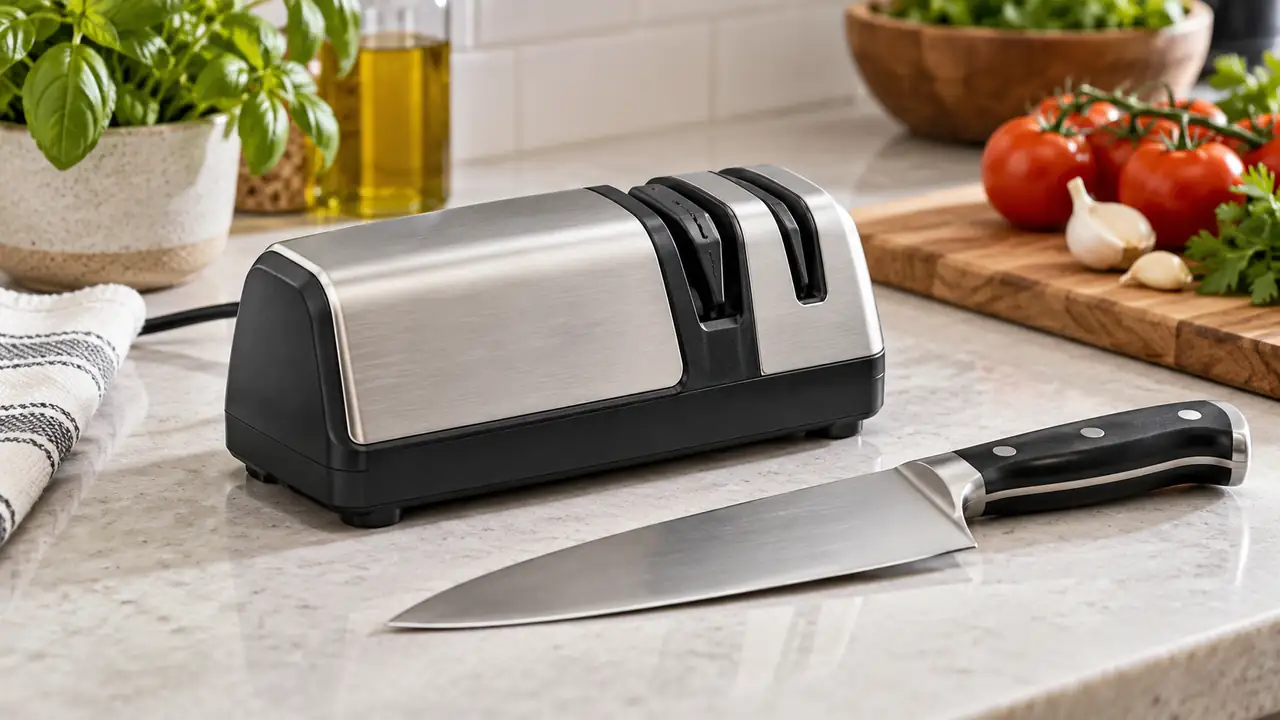
A dull chef’s knife can turn a quick onion chop into a slow, slippery chore, which is why many home cooks look for the Best Electric Knife Sharpener. These machines use powered abrasives and guided slots to restore an edge with less technique than a whetstone requires. The catch is that “electric” does not mean universally compatible. A sharpener built for a fixed 15-degree edge may be a poor match for a thick European knife, while a compact two-stage unit may struggle with serrated blades, cleavers, scissors, or damaged edges.
The most important details are the sharpening stages, abrasive type, angle guidance, supported blade styles, and cleanup requirements. Some products use diamond abrasives for coarse repair and refinement, while others use flexible belts that can follow unusual shapes. A fixed angle keeps the process simple, but an adjustable guide gives more control over Japanese-style knives, Western kitchen knives, and heavier blades. Buyers should also check whether the device is intended for straight edges only, whether it accepts serrations, and whether the manufacturer provides clear instructions for avoiding unnecessary metal removal.
Different kitchens need different tools. A household with standard chef knives may prefer the straightforward Presto 08810, while a cook with mixed blades may benefit from the broader angle and tool compatibility of the Work Sharp Ken Onion Mk2. For the strongest combination of guided sharpening, diamond abrasives, three-stage control, and serrated-knife support, the Chef’sChoice 15XV is the leading overall match in this group.
Quick Answer
- Chef’sChoice 15XV: Best Overall for cooks who want guided three-stage sharpening, diamond abrasives, and support for both straight and serrated knives.
- Work Sharp Ken Onion Mk2: Best for Multiple Knife Types, with an adjustable 15-to-30-degree guide, variable belt speed, and support for knives, scissors, serrated blades, and garden tools.
- Presto 08810 Professional EverSharp: Best for Beginners who want a three-stage system with a blade-thickness selector for light, standard, and heavier knives.
Best Electric Knife Sharpener Comparison Table
| Product | Best For | Sharpening Stages | Angle System | Blade Compatibility |
|---|---|---|---|---|
| Chef’sChoice 15XV EdgeSelect | Overall performance | 3 | Guided 15-degree edge | Straight and serrated |
| Work Sharp Ken Onion Mk2 | Multiple knife types | Belt-based stages | Adjustable 15 to 30 degrees | Knives, scissors, serrated blades, tools |
| Presto 08810 Professional EverSharp | Beginners | 3 | Thickness selector | Kitchen and sport knives |
| Electric Knife and Scissor Sharpener | Adjustable angle sharpening | 3 | 12 to 22 degrees | Knives, scissors, ceramic, serrated |
| 5-in-1 Electric Knife Sharpener | Broad household use | 3 | 20 degrees, adjustable to 32.5 | Straight, serrated, cleavers, scissors, axes |
| Chef’sChoice AngleSelect | 15- and 20-degree knives | 3 | 15 or 20 degrees | Straight and serrated |
| 3-Stage Kitchen Knife Sharpener | Kitchen-only sharpening | 3 | Guided 15 degrees | Chef, utility, and paring knives |
| Presto 08800 EverSharp | Simple straight-edge care | 2 | Fixed guided angle | Most non-serrated blades |
| Narcissus Knife Sharpener | Knives and scissors | 2 | Guided slot system | Straight knives and scissors |
The detailed reviews below explain where each electric sharpener fits, which blades it supports, and what trade-offs matter before purchase.
1. Chef’sChoice 15XV EdgeSelect – Best Overall

The Chef’sChoice 15XV earns the top position because its three-stage system covers the jobs most home kitchens actually face. The first two stages use 100-percent diamond abrasives to establish and refine the edge, while the third uses a flexible abrasive system for polishing. Its guided design is intended to convert traditional 20-degree household knife edges to a 15-degree Trizor XV edge, giving buyers a defined process rather than a vague “pull the blade through until sharp” routine.
That setup is especially useful in a kitchen with mixed straight-edge and serrated knives. The product information specifically lists support for both, and the polishing stage is intended to help maintain serrated blades. Spring guides help keep the blade positioned during sharpening, while the approximately 10-inch by 4.25-inch footprint should fit on many counters without becoming a permanent obstacle. It is a focused kitchen appliance, though, so the fixed 15-degree approach deserves attention before use on thick or unusually shaped blades.
Pros
- Three-stage system combines sharpening, honing, and polishing.
- 100-percent diamond abrasives are used in the first two stages.
- Supports straight-edge and serrated knives.
- Spring guides help maintain a consistent sharpening position.
- Includes a three-year limited warranty according to the supplied product information.
Cons
- The 15-degree edge may not suit every existing blade profile.
- Its focused kitchen design offers less versatility for tools such as axes or garden blades.
This is the strongest choice for a household that wants a repeatable electric system and owns a mixture of ordinary kitchen knives and serrated blades. Buyers should follow the instructions carefully, particularly if a favorite knife has a different edge geometry or a single-bevel design. Those seeking adjustable angles or broader tool support may prefer a belt-based Work Sharp, but the 15XV is easier to place in a conventional kitchen sharpening routine.
To buy this product, click here.
2. Work Sharp Ken Onion Mk2 Electric Knife Sharpener – Best for Multiple Knife Types

The Work Sharp Ken Onion Mk2 takes a different route from slot-style sharpeners. Its flexible abrasive belts can follow the edge of a kitchen knife, pocket knife, serrated blade, scissor, or garden tool, while the guide adjusts from 15 to 30 degrees. That range matters for households where a thin kitchen edge shares drawer space with a heavier hunting or outdoor blade. The angle dial and variable-speed control give the user more decisions, but they also make this a more involved machine.
For a cook who also maintains household tools, the broader format can be practical. A slower belt setting is suited to more controlled finishing, while a faster setting is available for more aggressive work. Quick-change belts make it possible to move between abrasive tasks without buying separate electric machines. The trade-off is that belt sharpening requires attention to pressure, angle, and pass length. A buyer wanting a simple slot, a switch, and minimal adjustment may find the Chef’sChoice or Presto systems easier to live with.
Pros
- Adjustable guide covers angles from 15 to 30 degrees.
- Flexible belts accommodate straight and serrated blades.
- Variable speed provides more control over different sharpening tasks.
- Suitable for knives, scissors, axes, and garden tools.
- Quick-change belts support different abrasive stages.
Cons
- Its broader controls require more technique than a fixed-slot sharpener.
- Belt replacement and storage add maintenance tasks.
This model makes sense for a serious home workshop, a cook with varied blades, or anyone who wants one powered system for kitchen and outdoor tools. It may be more machine than needed for a drawer containing two standard chef knives. Buyers should also treat the adjustable angle as a responsibility, since selecting the wrong setting can change the blade bevel rather than simply refresh it.
To buy this product, click here.
3. Presto 08810 Professional EverSharp – Best for Beginners

The Presto 08810 is built around a useful beginner-friendly idea: guide the blade mechanically, then let the stages handle the progression. Its three-stage system includes an extra-fine ceramic wheel for finishing, and a thickness selector helps set the guides for thin blades such as fillet or paring knives, standard kitchen knives, and thicker hunting knives. That selector gives the unit more flexibility than a basic fixed-slot sharpener without requiring a separate angle dial.
Picture a kitchen drawer containing a paring knife, a standard chef’s knife, and a thicker outdoor blade. The selector gives each category a more appropriate starting point, at least within the ranges described by the product information. The listing also identifies Santoku compatibility, which broadens its usefulness for cooks who favor a flatter Japanese-style profile. It is still important to confirm the manufacturer’s instructions for unusual edges, since the supplied information does not establish universal compatibility with every serrated or single-bevel knife.
Pros
- Three-stage sharpening system includes a fine ceramic finishing wheel.
- Thickness selector accommodates thin, standard, and thicker blades.
- Guides reduce the need to hold a manual sharpening angle.
- Listed as suitable for kitchen, sport, and Santoku knives.
- Offers a straightforward format for routine home maintenance.
Cons
- The product information does not establish support for serrated knives.
- Users must select the correct thickness setting before sharpening.
The 08810 is a sensible fit for a first electric sharpener or a household that wants more adjustment than a two-stage entry model. It is less compelling for someone who owns many serrated knives or needs a system for scissors and axes. Its strength is practical guidance, especially for people who would rather choose a blade-thickness setting than learn freehand sharpening.
To buy this product, click here.
4. Electric Knife and Scissor Sharpener – Best Adjustable-Angle Option

This sharpener stands out for its six selectable angles: 12, 14, 15, 18, 20, and 22 degrees. That range gives buyers a way to match the guide to different blade profiles rather than forcing every knife through one fixed setting. The supplied information associates the lower angles with thinner blades, middle settings with Santoku and Western kitchen knives, and higher settings with cleavers and heavier blades.
Its three stages separate repair, refinement, and polishing, while diamond abrasives are listed for the coarse and fine stages. A removable magnetic collection tray is intended to capture metal filings, which is useful when the machine lives beside a cutting board and cleanup needs to stay contained. The product also lists support for scissors, ceramic, irregular, and serrated blades. Such a broad compatibility claim makes the manual especially important, since each blade type may require a different slot or technique.
Pros
- Six selectable angles provide more flexibility than a single fixed guide.
- Three stages cover damaged-edge repair through polishing.
- Diamond abrasives are listed for the coarse and fine stages.
- Supports knives, scissors, ceramic, irregular, and serrated blades according to the supplied information.
- Removable magnetic tray helps collect sharpening debris.
Cons
- The number of angle choices may feel complicated for a first-time user.
- Broad compatibility claims still require careful blade-by-blade instruction checking.
This is a good match for a kitchen with several blade styles and an owner willing to select settings thoughtfully. It offers more control than a basic two-stage appliance, but the extra choices do not remove the need to identify the knife’s existing geometry. Buyers who want the simplest possible routine may prefer a fixed 15-degree system, while mixed-tool households may appreciate the added range.
To buy this product, click here.
5. 5-in-1 Electric Knife Sharpener – Best for Broad Household Use

The appeal here is breadth. The five-in-one design is listed for straight knives, serrated blades, meat cleavers, ceramic knives, scissors, and axes, with a removable ceramic polishing bar for unusually shaped tools. Three motor speeds offer another layer of control, while a spring-loaded guide is described as maintaining the sharpening angle along the blade. The device lists a 20-degree setting with an adjustable stop extending to 32.5 degrees, making it particularly relevant to buyers who maintain both ordinary kitchen knives and heavier tools.
A household that sharpens a chef’s knife on Sunday and garden tools later in the month may value this range. The LCD display and speed selection give the user a clearer interface than a simple on/off appliance, while the bottom swarf plate is designed to collect debris. The wider tool list also creates more opportunities for misuse, so a buyer should distinguish between the intended slot, abrasive stage, and angle for each item.
Pros
- Listed compatibility includes straight, serrated, ceramic, cleaver, scissor, and axe edges.
- Three speed settings allow more control across different tools.
- Three-stage sharpening system includes coarse, medium, and fine work.
- Spring-loaded guide is intended to maintain a consistent angle.
- Removable collection parts simplify debris cleanup.
Cons
- The broad feature set may be more than a small kitchen requires.
- Its listed 20-degree and 32.5-degree settings do not provide the same range as some six-angle systems.
Choose this model if one electric sharpener needs to serve a busy household with varied cutting tools. It is less attractive for someone who owns only standard straight-edge kitchen knives and wants a minimal countertop appliance. The key trade-off is versatility versus simplicity, with the product’s multiple slots and speeds rewarding careful setup.
To buy this product, click here.
6. Chef’sChoice AngleSelect – Best for 15- and 20-Degree Knives

The AngleSelect is useful for kitchens that contain both Asian-style and European or American knives. Its documented angle control is built around 15- and 20-degree edges, allowing the user to select between two common profiles instead of converting every knife to one angle. The system uses diamond abrasives and flexible stropping or polishing disks, and the product information identifies support for straight, serrated, single-bevel, and double-bevel knives.
That combination makes it a strong alternative to the 15XV for buyers who want more angle choice. A Santoku or other thinner Asian-style blade can be handled differently from a traditional 20-degree household knife, while the polishing stage helps finish the edge. The supplied information describes the unit as a three-stage electric sharpener despite the product title’s two-stage wording, so buyers should confirm the included instructions and exact operating sequence before use.
Pros
- Offers separate 15- and 20-degree sharpening options.
- Uses 100-percent diamond abrasives for sharpening and honing.
- Lists support for straight, serrated, single-bevel, and double-bevel knives.
- Flexible polishing disks help finish the edge.
- Includes a three-year limited warranty according to the supplied information.
Cons
- Its angle range is narrower than adjustable systems spanning several settings.
- The supplied title and feature information describe the stage count differently.
This model suits cooks who understand that a Japanese-style knife and a Western kitchen knife may require different edge treatment. It is less appropriate for a tool-heavy workshop or buyers wanting to sharpen axes and garden equipment. Its meaningful advantage is controlled access to two familiar kitchen angles without moving into a fully variable belt system.
To buy this product, click here.
7. 3-Stage Kitchen Knife Sharpener – Best Kitchen-Focused Design

This compact electric sharpener is aimed specifically at kitchen knives, including chef knives, utility knives, and paring knives. Its three-stage diamond grinding system is described as moving from coarse repair to medium sharpening and fine finishing, while the built-in 15-degree guide keeps the process consistent for users who do not want to manage a freehand angle. A non-slip base adds stability during operation.
The kitchen-only focus can be a benefit for someone who wants a less complicated appliance. Imagine a cook maintaining a chef’s knife after a month of dulling and touching up a paring knife before preparing fruit. The stated workflow is easy to understand, with each stage assigned a particular job. The limitation is equally clear: the available information does not establish support for scissors, axes, ceramic blades, or serrated knives, so this should be treated as a straight-edge kitchen tool rather than a universal sharpener.
Pros
- Three diamond grinding stages cover repair, sharpening, and polishing.
- Built-in 15-degree guide supports repeatable positioning.
- Intended for common chef, utility, and paring knives.
- Non-slip base helps keep the unit stable during use.
- Focused controls may be approachable for everyday kitchen maintenance.
Cons
- The supplied information does not confirm serrated-blade compatibility.
- Its kitchen-only design offers less flexibility for scissors or outdoor tools.
This is a sensible choice for a home cook with conventional straight-edge knives and no need for a multi-tool sharpening station. It may be a poor match for a knife collection built around serrated bread knives, ceramic blades, or heavy cleavers. The fixed 15-degree guide keeps the routine simple, but buyers should verify that their knives are appropriate for that edge profile.
To buy this product, click here.
8. Presto 08800 EverSharp – Best Simple Two-Stage Option
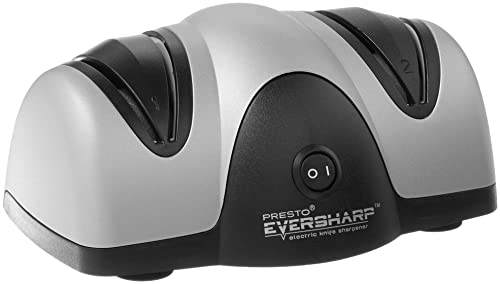
The Presto 08800 keeps the task uncomplicated with two stages: the first creates the edge using Sapphirite sharpening wheels, and the second fine-hones and polishes it. Precision blade guides hold the knife at the intended position, which can be reassuring for someone who has never used a stone or manual pull-through sharpener. Its product information describes compatibility with kitchen and sport knives, with the clearest limitation being that it is intended for most non-serrated blades.
For a standard kitchen drawer, that narrow focus may be perfectly reasonable. A home cook with a chef’s knife, utility knife, and paring knife can work through the sharpening stage and finishing stage without navigating several settings. The unit is listed for North American electrical standards and 120-volt use, so buyers outside that electrical system should verify compatibility before purchase. The absence of a documented serrated setting also matters for households that rely on bread or scalloped-edge knives.
Pros
- Simple two-stage process is easy to understand.
- Sapphirite wheels handle grinding and fine honing.
- Precision guides reduce angle guesswork.
- Suitable for many non-serrated kitchen and sport knives.
- Compact operating concept suits routine straight-edge maintenance.
Cons
- It is not intended for most serrated blades.
- The two-stage design provides less refinement control than three-stage models.
The 08800 is best for buyers who want a basic powered sharpener for ordinary straight-edge knives and prefer fewer controls. It is less suitable for a varied collection containing serrated, single-bevel, or specialty blades. Its value lies in reducing the steps between a dull standard knife and a maintained edge, provided the blade falls within its supported category.
To buy this product, click here.
9. Narcissus Knife Sharpener – Best for Knives and Scissors
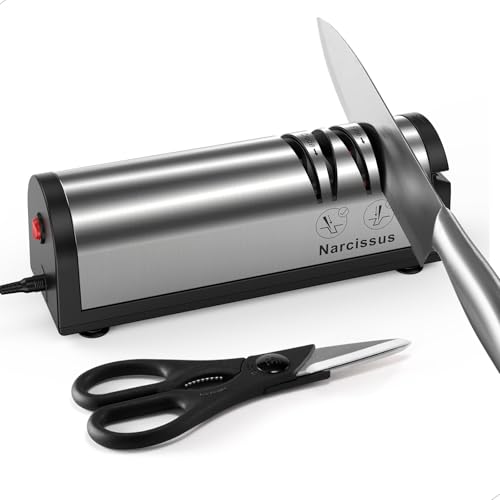
The Narcissus sharpener adds a dedicated scissors slot to a two-stage system intended for straight-blade kitchen knives. The coarse stage works on a dull edge, while the fine stage polishes it, and a magnetic collection box is included to catch metal dust beneath the unit. The product information identifies chef, slicing, and Santoku knives among its intended uses, giving it a practical role in a kitchen that needs occasional maintenance across several common blade shapes.
A listed 30-watt DC motor and wide-voltage design support repeated household use, while the compact stainless-steel-and-silver body should be easier to store than a workshop-style belt system. The scissors slot is useful for kitchen shears and household cutting tasks, although the supplied information does not establish compatibility with serrated knives, axes, or ceramic blades. Buyers should also follow the recommended insertion angle and review the instructions before using the side slot.
Pros
- Two-stage system handles sharpening and polishing.
- Dedicated scissors slot adds household versatility.
- Magnetic collection box helps contain metal dust.
- Listed for chef, slicing, and Santoku knives.
- Wide-voltage design supports use across 100 to 240 volts according to the supplied information.
Cons
- The supplied information does not confirm serrated, ceramic, or axe compatibility.
- Two stages provide less process control than the three-stage alternatives.
This model fits a household that wants one compact appliance for ordinary straight knives and scissors. It is less compelling for owners of specialty blades or anyone seeking adjustable angle control. Its practical distinction is the side scissors slot, which can save drawer space when the goal is basic maintenance rather than a highly configurable sharpening setup.
To buy this product, click here.
Buying Guide
Match the Sharpening Angle to the Blade
A fixed angle keeps operation straightforward, but it can also change the geometry of a knife if the setting does not match its existing edge. The Chef’sChoice 15XV and the kitchen-focused three-stage model use a 15-degree approach, while the AngleSelect offers 15- and 20-degree choices. Adjustable products such as the six-angle sharpener and Work Sharp Ken Onion Mk2 give more freedom, though the user must identify an appropriate setting before removing metal.
Powered convenience still depends on blade compatibility. The whetstone and electric-sharpener comparison helps assess what the guides and abrasives can change.
Choose the Right Abrasive and Stage Structure
Diamond abrasives are listed on several models and are used for sharpening or repairing an edge. Flexible belts take a different approach by conforming to blade shapes, while ceramic finishing wheels are intended for fine honing. More stages can separate heavy repair from refinement and polishing, but a two-stage device may be easier for a standard knife drawer. A machine should be selected according to the condition and types of blades you actually maintain.
Check Straight-Edge and Serrated Compatibility
Serrated knives need different contact with the abrasive than smooth chef knives. The 15XV, AngleSelect, Work Sharp Ken Onion Mk2, five-in-one sharpener, and adjustable-angle knife-and-scissor model list serrated support. The Presto 08800 is identified for most non-serrated blades, and the kitchen-only model does not provide documented serrated compatibility in the supplied information. Never assume a serrated knife belongs in a standard slot simply because its overall shape resembles a chef’s knife.
Decide Whether You Need Tool Versatility
For kitchen knives alone, a guided countertop sharpener may be the cleanest fit. If scissors, cleavers, axes, or garden tools are part of the same maintenance routine, look at the five-in-one model or Work Sharp system. Broader compatibility often brings more controls, belts, slots, and instructions. That can be useful in a workshop, but it may feel excessive beside a small kitchen counter.
Plan for Metal Dust and Maintenance
Powered sharpening removes material, so debris collection and cleanup deserve attention. The Narcissus includes a magnetic collection box, while the adjustable-angle model lists a removable magnetic tray and the five-in-one device includes removable collection parts. These features help contain filings, but they do not remove the need to clean the sharpener according to its instructions. Avoid treating a sharpening appliance as maintenance-free.
Respect Blade Construction and Edge Type
The supplied product data does not establish universal compatibility with every single-bevel, unusually thick, ceramic, or specialty blade. Some models list support for these categories, while others are clearly aimed at ordinary straight-edge kitchen knives. Check the exact instructions for the blade before sharpening. A device that works well for a Western chef’s knife may require a different setting, stage, or technique for a Japanese-style knife or heavy cleaver.
Best Electric Knife Sharpener FAQ
Are electric knife sharpeners suitable for every kitchen knife?
No. Compatibility depends on the device, blade edge, thickness, and construction. Some models are intended for ordinary straight-edge knives, while others list serrated, ceramic, single-bevel, or heavy blades. Read the product instructions before sharpening specialty knives.
Is a 15-degree sharpener suitable for a Western chef’s knife?
It may change the knife’s existing bevel rather than simply maintain it. Several products in this guide use or support a 15-degree edge, while traditional household knives are often associated with a wider edge. Confirm the knife’s intended geometry and the sharpener’s instructions first.
Can an electric sharpener handle serrated knives?
Some can, but the feature must be specifically listed. The Chef’sChoice 15XV, Chef’sChoice AngleSelect, Work Sharp Ken Onion Mk2, five-in-one model, and adjustable-angle knife-and-scissor sharpener identify serrated compatibility in the supplied information. The Presto 08800 is described for most non-serrated blades.
What is the difference between a two-stage and three-stage sharpener?
A two-stage sharpener generally combines edge formation with fine honing or polishing. A three-stage system separates coarse repair, refinement, and finishing. The additional stage can be useful for badly dull knives or a smoother finish, while a two-stage appliance may be easier for routine care.
Are diamond abrasives better than flexible sharpening belts?
They serve different design approaches. Diamond abrasives provide a hard sharpening surface in guided slots, while flexible belts can follow various blade shapes and support broader tool use. Neither format is automatically right for every knife. Blade compatibility, angle control, and the condition of the edge matter more than the label alone.
Can these sharpeners be used for scissors?
Only models that provide a scissors slot or specifically list scissor compatibility should be used for that purpose. The Narcissus, five-in-one model, adjustable-angle knife-and-scissor sharpener, and Work Sharp Ken Onion Mk2 include scissors among their supported uses in the supplied information.
How should metal filings be cleaned up?
Use the sharpener’s collection tray, plate, or box where provided, then follow the product instructions for emptying and cleaning it. The Narcissus includes a magnetic dust collection box, and other models list removable collection components. Keep filings away from food preparation surfaces and do not rinse an electrical appliance unless the instructions permit it.
Final Verdict
The Chef’sChoice 15XV is the strongest overall choice among these nine electric sharpeners. Its three-stage process, diamond abrasives, guided 15-degree edge, and listed straight-edge and serrated compatibility give it a well-rounded fit for a conventional kitchen. It is especially appealing to buyers who want a defined countertop routine rather than a flexible belt system. The main trade-off is its focused angle approach, which may not suit every blade without changing the existing bevel.
For a broader tool collection, the Work Sharp Ken Onion Mk2 offers adjustable 15-to-30-degree control, variable speed, and flexible belts for knives, scissors, serrated blades, and outdoor tools. Beginners who prefer a simpler guided process should look at the Presto 08810, while cooks maintaining both 15- and 20-degree knives may prefer the Chef’sChoice AngleSelect. Match the sharpener to the blades already in your kitchen, check compatibility before the first pass, and choose the model whose controls you will use correctly rather than the one with the longest feature list.
