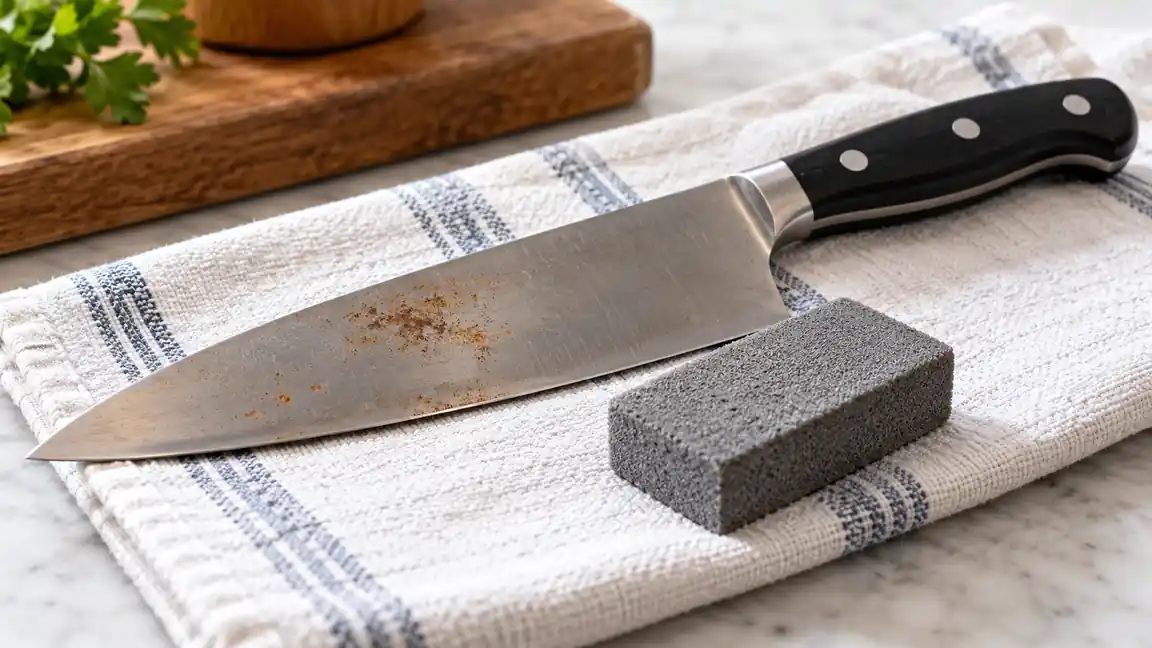
A rusty kitchen knife can go from dependable tool to worrying drawer resident surprisingly fast. A damp blade left overnight, acidic food residue, or a carbon-steel edge stored before it was fully dry may develop orange spots and dull-looking oxidation. The best knife rust remover depends on whether you are treating a small surface mark, cleaning a carbon-steel blade, or restoring several metal tools at once. A rust eraser, maintenance oil, soak, and spray each solve a different part of that problem.
The common mistake is reaching for the strongest household cleaner without checking the blade finish or intended use. Abrasive blocks can alter a polished surface, while chemical rust removers require careful rinsing before a knife returns to food preparation. Look for the product’s application method, compatibility with stainless or carbon steel, included protective accessories, and the amount of cleanup required afterward. Different buyers have different priorities. A home cook with one spotted chef’s knife may prefer a compact eraser, while someone maintaining carbon-steel knives may need a complete oil-and-cloth kit.
This comparison focuses on products that can address knife rust directly or support broader metal restoration. The PuGez Knife Oil Rust Eraser Kit earns the strongest overall position because it combines a sizable eraser with blade oil and a cloth, giving buyers both immediate spot treatment and a way to help protect the cleaned blade. Larger soak products and specialized abrasives appear below for readers handling cookware, tools, or a collection of knives.
Quick Answer
Best Overall: PuGez Knife Oil Rust Eraser Kit combines a 3 × 1 × 0.5-inch eraser with food-grade mineral and camellia oils plus a lint-free cloth. It is the most complete knife-focused choice in this group.
Best for Controlled Surface Cleaning: Dalstrong Rust Remover and Eraser is a solid, water-activated abrasive block intended for rubbing along the steel grain. Its finish restrictions make careful handling important.
Best for Larger Metal Restoration: CRC Evapo-Rust Heavy Duty Rust Remover uses a reusable water-based soak for removable metal parts and cookware. It makes more sense for blades that can be submerged than for a quick spot on a finished knife.
Best Multi-Tool Kit: Knife Blade Oil Rust Eraser Kit adds oil, an eraser, cloths, a brush, a refillable bottle, and a two-stage sharpener for buyers maintaining several types of blades.
Best Knife Rust Remover Comparison Table
| Product | Best For | Application | Protection Included |
|---|---|---|---|
| PuGez Knife Oil Rust Eraser Kit | Everyday knife care | Eraser and wipe-on oil | Oil and cloth |
| Dalstrong Rust Remover and Eraser | Small surface rust spots | Water-activated block | No oil listed |
| Azitamo Rust Eraser 2-Pack | Rust and light deburring | Wet or dry abrasive | No oil listed |
| CRC Evapo-Rust 32 oz | Removable rusty parts | Submersion soak | Separate inhibitor required |
| Stainless Steel Rust Stain Remover | Stainless blades and surfaces | Apply, wait, rinse | Protection claim listed |
| Knife Blade Oil Rust Eraser Kit | Multi-tool maintenance | Eraser, oil, sharpener | Oil and cloths |
| CRC Evapo-Rust 1 Gallon | Large collections and tools | Reusable soak | Separate inhibitor required |
| enterlent Heavy Duty Rust Removal | Quick surface treatment | Spray and wipe | Rust-converter claim listed |
| Rust Remover Spray for Metal | Fast treatment of mixed metal | Spray and wipe | Protective-barrier claim listed |
The detailed reviews explain which products fit a single kitchen knife, a carbon-steel collection, or a larger metal-cleaning job.
1. PuGez Knife Oil Rust Eraser Kit — Best Overall
A knife with a few orange freckles needs two solutions: something to lift the existing surface rust and something to help keep moisture away afterward. The PuGez kit addresses both jobs in one compact package. Its listed 3 × 1 × 0.5-inch rust eraser gives the user a broad working face for blade spots, while the included lint-free cloth helps remove residue after treatment.
The maintenance oil is described as a blend of refined mineral oil and camellia oil with food-grade purity. That makes the kit especially relevant for kitchen knives and carbon-steel blades that need regular drying and protective wiping. The listing also describes the oil as odorless, tasteless, and low viscosity, though any oil used on a food-contact blade should be applied sparingly and wiped thoroughly. This is a practical choice for the drawer where a carbon-steel petty knife develops a spot after a humid week.
Pros
- Combines a rust eraser, blade oil, and lint-free cloth.
- Large eraser dimensions provide a useful working surface.
- Oil is listed as a food-grade mineral and camellia oil blend.
- Suitable for kitchen knives, carbon-steel blades, and other tools.
- Supports both rust removal and follow-up corrosion prevention.
Cons
- The eraser may be too abrasive for delicate polished or coated finishes.
- Removing deeper pitting may require more restoration than this kit provides.
This is the strongest match for a home cook who wants a knife-specific maintenance setup rather than a general metal chemical. It also suits buyers who understand that rust removal is only half the job. Wipe the blade clean, dry it fully, and use a very light protective film afterward. Buyers seeking a soak for loose parts or a product for a large workshop should choose one of the Evapo-Rust sizes instead.
To buy this product, click here.
2. Dalstrong Rust Remover and Eraser — Best for Controlled Surface Cleaning
The Dalstrong block takes a direct, hands-on approach. The directions call for soaking it in water for five minutes, then rubbing the affected area along the steel grain while working toward the edge. That method gives the user control over a small rust mark, which is useful when a blade has one visible spot rather than widespread corrosion.
Its 3 × 1.2 × 1.2-inch solid-block format is substantial enough to hold securely during short cleaning sessions. The abrasive is described as fine grit, yet it can scratch or change a blade finish if used with excessive pressure or across the wrong surface. Keep it away from mirror-polished blades, coatings, and etched logos. A brushed stainless knife or plain carbon-steel blade is a more appropriate candidate.
Pros
- Solid block design is easy to grip during spot treatment.
- Directions explain the water soak and grain-following technique.
- Suitable for listed use on stainless and carbon steel.
- Can also address stains on scissors, steel cookware, and whetstones.
- Useful for treating rust as soon as small spots appear.
Cons
- May scratch or change the appearance of polished, coated, or etched blades.
- Does not include a protective knife oil in the listed package.
This block is a sensible pick for someone comfortable working slowly by hand. Imagine a stainless chef’s knife with a small mark near the heel after contact with a wet sink. A few careful passes along the grain are more targeted than immersing the entire knife. Skip it for decorative finishes unless the finish can tolerate mild abrasion, and plan a separate cleaning and protection step afterward.
To buy this product, click here.
3. Azitamo Rust Eraser 2-Pack — Best Two-Pack for Light Restoration
Azitamo’s two-pack is aimed at users who prefer a dry or wet abrasive over a liquid treatment. The erasers are described as rubber and silicon carbide, with moderate roughness for surface rust, dull oxidation, secondary polishing, and deburring. That combination gives the product a broader workshop role than a kitchen-only spot cleaner, especially for someone caring for knives alongside small metal accessories.
Each eraser measures 3.54 × 0.98 × 0.55 inches. The slim shape can reach narrow areas, though its relatively thin profile may provide less hand comfort than a thicker block. The product information specifically warns against coated cookware and tools because treatment can expose bare iron. That warning matters for coated knife blades and painted accessories. Any exposed carbon steel should be dried promptly and protected after cleaning.
Pros
- Two erasers provide a spare for continued maintenance.
- Can be used wet or dry according to the cleaning task.
- Listed for surface rust, oxidation, secondary polishing, and deburring.
- Rubber and silicon carbide construction avoids a liquid chemical treatment.
- Long, narrow dimensions can suit small metal details and blade spots.
Cons
- Not suitable for coated cookware or coated tools.
- Does not include oil, cloth, or another corrosion-protection product.
This option fits a cook who also maintains garden shears, tool accessories, or cast-iron items. It is especially useful when the job calls for a small amount of mechanical abrasion and the user wants a second eraser available. It is less appropriate for a highly polished display blade or anyone who wants a complete knife-care kit in one package.
To buy this product, click here.
4. CRC Evapo-Rust Heavy Duty Rust Remover, 32 oz — Best for Removable Rusty Parts
Evapo-Rust takes a different route from a hand eraser. The water-based formula is intended for complete submersion, making it practical for removable knife parts, steel tools, cookware, and hardware that can be placed in a container. The product information describes it as reusable and free of acids, solvents, bases, odors, and fumes, which may appeal to households that prefer a soak rather than aggressive scrubbing.
A 32-ounce bottle is more useful for occasional restoration than for a single tiny mark on a chef’s knife. The blade must be fully submerged for the process, then rinsed with water and protected with a corrosion inhibitor. That final step should not be skipped. Knives with wood handles, assembled mechanisms, glued components, or finishes that should not be immersed require extra caution or a different treatment method.
Pros
- Water-based formula is listed for soaking rusty metal parts.
- Product information describes it as free of acids, solvents, bases, and fumes.
- Reusable formula can serve multiple restoration jobs.
- Suitable for listed applications including tools, cookware, and antiques.
- Does not require sanding or scrubbing according to the product description.
Cons
- Submersion is inconvenient for assembled kitchen knives and fixed handles.
- A separate corrosion inhibitor is required after rinsing.
Choose this bottle for a removable blade or a batch of rusty metal pieces rather than a quick wipe on a finished knife. A collection of carbon-steel tools waiting in a workshop tub is a more natural use case than a high-polish Japanese-style blade with an attached handle. Rinse carefully and dry completely before returning any kitchen item to service.
To buy this product, click here.
5. Stainless Steel Rust Stain Remover and Cleaner — Best for Stainless Steel Surfaces
This product is aimed at stainless steel rust spots and related household surfaces. Its listed process is simple: apply the cleaner, let it stand for the recommended two to three minutes, then rinse. That short contact approach may suit a stainless kitchen knife with a visible stain, provided the blade material and finish are compatible and the product is kept away from the handle.
The formula is also listed for nickel, copper, grills, sinks, refrigerators, and other appliances. That broader use can be convenient in a kitchen where a rusty knife and a stained grill surface need attention on the same cleaning day. The listing cautions users to distinguish stainless steel metal from a stainless coating. Rinsing is especially important for any blade used around food, and the product should not be treated as a substitute for ordinary washing.
Pros
- Made for rust spots on stainless steel surfaces.
- Short listed dwell time can simplify small cleaning jobs.
- Can also be used on listed nickel and copper surfaces.
- Useful beyond knives for grills and kitchen appliances.
- Product information describes a streak-free finish and ongoing protection.
Cons
- Compatibility with coated stainless surfaces must be checked carefully.
- Requires thorough rinsing before a knife returns to food preparation.
This cleaner is best for stainless-steel users who want a liquid treatment rather than a rubbing block. It has more household crossover than the knife-specific kits, which can be helpful if the same rust stain appears on a grill or appliance. Buyers with carbon-steel knives, polished decorative finishes, or uncertainty about coating compatibility should choose a more controlled eraser instead.
To buy this product, click here.
6. Knife Blade Oil Rust Eraser Kit — Best Multi-Tool Maintenance Kit
This six-piece kit is built for buyers who want more than rust removal. The listed contents include protective oil, a rust eraser, a refillable spray bottle, a sharpening stone, a brush, and two lint-free cloths. That assortment can be useful in a drawer containing carbon-steel kitchen knives, pocket knives, axes, gardening scissors, or other metal tools.
The oil is described as a food-safe blend of camellia and mineral oils, while the eraser measures approximately 3.2 × 1 × 0.5 inches. A two-stage sharpener adds a separate edge-maintenance function, although the available information does not specify its angle system or compatibility with every blade style. Treat that sharpener as an accessory rather than assuming it suits single-bevel or unusually thin edges.
Pros
- Includes rust treatment, protective oil, cloths, brush, and refillable bottle.
- Food-safe oil blend is listed for kitchen and carbon-steel blades.
- Rust eraser provides a dedicated tool for surface spots.
- Supports maintenance of knives, axes, scissors, and other metal tools.
- Includes a sharpener for buyers building a broader care setup.
Cons
- The included sharpener’s exact angle and blade compatibility are not documented.
- More accessories may be unnecessary for someone treating one knife.
This kit makes sense beside a mixed tool collection where oil, wiping cloths, and basic edge care are all useful. A home cook who owns several carbon-steel blades may appreciate having the supplies together instead of assembling them separately. A buyer with a highly specialized Japanese edge should use caution with the unspecified sharpener and focus on the oil-and-eraser components unless compatibility is confirmed.
To buy this product, click here.
7. CRC Evapo-Rust Heavy Duty Rust Remover, 1 Gallon — Best for Larger Collections
The gallon-size Evapo-Rust is the collection-focused version of the smaller soak. Its ready-to-use, water-based formula is intended for complete immersion and reuse, so it can serve a household or workshop with several rusty tools, removable blades, cast-iron cookware, and camping equipment. The larger container is unnecessary for one small orange mark, yet valuable when multiple parts need the same treatment.
The product description says rust can be removed without sanding or scrubbing, followed by rinsing and protection with a corrosion inhibitor. That workflow is relatively straightforward, but it still requires a suitable container and enough space to submerge the item. Do not assume every kitchen knife should be soaked. Handles, tang transitions, decorative finishes, and assembled mechanisms may have restrictions that a removable bare-metal part does not.
Pros
- Large ready-to-use volume suits repeated restoration work.
- Reusable water-based soak can handle multiple metal items.
- Listed as non-corrosive and non-flammable.
- Works across listed applications including tools, cookware, and antiques.
- Submersion can reach rust across areas difficult to rub by hand.
Cons
- Large container is excessive for occasional knife spot treatment.
- Requires full immersion, rinsing, drying, and separate corrosion protection.
This is a practical choice for a serious maintenance shelf, especially where rusty garden tools and cookware share space with knives. It is less convenient for a finished kitchen knife that should stay attached to its handle. Buyers who need a compact, food-oriented kit will find PuGez or the multi-tool oil kit easier to store and use.
To buy this product, click here.
8. enterlent Heavy Duty Rust Removal Spray — Best for Quick Surface Treatment
The enterlent spray is positioned as a broad metal cleaner for rust, minerals, and other surface contaminants. Its listed applications include stainless steel, pots, grills, glass, tile, concrete, brick, and chrome. For a knife owner, the relevant feature is the spray format and the stated four-to-six-minute treatment window, which can be more convenient than preparing a soak for one localized mark.
Broad compatibility claims deserve a careful, small-area approach. A kitchen knife has a sharpened edge, handle, and often a finish that differs from a grill or bare steel fitting. Apply only where appropriate, keep the product away from the handle and cutting edge unless the directions support that use, and rinse thoroughly afterward. The listing calls it a rust converter spray, but the available information does not establish how it interacts with every blade steel or finish.
Pros
- Spray format suits localized treatment without a full soak.
- Listed for rust, mineral deposits, and other metal contaminants.
- Provides a stated four-to-six-minute treatment window.
- Can serve broader household cleaning tasks beyond knives.
- Suitable for listed stainless steel and other hard surfaces.
Cons
- Broad surface claims do not establish compatibility with every knife finish.
- Requires careful rinsing and controlled application around handles and edges.
This product is a reasonable fit for a buyer who wants one spray for occasional metal cleanup around the kitchen. It can make sense for a stainless knife with a small surface stain when the user follows the label and tests an inconspicuous area first. A dedicated eraser remains easier to control on a valuable blade, while a soak is better for loose parts with widespread corrosion.
To buy this product, click here.
9. Rust Remover Spray for Metal — Best for Fast Mixed-Metal Jobs
This spray is aimed at a wide range of metal items, including tools, chains, grills, bolts, appliances, and plumbing fixtures. The product information describes a spray-and-wipe process, visible results in one to three minutes, and a protective-barrier claim for humid environments. That makes it appealing for quick maintenance on utility metalwork where speed and broad application matter.
Its stated compatibility includes chrome, steel, iron, and alloys, but the available details do not identify a specific kitchen-knife steel or finish. The non-conductive claim is relevant to some household equipment, yet it does not automatically establish food-contact suitability. For a knife, use a controlled amount, follow the product directions, and wash and rinse the blade thoroughly before any food preparation.
Pros
- Fast listed one-to-three-minute treatment time.
- Spray nozzle supports localized application.
- Listed for steel, iron, chrome, and alloys.
- Product information describes a protective barrier after treatment.
- Broad use covers tools, grills, bolts, and household metal fixtures.
Cons
- Food-contact suitability for kitchen knives is not documented in the supplied information.
- Compatibility with polished, coated, or decorative blade finishes remains uncertain.
This spray belongs lower in the ranking because it is a general metal product rather than a clearly knife-centered care kit. It can suit someone cleaning a rusty utility knife alongside garage hardware, but a cook seeking a food-oriented maintenance routine should start with PuGez or another product that includes listed blade oil. Its fast contact time is useful, though careful cleanup matters more than speed on a kitchen blade.
To buy this product, click here.
Buying Guide
Match the Treatment to the Rust
Small orange freckles or a narrow stain are usually easier to address with a controlled eraser or localized cleaner. A removable blade with widespread corrosion may be better suited to a soak. Think of the difference between wiping a spot from a chef’s knife after dinner and restoring several loose tools found in a damp shed. The first job rewards precision, while the second rewards coverage and reuse.
Check the Blade Finish Before Using Abrasive Blocks
Rust erasers contain abrasive material, so pressure and direction matter. The Dalstrong listing specifically advises working along the steel grain and warns that the block can scratch or alter certain finishes. Mirror-polished, coated, etched, or decorative blades deserve extra caution. Test an inconspicuous section when the finish matters, and avoid rubbing across logos or patterns.
Separate Stainless Steel From Carbon Steel Care
Stainless steel is more resistant to corrosion, but it is not immune to rust stains. Carbon steel generally needs more attentive drying and protection, especially after contact with acidic foods or humid air. An oil-containing kit is useful for that routine. Chemical sprays and soaks may remove rust, yet they do not replace drying and a suitable protective film.
First distinguish a stable patina from active rust. The carbon-steel and stainless-steel care comparison explains why color alone does not establish the same treatment need.
Plan the Rinse and Drying Step
Any liquid rust remover used on a kitchen knife should be followed by the cleanup directed on its label. Rinse away residues, dry the blade completely, and inspect the edge and handle junction before storage. A knife that is returned to a block while damp can develop the same problem again. Keep the cutting edge away from abrasive contact unless the product specifically supports that use.
Do Not Assume a General Metal Cleaner Is Food-Ready
A product may list steel, grills, tools, or appliances without documenting food-contact use on knife blades. That distinction matters. The oils in the PuGez and multi-tool kits are listed as food-grade, while the general sprays in this roundup require more caution. Follow the label, rinse thoroughly, and wash the knife with an appropriate dish soap before it returns to food preparation if a chemical cleaner was used.
Use a Protective Product After Rust Removal
Removing the visible spot does not address the moisture that caused it. A thin wipe of suitable knife oil can help protect carbon-steel blades during storage, while a dry environment and prompt hand drying reduce repeat corrosion. Do not leave a heavy oily film on a blade used immediately for food. The goal is a light protective coating that is wiped appropriately before use.
Best Knife Rust Remover FAQ
What Is the Best Knife Rust Remover for a Small Rust Spot?
A knife-specific eraser is usually the most controllable option for a small surface mark. The Dalstrong block and Azitamo erasers are intended for hands-on treatment, while the PuGez kit adds oil and a cloth for follow-up care. Use light pressure, work along the grain where appropriate, and stop if the finish begins to change.
Can I Use Evapo-Rust on a Kitchen Knife?
The supplied product information lists Evapo-Rust for metal parts, tools, cookware, and other items through submersion. A removable bare-metal blade may be a suitable candidate, but an assembled knife with a wood or composite handle requires more caution. Rinse, dry, and apply suitable protection after treatment, following the product directions.
Is a Rust Eraser Safe for a Polished Knife?
Not automatically. Rust erasers are abrasive, and the Dalstrong information specifically warns that use can scratch or change a blade finish. Avoid mirror-polished, coated, or etched areas unless the manufacturer supports that application. A small test area and gentle pressure are safer than aggressive rubbing across the entire blade.
Should I Oil a Knife After Removing Rust?
For carbon-steel knives, a light protective oil can help reduce contact with moisture during storage. The PuGez and multi-tool kits include oils described as food-grade mineral and camellia blends. Apply sparingly, wipe away excess, and clean the blade appropriately before food preparation. Oil does not replace drying the knife after washing.
Can I Use a Household Rust Spray on a Food Knife?
A general metal spray may be listed for stainless steel, tools, grills, or appliances without being documented for direct food-contact surfaces. If you use one on a knife, follow the label closely, keep it away from the handle where possible, rinse thoroughly, and wash the blade before use. A knife-focused eraser or food-grade oil kit creates a clearer care routine.
Will Rust Remover Remove Deep Pitting?
These products are primarily suited to surface rust, stains, and oxidation. Deep pits are damage within the metal and may remain after the surrounding rust is removed. Aggressive abrasion can change blade geometry or finish, so a heavily pitted or structurally compromised knife may require professional assessment or replacement rather than repeated chemical treatment.
How Can I Prevent Rust From Returning?
Dry the knife immediately after washing, avoid leaving it in a wet sink, store it where air can circulate, and use a suitable light oil on carbon steel when appropriate. Acidic food residue should be washed away promptly. A knife block, sheath, or drawer should be dry before the blade goes inside.
Final Verdict
The PuGez Knife Oil Rust Eraser Kit is the strongest overall choice for most home cooks because it addresses the complete maintenance cycle. Its large eraser handles surface spots, the included cloth supports cleanup, and the listed mineral-and-camellia oil blend provides a way to protect a cleaned blade. It is especially well matched to carbon-steel kitchen knives that need more attention than ordinary stainless cutlery.
Choose the Dalstrong block for deliberate spot cleaning on suitable plain or brushed steel, or select the six-piece knife blade kit if oil, cloths, and extra maintenance accessories will serve several tools. For removable rusty parts and larger collections, CRC Evapo-Rust offers the more practical soak format in either bottle size. Whichever product you choose, confirm finish compatibility, rinse chemical treatments thoroughly, dry the blade fully, and treat rust prevention as part of the job rather than an afterthought.
