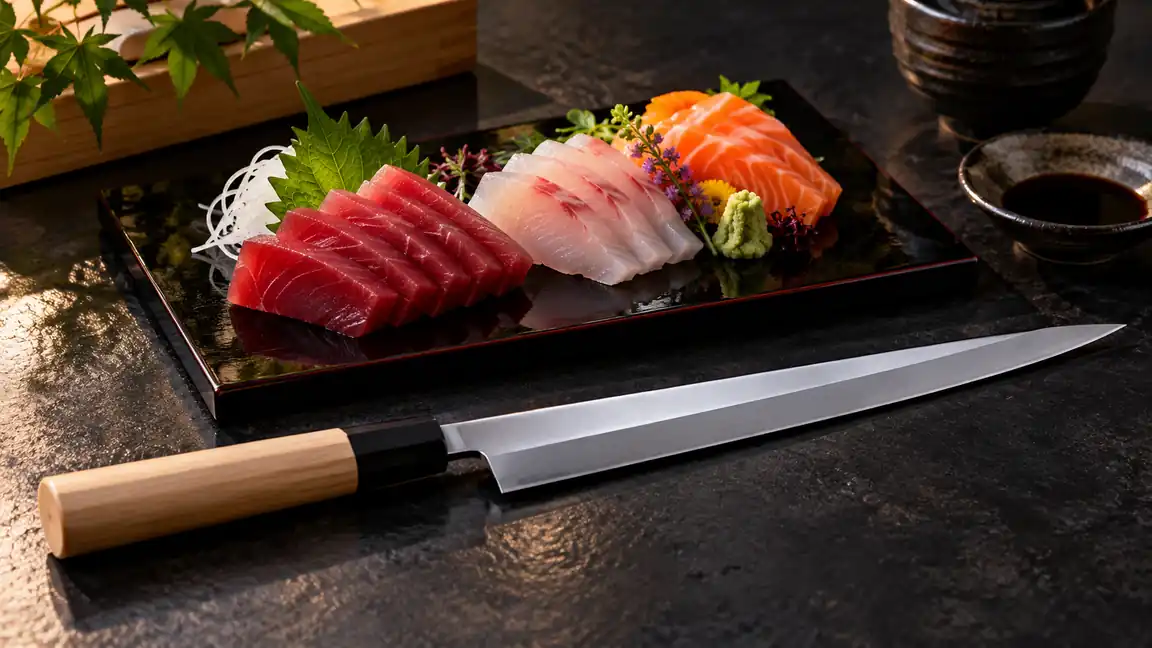
A yanagiba is a specialist fish-slicing knife, built for long draw cuts through sashimi, sushi fish, and boneless fillets. Its narrow blade and extended cutting edge reward a steady pull rather than the rocking motion used with a Western chef’s knife. That distinction matters at the cutting board. A knife can look Japanese-inspired yet still have a double-bevel or general-purpose design that behaves more like a sujihiki, so shoppers should check the edge construction and intended use before buying.
Blade length, edge geometry, steel, handle shape, and maintenance all influence the experience. A 10-inch blade offers room for long slices but needs a suitable cutting surface. A shorter model can feel easier to manage, while a single-bevel knife may demand more technique and a compatible sharpening routine. Stainless and high-carbon stainless steels simplify corrosion care, but neither removes the need to wash and dry the blade promptly. Different buyers have different priorities, so this guide includes traditional single-bevel options, accessible home-kitchen models, double-bevel alternatives, and very long knives for large fish.
The selected knives are ranked by how directly their documented design matches yanagiba-style sashimi preparation, along with practical details such as handle construction, blade length, steel information, storage, and sharpening implications. The FINDKING Prestige Series takes the top position for its dedicated 10.5-inch single-bevel design, while Shun offers a more refined premium alternative and Kai provides a shorter, approachable choice for smaller preparation spaces.
Quick Answer
FINDKING Prestige Series Yanagiba is the strongest overall match for shoppers seeking a dedicated sashimi knife. Its 10.5-inch single-bevel blade, documented SKD11 steel, octagonal handle, walnut saya, and focused pull-cut design align closely with traditional yanagiba use.
Shun Dual Core Yanagiba is the premium alternative. It combines a 10.5-inch blade with VG10 and VG2 Damascus construction, a Pakkawood handle, a sheath, and documented Japanese handcrafting. Kai Wasabi Yanagiba is the more compact option, with an 8.25-inch blade, a symmetrical handle, and high-carbon stainless steel suited to home cooks who want a shorter fish knife.
Best Yanagiba Knife Comparison Table
| Product | Best For | Blade Length | Edge and Steel | Handle |
|---|---|---|---|---|
| FINDKING Prestige Series Yanagiba | Dedicated sashimi preparation | 10.5 inches | Single bevel, SKD11 | Ebony octagonal handle |
| Shun Dual Core Yanagiba | Premium fish slicing | 10.5 inches | 16-degree edge, VG10/VG2 Damascus | Pakkawood octagonal handle |
| HOSHANHO 10-Inch Sushi Knife | Layered-steel home sushi work | 10 inches | 12 degrees per side, 10Cr15CoMoV | Mahogany and G10 |
| SHAN ZU 10-Inch Japanese Sushi Knife | Controlled slicing and presentation | 10 inches | 12-degree edge, 10Cr15MoV | Red sandalwood octagonal handle |
| HOSHANHO 10-Inch Olive Wood Knife | Mirror-finish presentation | 10 inches | 12-degree edge, 10Cr15CoMoV | Olive wood and G10 |
| Sumteene 9.5-Inch Sushi Knife | Single-bevel entry point | 9.5 inches | Single bevel, 440A | Pakkawood |
| Kai Wasabi Yanagiba | Compact fish preparation | 8.25 inches | High-carbon stainless steel | Polypropylene-bamboo blend |
| KEEMAKE KIKU Sashimi Knife | Easy-clean coated blade | 10 inches | 440C, 58 HRC | Rosewood and G10 |
| YOUSUNLONG Sakimaru Yanagiba | Very large fish and ingredients | 23 inches | Double-sided edge, 67-layer Damascus | Extended walnut handle |
The detailed reviews below explain how each knife’s length, edge style, steel, handle, and intended use affect the buying decision.
1. FINDKING Prestige Series Yanagiba Knife — Best Overall

The FINDKING Prestige Series earns the top spot because its design is closely tied to the classic yanagiba task. The 10.5-inch blade is intended for long pull cuts through sashimi, sushi, fish fillets, and other boneless proteins. Its single-bevel geometry is especially relevant for buyers who want a dedicated Japanese-style slicer rather than a general-purpose chef’s knife. That edge arrangement requires the user to understand single-bevel sharpening and cutting technique, but it also gives this knife a clearer identity than the many double-edged models marketed as sushi knives.
The listing identifies Japanese SKD11 alloy steel and includes a walnut saya with felt lining. The saya is a practical addition because a long, sharp slicing blade should not be left loose in a drawer. Ebony, sapele mahogany, and copper spacers form the octagonal handle, while the wooden presentation box adds storage and gifting appeal. The decorative Damascus pattern contributes visual character, but the useful buying distinction is the single-bevel design and dedicated slicing profile. This is the knife for a cook who expects to prepare fish in deliberate, uninterrupted strokes rather than chop across a crowded board.
Pros
- Dedicated 10.5-inch yanagiba format for long sashimi slices.
- Single-bevel edge suits traditional draw-cut preparation.
- SKD11 steel is clearly identified in the product information.
- Octagonal ebony and sapele mahogany handle offers a traditional grip shape.
- Walnut saya and presentation box support safer storage.
Cons
- Single-bevel geometry requires appropriate sharpening knowledge.
- Long blade is less convenient on small cutting boards.
Choose this model if traditional edge geometry and a purpose-built fish slicer matter more than all-purpose versatility. It is less suitable for someone who wants one knife for rocking, chopping, and routine vegetable prep. Buyers should also confirm that their sharpening setup can accommodate a single-bevel blade before purchase. For sashimi-focused preparation, its combination of length, edge design, and protective saya gives it the clearest overall match in this group.
To buy this product, click here.
2. Shun Dual Core Yanagiba Knife — Best Premium Design

Shun’s Dual Core Yanagiba is aimed at buyers who want a more established premium construction for fish slicing. Its 10.5-inch length gives the user plenty of edge for a single continuous pull through a fillet, while the octagonal Pakkawood handle provides a symmetrical shape that the listing identifies as suitable for both left- and right-handed users. The product information describes a 16-degree edge and 71 alternating micro-layers of VG10 and VG2 stainless steels, giving shoppers more documented construction detail than many generic sushi-knife listings.
This knife also includes a sheath, which matters for a long blade that may be stored or transported outside a knife block. Shun states that the knife is handcrafted in Japan and supported by free sharpening and honing, but buyers should still verify the current service terms before relying on them. The Dual Core construction is visually distinctive, yet the main practical appeal is the combination of length, stainless-steel materials, handle symmetry, and brand-supported care. It suits a serious home sushi station or a cook who already understands long slicing knives and wants a high-end dedicated tool.
Pros
- 10.5-inch blade supports long fish-slicing strokes.
- VG10 and VG2 stainless-steel construction is clearly documented.
- 71-layer pattern gives the blade a distinctive finished appearance.
- Octagonal Pakkawood handle is listed as suitable for either hand.
- Includes a sheath and advertised sharpening support.
Cons
- Premium construction is more than occasional sushi preparation may require.
- Long blade and specialized profile limit general kitchen versatility.
This is a strong fit for experienced users who want premium materials and a dedicated fish-slicing format. A casual cook who prepares sashimi once or twice a year may find a shorter model easier to store and justify. As with any specialized long knife, a clear cutting path and suitable sharpening plan are part of ownership. Among the nine selections, this is the most refined alternative to the FINDKING for buyers who place greater emphasis on brand construction and documented layered stainless steels.
To buy this product, click here.
3. HOSHANHO 10-Inch Sushi Knife — Best Layered-Steel Home Option

This HOSHANHO model targets home cooks who want a full-length 10-inch sushi knife with a decorative layered construction. The listing describes a 10Cr15CoMoV core, nine-layer forged steel, vacuum heat treatment, tempering, and a stated hardness of 62 HRC. Those details provide useful information for comparison, although hardness alone cannot predict edge life or cutting quality. The blade is described as flat and slim, with a 12-degree edge on each side, so this model should be treated as a double-bevel knife rather than assumed to be a traditional single-bevel yanagiba.
The octagonal natural mahogany handle is paired with G10 bolsters, a combination that may appeal to cooks who want wood character with a more water-resistant transition area. The hammered, darkened finish is visually bold and may help reduce the look of food residue, but it should not be treated as proof of superior cutting performance. This knife makes sense for a household that prepares sushi, sashimi, tofu, or other soft foods and prefers a double-edged format that can be more familiar than a traditional single bevel.
Pros
- 10-inch length suits full-size sashimi preparation.
- 10Cr15CoMoV core and nine-layer construction are documented.
- G10 bolster adds a composite element around the wooden handle.
- Octagonal handle shape supports directional control.
- Suitable listed applications include sashimi, sushi, and soft foods.
Cons
- Double-bevel edge is less traditional than a classic single-bevel yanagiba.
- Specific blade weight and overall dimensions are not provided.
Select this model if you want a long sushi knife with a double-bevel format and layered visual finish. It may be easier to integrate into a mixed kitchen than a highly specialized single-bevel tool, but buyers seeking traditional yanagiba geometry should look higher in the ranking. Hand washing, prompt drying, and careful storage remain sensible practices for the high-carbon stainless construction and natural wood handle.
To buy this product, click here.
4. SHAN ZU 10-Inch Japanese Sushi Knife — Best for Controlled Presentation

SHAN ZU’s 10-inch knife brings together a 10Cr15MoV core, nine-layer construction, and a stated 62 HRC hardness. The product information also lists a 12-degree blade angle and a tapered spine, features aimed at controlled slicing through fish and other soft ingredients. The matte blade finish is a practical visual choice for cooks who dislike fingerprints and obvious residue on a polished surface. These details make it a plausible home sushi knife, although the available information does not establish that it uses the single-bevel geometry associated with traditional yanagiba knives.
The natural red sandalwood handle has an octagonal profile, which can help the user orient the blade during a long pull cut. The included gift box makes this model attractive for presentation, yet the box should not replace a safer day-to-day storage method if the knife will be used frequently. It is best viewed as a modern Japanese-style sashimi knife for a home cook who values a substantial 10-inch blade and a matte appearance. A buyer who wants an explicitly documented single bevel should choose the FINDKING or Sumteene instead.
Pros
- Full 10-inch blade provides useful length for sashimi slices.
- 10Cr15MoV core and nine-layer structure are specified.
- Stated 12-degree edge supports a fine slicing profile.
- Octagonal red sandalwood handle aids blade orientation.
- Matte finish is less visually prone to fingerprints.
Cons
- The supplied information does not clearly identify a traditional single bevel.
- Gift-box packaging does not provide the same blade protection as a fitted saya.
This knife fits shoppers who want an attractive, modern sushi knife for fish slicing and occasional soft-food preparation. It is less compelling for a traditionalist who wants a clearly specified single-bevel back and a dedicated saya. The long blade also calls for a clear board and deliberate cutting path. Its strongest distinction is the combination of documented layered steel, a matte finish, and an orientation-friendly wooden handle.
To buy this product, click here.
5. HOSHANHO 10-Inch Olive Wood Sushi Knife — Best Mirror-Finish Presentation
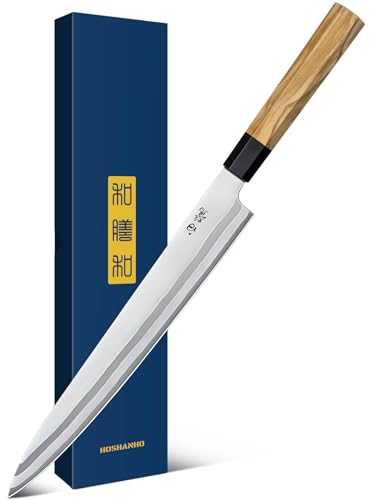
The olive wood HOSHANHO is another 10-inch Japanese-style sushi knife, but its main visual distinction is the mirror-polished blade and natural olive wood handle. The listing identifies a 10Cr15CoMoV high-carbon stainless-steel core, a stated 62 HRC hardness, and a 12-degree edge. Those specifications point toward a fine slicing tool for fish filleting and sashimi preparation. The product description also presents it as a multipurpose kitchen knife, though the long, narrow sushi profile remains better suited to slicing than routine chopping.
The octagonal handle uses olive wood with G10 elements, giving the design a mix of natural material and composite reinforcement. A polished surface can look striking beside a sushi platter, but it usually calls for more visible care because fingerprints and residue stand out. The supplied information does not establish a single-bevel edge, so shoppers should confirm the exact geometry if traditional yanagiba technique is their priority. This model suits a home cook who wants a giftable knife with a bright finish and a familiar double-edged style.
Pros
- 10-inch length is appropriate for larger sashimi portions.
- 10Cr15CoMoV steel core and 62 HRC claim are documented.
- Stated 12-degree edge supports fine slicing.
- Olive wood and G10 handle combine natural and composite materials.
- Mirror-polished finish creates a formal presentation.
Cons
- Polished finish will show fingerprints and residue more readily.
- Traditional single-bevel construction is not clearly documented.
Pick this model for presentation, a long blade, and a wood-handled double-bevel format. It is less suited to buyers who want low-visibility maintenance or a clearly traditional yanagiba edge. Keep the blade dry after washing and store it so the polished edge cannot contact other utensils. Its place in the ranking comes from its useful documented specifications and distinctive finish rather than from appearance alone.
To buy this product, click here.
6. Sumteene 9.5-Inch Sushi Knife — Best Single-Bevel Entry Point
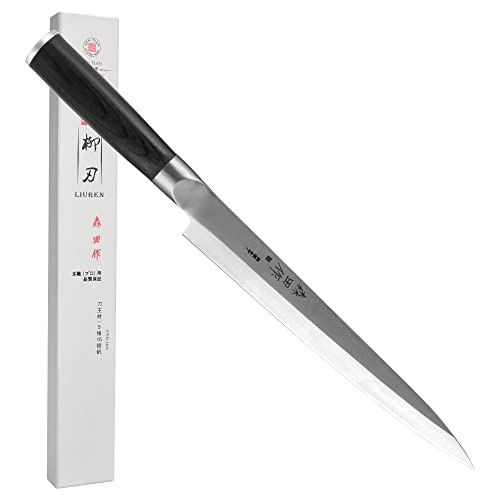
Sumteene stands apart from many similarly styled listings because its product information explicitly describes a single-sided sharp blade, a 9.5-inch length, and 440A steel. The back is described as having a slight curve rather than being completely flat, with an air-pocket effect intended to help fish release from the blade. Buyers should treat that construction description as the manufacturer’s design claim, but the single-bevel specification still makes this a more direct match for traditional yanagiba shoppers than many double-bevel alternatives.
The Pakkawood handle is intended to provide a balanced grip, and the knife arrives in a presentation box. The listing advises sharpening before use, an especially relevant detail for buyers who may expect a handmade knife to be ready for demanding sashimi work immediately. Because the steel is identified as 440A rather than a more specialized alloy, this model may appeal to users who prefer a simpler, more approachable knife and do not need elaborate layered construction. Its 9.5-inch blade also sits between compact home models and longer professional-style slicers.
Pros
- Single-bevel construction is explicitly described.
- 9.5-inch blade balances reach with a more manageable length.
- 440A steel designation is provided.
- Pakkawood handle offers a practical composite wood construction.
- Product information directly addresses sashimi release from the back of the blade.
Cons
- Listing advises sharpening before use.
- 440A construction is less extensively specified than the layered-steel alternatives.
This is a sensible choice for someone who wants to learn the feel and upkeep of a single-bevel sushi knife without moving immediately to a very long blade. It should be paired with a sharpening method appropriate for single-bevel edges, and a beginner should practice on suitable ingredients before attempting presentation-critical cuts. Buyers who want a polished premium finish or a protective saya will find stronger options elsewhere, but the documented edge style gives Sumteene a clear purpose.
To buy this product, click here.
7. Kai Wasabi 8.25-Inch Yanagiba Knife — Best Compact Design
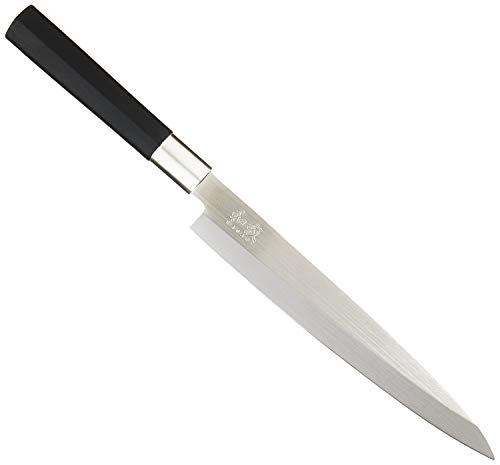
Kai’s Wasabi Yanagiba is the shortest knife in this selection, with an 8.25-inch blade intended for tuna, salmon, sashimi, and similar fish preparation. That reduced length can be useful on a compact counter or for cooks who are still becoming comfortable with long slicing knives. The trade-off is reach. A shorter blade may require more repositioning for large fillets, while a longer yanagiba can complete a broader slice in one motion.
The product uses high-carbon stainless steel and a symmetrical black handle made from a polypropylene and bamboo blend. The symmetrical handle is listed as suitable for left- and right-handed users, making this model more flexible for shared kitchens than a strongly handed traditional handle. Kai also advertises sharpening and honing support, though buyers should check the current terms. The available information does not establish a single-bevel edge, so this is better classified as an accessible Japanese-style fish knife than a strict traditionalist’s yanagiba.
Pros
- 8.25-inch blade suits smaller cutting boards and storage spaces.
- High-carbon stainless steel is identified.
- Symmetrical handle accommodates left- and right-handed users.
- Long, thin profile is intended for fish and sashimi slicing.
- Product information lists sharpening and honing support.
Cons
- Shorter blade provides less reach for large fillets.
- Single-bevel construction is not specified in the supplied information.
Choose Kai if compact handling and a recognizable brand matter more than a traditional single-bevel layout. It is a practical candidate for occasional home sushi preparation, especially where a 10-inch blade would feel awkward. Buyers preparing whole salmon sides or large tuna portions may prefer a longer option. The accessible handle material also makes it a less formal choice than the wood-handled knives, which can be useful in a busy everyday kitchen.
To buy this product, click here.
8. KEEMAKE KIKU 10-Inch Sashimi Knife — Best Easy-Clean Finish

KEEMAKE takes a modern approach with a 10-inch sashimi knife made from 440C high-carbon stainless steel and a black non-stick coating. The listing gives the steel a stated hardness of 58 HRC and describes the coating as hydrophobic, anti-rust, and easier to clean. A coated blade can appeal to cooks who dislike food residue on a bright metal surface, but the coating also means the user should avoid abrasive cleaning that could damage the finish. The product information does not identify a single-bevel edge, so its yanagiba label should be understood as a Japanese-style sashimi format rather than proof of traditional geometry.
The rosewood handle is paired with G10 bolsters, and the listing describes the balance point as being near the blade-handle joint. Balance claims are design descriptions rather than a guarantee of comfort for every hand, but the configuration gives the knife a clear home-kitchen identity. This model suits shoppers who want a full-length fish slicer with a dark appearance, a composite bolster, and a steel designation that is easy to understand. It is less suitable for cooks seeking a classic exposed-steel yanagiba and traditional single-bevel sharpening routine.
Pros
- 10-inch length supports full-size sashimi portions.
- 440C steel and a stated 58 HRC hardness are documented.
- Hydrophobic black coating is intended to ease cleaning.
- Rosewood and G10 handle construction is clearly described.
- Product information identifies a balance point near the bolster.
Cons
- Non-stick coating requires care to avoid abrasive cleaning.
- Traditional single-bevel construction is not specified.
KEEMAKE makes the most sense for a home cook who values a distinctive coated blade and straightforward cleanup. It should be washed by hand, dried promptly, and stored away from contact with other metal tools. A sushi enthusiast who wants to practice classic single-bevel technique should select a more explicitly traditional model. For modern presentation and a full-length sashimi knife, however, this design offers a meaningful alternative to polished or patterned blades.
To buy this product, click here.
9. YOUSUNLONG Sakimaru Yanagiba — Best for Very Large Ingredients
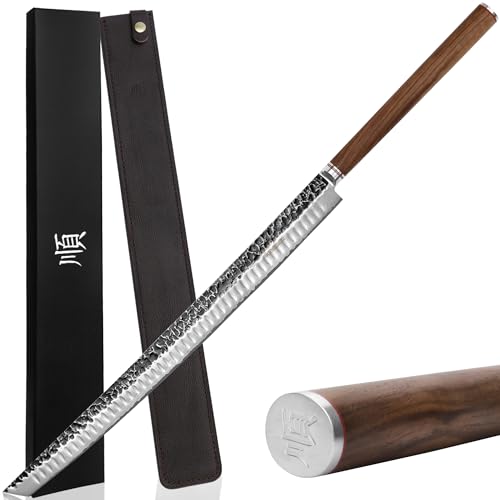
YOUSUNLONG is an outlier in this group with a listed 23-inch blade intended for large tuna, salmon, roasts, steaks, and other substantial ingredients. That length is the entire point. A very large fish or a broad roast can require a long slicing path, and this sakimaru-style knife is aimed at users who have the workspace and technique to manage it. The product information describes a double-sided edge, 67-layer forged Damascus construction, and a high-carbon steel core with a stated hardness range of 58 to 60 HRC.
The elongated walnut handle is described as suitable for a two-handed hold, and a leather sheath is included for protection during storage or transport. Those details make the knife more practical for professional-style food preparation, yet the sheer size creates clear restrictions for ordinary home kitchens. It will be awkward on a small board, difficult to store, and excessive for a salmon portion or a few sushi rolls. The Damascus pattern and hammered surface are visually distinctive, but the purchase decision should rest on the need for exceptional reach rather than decoration.
Pros
- 23-inch blade provides unusual reach for large fish and roasts.
- 67-layer Damascus construction and a 58 to 60 HRC range are listed.
- Double-sided edge may suit users who prefer symmetrical handling.
- Extended walnut handle supports the stated two-handed grip.
- Leather sheath provides a dedicated storage and transport option.
Cons
- Very large size demands substantial workspace and careful handling.
- Double-sided design is less traditional than a classic single-bevel yanagiba.
This knife belongs with a buyer who regularly handles large fish, oversized cuts, or catering-style preparation. It is a poor match for a compact apartment kitchen or occasional sashimi work. Measure the available cutting surface and storage area before ordering, and plan for a stable, unobstructed cutting path. Its ranking reflects a specific use case rather than broad suitability, since no other selected knife offers comparable reach.
To buy this product, click here.
Buying Guide
Match the Edge Style to Your Technique
A traditional yanagiba is generally associated with a single-bevel edge and a smooth draw cut. That geometry differs from the double-bevel construction listed for several modern sushi knives in this guide. Single-bevel models such as the FINDKING and Sumteene deserve special attention during sharpening because their edge maintenance is different from that of a symmetrical blade. Double-bevel options may feel more familiar to a cook who already uses Western knives, but they do not provide the same traditional format by default.
A yanagiba’s role is distinct from fish breakdown. The overview of Japanese kitchen-knife types separates those specialist tasks.
Choose Blade Length for Your Cutting Board
Most home users will find a 9.5- to 10.5-inch knife easier to accommodate than the 23-inch YOUSUNLONG. Longer blades can reduce the need to saw or reposition during a broad fish slice, but they also require a clear board, open counter space, and controlled handling. The Kai Wasabi’s 8.25-inch blade is more compact, while the Shun and FINDKING provide greater reach. Measure the board diagonally and think about the largest fillet you normally prepare.
Read Steel Claims Carefully
The selected knives list several different materials, including SKD11, VG10, VG2, 10Cr15MoV, 10Cr15CoMoV, 440A, 440C, and AUS-free alternatives that are not included in the final nine. A named steel gives more useful information than vague terms such as “premium Japanese steel,” but steel alone does not determine cutting performance. Heat treatment, edge geometry, sharpening quality, and care also matter. Stated hardness can help with comparison, yet it is not a direct measurement of edge retention in your kitchen.
Consider Handle Shape and Handedness
Octagonal handles help communicate blade orientation, which can be useful during long slicing strokes. The Shun and Kai listings specifically identify ambidextrous suitability, while traditional wood handles may feel more directional depending on their construction. Natural wood, Pakkawood, G10, and polypropylene-bamboo each have different care implications. Handle comfort remains personal, so treat claims about balance or reduced fatigue as design intentions rather than guarantees.
Plan for Sharpening and Storage
A long yanagiba should have a protected storage location. The FINDKING includes a walnut saya, the Shun includes a sheath, and the YOUSUNLONG includes a leather sheath. Other models come with presentation boxes, but a gift box may not be a convenient daily blade guard. Single-bevel knives need an appropriate sharpening routine, and the Sumteene listing specifically recommends sharpening before use. Avoid applying a generic double-bevel sharpening method to a single-bevel blade.
Use the Knife for Its Intended Foods
Yanagiba-style knives are intended for slicing boneless fish, sashimi, sushi ingredients, and other soft foods. They are poor choices for frozen food, hard bones, and forceful chopping unless the product information specifically supports that task. A sujihiki-style double-edged knife may be more versatile for cooked meats, while a yanagiba is a more focused tool for clean fish slicing. Choosing the specialized blade makes sense only when the intended preparation matches the geometry.
Finished rolls present a different cutting problem from slicing an unassembled fillet. The guide to cutting sushi rolls cleanly explains the support and drawing motion required.
Best Yanagiba Knife FAQ
What is a yanagiba knife used for?
A yanagiba is a long, narrow slicing knife associated with sashimi and sushi preparation. Its length supports a continuous draw cut through boneless fish, helping the user create broad, clean slices. It is not intended to replace a chef’s knife for chopping vegetables or a deba for cutting through fish bones.
Is a yanagiba usually single bevel?
Traditional yanagiba knives are commonly associated with single-bevel construction. Several products marketed as yanagiba or sushi knives use double-bevel edges, so the product details should be checked carefully. The FINDKING and Sumteene listings explicitly describe single-bevel designs, while other selections in this guide are presented as Japanese-style or double-bevel alternatives.
Is a 10-inch yanagiba too long for home use?
Not necessarily. A 10-inch blade can be practical for home sashimi preparation if the cutting board and counter provide enough open space. It becomes inconvenient when the board is narrow, the fish portion is small, or storage is limited. A shorter 8.25-inch knife such as the Kai Wasabi may be easier for compact kitchens.
How should a yanagiba be sharpened?
Sharpening depends on whether the knife is single bevel or double bevel. A single-bevel yanagiba should be maintained with a method intended for that geometry rather than sharpened like a symmetrical chef’s knife. Follow the product’s care guidance, use suitable abrasives, and avoid removing unnecessary material from the blade.
Can a yanagiba cut meat?
Some long slicing knives can handle boneless meat, and the product listings for several models mention meat slicing. That does not make them suitable for bones, frozen food, or forceful chopping. If cooked roasts and broad meat cuts are your main task, a double-bevel sujihiki may offer a more practical format.
Are stainless yanagiba knives rustproof?
No knife should be treated as completely rustproof. Stainless and high-carbon stainless steels generally offer corrosion resistance, but food residue, moisture, and poor storage can still create problems. Wash the blade by hand unless the exact manufacturer guidance says otherwise, dry it promptly, and protect the edge during storage.
What cutting board works best with a yanagiba?
Use a stable food-preparation board with enough length for the blade and the fish portion. A board that is too short forces awkward repositioning and increases the chance of contacting the blade against nearby objects. The product data does not identify one universal board material, so prioritize stability, adequate dimensions, and a clean surface free from hard contaminants.
Final Verdict
The FINDKING Prestige Series is the best overall choice for shoppers who specifically want a dedicated yanagiba-style sashimi knife. Its 10.5-inch blade, single-bevel construction, documented SKD11 steel, octagonal handle, and included walnut saya create the most complete match for traditional fish slicing among these nine selections. It still requires appropriate sharpening knowledge and enough counter space, so it is a focused tool rather than a general kitchen knife.
Shun’s Dual Core model is the premium alternative for buyers who prioritize layered VG10 and VG2 construction, a 10.5-inch format, a Pakkawood handle, and brand-supported care. Kai’s Wasabi is the practical compact choice for smaller boards and shared kitchens, while Sumteene offers another explicitly single-bevel option at a shorter 9.5-inch length. Match the purchase to your actual fish preparation, cutting space, handedness, and sharpening routine. A well-chosen 10-inch knife will serve a sashimi-focused cook better than an oversized blade that cannot be used comfortably, while a 23-inch sakimaru belongs only with buyers who genuinely prepare very large ingredients.
