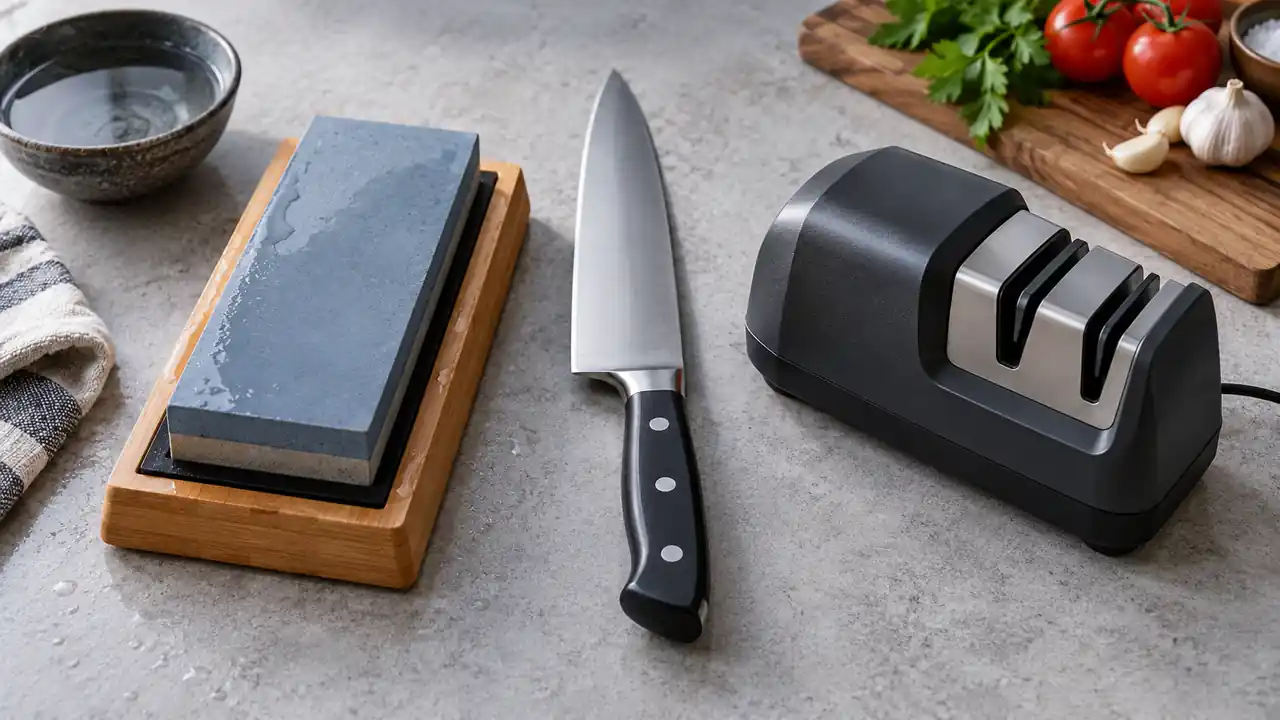
A whetstone offers greater control over sharpening angle, edge shape, abrasive progression, and metal removal. An electric sharpener is faster and easier to use consistently, but its guides and abrasive stages may not suit every knife. The better choice depends on the blade’s geometry, the sharpener’s compatibility, and how much time the user is prepared to spend learning technique.
For ordinary double-bevel kitchen knives, either method can produce a useful cutting edge when used correctly. Whetstones are generally better for varied knife collections, thin blades, asymmetrical edges, and careful repair work. Electric sharpeners suit compatible knives that need convenient, repeatable maintenance with minimal setup.
Want to compare the stone-based route in more detail? The waterstone comparison covers different formats; the discussion below explains how that approach differs from an electric sharpener.
Whetstone vs. Electric Sharpener at a Glance
| Comparison Point | Whetstone | Electric Sharpener |
|---|---|---|
| Angle control | User controls and can adjust the angle | Usually set or guided by the machine |
| Learning curve | Requires practice and angle control | Usually easier for a beginner |
| Sharpening speed | Slower, especially while learning | Usually faster |
| Metal removal | Can be controlled through pressure, grit, and technique | Can remove metal quickly, depending on the abrasive and stage |
| Knife compatibility | Broad, provided the method matches the edge geometry | Limited to the blade types supported by the specific machine |
| Edge customization | High | Limited |
| Maintenance | Some stones require flattening, soaking, or surface cleaning | Abrasive components may wear and require cleaning or replacement |
| Best suited to | Users seeking control and broad compatibility | Users prioritizing convenience and repeatability |
How a Whetstone Sharpens a Knife
A whetstone is an abrasive surface over which the blade is moved at a controlled angle. The abrasive removes steel from both sides of a double-bevel edge until the bevels meet at the apex. As sharpening progresses, a burr may form along the opposite side. That burr must then be reduced and removed through controlled alternating strokes or another suitable finishing process.
The user determines the angle, pressure, stroke direction, and amount of work applied to each section of the blade. This control makes stones useful for correcting uneven bevels, accommodating blade asymmetry, and preserving an existing edge geometry.
“Whetstone” is a broad term rather than a single material. Common forms include:
- Water stones: Used with water according to the manufacturer’s directions. Some require soaking, while others are splash-and-go.
- Oil stones: Used with an approved honing oil or another lubricant specified by the manufacturer.
- Diamond plates: Metal plates coated with diamond abrasive. They remain flat more readily than many conventional stones, though their surfaces still wear over time.
- Ceramic stones: Abrasive stones that vary in hardness, cutting speed, and required preparation.
Grit numbers indicate abrasive coarseness within a particular classification system. Numbers from different grit standards are not necessarily direct equivalents. A coarse abrasive removes steel and repairs damage more aggressively, while a finer abrasive refines the scratches and edge left by an earlier stage.
How an Electric Knife Sharpener Works
An electric sharpener draws the edge past powered abrasive wheels, disks, or belts. Built-in slots usually guide the blade at a predetermined angle or within a narrow angle range. Many machines use separate stages for coarse sharpening, refinement, and finishing, though the construction varies by model.
For the powered route, compare electric knife sharpeners by their guides and abrasive stages while checking the knives you intend to use.
This guided operation reduces the need to hold an angle freehand. It also speeds up material removal. That combination makes electric sharpening convenient, but it leaves less control over the resulting bevel.
The machine’s angle is especially significant. If it differs from the knife’s existing edge angle, the abrasive must remove enough metal to establish a new bevel before it can reach the apex. Repeated use of an aggressive stage can remove more steel than necessary. Light pressure and the minimum required passes help limit avoidable wear, provided those directions agree with the machine’s manual.
Control Over Edge Geometry
Whetstones provide the greater range of adjustment. A user can follow an existing bevel, create a small secondary bevel, sharpen an asymmetrical double-bevel edge, or work different areas of a curved blade with deliberate changes in hand position.
That flexibility has a cost. Inconsistent angles can round the apex or create uneven bevel widths. Excess pressure can also make angle control more difficult. Developing a steady motion usually requires practice.
An electric sharpener exchanges flexibility for mechanical guidance. A compatible knife can receive a consistent edge without freehand angle control. The machine cannot readily adapt if its slots do not match the blade’s thickness, bevel configuration, or intended edge geometry.
Fixed guidance is neither inherently good nor inherently harmful. It works well when the knife and machine are compatible. Problems arise when a sharpener is treated as universal despite restrictions in its instructions.
Which Method Removes More Metal?
Both methods remove steel. The amount depends on abrasive coarseness, pressure, technique, edge condition, and time spent sharpening.
When assessing metal removal, first distinguish honing from sharpening; tool names do not always describe the same operation.
A coarse electric stage can remove metal rapidly. Repeated passes after the edge is already sharp may shorten the blade’s useful life and gradually change its profile. Some machines include finer maintenance stages that are less aggressive, but their behavior remains model-specific.
A whetstone allows closer control over where and how quickly steel is removed. That does not guarantee minimal removal. A coarse stone, excessive pressure, or prolonged grinding can also alter a blade unnecessarily.
With either system, sharpening should stop once the edge has been properly formed, refined, and deburred. A knife that only needs minor edge maintenance should not automatically be subjected to the coarsest abrasive.
Knife Compatibility Matters More Than Sharpening Speed
Ordinary Double-Bevel Kitchen Knives
Many chef’s knives, santoku knives, paring knives, and utility knives have double-bevel edges. They can often be sharpened with either method. For an electric machine, confirm that the blade thickness, edge angle, and material fall within the manufacturer’s supported range.
Thin or Delicate Edges
Thin blades and narrow edge angles can be sensitive to excessive material removal. A whetstone gives the user more control, provided the sharpening technique is appropriate. An electric sharpener should be used only if its documentation specifically supports the knife’s construction and edge geometry.
Single-Bevel Knives
Traditional single-bevel knives require a sharpening process that accounts for the beveled face and the shaped back of the blade. An ordinary double-sided electric sharpener can change that geometry. A suitable stone method or a system specifically documented for the knife is the safer choice.
Asymmetrical Double-Bevel Edges
Some knives use different bevel proportions on each side. A whetstone can preserve that asymmetry through controlled sharpening. A machine that treats both sides equally may convert the edge toward a more symmetrical form.
Serrated Knives
Standard sharpening slots and ordinary flat-stone methods are generally unsuitable for sharpening individual serrations. Some electric machines include a stage approved for certain serrated edges, but that capability should never be assumed. Serrations may require a tapered rod, specialized equipment, or professional service, depending on their shape and the manufacturer’s instructions.
Blades With a Full Bolster
A full bolster can prevent some electric sharpeners or flat stones from reaching the heel of the cutting edge. Repeated sharpening may leave a raised section near the heel that interferes with complete board contact. Correcting substantial bolster interference can require specialized work.
Time, Setup, and Ongoing Maintenance
Electric sharpening is usually the quicker process. Once the unit is positioned securely and the correct stage is identified, sharpening may require relatively few passes. Cleanup and maintenance depend on the machine. Metal filings can collect inside some units, and removable components must be handled according to the manual.
Stone sharpening takes longer because the stone may need preparation, the angle must be maintained by hand, and each abrasive stage requires controlled work. Water stones that wear unevenly also need periodic flattening. A dished stone makes consistent bevel contact harder to maintain.
Preparation varies by abrasive. A stone should never be soaked or lubricated based solely on its appearance. Follow its instructions, and do not apply oil to a water stone unless the manufacturer permits it.
Sharpening Quality Depends on Technique and Compatibility
A stone does not automatically create a sharper edge than a machine. Likewise, an electric sharpener does not guarantee a properly apexed and deburred edge. Each method can produce poor results if the abrasive sequence, angle, pressure, or blade compatibility is wrong.
Signs of a sound sharpening result include:
- The edge cuts cleanly without requiring excessive force.
- The heel, middle, and tip perform consistently.
- No large burr remains folded to one side.
- The bevels match the intended geometry.
- The edge has no new chips or overheated discoloration.
Inspect the edge under good lighting and use a controlled cutting test, such as slicing paper away from the body or cutting a suitable food item on a stable board. Never test sharpness by sliding a finger along the edge.
When a Whetstone Is the Better Choice
A whetstone is a strong fit if one or more of these conditions apply:
- You own knives with different edge angles or bevel configurations.
- You need to preserve a single-bevel or asymmetrical edge.
- You want direct control over pressure and material removal.
- You need to correct localized dullness or minor edge damage carefully.
- You are willing to practice angle control and maintain the stone.
- Your knife’s manufacturer recommends stone sharpening.
Stone sharpening is particularly valuable for users who want to follow an existing bevel rather than convert it to the angle established by a machine.
When an Electric Sharpener Is the Better Choice
An electric sharpener may be more practical when:
- Your knives are explicitly compatible with the machine.
- You value speed and simple operation.
- You have difficulty maintaining a steady freehand angle.
- Your knives use conventional double-bevel edges that match the guide system.
- You prefer repeatable maintenance over edge customization.
Compatibility should be checked separately for each knife rather than inferred from labels such as “Western” or “Japanese.” Knives within either broad style can differ in blade thickness, steel, hardness, grind, and edge angle.
Can You Use Both Methods?
Using both is possible, but the two methods should support the same intended edge geometry. For example, an electric unit might establish an edge while a fine stone handles later refinement. A mismatch between the machine’s guide angle and the stone angle can create a secondary bevel or prevent the abrasive from reaching the apex efficiently.
Frequent switching is unnecessary if one method maintains the knife effectively. Consistency generally makes it easier to preserve bevel shape and avoid excess steel removal.
Safe Use and Care
- Place the stone or electric unit on a stable, dry work surface.
- Keep fingers clear of the edge and sharpening path.
- Move the blade through an electric slot without twisting or forcing it.
- Use only the stages approved for the knife type.
- Disconnect an electric sharpener before cleaning it or removing approved service parts.
- Do not disassemble or modify the electrical unit beyond the manual’s directions.
- Wash or wipe the blade after sharpening to remove abrasive residue and metal particles, then dry it promptly.
- Store the sharpened knife so the edge is protected from accidental contact.
Whetstone or Electric Sharpener: Which Should You Choose?
Choose a whetstone for maximum control, adaptable angles, and compatibility with a wider range of edge geometries. Choose an electric sharpener for speed and guided consistency, provided the machine is approved for the knife.
A rolling system is another arrangement rather than an electric sharpener. The rolling-sharpener-versus-whetstone comparison treats that choice separately.
A varied collection containing thin blades, single-bevel knives, or asymmetrical edges favors stone sharpening. A collection of compatible double-bevel kitchen knives may be maintained efficiently with an electric unit. The knife manufacturer’s sharpening guidance and the sharpener’s operating manual should take priority over generalized angle advice.
Neither method is universally superior. The best result comes from matching the abrasive system to the blade, removing only the steel required, and stopping once the edge is properly formed and deburred.
