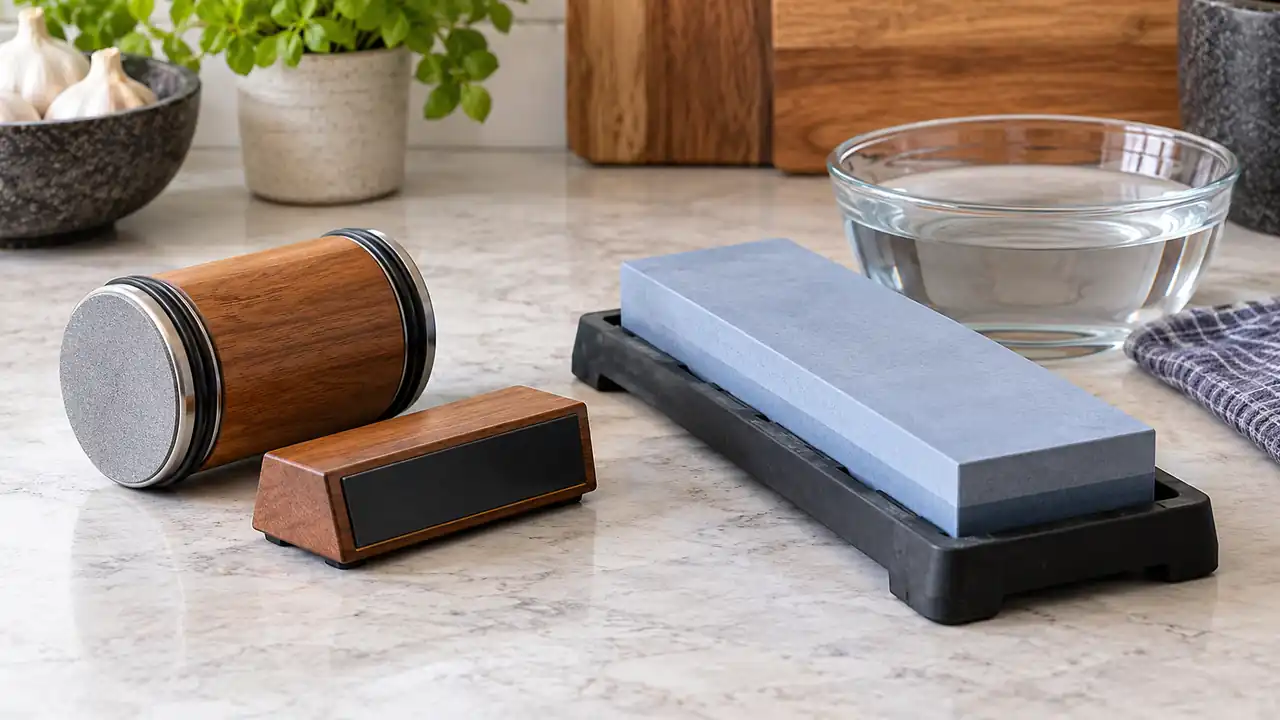
A rolling knife sharpener uses an angle support and a moving abrasive disc to simplify part of the setup. A whetstone usually asks the user to control the blade’s angle and contact directly while offering more freedom over the working surface. The better choice depends on the actual knife, the system’s geometry, and the maintenance you are willing to learn, rather than convenience alone.
If a supported-angle setup appeals to you, compare rolling knife sharpeners and their angle supports. The comparison below explains the limits of that convenience and where a freehand stone offers more control.
Identify What Holds the Angle
In a typical rolling system, the knife is held against a support while the abrasive rolls along the edge. The support establishes a reference angle, but the user still controls placement, pressure, travel, and how the tip is treated. A support does not automatically make every knife fit.
With a freehand whetstone, the user moves the blade over a flat abrasive surface and maintains the intended angle throughout the stroke. That gives flexibility but adds a skill to practice. A suitable holder can stabilize the stone; it does not establish the knife angle by itself.
| Decision | Rolling system | Freehand whetstone |
|---|---|---|
| Angle setup | Depends on the support positions and how the knife sits. | Depends on the user’s control and any compatible guide. |
| Access to the edge | Limited by support contact, disc travel, and knife shape. | More open access, but contact still needs skilled control. |
| Abrasive progression | Depends on the discs or accessories approved for that system. | Depends on the stones and the intended edge work. |
| Routine maintenance | Clean and maintain the discs and support as instructed. | Prepare, clean, inspect, and maintain the stone as instructed. |
Check Blade Shape Before Choosing Convenience
Look at blade height, length, curvature, bolster, and the flat area available for support. A very short or narrow blade may not sit in the intended position. An unusually tall blade can change the required working arrangement. Follow the system’s guidance rather than improvising an unstable extension or support.
Curved tips require attention with either method. On a stone, the user adjusts the stroke to keep the intended bevel in contact. With a rolling system, disc travel and knife placement must still reach the tip without changing the geometry unintentionally.
Serrations, ceramic blades, asymmetrical edges, and traditional single-bevel knives need separate compatibility checks. Do not assume that a device described as suitable for “Japanese knives” supports every Japanese grind. The guide to Japanese-knife sharpening and compatibility explains why the actual edge takes priority over a style label.
Compare Learning Tasks, Not Promised Results
A supported-angle setup can reduce the need to hold one particular freehand angle, but it does not remove the need to understand the edge. The user still needs to know when coarse work is appropriate, when to stop, and how the specified finishing process works.
A whetstone gives the user more direct control over contact and angle. That control can be useful across a varied collection, yet an unpracticed movement can also produce inconsistency. Greater freedom is a capability, not a guarantee of better results.
HORL’s discussion of home sharpening describes its supported rolling approach. Treat performance and convenience statements as the maker’s claims for its system, rather than independent proof that rolling is universally faster or removes less metal than every whetstone method.
Think About Abrasives and Ongoing Care
A rolling system’s available discs define the approved abrasive sequence. Check replacement availability and cleaning instructions before purchasing. A disc that looks similar to another brand’s accessory is not automatically interchangeable.
A whetstone can offer different abrasive types and grades, but grit numbers and preparation requirements need context. A coarse stage is not a mandatory first step every time. Select the least aggressive work that addresses the edge’s condition, within the knife and abrasive makers’ guidance.
These waterstones for kitchen-knife maintenance illustrate the range of formats. Space for preparation, drying, and flatness checks is part of owning a stone, not an optional detail to consider after the edge has become inconsistent.
Clamp-and-Rod Systems Are a Different Arrangement
A guided rod system typically secures the knife in a clamp while a supported abrasive travels across the edge. It is not simply a rolling sharpener with another name. Clamp access, blade positioning, rod travel, and usable angles need their own checks.
Compare clamp-and-guide-rod sharpening systems if that arrangement fits the maintenance you want to perform. Neither a clamp nor a magnetic support establishes universal compatibility with every blade length, shape, or bevel.
Make the Decision From Your Knife Collection
- For a small group of compatible ordinary blades: a rolling setup may offer a convenient, repeatable arrangement when the instructions match the knives.
- For varied geometry or specialized work: an appropriate stone method can offer useful control, provided the user learns the technique.
- For damaged or unfamiliar specialist edges: obtain suitable professional guidance instead of choosing a device by convenience claims.
Electric sharpening introduces another set of guides, abrasives, and operating restrictions. The separate whetstone-versus-electric-sharpener comparison covers that decision without treating powered and rolling systems as interchangeable.
Choose a method whose setup you can use correctly and maintain consistently. A simple routine that suits the actual blade is more useful than owning several systems whose limits have not been checked.
