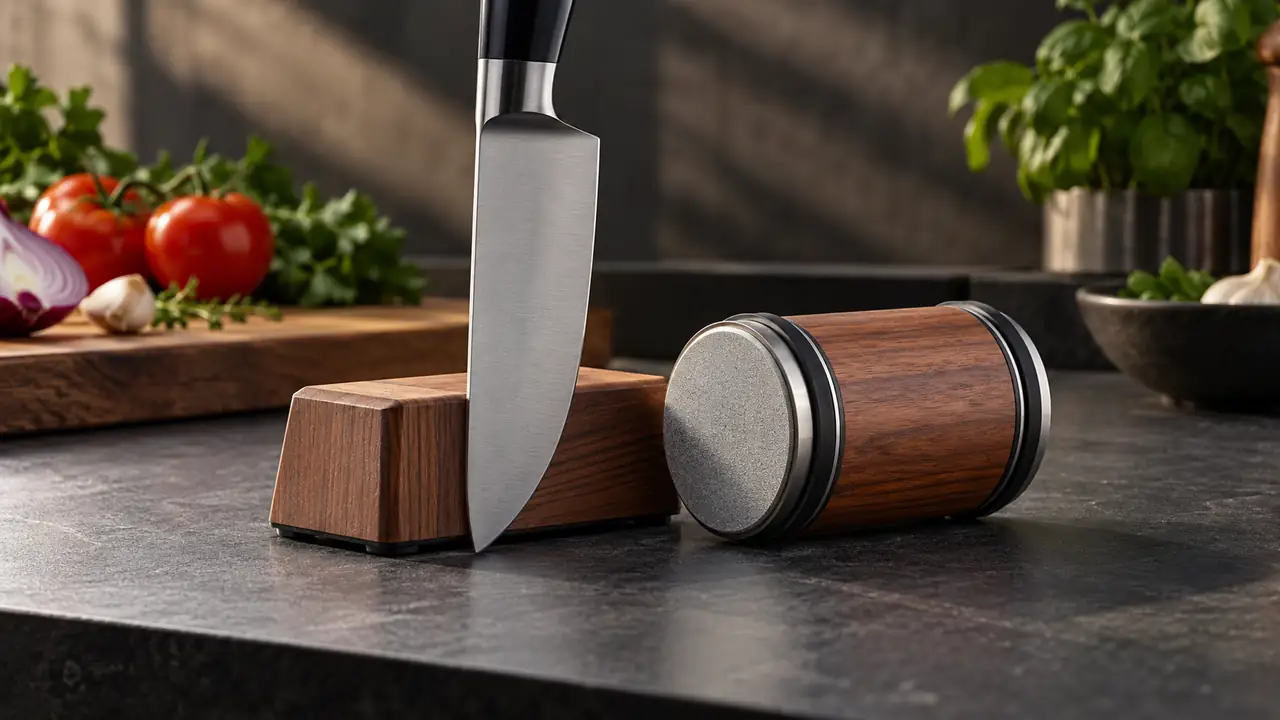
A rolling knife sharpener appeals to cooks who want more control than a pull-through device without learning the full technique of a whetstone. The roller travels along the blade while a magnetic guide holds the knife at a preset angle, creating a repeatable sharpening motion for ordinary kitchen knives, outdoor blades, and utility tools. The catch is that these systems differ considerably in abrasive stages, angle options, replacement parts, and compatibility with serrated or single-bevel blades.
A coarse diamond disc can restore a neglected edge, while a finer diamond, ceramic, or honing surface refines the result. That distinction matters because sharpening removes metal, whereas honing and stropping mainly refine the edge and help clear a burr. Angle selection matters too. A 20-degree guide generally suits many sturdy household knives, while a 15-degree setting is intended for finer edges, though the correct choice should match the knife’s existing geometry rather than a broad assumption about Japanese or Western blades.
The products below range from compact two-angle kits to systems with several abrasive stages, adjustable guidance, or replaceable discs. The Tumbler Pro earns the strongest overall position because its removable disc system, diamond and ceramic stages, and weighted body give it a useful balance of control and flexibility. Other options make more sense for a complete kitchen collection, a refined wooden design, a wider selection of angles, or a lower-complexity setup.
Quick Answer
- Tumbler Pro Rolling Knife Sharpener: Best Overall for buyers who want a sturdy guided system with a four-layer diamond disc, ceramic honing disc, and removable abrasive design.
- HORL 3 Walnut Rolling Knife Sharpener: A refined choice for users who want a walnut-bodied system with 15-degree and 20-degree guides plus diamond and ceramic discs.
- Work Sharp Rolling Knife Sharpener: A practical choice for maintaining a full kitchen knife collection, with four preset angles and access to genuine replacement abrasives.
Best Rolling Knife Sharpener Comparison Table
| Product | Best For | Angle Options | Abrasive Setup |
|---|---|---|---|
| Tumbler Pro Rolling Knife Sharpener | Overall control and flexibility | Guided 15° and 20° | Four-layer diamond and ceramic |
| HORL 3 Walnut Rolling Knife Sharpener | Premium wooden construction | 15° and 20° | Diamond and ceramic |
| Work Sharp Rolling Knife Sharpener | Full knife collections | Four preset angles | Diamond abrasives |
| ORIVIX Rolling Knife Sharpener Kit | Multiple grits and travel storage | 15°, 18°, 20°, and 22° | Two diamond and two ceramic discs |
| Hatori Adjustable Angle Rolling Sharpener | Guided multi-stage sharpening | Adjustable guidance with 15° and 20° positioning | Diamond surfaces, whetstones, and honing steel |
| The Original Tumbler Rolling Knife Sharpener | Simple diamond sharpening | 15° and 20° | Diamond and stainless steel helix disc |
| AIERLIAN Rolling Knife Sharpener Kit | Compact two-stage maintenance | 15° and 20° | 400-grit diamond and 3000-grit ceramic |
| BOGONI Rolling Knife Sharpener | Wooden kit with strop | 15° and 20° | 400-grit diamond and 3000-grit ceramic |
| ALBEG Rolling Knife Sharpener | Water-free diamond sharpening | 15° and 20° | 400-grit and 1000-grit diamond |
The detailed reviews explain how each system handles abrasive stages, angle selection, storage, replacement parts, and blade compatibility.
1. Tumbler Pro Rolling Knife Sharpener — Best Overall

The Tumbler Pro is the most complete match for shoppers who want a rolling sharpener that can handle routine maintenance and more deliberate edge refinement. Its four-layer diamond disc is intended for controlled material removal, while the EdgeBoost ceramic disc provides a finer finishing stage. That two-part arrangement is useful for a dull chef’s knife that needs more than a quick touch-up, since the abrasive work and final refinement are handled separately.
The weighted resin body and magnetic angle support give the system a more substantial format than a very small roller. Its removable disc design also leaves room for optional whetstone discs, sold separately, which may appeal to users who want to expand their sharpening routine later. The available information describes use with kitchen knives, utility blades, field knives, and everyday-carry blades, but serrated and unusual edge profiles should be treated cautiously unless specifically supported.
Pros
- Four-layer diamond disc supports controlled edge restoration.
- Included ceramic disc provides a separate refining stage.
- Removable disc system allows future expansion with optional discs.
- Weighted resin body offers a substantial sharpening platform.
- Suitable for kitchen, utility, field, and everyday-carry blades according to the listing.
Cons
- Optional whetstone discs add another purchase for advanced sharpening.
- Its larger system format may be more than a casual user needs.
This is the strongest pick for a home cook with several knives, especially if some edges need genuine reshaping while others only need refinement. Buyers who want the simplest possible two-disc kit may find the extra system flexibility unnecessary. Use the coarse abrasive sparingly, then move to the ceramic stage once the edge has been restored rather than repeatedly removing steel from an already serviceable blade.
To buy this product, click here.
2. HORL 3 Walnut Rolling Knife Sharpener — Best Premium Wooden Design

The HORL 3 Walnut focuses on a polished, compact sharpening experience built around two familiar stages. Its block-diamond disc is described as removing steel faster than the earlier HORL 2 version, while the ceramic disc refines the edge and helps remove the burr left by grinding. For a cook who wants a dedicated tool stored beside a knife block, that arrangement keeps the routine straightforward without requiring water, oil, or a stone setup.
Its two magnetic angle positions cover a fine 15-degree edge and a more robust 20-degree edge. The finer position may suit certain high-carbon or Damascus blades, while the broader setting is aimed at everyday European-style chef’s knives and outdoor blades. Those descriptions should guide setup, but the existing bevel still deserves attention. A rolling sharpener is easiest to use when its guide matches the knife rather than forcing a new angle on every blade.
Pros
- Walnut body gives the tool a distinctive kitchen-friendly appearance.
- Diamond and ceramic discs separate reshaping from refinement.
- 15-degree and 20-degree magnetic positions cover common knife needs.
- Updated grip pad and magnets are intended to hold blades securely.
- Suitable for kitchen, pocket, and outdoor knives according to the supplied information.
Cons
- Only two angle positions are available.
- The premium design may be unnecessary for users maintaining inexpensive everyday knives.
The HORL 3 Walnut suits buyers who care about both sharpening function and countertop presentation. It is especially appealing for a household with a mix of fine-edged and sturdier knives. It is less suitable for someone seeking adjustable angle control or a broad assortment of included grits. Keep the ceramic disc for finishing work, and avoid treating the diamond disc as a daily honing surface.
To buy this product, click here.
3. Work Sharp Rolling Knife Sharpener — Best for a Full Knife Collection

A kitchen drawer filled with a chef’s knife, santoku, paring knife, and utility blade can make angle consistency frustrating. The Work Sharp Rolling Knife Sharpener addresses that situation with four preset angles, giving the user more choices than the common 15-degree and 20-degree pairing. The magnetic guide handles the angle while the roller supplies the motion, which can make it easier to maintain a similar edge across a mixed collection.
The system uses diamond abrasives and is described for chef, santoku, paring, and utility knives. That product focus makes it a practical choice for regular kitchen maintenance rather than a specialized tool for a single blade style. Another meaningful distinction is access to genuine Work Sharp replacement abrasives. Replacement availability matters because a rolling sharpener becomes less useful once its abrasive wears, and the supplied information specifically presents this system as serviceable over time.
Pros
- Four preset angles offer more adjustment than two-position systems.
- Suitable for several common kitchen knife categories.
- Rolling format supports repeatable guided sharpening.
- Diamond abrasives address dull edges efficiently.
- Genuine replacement abrasives are available from the brand.
Cons
- The supplied information does not specify the exact grit progression.
- Angle choices still remain preset rather than fully adjustable.
This model makes sense for households that maintain a complete knife set and want one system for several blade types. The four-angle format gives useful flexibility, although buyers who require a documented coarse-to-fine progression may prefer a kit that lists each disc or stage clearly. It also deserves attention from anyone who dislikes disposable sharpening tools, since replacement abrasive support is a practical ownership advantage.
To buy this product, click here.
4. ORIVIX Rolling Knife Sharpener Kit — Best for Angle and Grit Variety

The ORIVIX kit stands out through breadth rather than a single headline feature. Its 3.86-inch wooden roller is longer than many compact designs, and the listing positions that extra length as a way to improve grip and movement. Four angle settings, 15, 18, 20, and 22 degrees, give the user a useful spread for fine slicing knives, general kitchen blades, and sturdier utility edges.
Its abrasive package is unusually complete for this group. The kit includes 400-grit and 1000-grit diamond discs for heavier and lighter sharpening work, along with 3000-grit and 6000-grit ceramic discs for refinement. A leather strop is included for final burr removal, and the carrying case helps keep the pieces together in a drawer or travel bag. The trade-off is a little more decision-making, since a beginner must learn which stage belongs where.
Pros
- Four angle positions provide broad guided adjustment.
- Includes two diamond and two ceramic abrasive stages.
- Longer wooden roller is intended to support controlled movement.
- Leather strop adds a separate finishing step.
- Carrying case supports organized storage or travel.
Cons
- The larger assortment may feel complicated for occasional sharpening.
- More included stages require careful selection to avoid unnecessary steel removal.
Choose the ORIVIX when angle range and included finishing options matter more than minimal setup. It is a sensible fit for a household with different knife styles, provided the user follows a restrained progression from coarse diamond to finer finishing surfaces. Someone who wants to sharpen one or two ordinary knives twice a year may prefer a simpler system.
To buy this product, click here.
5. Hatori Adjustable Angle Rolling Sharpener — Best for Guided Multi-Stage Work

The Hatori takes a different approach from a basic magnetic roller by combining guided positioning with a dial-controlled system, a guide rod, and an anti-slip base. The available information also lists diamond surfaces, wet whetstone blocks, and a stainless-steel honing steel. That combination gives the user several maintenance methods, although it also means the kit asks for more involvement than a simple diamond-and-ceramic roller.
Two magnetic angle positions, 15 and 20 degrees, are listed alongside adjustable guided sharpening. The kit is intended for common stainless-steel cutlery, chef knives, and paring knives, with a clear restriction against serrated blades and scissors. Detachable components can be rinsed, and the manual format works without power, which may appeal to an RV, camping, or compact-kitchen user who wants a portable sharpening setup.
Pros
- Dial-guided design offers more control than a basic free-rolling system.
- Includes diamond, whetstone, and honing components.
- Anti-slip base supports countertop use.
- Detachable parts allow water-based cleanup.
- Portable manual format suits indoor and outdoor use.
Cons
- The mixed sharpening system may require more setup and maintenance knowledge.
- It is unsuitable for serrated blades and scissors.
Hatori is a good match for a beginner who wants guidance but also expects to explore more than one sharpening method. The whetstone components need appropriate handling, and the honing steel should not be treated as a substitute for abrasive sharpening when an edge is genuinely dull. Buyers seeking a quick, dry routine will likely find the simpler kits easier to live with.
To buy this product, click here.
6. The Original Tumbler Rolling Knife Sharpener — Best for Simple Guided Sharpening

The Original Tumbler keeps the routine focused: secure the blade with the magnetic angle support, roll the diamond disc, then use the stainless-steel helix disc to hone and refine the edge. That simple sequence may be appealing to a home cook who has no interest in soaking stones or managing several abrasive grades. The system is listed for kitchen, field, utility, and outdoor knives, giving it broader use than a kitchen-only sharpener.
Its fixed 15-degree and 20-degree positions cover the two common angle choices represented across this category. The diamond disc is intended to restore sharpness, while the helix disc handles the finishing stage. Because the product information does not list a set of interchangeable grits, the Original Tumbler is better viewed as a streamlined maintenance tool than a highly configurable sharpening platform.
Pros
- Simple diamond-to-honing workflow is easy to understand.
- 15-degree and 20-degree guides suit different edge preferences.
- Magnetic support helps maintain the selected angle.
- Listed for kitchen, field, utility, and outdoor knives.
- Wood construction gives the system a traditional appearance.
Cons
- Fixed angle positions limit customization.
- The supplied information does not identify multiple replaceable grit options.
This is a reasonable choice for someone who values a tidy, repeatable routine over a large accessory set. It may be less suitable for a user who frequently repairs heavily damaged edges or wants to tune different steels with several abrasive levels. For ordinary kitchen upkeep, its uncomplicated sequence is the main attraction.
To buy this product, click here.
7. AIERLIAN Rolling Knife Sharpener Kit — Best Compact Two-Stage Kit
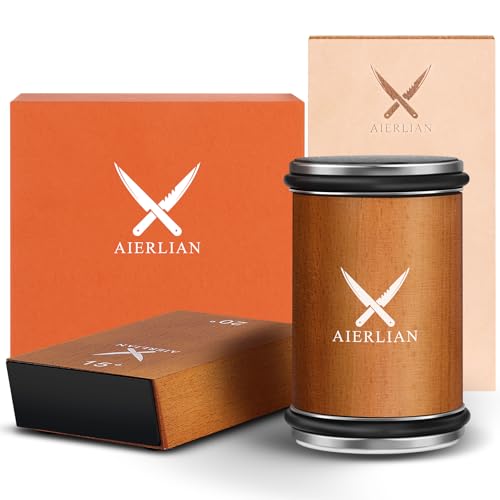
AIERLIAN uses a straightforward 400-grit diamond disc followed by a 3000-grit ceramic disc. That pairing gives the user a clear division of labor: the diamond surface handles a dull edge, while the ceramic surface refines it. Four N42 magnets are listed in the magnetic support, and the natural wood body keeps the kit visually familiar for a kitchen drawer or countertop.
The two guide positions are 15 and 20 degrees. The product information excludes serrated knives and scissors, so this is aimed at smooth-edged kitchen and outdoor blades. A leather strop is included for further burr refinement, which adds a useful finishing step without turning the kit into a large multi-disc system. Its limited angle range is easier to understand, although it may not suit knives that require a different existing bevel.
Pros
- Clear 400-grit diamond and 3000-grit ceramic progression.
- Leather strop adds a final edge-refining option.
- Magnetic support uses four listed N42 magnets.
- Wooden body offers a compact kitchen-friendly format.
- Two angle positions keep setup relatively simple.
Cons
- Not intended for serrated knives or scissors.
- Only two angle positions are provided.
AIERLIAN fits a cook who wants more than a single abrasive but fewer parts than a full sharpening system. The strop is useful after the ceramic stage, while the 400-grit disc should be reserved for edges that actually need material removed. Buyers with several specialty blades or unusual bevels will likely need a more adjustable option.
To buy this product, click here.
8. BOGONI Rolling Knife Sharpener — Best Wooden Kit with Strop

BOGONI follows a familiar two-stage pattern with a 400-grit diamond disc and a 3000-grit ceramic disc. That makes the kit easy to understand for a household knife drawer: use the diamond surface for a dull edge, then move to ceramic for a finer finish. The listing also describes six N52 magnets in the support and a natural wood roller, features aimed at keeping the blade positioned while the user works.
The 15-degree and 20-degree guides cover fine and robust edge setups, although they should be selected with the blade’s existing bevel in mind. A leather strop is included, and the product is listed for kitchen and pocket knives. That combination gives BOGONI a useful maintenance sequence in a small package, but the available information does not provide a broader grit assortment for extensive edge repair.
Pros
- Includes both diamond and ceramic sharpening stages.
- Leather strop provides an additional finishing step.
- Two magnetic angle positions cover common household edges.
- Six listed N52 magnets support blade positioning.
- Wooden roller and gift-ready packaging suit home use.
Cons
- The system offers fewer grit choices than multi-disc kits.
- Its listed compatibility does not extend to every blade style.
BOGONI is suited to a cook who wants a conventional roller, a ceramic finishing stage, and a strop without a long learning curve. It is less compelling for a knife enthusiast who wants to reprofile several blade types or replace worn discs with a wide range of abrasives. Use light, controlled passes and let the abrasive do the work.
To buy this product, click here.
9. ALBEG Rolling Knife Sharpener — Best Water-Free Diamond Setup

ALBEG keeps its abrasive system entirely diamond-based, with 400-grit and 1000-grit discs. The coarse disc is intended for restoring a dull edge, while the finer disc refines the result. For a user who wants a dry setup with no water or oil, that arrangement is appealing. The rolling motion and magnetic holder also reduce the need to maintain a freehand angle during a quick maintenance session.
The discs use a removable threaded design, so they can be taken off and replaced when worn. Replacement discs are not included, which is a practical ownership detail to keep in mind. The 15-degree and 20-degree guide options suit many smooth-edged kitchen knives, but the system’s available information does not list a ceramic or stropping stage, so it is focused more on sharpening than final polishing.
Pros
- 400-grit and 1000-grit diamond discs cover two sharpening stages.
- Dry operation avoids water or oil setup.
- Threaded discs can be removed and replaced.
- 15-degree and 20-degree magnetic guides support common edge angles.
- Compact manual design suits routine kitchen maintenance.
Cons
- Replacement discs are not included.
- No ceramic or leather finishing stage is listed.
ALBEG makes sense for someone who values quick, water-free sharpening and replaceable abrasive components. It may leave a user wanting a finer finishing stage, especially on knives where a polished edge is preferred. Pairing the tool with careful light passes is more appropriate than using the coarse disc for every routine touch-up.
To buy this product, click here.
Buying Guide
Match the Angle to the Existing Edge
Rolling sharpeners simplify angle control, but a 15-degree or 20-degree guide is not automatically right for every knife. A finer guide may suit a delicate, thin edge, while a 20-degree position is commonly intended for a more durable household edge. Check the product’s supported positions and avoid changing angles casually, since repeated reprofiling removes more metal than routine maintenance.
Separate Sharpening From Honing
Diamond discs and coarse abrasives remove material to rebuild an edge. Ceramic discs, stainless honing surfaces, and leather strops refine the edge after that work. A system with both stages gives you more control, but it also requires restraint. If a knife still cuts well, a fine ceramic pass or strop may be more appropriate than starting with a coarse diamond disc.
Compare Abrasive Progression
A two-disc system can be perfectly practical, but the grit sequence determines how much control you have over dull or damaged blades. The ORIVIX lists 400 and 1000 diamond discs plus 3000 and 6000 ceramic discs, while ALBEG lists 400 and 1000 diamond discs. Products with more stages allow finer progression, though they require more choices and storage space.
Check Blade Compatibility
Several products in this roundup are intended for smooth-edged kitchen knives and exclude serrated knives or scissors. Serrations need a different approach because a flat rolling abrasive cannot follow each scallop properly. Single-bevel knives also deserve caution, since ordinary dual-angle guidance may not match their edge construction.
Think About Replacement Parts
Disc wear is part of ownership. ALBEG uses removable threaded discs but does not include replacements, while Work Sharp specifically lists genuine replacement abrasives. Tumbler Pro supports removable discs and optional whetstone discs. A replacement path can matter more than an attractive initial kit if you sharpen frequently.
Choose the Right Storage Format
A small two-stage roller is easy to keep in a kitchen drawer. A multi-disc kit with a strop, extra angle guides, or a carrying case needs more room but may serve a wider range of knives. If the sharpener will travel to a campsite or second kitchen, a case and dry operation can be more useful than a larger collection of accessories.
Best Rolling Knife Sharpener FAQ
Are rolling knife sharpeners suitable for beginners?
They can be easier to learn than freehand whetstone sharpening because the magnetic support establishes a guide angle. Beginners still need to identify the correct angle, secure the knife, use controlled passes, and avoid excessive pressure. Start with a smooth-edged kitchen knife and follow the product’s instructions.
Angle support reduces one part of the setup but does not settle every compatibility question. The rolling-sharpener-versus-whetstone comparison explains blade fit and abrasive access.
Is a 15-degree angle sharper than a 20-degree angle?
A 15-degree guide can produce a finer edge geometry, but sharpness depends on the abrasive, edge condition, technique, and knife construction. A 20-degree edge may be a better practical match for a sturdier household blade. The smaller number is not automatically superior for every knife.
Can these sharpeners handle serrated knives?
Do not assume that they can. The supplied information for AIERLIAN and Hatori specifically excludes serrated knives, and a flat rolling disc generally cannot follow individual serrations. Use a sharpening method intended for the serration shape instead.
Should I use the coarse diamond disc every time?
No. Coarse diamond abrasives remove more material and are better suited to a dull or damaged edge. For routine maintenance, use the finer stage, ceramic disc, or strop if the product provides one. Stop once the edge has been restored rather than continuing for a fixed number of passes.
Do rolling sharpeners require water or oil?
Many of the products listed here are designed for dry use. ALBEG specifically describes water-free sharpening, while Hatori includes wet whetstone components that involve a different maintenance routine. Always follow the instructions for the exact abrasive being used rather than applying one method to every disc.
Can I use one rolling sharpener on Japanese and Western knives?
Some products list compatibility with both types, but the angle and edge construction still matter. A 15-degree guide may suit some fine Japanese-style blades, while a 20-degree setting may suit many sturdier Western kitchen knives. Avoid assuming that every Japanese knife shares one angle or that every Western knife uses another.
How often should a rolling knife sharpener be used?
There is no universal schedule. Frequency depends on cutting volume, the board surface, food preparation, and the knife’s edge condition. Use a sharpener when the knife no longer performs as expected, and favor the finest suitable stage before reaching for a coarse abrasive.
Final Verdict
The Tumbler Pro Rolling Knife Sharpener is the strongest overall choice in this nine-product comparison. Its diamond and ceramic stages cover restoration and refinement, while the removable disc format leaves room for a more advanced setup later. It suits a household with several smooth-edged knives and a user who wants more control than a basic two-stage roller provides.
The HORL 3 Walnut is the refined alternative for buyers who value a compact wooden design and a clear 15-degree or 20-degree workflow. Work Sharp is the better fit for a varied kitchen collection because its four preset angles and replacement abrasive support address long-term maintenance. For broader grit and angle selection, ORIVIX deserves attention, while ALBEG is the simpler water-free diamond option. Match the sharpener to your blade types, existing bevels, preferred finishing stage, and willingness to manage replacement parts.
