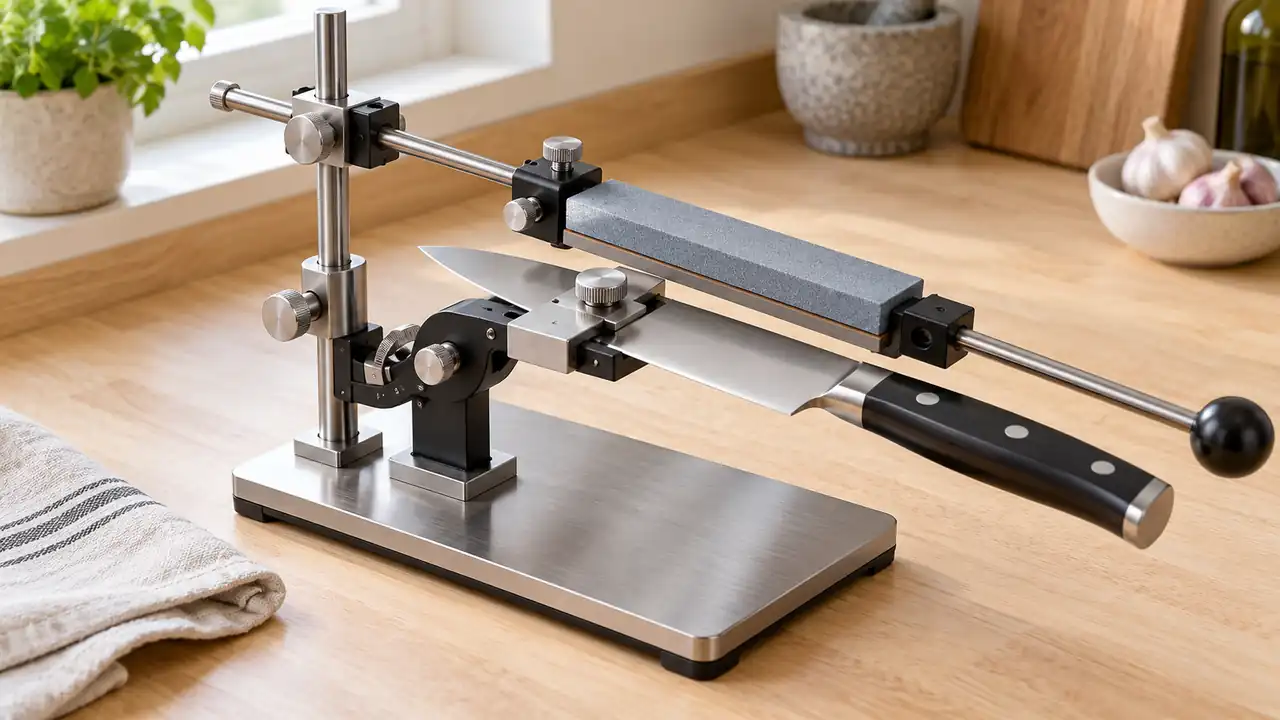
A guided knife sharpening system gives home cooks a repeatable way to restore an edge without relying entirely on freehand technique. Instead of balancing a stone by eye, the guide rod, clamp, or angle mechanism helps keep the abrasive aligned with the blade. That can be especially useful for kitchen knives that have gradually become dull, pocket knives with uneven bevels, or hunting blades that need more controlled maintenance.
The biggest mistake is treating every guided sharpener as interchangeable. Angle range, clamp design, abrasive progression, blade clearance, and the method used to flip the knife all affect the result. A compact system with three diamond plates may be convenient for routine kitchen maintenance, while a larger kit with coarse diamonds, fine stones, and a strop may suit someone maintaining several knives. Adjustable angles also deserve careful attention. The number shown by a guide may refer to one side rather than the total edge angle, so it should be matched thoughtfully to the existing bevel.
This comparison focuses on systems that provide some form of guided angle control, fixed-angle support, or guided contact. The leading options differ considerably. Some favor portability and simple diamond plates, while others offer broad grit ranges, clamps for different blade widths, or a guided benchstone format that takes up less room. The SHARPAL 202H with its angle reference base stands out for buyers who want the broadest adjustment range and a complete abrasive sequence, while the Work Sharp Precision Adjust remains a more compact choice for everyday knife care.
Quick Answer
- Best Overall: SHARPAL 202H Precision Knife Sharpening System for its 10 to 35 degree adjustment range, dual sliding clamps, broad abrasive selection, and angle gauge reference base.
- Best Compact System: Work Sharp Precision Adjust Knife Sharpener Kit for kitchen, pocket, hunting, and some serrated knives when storage space and manual control matter.
- Best Roller Design: Rolling Knife Sharpener for cooks who prefer a rolling sharpening motion, adjustable height, and five removable plates for kitchen blades.
Best Guided Knife Sharpening System Comparison Table
| Product | Best For | Angle System | Abrasive Setup |
|---|---|---|---|
| SHARPAL 202H Precision System | Broadest guided adjustment | 10 to 35 degrees | Diamond, ceramic, whetstone, strop |
| XARILK GEN3 Aluminum System | Routine kitchen and outdoor use | Adjustable | 320, 800, 2000 diamond plates |
| XARILK GEN3 With Carrying Case | Portable guided sharpening | Adjustable | 320, 800, 2000 diamond plates |
| XARILK GEN3 With Securing Clip | Added clamping stability | Adjustable | 320, 800, 2000 diamond plates |
| Work Sharp Precision Adjust | Compact mixed knife collections | 15 to 30 degrees | Progressive guided abrasives |
| RUIXIN PRO RX-008 | Large grit selection | Fixed-angle rod system | 10 whetstones |
| Rolling Knife Sharpener | Kitchen knives and cleavers | 10 to 40 degrees | Diamond, ceramic, corundum, strop |
| Lansky Standard System | Simple coarse-to-fine work | Controlled-angle clamp | 120, 280, 600 hones |
| Work Sharp Benchstone | Guided bench sharpening | 20 or 25 degrees | 400, 800 diamond, ceramic |
The individual reviews explain how each system handles angle control, abrasive progression, blade compatibility, storage, and the practical compromises behind its ranking.
1. SHARPAL 202H Precision Knife Sharpening System – Best Overall

The SHARPAL 202H earns the top position because it offers the most complete guided setup in this group without restricting the user to a narrow angle range. Its adjustment spans 10 to 35 degrees, giving it room for many common kitchen, pocket, outdoor, and broad-bladed knife profiles. The dual sliding clamps are intended to hold blades of different widths, and the flip mechanism is designed to preserve the selected setting as the knife moves from one side to the other.
The abrasive progression is the main attraction for anyone who wants more than basic edge repair. Four diamond plates cover 220, 325, 600, and 1000 grit, followed by a 3000-grit ceramic plate, a 6000-grit whetstone plate, and a leather strop. That sequence lets a user stop after a practical sharpening stage or continue toward a more refined finish. The angle gauge reference base is also useful for buyers who want to check a digital gauge against the abrasive and guide rod rather than estimate the relationship by eye.
Pros
- Adjustable 10 to 35 degree angle range suits a broad selection of blades.
- Seven abrasive components cover repair, sharpening, refinement, and stropping.
- Dual sliding clamps are intended for narrow knives through wide cleavers.
- Angle gauge reference base supports more careful angle setup.
- Rigid case and anti-slip base help with organization and stability.
Cons
- The large abrasive selection can make setup slower for beginners.
- Its larger system format may be more equipment than a casual cook needs.
This is the strongest choice for a household with several knife types or for a user who wants to learn how different abrasives affect an edge. It also makes sense for someone who values repeatable settings and wants a case for storing the components together. Buyers who sharpen one inexpensive kitchen knife a few times a year may find the extensive progression unnecessary. Users should also confirm how the stated angle is measured before applying it to a delicate or specialized edge.
To buy this product, click here.
2. XARILK GEN3 Guided Knife Sharpening System – Best Three-Plate Diamond System

XARILK’s GEN3 system keeps the format relatively straightforward: an aluminum guided sharpener paired with three aluminum-backed diamond plates. The 320-grit plate is suited to more substantial edge repair, the 800-grit plate handles general sharpening, and the 2000-grit plate provides a finer finishing stage. That progression is easier to understand than a large collection of stones, especially for someone who wants to maintain kitchen knives and occasional outdoor blades without building a full sharpening bench.
Angle and pressure are adjustable, which gives the user more control than a fixed pull-through sharpener. The aluminum construction is also relevant for people who expect to use the system repeatedly and want a metal platform rather than a lightweight plastic guide. The available information lists compatibility with kitchen, hunting, folding, and other knives, though the actual blade fit still depends on the clamp and the knife’s shape.
Pros
- Three clearly separated diamond stages cover repair through fine sharpening.
- Adjustable angle and pressure allow more control over the edge.
- Aluminum construction provides a substantial guided platform.
- Suitable for kitchen, folding, hunting, and outdoor knife categories.
- Fewer components make the sharpening sequence easier to follow.
Cons
- It lacks the very fine ceramic, whetstone, and strop stages included with larger kits.
- The available information does not specify a numerical angle range.
This XARILK is a sensible fit for a buyer who wants a direct three-step routine and does not need a mirror-polishing setup. The 320, 800, and 2000 sequence gives enough range for regular edge care, but users repairing heavily damaged blades may prefer a coarser starting abrasive. It is also worth checking the knife’s width and clamp contact before sharpening expensive or unusually shaped blades.
To buy this product, click here.
3. XARILK GEN3 Guided Knife Sharpening System With Hard Carrying Case – Best Portable Option

This version uses the same core three-plate arrangement as the other XARILK GEN3 system, but the hard carrying case changes its practical appeal. The case has pre-cut foam sections for the main sharpener and the 320, 800, and 2000 grit plates. That matters if the system will travel between a home kitchen, workshop, campsite, or hunting kit, since loose diamond plates can become scratched, misplaced, or difficult to identify when stored together.
The sharpening sequence remains uncomplicated. A dull edge can begin on the coarser plate, move to the medium abrasive, and finish on the finer plate without switching to a separate stone holder or strop. The aluminum-backed plates and adjustable guided design give it a more structured feel than freehand sharpening, although the listing does not provide a numerical adjustment range. Portability is the defining distinction here, not a broader abrasive range.
Pros
- Hard case keeps the sharpener and three plates organized during storage or travel.
- Foam interior helps prevent components from shifting inside the case.
- 320, 800, and 2000 grit plates create a logical three-stage routine.
- Aluminum construction is suited to repeated sharpening sessions.
- Adjustable guided format can serve kitchen, folding, hunting, and outdoor knives.
Cons
- The carrying case adds bulk compared with a bare sharpening system.
- There are no listed ultra-fine polishing or stropping components.
Choose this configuration if the sharpener will spend part of its life in a drawer and the rest in a travel case. It is especially practical for people who maintain knives in more than one location. A stationary home user may prefer the simpler version if storage is already easy, while someone seeking a polished finishing edge will need an additional stropping or polishing step.
To buy this product, click here.
4. XARILK GEN3 Guided Knife Sharpening System With Securing Clip – Best for Added Blade Stability

The securing clip is the important difference in this XARILK configuration. Guided sharpening depends on the blade remaining steady while the abrasive travels across the edge, so movement at the clamp can make consistent bevel work harder. This version is aimed at users who want extra support around the blade fixture while working through the same 320, 800, and 2000 grit diamond progression found in the other GEN3 options.
The three plates cover the basic arc from restoring a dull edge to refining it. Diamond abrasives also avoid the soaking routine associated with many water stones, although they still need appropriate cleaning and careful handling. The aluminum body is listed as durable, and the system is intended for kitchen, hunting, pocket, and outdoor knives. Its main limitation is the absence of a stated numeric angle range, which makes it harder to compare its adjustment directly with systems that publish specific settings.
Pros
- Securing clip is intended to reduce blade movement during sharpening.
- Three diamond plates support coarse, medium, and fine stages.
- Aluminum construction provides a sturdy platform for guided work.
- Broad intended use includes kitchen, hunting, pocket, and outdoor blades.
- Adjustable guide offers more control than a fixed pull-through sharpener.
Cons
- The listing does not specify a numerical angle range.
- The kit does not include a separate leather strop or ultra-fine finishing abrasive.
This model is a reasonable pick for someone who places clamp stability ahead of portability or an extensive finishing kit. It may be particularly useful for a beginner who finds blade movement distracting during the first sharpening sessions. Buyers who need documented angle settings, a travel case, or a wider abrasive progression should look toward SHARPAL or the Work Sharp Precision Adjust instead.
To buy this product, click here.
5. Work Sharp Precision Adjust Knife Sharpener Kit – Best Compact System
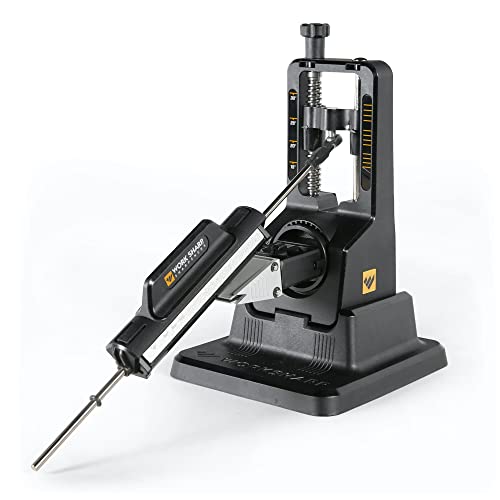
The Work Sharp Precision Adjust is built around a compact fixed-angle concept that suits buyers who want repeatable manual sharpening without a large bench setup. Its adjustment range runs from 15 to 30 degrees, covering many common kitchen, chef, paring, hunting, and folding knife needs. The guided structure removes much of the guesswork from holding an abrasive at a consistent relationship to the edge, while the manual format keeps the process quiet and independent of power.
Its intended compatibility is unusually broad for a compact kit, with the listing also identifying serrated edges among its supported applications. That does not mean every serrated blade should be treated like a plain edge, so users still need to follow the appropriate contact method and avoid forcing a flat abrasive into individual serrations. The progressive abrasive arrangement supports edge repair and refinement in one setup, and the folding design makes drawer or camp storage easier.
Pros
- 15 to 30 degree adjustment range suits many household and outdoor knives.
- Compact manual design needs no cord, motor, or battery.
- Progressive abrasives support repair and routine sharpening.
- Intended for kitchen, pocket, hunting, fillet, and paring knives.
- Listing includes serrated-edge compatibility.
Cons
- The angle range is narrower than the SHARPAL and rolling systems.
- The compact format may provide less support for very wide blades.
This is a strong match for a cook with a mixed drawer of kitchen and pocket knives who wants a system that can be put away quickly. It also suits a beginner who wants a clear angle adjustment rather than a freehand stone lesson. Buyers with very broad cleavers, a need for extensive polishing stages, or a preference for a rigid case may find one of the larger systems more practical.
To buy this product, click here.
6. RUIXIN PRO RX-008 Professional Knife Sharpener – Best Grit Variety

The RX-008 is aimed at users who want many abrasive choices in a guided clamp system. Its kit lists 10 whetstones, including coarse options at 120 and 180 grit, midrange plates such as 320, 400, 600, and 800 grit, and finer stages reaching 1500, 2000, and 3000 grit. That range gives the user more room to match the abrasive to the job, from repairing a damaged edge to refining a comparatively clean bevel.
A G-clamp anchors the system to a table or other suitable surface, while the 360-degree flip design allows the blade to be turned for the opposite side. The listing describes a deviation of plus or minus two degrees during flipping, so users seeking highly symmetrical results should pay attention to setup and confirm the edge rather than assume the flip is perfectly identical. Angle adjustment is available, but the product information does not provide a fixed numerical range. The system is also listed for scissors, chisels, razors, and several knife types, though each tool still requires appropriate contact and angle control.
Pros
- Ten listed whetstones provide unusually broad grit coverage.
- G-clamp anchors the sharpener to a compatible work surface.
- 360-degree flip design supports sharpening both sides of a blade.
- Stainless steel construction is used through much of the system.
- Suitable for several knife types and selected non-knife tools.
Cons
- The many stones can make selection and setup more involved.
- The product information notes possible angle deviation during flipping.
This system makes the most sense for a user who enjoys controlling the sharpening sequence and wants coarse repair stones alongside fine finishing options. It is less attractive for someone seeking a quick, low-maintenance routine. Because whetstones may require more care than diamond plates, buyers should be prepared to keep the stones clean and organized and to select the abrasive deliberately rather than cycling through every plate automatically.
To buy this product, click here.
7. Rolling Knife Sharpener – Best Roller Design for Kitchen Knives

The rolling design takes a different path from clamp-and-rod sharpeners. Rather than moving an abrasive along a guided rod, the system rolls along the blade while the sharpening plate maintains its relationship with the edge. Its angle range runs from 10 to 40 degrees, and the built-in height adjustment is intended to accommodate smaller kitchen knives as well as chef knives, butcher knives, and cleavers.
The five removable plates create a useful kitchen-oriented progression: 400 and 800 grit diamond plates, a 1000-grit ceramic plate, and 3000 and 6000 grit corundum plates. A leather strop with beechwood backing adds a finishing option, while the included eraser is intended for cleaning the diamond plates. The travel case keeps the components together. Buyers should still check the blade profile and clearance before use, particularly with unusually tall cleavers or knives whose bevels differ substantially from ordinary double-bevel kitchen edges.
Pros
- 10 to 40 degree range covers a broad selection of kitchen blade settings.
- Height adjustment is intended for both smaller knives and larger cleavers.
- Five plates progress from diamond repair to fine corundum finishing.
- Leather strop and diamond-plate cleaning eraser are included.
- Rolling motion may feel intuitive to cooks unfamiliar with clamp systems.
Cons
- The roller format may require more attention to blade contact and movement.
- Compatibility with specialized single-bevel edges is not documented.
This is a good option for a kitchen-focused buyer who wants broad angle adjustment and a recognizable rolling motion. It has more finishing equipment than the basic three-plate systems, yet remains centered on everyday kitchen knives. Someone maintaining pocket knives with narrow clamps or requiring a fully documented fixed-angle clamp may prefer Work Sharp or SHARPAL instead.
To buy this product, click here.
8. Lansky Standard Coarse Sharpening System – Best Simple Coarse-to-Fine Setup

The Lansky Standard system keeps the guided method focused on three coarse-to-fine hones and a knife clamp. The red coarse hone is listed at 120 grit for edge reconditioning, the green medium hone at 280 grit for sharpening and occasional touch-ups, and the blue fine hone at 600 grit for more regular maintenance. That arrangement is easy to understand, particularly for a user who prefers a short sharpening sequence over a kit filled with specialized finishing plates.
Each hone has its own guide rod, so the abrasive remains connected to the clamp-based angle system as the user progresses. The available product information describes the clamp as multi-angle, but it does not provide a numerical adjustment range. This system is therefore better suited to buyers comfortable following the guide’s settings than to those who need a clearly documented 10 to 35 or 10 to 40 degree range. It is also a more focused choice for plain-edge maintenance than for elaborate polishing.
Pros
- Three hones create a clear coarse, medium, and fine sequence.
- Separate guide rods connect each hone to the controlled-angle clamp.
- 120-grit coarse hone is suited to more substantial edge reconditioning.
- 600-grit fine hone supports routine edge touch-ups.
- Simple format avoids the learning curve of a large abrasive collection.
Cons
- The abrasive progression stops at a relatively modest 600 grit.
- The available information does not state a numerical angle range.
Choose the Lansky if the goal is controlled sharpening with fewer parts and a familiar clamp-and-hone arrangement. It can be a practical introduction to guided sharpening, especially for users who do not need a polished finishing edge. A buyer maintaining expensive Japanese-style knives, very wide blades, or several distinct edge geometries may need a system with broader adjustment and more detailed compatibility information.
To buy this product, click here.
9. Work Sharp Benchstone Knife Sharpener – Best Guided Benchstone Format

The Work Sharp Benchstone is a useful middle ground between a fully guided clamp system and freehand sharpening. Its built-in guides can be set to 20 or 25 degrees, and they can be removed when the user wants to sharpen freehand. That makes the system appealing to someone who wants a controlled starting point but may eventually develop more confidence with a benchstone technique.
Three abrasive surfaces are built into the benchstone format. The 400-grit diamond and 800-grit diamond plates handle the main sharpening work, while the fine ceramic surface offers a finishing stage. The pivot-response feature is intended to follow a curved blade, and it can be locked for a rigid sharpening surface. Additional 15 and 17 degree guides are available separately according to the supplied information, but they are not part of the core configuration described here.
Pros
- Integrated guides provide 20 and 25 degree reference settings.
- Three-sided format includes two diamond stages and fine ceramic.
- Pivot-response feature is intended to follow a curved blade.
- Guides can be removed for freehand sharpening practice.
- Replacement abrasives are listed as available for continued use.
Cons
- The included angle options are more limited than adjustable guided systems.
- Additional 15 and 17 degree guides are separate rather than included.
This benchstone suits a user who wants a compact sharpening surface and a gentle transition toward freehand technique. It is also a sensible choice for someone who dislikes clamping a knife into a larger mechanism. Buyers who need highly adjustable angles, extensive coarse-to-fine progression, or a case containing many accessories should choose a different system from this roundup.
To buy this product, click here.
Buying Guide
Match the Guide to Your Knife Collection
A guided sharpener should fit the knives you actually maintain. A household with standard chef, paring, and utility knives may be well served by a three-plate diamond system or the Work Sharp Precision Adjust. A collection that includes pocket knives, hunting knives, broad cleavers, and several edge profiles benefits from wider clamp capacity and a broader adjustment range. Before buying, check whether the system describes support for the blade widths and shapes in your drawer.
Understand the Angle Range
Adjustable systems provide flexibility, but a wider numerical range is useful only when the mechanism can hold the blade securely and the user understands how the angle is measured. SHARPAL lists 10 to 35 degrees, while the rolling system lists 10 to 40 degrees. Work Sharp lists 15 to 30 degrees. These numbers should not be compared blindly because product listings may express an angle per side rather than as the total included edge angle. Preserve the existing bevel when practical instead of selecting a setting solely because it is smaller.
Choose the Abrasive Progression Carefully
Grit tells you where an abrasive sits in a sequence, but grit numbers from different abrasive materials do not always behave identically. Coarse plates remove more material and can help with serious dullness or edge repair. Medium stages establish the working edge, while fine stones, ceramic plates, and strops refine it. The SHARPAL and rolling systems offer the broadest finishing paths in this group. Lansky’s three-hone arrangement is easier to follow but ends at 600 grit, which may be enough for routine maintenance without producing a highly refined finish.
Decide Between Diamond Plates and Whetstones
Diamond plates offer a convenient dry setup and appear in the XARILK, SHARPAL, and Work Sharp systems. Whetstones provide a different sharpening surface and may require more attention to cleaning, storage, or preparation. The RUIXIN kit gives the user many whetstone choices, but that flexibility also creates more decisions. A buyer who wants a quick, repeatable kitchen routine may prefer fewer diamond stages, while someone who enjoys adjusting the process may appreciate a larger stone selection.
Check Blade Support and Flipping Method
Clamp stability matters because a moving blade can change the bevel from one pass to the next. Dual sliding clamps, a securing clip, or a fixed bench guide each address stability differently. Systems that flip the knife should be checked for how consistently they preserve the selected angle. The RUIXIN listing acknowledges possible deviation during flipping, so careful setup is especially relevant there. For wide blades, confirm that the clamp or roller has enough clearance before purchasing.
Separate Sharpening From Stropping
Sharpening removes material to create or restore an edge. Stropping is a later finishing step that uses a leather surface and compound. A strop cannot replace a coarse abrasive when an edge is genuinely dull or damaged. SHARPAL and the rolling system include leather finishing components, while the three-plate XARILK systems stop after the 2000-grit diamond stage. That does not make them incomplete for ordinary maintenance, but it means buyers seeking a stropped finish may need an additional accessory.
Think About Storage and Setup Space
Large guided systems can be easier to organize when they include a case, yet they still need a stable surface during use. The XARILK case version is aimed at portability, while the Work Sharp Benchstone takes a more compact bench-oriented approach. A G-clamp system such as the RUIXIN requires a compatible surface for secure attachment. Measure the area where sharpening will happen and identify where the plates, rods, and clamps will live between sessions.
Best Guided Knife Sharpening System FAQ
What is a guided knife sharpening system?
A guided system uses a clamp, guide rod, angle reference, roller, or fixed support to help keep the abrasive aligned with the knife edge. It reduces the need to hold a stone at a consistent angle entirely by hand. The exact degree of guidance varies. A clamp-and-rod system controls the abrasive path differently from a guided benchstone or rolling sharpener.
Are guided sharpeners suitable for kitchen knives?
Many are intended for kitchen knives, including chef, paring, folding, hunting, and other blade categories. The knife still needs to fit the clamp or contact area, and the selected angle should suit the existing edge. A system listed for cleavers may have more clearance than a compact pocket-knife sharpener, so blade height and profile remain relevant.
Is a higher grit always better?
No. Coarse abrasives are useful for repairing or reshaping an edge, while medium grits handle much of the ordinary sharpening work. Fine abrasives and strops refine an edge after the bevel has been established. Starting with an unnecessarily fine plate on a very dull knife can make the process slow. Starting with an excessively coarse plate on a nearly sharp knife can remove more material than needed.
Can these systems sharpen Japanese knives?
Several products list compatibility with kitchen or Japanese-style knives, but that does not mean every system suits every Japanese blade. Single-bevel knives require a different approach from ordinary double-bevel knives, and delicate edges should not be treated as though they were broad utility blades. Check the system’s clamp, angle range, and instructions before sharpening a specialized Japanese knife.
Check specialist edge geometry before clamping or setting an angle. The guide to sharpening Japanese knives explains why a style label is insufficient.
Does a guided system remove the need to learn sharpening technique?
It reduces one major challenge, which is holding a consistent angle, but technique still matters. Users need to control pressure, keep the abrasive in appropriate contact with the edge, progress through the grits sensibly, and avoid lingering at the tip. A guide improves repeatability, but it cannot compensate for forcing the blade, choosing the wrong abrasive, or ignoring the knife’s edge design.
Should I choose a roller sharpener or a clamp system?
A roller can feel intuitive for kitchen knives because the sharpening unit moves along the blade while maintaining its contact relationship. Clamp systems hold the blade and guide an abrasive rod, which can provide more direct control over individual sections of the edge. The better choice depends on blade shape, available space, preferred workflow, and whether the system supports the knives in your collection.
Clamping a blade and supporting a rolling abrasive are different arrangements. The comparison of rolling systems and whetstones also explains where clamp-and-rod tools fit.
How often should a knife be sharpened with a guided system?
There is no universal schedule. Sharpen when the knife no longer performs its intended cutting work safely and efficiently, rather than removing material on a fixed calendar. Light maintenance may require only a fine stage, while a neglected or damaged edge can need a coarser abrasive. Frequent light sharpening is generally a different task from repairing a visibly damaged bevel.
Final Verdict
The SHARPAL 202H Precision Knife Sharpening System is the strongest overall match for buyers who want a complete guided setup with broad angle adjustment, dual clamps, multiple abrasive stages, and an angle gauge reference base. Its range from 10 to 35 degrees and combination of diamond, ceramic, whetstone, and leather surfaces give it more room to adapt than the simpler systems. It is best suited to a user who maintains several knife types and is willing to spend time learning the sequence.
The Work Sharp Precision Adjust is the more compact alternative for a mixed kitchen and pocket-knife collection, while the Rolling Knife Sharpener makes a strong case for cooks who prefer a roller and need height adjustment for different kitchen blades. XARILK’s three-plate systems keep the routine simpler, Lansky offers a focused coarse-to-fine clamp format, and the RUIXIN appeals to users who want many whetstone choices. Match the guide to your blade width, edge style, storage space, and preferred level of sharpening control before making the final choice.
