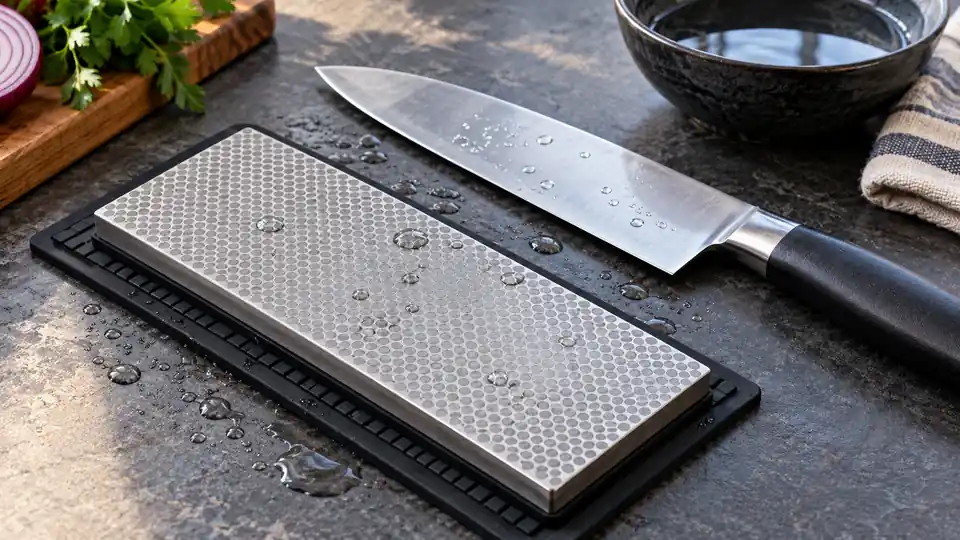
A good diamond sharpening stone gives a kitchen knife a controlled abrasive surface without the soaking, flattening, or long setup associated with many water stones. That makes this category appealing to home cooks who want to restore a dull chef’s knife, maintain a santoku, or sharpen several household blades with less mess. The common mistake is choosing a stone by grit number alone. Surface size, abrasive layout, stability, angle guidance, and the difference between repairing an edge and refining it all affect the result.
For kitchen knives, a coarse side is useful when an edge has become genuinely dull or slightly damaged, while a finer side can refine the burr and leave a cleaner working edge. Diamond plates are also a practical match for hard knife steels and tools, although light pressure matters because aggressive use can remove material quickly. A full-size plate helps with long blades and consistent strokes, while compact stones suit drawers, tool bags, and occasional maintenance. Different buyers will prioritize different traits, so this guide includes broad dual-grit plates, multi-grit systems, compact options, and kits intended for more deliberate sharpening.
The SHARPAL 162N stands out as the strongest all-around fit because it combines an 8-by-3-inch working surface, coarse and extra-fine diamond grits, a storage case, a non-slip base, and several angle-guide settings. The other selections make sense for shoppers who need more grit steps, a smaller footprint, a premium three-stage kit, or a more extensive set of dedicated plates.
Quick Answer
SHARPAL 162N is the best overall choice for most kitchen knife owners. Its 325/1200-grit combination covers edge repair and finishing, while the large flat plate gives longer blades room to travel.
SHARPAL 168H is a strong alternative for buyers who want the same broad 8-by-3-inch format with a 325/1000-grit pairing. For more deliberate progression through several stages, the DMT Deluxe kit offers three separate 325, 600, and 1200-grit blocks in a storage box.
Best Diamond Sharpening Stone For Knives Comparison Table
| Product | Best For | Grit Configuration | Size or Format |
|---|---|---|---|
| SHARPAL 162N | Overall kitchen knife maintenance | 325 / 1200 | 8 x 3 inches, dual-sided |
| Five-Piece Diamond Stone Set | Multiple sharpening stages | 400 / 600 / 800 / 1000 / 1200 | Five separate plates |
| S SATC Diamond Stone | Simple two-stage sharpening | 400 / 1000 | 8-inch, double-sided |
| Double-Sided 400/1200 Stone | Guided sharpening on a smaller plate | 400 / 1200 | 7 x 3.5 inches |
| Three-Sided Diamond and Ceramic Stone | Fine polishing options | 400 / 1000 / 8000 ceramic | Three-sided format |
| SHARPAL 156N | Compact everyday sharpening | 325 / 1200 | 6 x 2.5 inches, dual-sided |
| DMT Deluxe Kit | Three-stage sharpening | 325 / 600 / 1200 | Three blocks with wood box |
| SHARPAL 168H | Large tools and hard steels | 325 / 1000 | 8 x 3 inches, dual-sided |
| Ultra Sharp Set | Dedicated multi-stone setup | 300 / 600 / 1200 | Three 8 x 3-inch stones |
The detailed reviews below focus on how each abrasive layout, working size, and support system fits practical kitchen knife sharpening.
1. SHARPAL 162N Double-Sided Diamond Sharpening Stone – Best Overall

The SHARPAL 162N has the proportions that make a sharpening plate comfortable for ordinary kitchen knives. Its 8-by-3-inch surface gives a chef’s knife or longer slicing blade enough room for controlled passes, while the stainless steel base is listed at 0.35 inch thick. The coarse 325-grit side is intended for setting an edge or addressing a neglected blade, and the 1200-grit side provides a finer finishing step.
Setup is straightforward because the stone is intended for dry sharpening and arrives with a storage case that doubles as a working base through its non-slip rubber pad. The integrated guide offers 14, 17, 20, and 25-degree settings, giving newer sharpeners a reference point rather than asking them to estimate the angle from scratch. That guide still requires attention to the knife’s existing bevel, but it can make a first session less awkward.
Pros
- Large 8-by-3-inch surface suits common kitchen knife lengths.
- 325 and 1200 grits cover repair and finishing work.
- Flat stainless steel base is intended to resist the uneven wear associated with softer stones.
- Storage case includes a non-slip pad for sharpening support.
- Four angle-guide settings provide useful starting points.
Cons
- Two grits leave fewer intermediate steps than a three-stone or multi-plate system.
- The larger format takes more drawer or cabinet space than a compact plate.
This is the most balanced choice for a household that wants one serious stone for chef’s knives, santoku knives, pocket knives, and general straight-edged tools. It is especially practical for someone who dislikes soaking a water stone or flattening a worn surface. Buyers seeking a highly polished finish or a very gradual progression may prefer a kit with more grit stages, but the 162N keeps the routine focused and easy to store.
To buy this product, click here.
2. Five-Piece Diamond Sharpening Stone Set – Best for Multiple Grit Steps
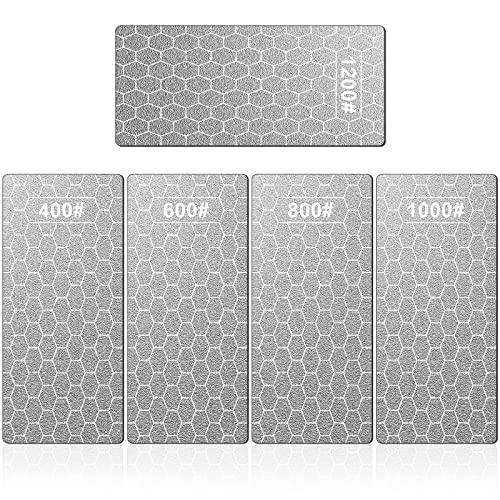
This five-piece set is aimed at buyers who prefer a smoother progression from a coarse sharpening pass to a fine maintenance pass. The included 400, 600, 800, 1000, and 1200-grit plates let a user move through smaller abrasive changes instead of jumping directly from a repair grit to a finishing grit. That arrangement can be useful when maintaining several knives with different levels of dullness.
Each plate measures about 5.91 by 2.48 inches and is described as approximately 0.04 inch thick. The narrow, lightweight format is easy to put away, although it offers less working area than the full-size 8-inch plates in this guide. A honeycomb surface and non-slip base are included in the listed design, and the plates can be used dry or with water or honing oil according to the product information.
Pros
- Five grit choices create a gradual sharpening sequence.
- Compact plates are easy to store in a small kitchen.
- 400 grit can address dull edges before finer maintenance stages.
- 1200 grit supplies a practical final abrasive step for everyday knives.
- Honeycomb surfaces and a non-slip base support a more organized setup.
Cons
- The plates are smaller than the full-size options, limiting stroke room on long blades.
- The set requires switching between separate plates during a sharpening session.
This set suits a careful home cook who wants more control over the transition between coarse and fine work. It can also appeal to someone maintaining chisels or other straight-edged tools alongside kitchen knives. The trade-off is physical handling. A user must keep track of several thin plates and maintain a consistent angle without the integrated multi-angle guide found on some other options.
To buy this product, click here.
3. S SATC 400/1000 Diamond Sharpening Stone – Best Simple Two-Stage Option

The S SATC plate keeps the process uncomplicated with a 400-grit side and a 1000-grit side on one 8-inch stone. That combination is easy to understand: use the coarser face when the knife needs meaningful edge work, then move to the finer face for refinement. For a home cook who wants a dedicated plate without a box of separate accessories, the two-sided format has a tidy appeal.
The listing describes a steel plate electroplated with monocrystalline diamonds and emphasizes that the surface does not need the flattening routine associated with many whetstones. Its 8-inch length gives a reasonable path for kitchen knife strokes, while the design is also intended for straight-edged tools such as chisels and plane blades. The available information does not list an included angle guide or base, so the sharpening surface may require a separate stable support.
Pros
- 8-inch length provides useful room for standard kitchen knives.
- 400/1000-grit pairing covers coarse and fine sharpening tasks.
- Double-sided construction reduces the need for several separate stones.
- Electroplated monocrystalline diamond surfaces are intended for durable use.
- Suitable for knives and other straight-edged tools.
Cons
- No angle guide or dedicated non-slip base is listed in the available product information.
- The two-grit layout offers less progression than multi-stage sets.
This is a sensible pick for an experienced sharpener who already has a stable bench setup or prefers to supply a separate holder. It is less convenient for a complete beginner who wants every support item included. The lack of a dedicated base is the key practical limitation, since a diamond plate must remain steady while a blade travels across it.
To buy this product, click here.
4. Double-Sided 400/1200 Diamond Sharpening Stone – Best Guided Compact Setup

This 7-by-3.5-inch plate brings the useful 400/1200-grit pairing into a smaller footprint than the full-size SHARPAL stones. The coarse side can address a dull kitchen knife, while the extra-fine side provides a finishing pass after the burr has been managed. The surface includes a honeycomb pattern, and the listed package includes a dust cover, non-slip rubber pad, and angle guide.
The angle guide offers 14, 17, and 20-degree settings. Those numbers are useful reference points, but they should not be treated as a universal prescription for every blade. A knife’s existing edge geometry and intended use still matter. The product can be used dry, with water, or with honing oil according to the supplied information, followed by cleaning and drying to help protect the plate.
Pros
- 400/1200 grit handles repair and fine edge refinement.
- 7-by-3.5-inch dimensions save space while retaining a useful working area.
- Non-slip pad provides a supplied support surface.
- Three angle-guide settings can help newer users establish consistency.
- Storage cover helps protect the sharpening plate between sessions.
Cons
- It offers fewer angle settings than some larger SHARPAL models.
- The 7-inch length gives long blades less travel room than an 8-inch plate.
This option fits a compact kitchen where a full 8-inch stone would be awkward to store. It is also a reasonable starting point for someone who wants basic angle assistance without moving to a multi-stage system. Buyers who frequently sharpen long carving knives or broad tools may appreciate the extra surface area of a larger plate instead.
To buy this product, click here.
5. Three-Sided Diamond and Ceramic Sharpening Stone – Best for Fine Polishing

This small three-sided system combines a 400-grit diamond surface, a 1000-grit diamond surface, and an 8000-grit ceramic surface. The first two stages cover the main sharpening work, while the ceramic face provides a much finer polishing step than the other dual-sided stones here. That arrangement is attractive to knife owners who enjoy refining an edge after the basic bevel work is complete.
A wide plastic base and built-in 14, 17, and 20-degree angle guide are listed as part of the design. The stone can be used with clean water or honing oil, then rinsed and stored after sharpening. The product information describes compatibility with kitchen knives, carving tools, chisels, and other manual-sharpenable tools, although the small format may feel less natural on a long blade than an 8-inch plate.
Pros
- Three surfaces provide coarse, medium, and very fine finishing options.
- 8000-grit ceramic adds a polishing stage missing from most two-sided plates.
- Built-in angle settings can help beginners establish repeatable strokes.
- Wide plastic base is intended to support stable sharpening.
- Compact format is convenient for storage.
Cons
- The small design offers less stroke length for large kitchen knives.
- A very fine ceramic surface is unnecessary for buyers who only need basic edge maintenance.
This stone is best suited to a user who wants a polished finishing stage and is willing to rotate through three surfaces. It may appeal to cooks maintaining thinner, finer kitchen knife edges, though a polished finish does not remove the need for correct angle control. For quick touch-ups on a large chef’s knife, a longer two-sided plate may feel simpler and more natural.
To buy this product, click here.
6. SHARPAL 156N Double-Sided Diamond Sharpening Stone – Best Compact Everyday Option

The SHARPAL 156N uses the same basic 325/1200-grit concept as the larger 162N, but its 6-by-2.5-inch format takes up less room. That makes it easier to keep near a kitchen workstation or pack with general tools. The narrower plate still covers routine kitchen knife maintenance, although long blades require more careful positioning and shorter sections of contact.
The stainless steel base is listed at 0.33 inch thick, and the product includes a storage case with a non-slip rubber pad. Its guide provides 14, 17, 20, and 25-degree settings, while the diamond surface is intended for dry sharpening. The available description also lists use with single- and double-bevel blades, but users should still follow the knife maker’s edge requirements rather than relying on a generic guide setting.
Pros
- Compact 6-by-2.5-inch format suits limited storage.
- 325 and 1200 grits cover common repair and maintenance needs.
- Case and non-slip pad provide a contained sharpening setup.
- Four angle settings offer broad adjustment for different edge preferences.
- Suitable for kitchen knives, pocket knives, and other tools.
Cons
- Narrower and shorter surface requires more care with long blades.
- Two grit stages provide less gradual refinement than a dedicated multi-stone kit.
This is the better SHARPAL choice for a drawer, apartment kitchen, or tool bag where the 8-inch model feels excessive. It can handle ordinary maintenance, but the compact dimensions reward slower, deliberate movements. Buyers with wide chef’s knives or longer slicers may prefer the added stability and stroke room of the 162N or 168H.
To buy this product, click here.
7. DMT Deluxe Diamond Professional Knife Sharpening Kit – Best Three-Stage Kit
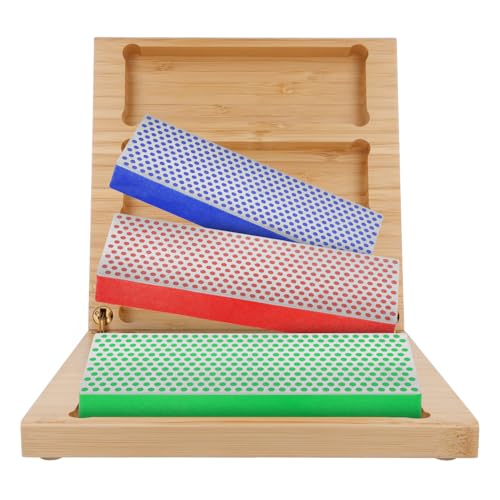
The DMT Deluxe kit separates the sharpening stages into three color-coded diamond blocks. The blue coarse block is listed at 325 mesh, the red fine block at 600 mesh, and the green extra-fine block at 1200 mesh. That progression gives a kitchen knife owner a distinct middle stage between edge repair and final refinement, which can be useful when a blade needs more than a light touch-up.
The blocks arrive in a natural wood box, providing a dedicated storage location rather than leaving loose plates in a drawer. The supplied guidance describes a 20-degree angle for most edges, but that should be understood as a general reference rather than a rule for every knife. Separate blocks also make it easier to keep abrasive stages distinct, though the user must provide the consistency and stability during each pass.
Pros
- Three separate grits create a clear sharpening progression.
- 325, 600, and 1200 mesh cover repair, honing, and refinement.
- Color coding makes the stages easy to identify.
- Wood storage box keeps the blocks organized.
- Separate surfaces can be useful for maintaining several knife types.
Cons
- Separate blocks require more handling and workspace than a dual-sided plate.
- The available product information does not list an integrated non-slip base or adjustable angle guide.
This kit suits a buyer who wants a more structured three-stage routine and values organized storage. It is a stronger fit for a dedicated sharpening area than a crowded kitchen drawer. Someone who sharpens only one or two household knives a few times a year may find the separate blocks more involved than necessary.
To buy this product, click here.
8. SHARPAL 168H Large Dual-Grit Diamond Sharpening Stone – Best for Large Tools and Hard Steels

The SHARPAL 168H is another full-size 8-by-3-inch plate, but it pairs 325 grit with 1000 grit rather than 1200 grit. The broad surface gives a knife more room for controlled travel and can also accommodate larger edge tools. The product information specifically describes use with hard steels, ceramic, chisels, plane blades, axes, and hatchets, making it a practical choice for a kitchen that shares sharpening equipment with a workshop.
MirrorFlat technology is listed with a precision-ground flatness claim, while the package includes a non-slip pad and four angle settings at 14, 17, 20, and 25 degrees. The plate is intended for dry use and uses monocrystalline diamond with a stated multi-step electroplating process. The 1000-grit finishing side is suitable for routine refinement, although buyers wanting a finer final surface may prefer a 1200-grit or ceramic finishing option.
Pros
- 8-by-3-inch size offers generous room for knives and larger tools.
- 325/1000-grit layout covers coarse repair and everyday refinement.
- Angle guide includes four reference settings.
- Non-slip pad supports a stable dry-sharpening setup.
- Listed compatibility extends beyond kitchen knives to workshop tools.
Cons
- The 1000-grit finishing side is less fine than the 1200-grit side on comparable SHARPAL models.
- Large dimensions require more storage space.
This plate makes sense for a household that sharpens kitchen knives and woodworking or garden tools with the same equipment. Its generous surface is helpful for larger edges, while the two-stage routine keeps the process manageable. Buyers focused exclusively on fine kitchen-knife finishing may prefer a model with a finer second side or an additional ceramic stage.
To buy this product, click here.
9. Ultra Sharp Diamond Sharpening Stone Set – Best Dedicated Three-Stone Format
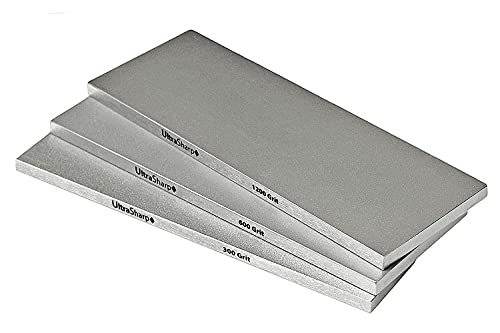
The Ultra Sharp set includes three full-size 8-by-3-inch stones in coarse 300, medium 600, and extra-fine 1200 grits. Unlike a dual-sided plate, each abrasive has its own broad surface, so the user can move through the stages without flipping a stone or working around a shared face. That format is appealing for a dedicated sharpening station serving several kitchen knives.
A stone holder is included and is listed as fitting stones from 6 to 9 inches long. Each stone is described as weighing 2.2 pounds, which suggests a substantial setup compared with the lightweight plates in this guide. The three-stage range is useful for restoring a dull edge and refining it gradually, but the full set takes more room and requires a clear place to keep the stones and holder together.
Pros
- Three separate 8-by-3-inch stones provide generous working surfaces.
- 300, 600, and 1200 grits create a broad sharpening progression.
- Included holder supports the stones during use.
- Separate stones avoid switching sides during a session.
- Suitable for knives and other listed tools, including ceramic knives.
Cons
- The full set has a large storage footprint and higher listed weight.
- It is more equipment than necessary for occasional touch-ups on one kitchen knife.
This set is aimed at buyers who want a fixed home sharpening station with large dedicated plates. The holder and full-size surfaces can make a multi-knife routine feel more organized, provided there is enough counter or cabinet space. For a small kitchen, a dual-sided SHARPAL plate offers a less involved storage solution.
To buy this product, click here.
Buying Guide
Match the Grit Range to the Knife’s Condition
Grit determines the role of the abrasive, but the same number does not create identical results across every abrasive system. A coarse range around 300 to 400 is useful for a genuinely dull edge or limited repair, while 600 to 1000 provides an intermediate or maintenance step. A 1200 side is a practical fine finish for many household knives. The 8000 ceramic surface on the three-sided stone is a specialized polishing stage rather than a replacement for coarse edge work.
A knife that still slices well but has lost some bite rarely needs the most aggressive side. Start with the least abrasive stage that addresses the condition, then progress only as needed. Excessive pressure can remove more steel than necessary, so a light, controlled stroke is preferable to pressing down hard.
Choose a Surface Size That Matches Your Blades
An 8-by-3-inch stone gives a chef’s knife, carving knife, or longer slicer more room for a consistent pass. The 6-inch SHARPAL 156N and smaller three-sided stone save storage space, but they require more careful positioning on long blades. Compact plates can work well for paring knives and pocket knives, while broad kitchen knives generally benefit from a larger contact area.
Decide Between Dual-Sided and Separate Stones
A dual-sided plate is convenient because coarse and fine abrasives share one body. It suits a cook who wants a contained routine with minimal storage. Separate stones provide more dedicated workspace and can make a three-stage process easier to organize, but they add handling, storage, and setup requirements. The DMT and Ultra Sharp kits are better suited to a dedicated sharpening area than a utensil drawer.
Look for Stability Before Angle Features
An angle guide can help a beginner establish a repeatable starting position, but it does not remove the need for careful technique. The SHARPAL and several honeycomb-patterned plates include non-slip pads or bases, which are useful because a moving stone makes consistent sharpening difficult. The S SATC plate does not list a dedicated base in the available information, so it may need a separate holder or stable support.
Understand Dry Diamond Sharpening and Cleanup
Many of these products are intended for dry sharpening, which avoids soaking and reduces preparation time. Some listings also allow water or honing oil. Follow the exact care instructions supplied with the selected product, and clean away sharpening residue after use. The honeycomb plates should be kept dry after cleaning according to their product information, while a storage case can help keep dust and debris away between sessions.
Match the Stone to the Knife Edge
Most kitchen knives have double-bevel edges, but some specialty knives use different geometry. A supplied angle guide should be treated as a reference, not proof that every setting suits every blade. Do not apply ordinary double-bevel sharpening movements to a single-bevel knife without understanding its edge design. Ceramic knives and very hard steels may also require an abrasive specifically listed as compatible by the product information.
An abrasive surface still needs to suit the knife’s grind. The guide to Japanese-knife sharpening and geometry explains that preparation.
Best Diamond Sharpening Stone For Knives FAQ
Are diamond stones suitable for kitchen knives?
Yes. Diamond plates are commonly used for kitchen knives because they provide a hard abrasive surface and do not require the soaking routine associated with many water stones. The correct grit and light pressure still matter. A coarse plate can remove material quickly, so it should be reserved for edges that need that level of correction.
What grit should a beginner use for a kitchen knife?
A two-stage stone with a coarse side around 325 to 400 grit and a fine side around 1000 to 1200 grit is a practical starting range. The coarse side addresses a dull edge, while the finer side refines the result. A beginner does not necessarily need an 8000-grit finishing surface for routine household maintenance.
Do diamond sharpening stones need water?
Several products in this guide are listed for dry sharpening, so water is not automatically required. Some also permit water or honing oil. Use the care method stated for the exact stone, then clean and dry it as directed. Adding liquid without checking the product instructions can create unnecessary cleanup or storage issues.
How does a diamond plate differ from a water stone?
A diamond plate uses diamond abrasive attached to a base, while a water stone uses abrasive material that typically wears and may require flattening over time. Diamond plates are convenient for buyers who want a flat working surface with less preparation. Water stones can offer a different sharpening feel and a wider range of finishing options, but they involve more maintenance.
Do not assume a diamond sharpening plate is approved for every lapping job. The guide to flattening waterstones separates those compatibility checks.
Can one diamond stone sharpen every kitchen knife?
One stone can maintain many straight-edged kitchen knives, but compatibility depends on the blade construction and edge geometry. Serrated knives, single-bevel knives, ceramic blades, and unusually delicate edges may need a more specific method. Check the sharpener’s listed compatibility and the knife maker’s guidance before using a generic angle setting.
Should the coarse side be used for every sharpening session?
No. Use the coarse side when the edge is significantly dull, damaged, or requires reprofiling. For a knife that only needs routine maintenance, begin with the finer side or use a less aggressive method if appropriate. Starting coarse every time can remove more blade material than necessary.
Is an angle guide necessary?
An angle guide can help a beginner develop consistency, especially during the first few sharpening sessions. It is not a substitute for understanding the knife’s existing bevel. The guides included with these products offer selected reference angles, while the appropriate setting depends on the blade and its intended use.
Final Verdict
The SHARPAL 162N is the best overall diamond sharpening stone for most kitchen knife owners because its 8-by-3-inch surface, 325/1200-grit layout, storage case, non-slip pad, and four angle references create a balanced package. It handles the common situation of a dull chef’s knife without demanding a large multi-stone setup. The SHARPAL 156N follows the same basic approach in a smaller format for kitchens with limited storage, while the SHARPAL 168H is better suited to buyers who also sharpen larger workshop or garden tools.
Choose the DMT Deluxe kit or Ultra Sharp set if you prefer separate stones and a more deliberate progression through coarse, medium, and fine stages. The five-piece set adds even more incremental grit choices in a compact format, and the three-sided diamond and ceramic model is the specialist pick for a very fine polishing stage. Whichever stone you select, match its dimensions to your longest blade, use the least aggressive grit that solves the problem, keep the plate stable, and follow the product’s cleaning and storage instructions.
