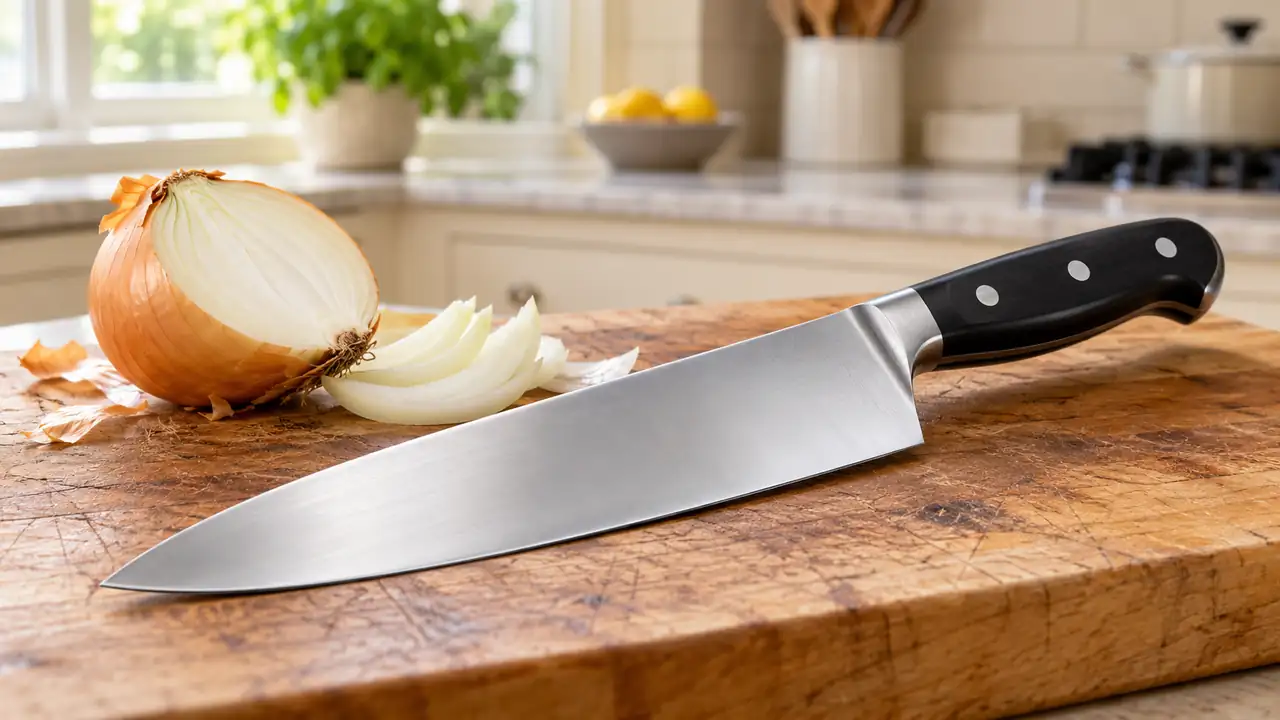
A chef’s knife is the knife that usually stays on the board from the first onion to the last bunch of herbs. It needs enough blade length for larger ingredients, a profile that matches your cutting motion, and a handle you can control through repeated prep. Many buyers focus on a dramatic Damascus pattern or a very high hardness number, then overlook practical details such as weight, edge geometry, cleaning, and whether the knife suits rocking or push-cutting. Those small mismatches become obvious during a busy dinner, especially when the handle feels awkward or the blade is too tall for the board.
The products below cover several sensible interpretations of a chef’s knife. Western-style options such as the Victorinox Fibrox Pro and WÜSTHOF Classic favor familiar all-purpose handling, while Japanese-style gyuto knives and Japanese chef knives bring different edge angles, handle shapes, and steel specifications. Blade length matters too. An 8-inch knife offers useful reach for cabbage, squash, and large proteins, while a lighter or more compact-feeling design may be easier to control in a small kitchen. Maintenance varies as well, so hand washing, drying, and sharpening compatibility deserve a place beside steel type in your decision.
This comparison focuses on documented construction, blade dimensions, handle materials, stated edge specifications, and practical limitations rather than relying on decorative claims. The Victorinox Fibrox Pro earns the strongest overall position because its 7.9-inch blade, grippy TPE handle, stainless construction, and dishwasher-safe listing create a particularly straightforward everyday package. Buyers who value Japanese craftsmanship, a forged Western profile, or a more decorative Damascus finish will find stronger alternatives among the remaining selections.
Quick Answer
Victorinox Fibrox Pro is the Best Overall choice for everyday cooking. Its 7.9-inch stainless blade and non-slip TPE handle suit routine chopping, slicing, dicing, and mincing without adding complicated care requirements.
Shun Premier is the strongest premium Japanese-style alternative, with a VG-MAX core, 68 layers of Damascus cladding, a hammered finish, and a contoured Pakkawood handle. For a traditional Western approach, WÜSTHOF Classic offers a forged high-carbon stainless blade, full tang, triple-riveted handle, and stated 8.5-ounce weight.
Best Chef Knife Comparison Table
| Product | Best For | Blade Length | Steel or Construction | Handle |
|---|---|---|---|---|
| Victorinox Fibrox Pro | Everyday cooking | 7.9 inches | Stainless steel | TPE, non-slip |
| Shun Premier | Premium Japanese-style cutting | 8 inches | VG-MAX, 68-layer cladding | Pakkawood |
| WÜSTHOF Classic | Western-style prep | 8 inches | Forged high-carbon stainless steel | Synthetic, triple riveted |
| Shun Classic | Traditional Japanese craftsmanship | 8 inches | VG-MAX, 68-layer cladding | D-shaped Pakkawood |
| HENCKELS Classic | Fully forged construction | 8 inches | High-carbon stainless steel | Triple riveted |
| SHAN ZU Chef Knife | Documented hard steel and G10 | 8 inches | 10Cr15MoV, 67 layers | G10 |
| Atumuryou Chef Knife | VG10 and decorative cladding | 8 inches | VG-10, 67-layer cladding | Resin wood |
| HOSHANHO Chef Knife | Pinch-grip positioning | 8 inches | 10Cr15CoMoV | Wood |
| imarku Gyutou Knife | Japanese-style versatility | 8 inches | High-carbon stainless steel | Pakka |
The detailed reviews below put each knife’s materials, dimensions, handle design, and care requirements into a practical kitchen context.
1. Victorinox Fibrox Pro 8-Inch Chef’s Knife : Best Overall

The Victorinox Fibrox Pro makes the most sense for a kitchen that needs one dependable general-purpose knife. Its listed 7.9-inch tapered stainless-steel blade sits in the familiar chef’s knife range, giving it enough reach for a halved melon or a pile of vegetables without becoming an especially large tool. The blade is described for chopping, mincing, slicing, and dicing, so its role is clear. A home cook preparing weeknight vegetables can use the same knife for herbs, boneless proteins, and fruit without switching between specialized profiles.
Its TPE handle is the practical highlight. The material is specified as non-slip, including when wet, which matters during rinsing or when prep becomes fast and messy. The listing also describes the knife as weighted and balanced for handling, although no detailed balance point is supplied. Dishwasher-safe construction adds convenience, but careful hand washing and drying remain sensible habits for preserving an edge. This is a fairly plain-looking knife beside patterned Damascus models, yet its restrained design is exactly why it fits so many kitchens.
Pros
- 7.9-inch tapered stainless-steel blade suits broad kitchen tasks.
- TPE handle is specified as non-slip, including in wet conditions.
- Listed as dishwasher safe for easier cleanup.
- Useful for chopping, mincing, slicing, and dicing.
- Swiss-made construction includes a lifetime warranty against material and workmanship defects.
Cons
- The stainless steel designation is less specific than the alloy details supplied for several competing knives.
- Dishwasher compatibility does not remove the need for regular edge maintenance.
This is the right pick for cooks who want a direct, low-fuss chef’s knife rather than a display piece or a highly specialized Japanese edge. Buyers seeking a documented VG-10 or VG-MAX core, a Damascus finish, or a heavier forged feel should look elsewhere. For the everyday task of moving from onions to chicken to herbs, its handle material and familiar blade length create a sensible balance of control and convenience.
To buy this product, click here.
2. Shun Premier 8-Inch Chef’s Knife : Best Premium Japanese-Style Design

The Shun Premier is aimed at cooks who want a Japanese-made chef’s knife with a more distinctive blade finish. Its 8-inch blade uses a VG-MAX core and 68 layers of Damascus stainless-steel cladding, according to the supplied product information. That layered exterior is part of the knife’s construction and appearance, while the VG-MAX core forms the cutting center. The hammered tsuchime finish is listed as a way to reduce drag and help prevent food from sticking, a useful detail during repetitive slicing of vegetables.
A stated 16-degree edge gives shoppers a clearer idea of the knife’s intended profile than vague references to sharpness. It also signals why a suitable sharpening approach matters. The contoured Pakkawood handle is described as comfortable and secure for both left- and right-handed users, although individual grip preferences still vary. Free sharpening and honing support adds practical ownership value for someone who wants an established care path rather than learning entirely by trial and error.
Pros
- VG-MAX core is specifically identified.
- 68-layer Damascus cladding and hammered finish provide documented construction details.
- Stated 16-degree edge suits precise kitchen cutting.
- Contoured Pakkawood handle is listed for left- and right-handed use.
- Includes free sharpening and honing support.
Cons
- The more refined edge and construction call for attentive sharpening and handling.
- The decorative cladding adds visual appeal but does not by itself prove superior cutting performance.
The Shun Premier is a strong match for a cook who enjoys careful prep and wants Japanese craftsmanship to be part of the ownership experience. It may be excessive for someone who prioritizes dishwasher convenience or wants a tougher, more utilitarian knife for rough treatment. Its best setting is a kitchen where the blade is hand washed, dried, stored safely, and maintained with an appropriate method.
To buy this product, click here.
3. WÜSTHOF Classic 8-Inch Chef’s Knife : Best Western-Style Design
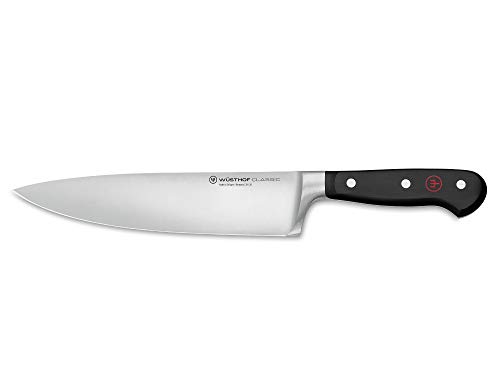
The WÜSTHOF Classic follows the traditional Western chef’s knife formula: an 8-inch blade, a full tang, a full bolster, and a triple-riveted handle. Its listed weight is 8.5 ounces, giving buyers a useful reference for comparing it with lighter Japanese-style options. That combination suits cooks who like a substantial knife for rocking through herbs or chopping vegetables with a steady, familiar motion. The synthetic handle is intended to resist fading and discoloration, which is practical in a busy kitchen.
The blade is forged from a single block of high-carbon stainless steel and listed at 58 HRC. The supplied information also identifies WÜSTHOF’s PEtec edge treatment and claims improved sharpness and edge retention compared with previous models. Those claims belong to the product description, not independent testing, but the underlying construction details still help explain the knife’s traditional positioning. A cook who reaches for a broad Western blade every evening may prefer this physical format over a lighter Japanese-style gyuto.
Pros
- 8-inch forged blade suits general chopping, slicing, mincing, and dicing.
- Full tang and triple-riveted handle provide a traditional construction layout.
- Full bolster and finger guard are included in the listed design.
- High-carbon stainless steel and 58 HRC are documented specifications.
- Listed 8.5-ounce weight gives shoppers a clear handling reference.
Cons
- The fuller construction may feel less nimble than lighter Japanese-style knives.
- A full bolster can influence sharpening access near the heel.
This knife fits cooks who prefer a planted Western profile and a clearly documented forged build. It is less appealing for someone who favors a very light blade, a narrow Japanese edge, or a handle with a fully symmetrical shape. The WÜSTHOF’s appeal comes from familiar geometry and substantial construction, making it a logical alternative to the Victorinox for cooks who want more heft and a traditional forged format.
To buy this product, click here.
4. Shun Classic 8-Inch Chef’s Knife : Best Traditional Japanese Craftsmanship

The Shun Classic shares important technical characteristics with the Premier, including an 8-inch blade, VG-MAX core, and 68 layers of Damascus stainless-steel cladding. Its distinction is the D-shaped Pakkawood handle associated with the Classic series. That shape can appeal to cooks who like a defined grip orientation rather than a completely neutral handle, although hand size and personal preference determine whether it feels natural. The blade is built for slicing, dicing, and mincing across ordinary meal preparation.
Like the Premier, this knife is listed with a 16-degree edge and support for free sharpening and honing. Those details make maintenance easier to plan, while the Japanese construction places more emphasis on controlled cutting and careful care than on casual dishwasher use. Picture a cook preparing a platter of vegetables for a dinner party, pausing to wipe the blade clean between ingredients. That sort of deliberate routine is a better match than leaving the knife loose in a sink.
Pros
- VG-MAX core and 68-layer cladding are clearly identified.
- 8-inch length supports broad all-purpose chef’s knife duties.
- D-shaped Pakkawood handle offers a defined grip profile.
- Stated 16-degree edge provides a useful maintenance reference.
- Free sharpening and honing support is included.
Cons
- The D-shaped handle may not suit every grip preference or hand position.
- Its refined Japanese-style construction requires more care than a dishwasher-oriented option.
The Shun Classic is for someone who values the established Classic series and wants a Japanese chef’s knife with a purposeful handle shape. Buyers who prefer a neutral handle or a more rugged Western profile may find the WÜSTHOF or HENCKELS more comfortable to live with. Its strongest use is careful home preparation where controlled slicing and regular maintenance matter more than quick cleanup.
To buy this product, click here.
5. HENCKELS Classic 8-Inch Chef Knife : Best Fully Forged Everyday Option

HENCKELS Classic takes a straightforward German-style approach with fully forged construction and a traditional triple-rivet handle. The available information describes a satin-finished blade intended for slicing, chopping, and mincing vegetables, fruit, and herbs, with broader claims covering large meat cuts and disjointing bones. That last use should be interpreted carefully. A chef’s knife is versatile, but hard bones and similar demanding materials can damage an edge unless the manufacturer’s guidance specifically supports the task.
The listing emphasizes a lightweight, easy-to-use format and quick cleanup, including dishwasher or hand washing. It also describes the blade as stain- and rust-free, though corrosion-resistant kitchen steel still benefits from prompt drying. The seamless transition from blade to handle gives the knife a traditional forged appearance and construction. For a household replacing a worn general-purpose knife, this design offers a familiar route without the more specialized edge and handle characteristics found on the Japanese-style selections.
Pros
- Fully forged construction is clearly stated.
- Traditional triple-rivet handle provides a familiar Western format.
- Suitable for slicing, chopping, and mincing routine ingredients.
- Listed as usable in a dishwasher or by hand.
- Satin-finished blade is described as stain and rust resistant.
Cons
- The available information does not identify a specific steel alloy or hardness value.
- Dishwasher suitability does not replace careful drying and regular sharpening.
HENCKELS Classic is a sensible option for cooks who want fully forged construction and uncomplicated all-purpose use. It is less compelling for shoppers comparing exact steel designations or seeking a documented narrow edge angle. This knife belongs in a conventional kitchen where vegetables, herbs, fruit, and boneless proteins make up most of the workload.
To buy this product, click here.
6. SHAN ZU 8-Inch Damascus Chef Knife : Best for Documented Hardness and G10
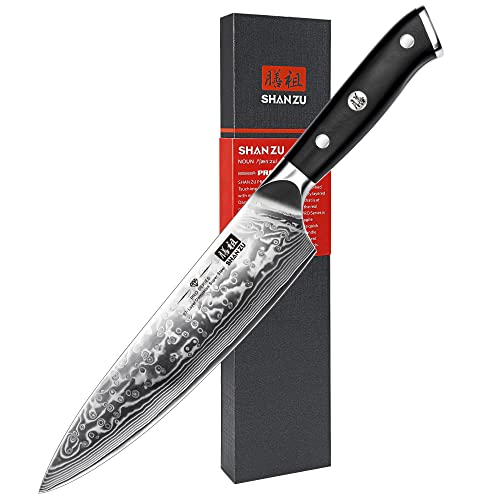
SHAN ZU gives shoppers more numerical detail than many midrange chef knives. The product information identifies a 10Cr15MoV core, 62 HRC hardness, 2.2 mm blade thickness, 2.5-inch blade width, 5.3-inch handle, and 270-gram weight. It also lists a 15-degree cutting angle and a 67-layer construction. These specifications do not prove cutting performance by themselves, but they let a buyer understand the intended package: a relatively substantial 8-inch Japanese-style knife with a defined edge and a firm G10 handle.
The G10 handle is made from glass fiber material and is described as comfortable and solid. That may suit a cook who prefers a structured grip over softer polymer. The patterned blade is presented as genuine layered Damascus rather than laser-etched decoration, though the visual pattern should still be treated separately from the cutting properties of the core steel. A 270-gram weight is worth noticing for anyone who prefers a lighter knife or spends long stretches doing fine prep.
Pros
- 10Cr15MoV core and stated 62 HRC hardness are documented.
- Blade thickness, width, handle length, and weight are supplied.
- 15-degree cutting angle provides a clear edge reference.
- G10 handle offers a durable, structured grip material.
- 67-layer construction and a 12-month warranty are listed.
Cons
- At 270 grams, it may feel substantial beside lighter chef knives.
- The detailed hardness and narrow edge call for careful sharpening and handling.
Choose SHAN ZU if specific measurements and a G10 handle matter more than a traditional Western bolster or a softer-feeling grip. It may be a poor match for cooks who prefer very light knives or who want the simplest possible cleaning routine. The knife’s strengths are clearest for deliberate prep where the user appreciates a defined edge angle and a solid handle.
To buy this product, click here.
7. Atumuryou 8-Inch VG-10 Chef Knife : Best for a Decorative VG-10 Build

Atumuryou combines a documented VG-10 steel core with 67-layer Damascus cladding, creating a chef knife aimed at buyers who want both a named Japanese steel and a decorative exterior. The listing states a 62 HRC hardness and a hand-sharpened 12-degree edge. Those figures describe a relatively refined cutting setup, though they should not be treated as a guarantee of edge longevity or universal cutting superiority. The 8-inch format remains versatile for routine vegetables, fish, and meat preparation.
The stabilized wood and resin handle is described as ergonomic and slip resistant. That material choice may appeal to someone who wants the visual warmth of wood with a more stable composite construction. The gift-box presentation adds appeal for a culinary gift, while the underlying care requirements remain those of a sharp, patterned kitchen knife: use a suitable cutting board, avoid hard bones and frozen foods unless supported, and wash and dry it promptly. The product information does not establish a measured balance point, so handle comfort remains personal.
Pros
- VG-10 core and 62 HRC hardness are specifically listed.
- 67-layer cladding gives the blade a documented layered construction.
- Stated 12-degree edge is useful information for sharpening planning.
- Stabilized wood and resin handle combines decorative appeal with a composite material.
- 8-inch length suits broad chef’s knife applications.
Cons
- The narrow stated edge requires compatible sharpening and careful board use.
- No verified balance point or handle dimensions are supplied.
This knife suits a buyer who wants VG-10 information and a decorative Damascus-style presentation in the same package. It is less suitable for someone who wants a dishwasher-oriented workhorse or dislikes maintaining a fine edge. Compared with the Shun models, it offers similar headline materials but less supplied information about long-term support, so shoppers should weigh the complete ownership package rather than layer count alone.
To buy this product, click here.
8. HOSHANHO 8-Inch Japanese High-Carbon Chef Knife : Best for a Guided Pinch-Grip Approach

HOSHANHO centers its design around a sloped bolster intended to encourage a pinch grip. That feature matters because a pinch grip places the thumb and forefinger near the blade rather than wrapping the whole hand around the handle. The listing identifies a wood handle, a matte blade finish, and a hand-sharpened 13-degree edge on each side. Together, those details suggest a knife aimed at controlled forward-and-back preparation rather than a purely heavy rocking style.
The blade steel is identified as 10Cr15CoMoV with a stated hardness of up to 60 HRC. The product information also describes ice tempering and heat treatment for resistance to cold, heat, corrosion, and moisture, though these claims should not be treated as permission to neglect drying. The matte finish may reduce the visual emphasis on decorative patterning, while the 8-inch length keeps it within the common chef’s knife range. A gift box is included, but the more meaningful purchase question is whether the bolster shape matches your preferred grip.
Pros
- 10Cr15CoMoV steel and stated hardness of up to 60 HRC are documented.
- 13-degree-per-side edge specification provides a clear sharpening reference.
- Sloped bolster is intended to encourage a pinch grip.
- Wood handle and matte blade provide a distinctive design direction.
- 8-inch blade covers common chopping, slicing, and dicing tasks.
Cons
- The grip-focused bolster may not suit cooks who prefer a handle-first hold.
- The listing does not provide blade thickness, weight, or handle dimensions.
HOSHANHO is a good fit for cooks who want a defined pinch-grip feature and a documented Japanese steel designation. It may be a weaker choice for shoppers who need detailed weight information before buying or prefer a full bolster and heavier Western feel. Its practical advantage lies in the grip guidance, so buyers should give that physical design more attention than the gift packaging.
To buy this product, click here.
9. imarku 8-Inch Gyutou Chef Knife : Best Japanese-Style Versatility

The imarku gyutou is a useful choice for shoppers who want a Japanese-style chef knife rather than a santoku or a Western chef’s knife. Its 8-inch blade is described as multipurpose for cutting, dicing, slicing, chopping, and mincing, with a high-carbon stainless-steel construction. The supplied information lists 0.6 to 0.75 percent carbon, 16 to 18 percent chromium, and a stated 56 to 58 HRC hardness. That combination gives buyers more material information than a generic “stainless steel” listing, although the claims remain product specifications rather than independent metallurgical verification.
The Pakka handle is intended to provide comfort and stability during extended preparation, while the corrosion-resistant stainless blade reduces some of the maintenance concerns associated with plain carbon steel. The listing also mentions cutting meat from bones, but a chef knife should still be kept away from hard bones and forceful impacts unless the manufacturer specifically supports that use. A possible logo variation is disclosed for this product, with the available information stating that randomly shipped branding does not change the materials or construction.
Pros
- Genuine gyutou-style positioning suits broad chef’s knife tasks.
- Carbon and chromium ranges are supplied for the stainless blade.
- Stated 56 to 58 HRC hardness gives a useful construction reference.
- Pakka handle is intended to support a stable, comfortable grip.
- Corrosion-resistant stainless construction is practical for regular home cooking.
Cons
- The listing does not provide a precise edge angle or blade thickness.
- Logo and packaging may vary because the brand is undergoing an update.
The imarku gyutou suits someone who wants Japanese-style versatility with more explicit carbon and chromium information than many generic listings provide. It is less appropriate for a shopper who wants a documented thin edge, a precise weight, or established Japanese manufacturing details. Its role is broad household prep, especially for buyers who want a gyutou form without moving into a highly specialized knife.
To buy this product, click here.
Buying Guide
Match the Blade Profile to Your Cutting Motion
A chef’s knife is shaped around the way you move it. A more curved Western profile can support rocking motions, where the tip stays near the board while the handle rises and falls through herbs or garlic. A flatter Japanese-style gyutou can feel more natural for push cutting, where the blade moves forward and down through a carrot or onion. Product titles alone do not reveal every detail of a blade profile, so look for information about the intended style rather than assuming Japanese or German branding tells the whole story.
A flatter blade and a more curved profile favor different movements. The santoku-versus-chef’s-knife comparison explains that distinction before you choose a cutting style.
Choose Length for Your Board and Ingredients
Most selections here use an 8-inch blade, while the Victorinox is listed at 7.9 inches. That length gives useful clearance around a large cabbage or a wide cutting board, yet it can feel cumbersome in a cramped apartment kitchen. A longer blade is not automatically more capable. Think about the largest ingredients you routinely prepare, the available board space, and whether the knife tip might extend beyond the working area.
Blade length should fit both the ingredients and the board; choosing a manageable chef’s-knife size brings reach, clearance, and handle comfort into the same decision.
Read Steel and Hardness Claims Carefully
Named steels such as VG-10, VG-MAX, 10Cr15MoV, and 10Cr15CoMoV provide more information than a broad phrase such as high-quality stainless steel. Hardness values can help describe the intended construction, but HRC does not independently establish sharpness, toughness, or edge retention. Geometry, heat treatment, edge preparation, and use all matter. A harder knife may also require more careful sharpening and handling, so do not choose the highest stated number automatically.
Compare Handle Materials and Grip Shapes
The handle is where a knife meets your hand for every cut. TPE offers a grippy polymer approach, G10 provides a structured composite surface, Pakkawood combines wood fiber with resin, and traditional synthetic or wood designs create different tactile expectations. The HOSHANHO’s sloped bolster is intended to encourage a pinch grip, while the WÜSTHOF and HENCKELS use more traditional Western layouts. These features suggest how a knife may be held, but comfort remains personal and cannot be guaranteed from a listing.
Plan for Cleaning and Storage
Only some knives in this group are explicitly listed as dishwasher safe. A dishwasher can expose a blade and handle to heat, detergent, water pressure, and contact with other items, so hand washing and prompt drying are sensible for any quality chef’s knife. Store sharp blades in a block, sheath, drawer organizer, or other arrangement that prevents the edge from knocking against loose utensils. Never leave a chef’s knife submerged in a sink where it can be hidden beneath cloudy water.
Match Sharpening to the Edge
The Shun Premier and Classic list 16-degree edges, HOSHANHO lists 13 degrees per side, SHAN ZU lists 15 degrees, and Atumuryou lists 12 degrees. These figures are not interchangeable, and the listing may express them in different ways. Follow the product’s stated guidance before selecting a sharpener. Honing can help realign an edge in some situations, but it does not remove the same amount of material as sharpening. Avoid aggressive pull-through devices unless their angle and blade compatibility are appropriate.
Best Chef Knife FAQ
What size chef’s knife is most versatile?
An 8-inch blade is a common all-purpose size because it offers useful reach for vegetables, herbs, fruit, and boneless proteins without the length of a larger professional blade. The 7.9-inch Victorinox occupies essentially the same practical range. Smaller cooks or people working on compact boards may prefer a shorter blade, while buyers who regularly prepare large ingredients may appreciate more reach.
Is a Japanese chef knife better than a Western chef’s knife?
Neither style is universally better. Japanese-style knives often emphasize defined edge angles, lighter handling, and push-cutting characteristics, while Western designs may offer a more substantial feel and profiles suited to rocking motions. The actual product matters more than the label. The Shun models, HOSHANHO, SHAN ZU, Atumuryou, and imarku gyutou each have different documented features, so they should not be treated as one identical category.
Does Damascus steel make a chef knife sharper?
Damascus cladding or a layered pattern does not automatically make a knife sharper. Cutting behavior depends on the core steel, blade geometry, heat treatment, edge preparation, and maintenance. In this guide, the Shun knives identify VG-MAX cores, while SHAN ZU and Atumuryou provide different core and layer details. The pattern may add visual appeal, but layer count alone is not a reliable performance ranking.
Can these chef knives go in the dishwasher?
The Victorinox Fibrox Pro is explicitly listed as dishwasher safe, and the HENCKELS listing also describes dishwasher or hand washing. The available information does not establish the same permission for every knife here. Hand washing, rinsing, and drying are generally the more controlled routine for preserving an edge and protecting handles. Keep sharp knives separate from other utensils during cleaning.
What should I use to sharpen a chef’s knife?
Use a sharpening method compatible with the knife’s edge geometry and the manufacturer’s guidance. A stated edge such as 12, 13, 15, or 16 degrees needs appropriate angle control. The Shun models include free sharpening and honing support, while the Victorinox listing identifies compatible sharpeners sold separately. A honing rod and a sharpening system serve different purposes, so do not assume one replaces the other.
Are chef’s knives safe for cutting bones or frozen food?
A general chef’s knife should not automatically be used on hard bones, frozen food, or other materials that can twist or damage the edge. The imarku listing mentions cutting meat from bones, but that does not establish suitability for hard bone impacts. Use a knife intended for the specific demanding task, and keep the chef’s knife on vegetables, fruit, herbs, fish, and appropriate boneless cuts unless the product documentation says otherwise.
Final Verdict
The Victorinox Fibrox Pro is the strongest Best Chef Knife choice for most households. Its nearly 8-inch stainless blade covers the everyday jobs people expect from a chef’s knife, while the TPE handle, dishwasher-safe listing, and straightforward construction keep ownership simple. The WÜSTHOF Classic is the more traditional alternative for cooks who want a forged Western design with a full tang, bolster, triple-riveted handle, and stated weight. HENCKELS Classic fills a similar role for shoppers drawn to fully forged construction and uncomplicated kitchen use.
For a more specialized Japanese-style experience, the Shun Premier stands out with its VG-MAX core, 68-layer cladding, hammered finish, 16-degree edge, and sharpening support. The Shun Classic offers related materials with a D-shaped handle, while the SHAN ZU, Atumuryou, HOSHANHO, and imarku gyutou provide different combinations of named steels, edge specifications, handle materials, and design features. Match the knife to your cutting motion, grip preference, cleaning habits, and maintenance routine. A plain knife that fits those daily conditions will serve you better than a more elaborate model that spends most of its life unused.
