A chef’s knife under $100 has to cover a lot of ground. It may be the blade used to mince garlic before work, break down a pile of onions for dinner, or slice a roast on the weekend. The challenge is separating useful construction details from decorative patterns and broad claims. A lower purchase price does not automatically mean poor performance, yet a flashy Damascus-style finish does not automatically indicate better cutting ability either.
Blade length, steel information, edge geometry, handle construction, and care requirements deserve more attention than packaging. An 8-inch blade is a practical middle ground for many kitchens, while weight and handle shape can change how controlled the knife feels during repetitive chopping. Some cooks prefer a lighter stamped blade, others want the additional structure of a forged design. Stainless and high-carbon stainless options also vary in maintenance needs, so the right choice depends on how often you cook and how carefully you clean and dry your knives.
The nine knives below focus on documented features from the supplied product information. The SHAN ZU earns the strongest overall position because it combines an 8-inch blade, stated 10Cr15MoV core, G10 handle, and clearly listed dimensions within the requested ceiling. Other picks emphasize easy maintenance, a lighter feel, a more traditional Western profile, or a useful accessory package.
Quick Answer
The SHAN ZU 8-Inch Chef Knife is the strongest overall match for shoppers seeking a feature-rich chef knife under $100. Its listed 10Cr15MoV core, 67-layer construction, 2.2 mm blade, G10 handle, and 270 g weight give buyers more specific information than many similarly priced alternatives.
The Mercer Culinary Genesis is a sensible choice for cooks who prefer a forged Western-style knife with high-carbon German steel and a textured handle. For a lighter, easier-care option, the HENCKELS Statement uses a single-piece precision-stamped blade and is listed as suitable for dishwasher or hand cleaning.
Best Chef Knife Under 100 Comparison Table
| Product | Best For | Blade Length | Steel Information | Handle |
|---|---|---|---|---|
| SHAN ZU Chef Knife | Feature-rich overall choice | 8 inches | 10Cr15MoV core, 67 layers | G10 |
| imarku Japanese Chef Knife | Everyday multipurpose prep | 8 inches | High-carbon stainless steel | Pakkawood |
| MOSFiATA Chef’s Knife | Accessory-rich gift package | 8 inches | EN1.4116 stainless steel | Micarta |
| Mercer Culinary Ultimate White | Simple daily cooking | 8 inches | High-carbon Japanese steel | Textured ergonomic handle |
| PAUDIN Chef Knife | Thin-blade handling | 8 inches | 5Cr15MoV stainless steel | Wood |
| Mercer Culinary Genesis | Forged Western-style design | 8 inches | High-carbon German steel | Textured ergonomic handle |
| HENCKELS Statement | Lightweight, easy-care use | 8 inches | Stainless steel, designation not listed | Not specified |
| FACZER Chef Knife | Hammered finish and storage | 8 inches | High-carbon stainless steel | Wood |
| Mercer Culinary Millennia | Balanced everyday prep | 8 inches | High-carbon Japanese steel | Textured ergonomic handle |
The detailed reviews explain how each knife’s documented construction affects daily chopping, slicing, maintenance, and storage.
1. SHAN ZU Chef Knife 8 Inch Japanese Steel Damascus Kitchen Knife: Best Overall
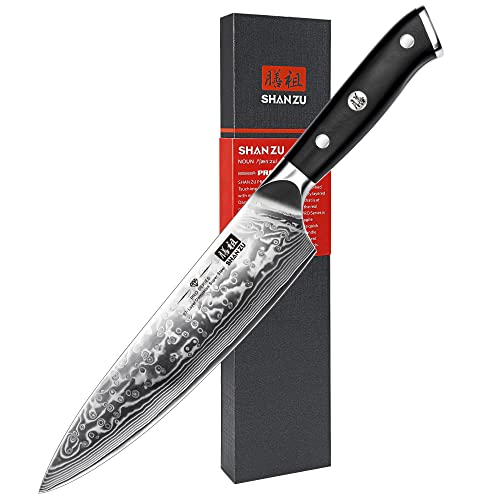
The SHAN ZU stands out because its available specifications are unusually detailed for a chef knife in this category. The listing identifies a 10Cr15MoV core, a 67-layer construction, an 8-inch blade, 2.2 mm thickness, 2.5-inch blade width, and a listed 270 g weight. That information gives shoppers a clearer sense of the knife’s proportions than a title built around vague terms such as “professional” or “ultra sharp.”
The 15-degree cutting angle and G10 handle point toward a knife intended for controlled everyday prep, from slicing vegetables to mincing herbs and handling boneless meats. Its Damascus pattern is described as part of a layered steel construction rather than a laser-etched decoration, although appearance alone does not establish superior cutting performance. The weight is substantial enough to matter for cooks who prefer a more present blade during long chopping sessions, while the 5.3-inch handle gives the knife a conventional full-size feel.
Pros
- Documented 10Cr15MoV core steel.
- Listed 67-layer construction with a patterned exterior.
- Useful 8-inch length for general kitchen preparation.
- G10 handle and stated 2.2 mm blade thickness.
- Available specifications include weight, width, handle length, and edge angle.
Cons
- The listed 270 g weight may feel substantial for cooks who prefer very light knives.
- The patterned finish requires hand-washing and prompt drying as part of sensible knife care.
This is a strong choice for a cook who wants a full-size chef knife with more documented construction details and a distinctive finish. It may be less appealing to someone seeking the lightest possible blade or a plain, utilitarian appearance. The SHAN ZU earns the top position because it offers a well-defined combination of dimensions, handle material, steel information, and general-purpose design without relying solely on branding.
To buy this product, click here.
2. imarku Japanese Chef Knife: Best for Everyday Multipurpose Prep

The imarku uses a gyutou-style profile aimed at broad kitchen work. Its supplied information describes a high-carbon stainless blade with 0.6 to 0.75 percent carbon, 16 to 18 percent chromium, and a stated hardness range of 56 to 58 HRC. Those figures should be read as product information rather than proof of measured cutting performance, but they do help explain why this knife is positioned as a general-purpose stainless option.
An 8-inch blade can handle the familiar rhythm of chopping onions, slicing produce, and preparing boneless meat. The pakkawood handle adds a warmer visual character than polymer, while the listing emphasizes comfort and stability during extended holding. A cook who regularly moves between vegetables and meat may appreciate the broad task range. The brand also notes that packaging or logo details may vary during an upgrade, so buyers focused on appearance should keep that qualification in mind.
Pros
- 8-inch gyutou-style profile suits varied kitchen tasks.
- Documented carbon and chromium ranges provide useful steel information.
- Stated 56 to 58 HRC hardness range.
- Pakkawood handle offers a composite wood-style grip surface.
- Product information includes a stated lifetime warranty and three-month refund policy.
Cons
- The available information does not specify exact blade thickness or weight.
- Logo and packaging details may vary according to the listing.
This knife makes sense for a household that wants one full-size blade for most routine prep and prefers a pakkawood handle. It is less suitable for a buyer who needs verified geometry, exact weight, or highly detailed balance information before purchasing. Compared with the SHAN ZU, it offers less dimensional detail, but its stated steel composition and familiar gyutou format make it a practical everyday alternative.
To buy this product, click here.
3. MOSFiATA 8-Inch Chef’s Knife: Best Accessory Package

MOSFiATA takes a more traditional German-steel route than the patterned Japanese-style knives in this group. The listing identifies EN1.4116 stainless steel with 0.45 to 0.55 percent carbon and 15 percent chromium. It also states that the blade is sharpened to 16 degrees per side. These specifications describe the intended construction, while real edge life will still depend on cutting surfaces, food preparation, sharpening, and cleaning.
The full-tang construction is paired with a Micarta handle and textured grip areas. That combination may appeal to cooks who want a firm, practical handle during repeated chopping. The package also includes a finger guard, blade guard, and knife sharpener. Those additions make the product easier to give as a kitchen gift, though an included sharpener should still be used according to its own design rather than assumed suitable for every edge.
Pros
- Documented EN1.4116 stainless steel.
- Full-tang construction with a Micarta handle.
- Stated 16-degree-per-side edge.
- 8-inch blade suits general chopping, slicing, and mincing.
- Includes a finger guard, blade guard, and knife sharpener.
Cons
- The blade pattern is laser-engraved, not a Damascus layered construction.
- The listing does not provide exact knife weight or blade thickness.
MOSFiATA is a useful match for someone assembling a kitchen setup from scratch or buying a present that includes basic accessories. A cook who already owns a preferred sharpening system may place less value on the extras. Its clearest advantage over similarly styled knives is the combination of documented stainless steel, full-tang construction, Micarta, and a supplied protective guard.
To buy this product, click here.
4. Mercer Culinary Ultimate White 8-Inch Chef’s Knife: Best for Simple Daily Cooking
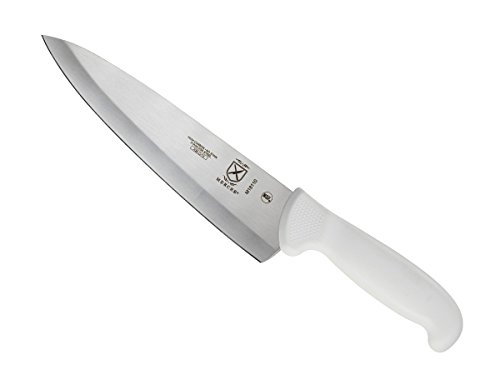
The Mercer Ultimate White keeps its proposition straightforward. It uses high-carbon Japanese steel, an 8-inch chef’s knife format, and a textured handle with finger points intended to support grip security. There is no decorative Damascus claim to sort through and no complicated accessory package competing for attention. That plain approach suits the cook who wants a conventional blade for onions, herbs, garlic, cabbage, and other routine ingredients.
The available information emphasizes easy edge maintenance rather than a precise steel designation or hardness value. That means shoppers receive less metallurgical detail than with the SHAN ZU or imarku, but the knife’s purpose is clear. Mercer specifically recommends hand-washing with mild soap, rinsing, and thorough towel drying. A knife that lives beside a cutting board every day benefits from that simple routine, especially when the goal is predictable upkeep rather than display-piece presentation.
Pros
- 8-inch profile covers common chopping and slicing tasks.
- High-carbon Japanese steel is identified in the product information.
- Textured finger points support a secure grip.
- Simple design avoids decorative features that add little practical information.
- Care instructions are clearly stated.
Cons
- The available specifications do not identify an exact steel grade, weight, or edge angle.
- Hand-washing is recommended rather than prolonged soaking or dishwasher use.
This Mercer is a good fit for a first serious chef knife or a shared household kitchen where the blade will see ordinary daily work. It may disappoint buyers who want a visible layered pattern, a specified hardness rating, or detailed balance measurements. Its appeal lies in a clear purpose and familiar proportions, making it easier to choose based on use rather than ornament.
To buy this product, click here.
5. PAUDIN 8-Inch Chef Knife: Best Thin-Blade Option

PAUDIN lists a 2 mm blade thickness, which gives this knife a more specific handling point than many products in the same group. The knife is intended for slicing, chopping, mincing, and dicing across vegetables, fish, chicken, and beef. That range suits a cook who wants one 8-inch tool for ordinary meal preparation without moving to a specialized blade.
The steel is identified as 5Cr15MoV stainless steel, and the product uses a wood handle with an integrated design. The listing also clearly says the decorative waved pattern is not real Damascus. That clarification is useful because it keeps the visual finish separate from the actual steel information. Buyers who like a traditional-looking handle and a thinner stated blade may find this configuration appealing, while those seeking exact hardness or tang details have less information to work with.
Pros
- Documented 2 mm blade thickness.
- 8-inch length suits broad household preparation.
- 5Cr15MoV stainless steel is identified.
- Wood handle gives the knife a traditional visual character.
- Listing clearly distinguishes the waved pattern from Damascus construction.
Cons
- The available information does not specify hardness, weight, or edge angle.
- The decorative pattern may appeal visually but does not establish a performance advantage.
PAUDIN is most relevant for cooks who pay attention to blade thickness and prefer a wood-handled knife. It is less compelling for someone who wants detailed metallurgical specifications or a documented full-tang design. Compared with the Mercer models, it offers a thinner stated blade and more decorative character, while the trade-off is less information about construction and balance.
To buy this product, click here.
6. Mercer Culinary M20608 Genesis 8-Inch Chef’s Knife: Best Forged Western-Style Design

The Genesis is aimed at cooks who prefer the construction language of a traditional Western chef knife. Mercer describes it as precision-forged from high-carbon German steel, with a taper-ground edge and an ergonomic handle. Those details suggest a knife built around familiar chopping and mincing motions rather than a narrowly specialized Japanese profile.
The textured handle is listed as non-slip, including in wet-hand situations. That is a design intention rather than a guarantee for every grip, but it is relevant in a busy kitchen where rinsed hands and damp ingredients are common. The knife is still an 8-inch general-purpose blade, so it can move from diced onions to herbs and larger vegetables without requiring a second tool for every task.
Pros
- Precision-forged construction is documented.
- High-carbon German steel is identified.
- Taper-ground edge is intended to support efficient cutting.
- Textured ergonomic handle is designed for grip security.
- 8-inch length fits common Western chef-knife tasks.
Cons
- The available information does not list an exact steel grade, weight, or edge angle.
- Mercer recommends hand-washing and complete drying after use.
Genesis suits cooks who want a sturdier, conventionally styled chef knife and who value forged construction. It may be less attractive to someone searching for a very thin blade, a Japanese gyutou profile, or extensive dimensional data. Against the Ultimate White, the Genesis offers more explicitly described forged construction and German steel, while both require a careful hand-washing routine.
To buy this product, click here.
7. HENCKELS Statement 8-Inch Chef Knife: Best Lightweight, Easy-Care Choice

HENCKELS takes a different route with a single-piece, precision-stamped blade. The supplied description presents it as lightweight and suitable for slicing, chopping, mincing, and larger meat preparation. A lighter stamped knife can be attractive to someone who spends a long time at the cutting board and prefers less mass in the hand, although the exact weight is not provided.
The blade is described as satin-finished and stain- and rust-resistant, with cleaning listed as possible by hand or in a dishwasher. That claim is unusual among the knives here, where the supplied care instructions favor hand-washing. Dishwasher convenience may matter in a busy household, but careful hand-washing and drying remain the gentler routine for maintaining a sharp kitchen blade over time.
Pros
- Single-piece precision-stamped blade construction.
- 8-inch length handles common chef-knife work.
- Described as lightweight and easy to use.
- Satin-finished blade is listed as stain and rust resistant.
- Product information lists dishwasher or hand cleaning.
Cons
- The available information does not identify the exact steel grade or weight.
- Stamped construction may not suit buyers specifically seeking a forged knife.
This HENCKELS is a sensible choice for cooks who place light handling and cleanup convenience above decorative finishes or detailed steel specifications. Buyers who want a clearly identified alloy, a stated hardness figure, or a forged build should look elsewhere in this roundup. Its main distinction is practical simplicity, especially for kitchens where a lighter blade and flexible cleaning options matter.
To buy this product, click here.
8. FACZER 8-Inch Hammered Chef Knife: Best for Built-In Storage

FACZER combines a full-size chef knife with a hammered blade texture, wooden handle, magnetic knife block, and sharpener. The listing identifies high-carbon stainless steel and a stated hardness of 58 plus or minus 2 HRC. It also gives a 12-degree-per-side edge claim. These are useful specifications, but they should be treated as the supplied listing information rather than independent measurements.
The hammered surface and laser pattern give the knife a more decorative appearance, while the listing associates the texture with reduced food contact. The practical value of that feature depends on the ingredient and cutting motion, so it should not overshadow the basics: an 8-inch blade, a wooden handle, and a storage solution included in the package. The magnetic block may help keep the knife visible and protected, but its exact capacity and installation requirements are not provided.
Pros
- 8-inch chef-knife format supports general preparation.
- High-carbon stainless steel and stated 58 plus or minus 2 HRC are listed.
- Stated 12-degree-per-side edge.
- Wooden handle and hammered blade provide a distinctive presentation.
- Includes a magnetic knife block and sharpener.
Cons
- The exact steel designation is not provided.
- Storage capacity and sharpener compatibility details are not listed.
FACZER fits a buyer who wants a presentable knife package rather than a blade alone. It may be a weaker match for someone who already has storage and sharpening equipment or who prefers a plain blade with fewer unknowns. Compared with MOSFiATA, it offers a different visual direction and a supplied block, while MOSFiATA provides more explicit steel identification and a protective blade guard.
To buy this product, click here.
9. Mercer Culinary M22608 Millennia Chef’s Knife: Best for Balanced Everyday Prep
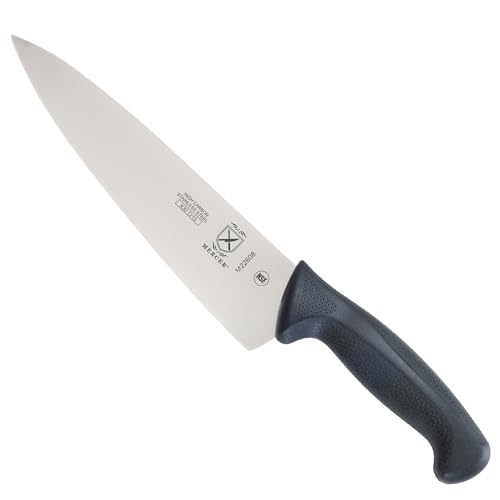
The Millennia uses a one-piece high-carbon Japanese steel blade and an 8-inch format. Mercer lists textured finger points on the handle and specifically mentions tang-related balance. That combination targets routine prep where the same knife may spend an evening moving between onions, herbs, garlic, cabbage, and other vegetables.
Its design is less ornate than the patterned alternatives, which can be an advantage for a buyer who wants a practical tool with easily understood care instructions. Mercer recommends washing by hand with mild soap, rinsing, and drying completely. The available information does not give a steel grade, edge angle, or weight, so this knife is best judged as a straightforward everyday option rather than a highly specified performance blade.
Pros
- One-piece high-carbon Japanese steel construction.
- 8-inch length suits broad kitchen preparation.
- Textured finger points support grip control.
- Tang is described as contributing to balance.
- Clear hand-washing and drying guidance is supplied.
Cons
- The exact steel designation, weight, and edge angle are not listed.
- It lacks the included guards, sharpener, or storage accessories found with some alternatives.
Millennia is a sensible fit for a cook who wants a no-frills knife from an established culinary cutlery line and prefers a handle with textured contact points. A buyer seeking a decorative blade, a specified hardness value, or a complete gift package may prefer another pick. Its place here comes from the combination of 8-inch versatility, one-piece construction, and balance-focused handle information.
To buy this product, click here.
Buying Guide
If this is a first purchase, consider the essential knives for a home kitchen before spending the whole budget on overlapping blade shapes.
Match the Blade Length to Your Cutting Board
An 8-inch chef knife is the dominant size in this roundup because it offers useful reach without taking over a typical home cutting board. It can handle a large onion or bunch of herbs while remaining manageable for smaller produce. A long blade may feel awkward in a cramped workspace, while a short blade can require more strokes across large ingredients. Check the board area and your usual food sizes before treating 8 inches as an automatic fit.
A lower price does not solve an awkward fit; matching chef’s-knife length to your workspace helps narrow the choice before comparing materials and extras.
Read Steel Claims With Care
A named alloy such as 10Cr15MoV, EN1.4116, 5Cr15MoV, or 5Cr15MoV gives more information than a broad phrase such as “premium steel.” Hardness figures can add context, but hardness alone does not prove edge retention or overall superiority. Geometry, heat treatment, edge preparation, toughness, and maintenance all affect ownership. The SHAN ZU, imarku, MOSFiATA, PAUDIN, and FACZER provide more specific material details than several alternatives.
Choose a Cutting Profile That Fits Your Motion
These knives are general-purpose chef knives, with several listings describing gyutou or Japanese-style influences. A pronounced belly can suit rocking motions, while a flatter edge may feel more natural for push cutting. Product data here does not provide detailed grind or belly measurements for every knife, so shoppers should avoid assuming that a Japanese-style label guarantees a particular geometry.
Balance Weight and Handle Construction
The SHAN ZU lists a 270 g weight, while the HENCKELS is described as lightweight without an exact figure. Those descriptions point to different handling priorities. G10, Micarta, pakkawood, wood, polymer, and textured composite handles also create different touch and maintenance considerations. A handle described as ergonomic cannot guarantee comfort for every hand, so pay attention to the available materials and dimensions instead of relying on the adjective alone.
Plan for Hand-Washing and Drying
Most knives in this selection come with hand-washing guidance. Rinse away food residue, use mild soap, and dry the blade and handle promptly. HENCKELS lists dishwasher cleaning as an option, but repeated dishwasher exposure can be harsher on sharp edges and handles than careful hand-washing. Avoid leaving a knife submerged or loose in a drawer, and use a guard, block, or another secure storage method.
Separate Decorative Patterning From Construction
A patterned blade can be attractive, but appearance should not carry the buying decision. The SHAN ZU listing describes a 67-layer construction, while PAUDIN and MOSFiATA explicitly distinguish their decorative patterns from Damascus construction. FACZER uses a hammered texture and laser pattern. Compare the actual steel, blade dimensions, handle, and care instructions before assigning performance value to a finish.
Best Chef Knife Under 100 FAQ
Is an 8-inch chef knife a good general-purpose size?
For many home kitchens, yes. An 8-inch blade offers enough length for larger vegetables and common meat-preparation tasks while remaining easier to control than a very long chef knife. The best fit still depends on cutting-board space, hand size, and whether you prefer a lighter or more compact tool.
Which steel information matters most in this price range?
A documented steel designation is useful because it gives you a clearer starting point for maintenance and expectations. The designation does not independently prove superior edge life. Look at the steel alongside blade geometry, stated hardness when available, handle design, and the care instructions.
Does a Damascus pattern mean the knife is sharper?
No. A Damascus or Damascus-style appearance describes a construction or surface pattern, but sharpness depends on edge geometry, grinding, sharpening, and maintenance. The SHAN ZU lists a layered construction, while other knives in this roundup use decorative patterns that are explicitly not Damascus.
Should a chef knife under $100 be washed in the dishwasher?
Follow the exact product guidance, but hand-washing and prompt drying are generally the gentler routine for a sharp kitchen knife. The HENCKELS listing permits dishwasher or hand cleaning, while Mercer recommends hand-washing. Avoid prolonged soaking and store the knife securely after it is dry.
Is a harder knife always better?
No. Hardness can relate to edge stability and wear resistance, but it does not tell the whole story. Toughness, geometry, heat treatment, sharpening skill, cutting surface, and food type also matter. A stated HRC value should be treated as one piece of information rather than a complete performance verdict.
Can these chef knives cut bones or frozen food?
They are general-purpose chef knives, not dedicated cleavers or bone-processing tools. Use them for the food preparation described in their listings, such as vegetables, herbs, fish, and boneless meats. Hard bones and frozen foods can place stresses on an edge that the supplied information does not show these knives are intended to handle.
Which handle material should I choose?
G10 and Micarta offer composite construction, pakkawood and wood provide a different traditional feel, and textured polymer handles can emphasize grip and easy care. No material guarantees comfort for every cook. Look for the handle length, texture, and overall knife weight that suit your preferred grip and preparation habits.
Final Verdict
The SHAN ZU Chef Knife is the strongest overall recommendation for this group. Its 8-inch blade, stated 10Cr15MoV core, 67-layer construction, G10 handle, listed 270 g weight, and documented dimensions give shoppers a useful level of product detail. It is a particularly good fit for someone who wants a full-size chef knife with a distinctive layered appearance and a more substantial feel.
The Mercer Culinary Genesis is the clearest alternative for cooks who prefer forged Western-style construction and high-carbon German steel. HENCKELS makes more sense for buyers prioritizing a lightweight design and listed dishwasher flexibility, while Mercer’s Ultimate White and Millennia models suit shoppers who want straightforward everyday tools. Whichever knife you select, match the blade length and handle style to your cutting board and grip, then protect the edge with suitable surfaces, careful cleaning, and secure storage.
