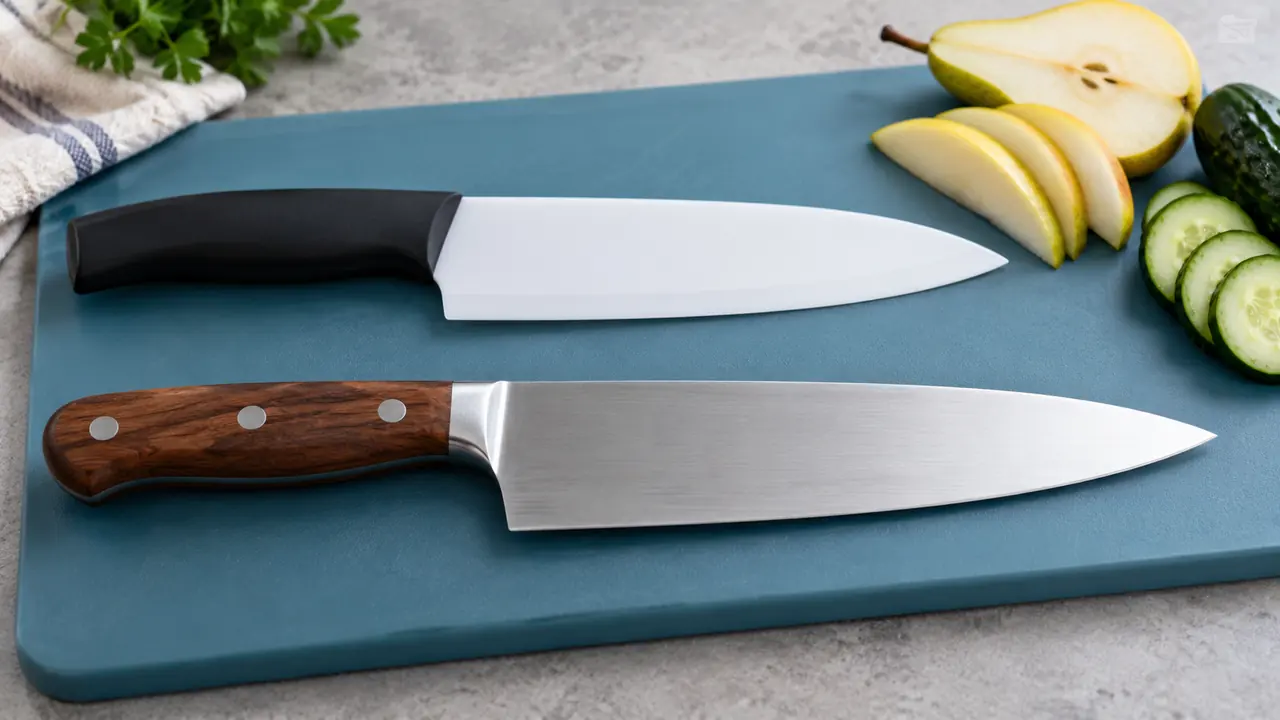
Ceramic knives and steel knives differ most in how they tolerate stress and how they are maintained. Ceramic can suit controlled slicing of produce and boneless food, but twisting, impact, and hard ingredients can damage its brittle edge. Steel covers a wider range of designs and sharpening routes. Neither material alone determines how sharp a particular knife is or whether its shape suits a task.
Considering ceramic for routine produce preparation? The ceramic chef-knife comparison helps identify available shapes and sizes; the limitations below explain why a steel knife may still be needed for other tasks.
Separate the Material From the Blade Shape
A ceramic santoku and a steel chef’s knife differ in both material and profile. If the ceramic knife feels shorter or cuts with a flatter motion, the shape may explain part of that difference. A material comparison is more useful when blade length, thickness, edge profile, and intended food are considered alongside the label.
Ceramic is also different from a ceramic coating on steel. Check the maker’s description rather than assuming a white or dark blade has a particular construction. A coating does not turn the metal underneath into a solid ceramic knife.
| Question | Ceramic knife | Steel knife |
|---|---|---|
| What work is it intended for? | Often controlled cuts through produce and boneless foods, subject to the maker’s limits. | Varies widely, from delicate slicers to substantial task-specific blades. |
| What handling deserves attention? | Side pressure, drops, twisting, and hard contact. | The same actions can cause damage; the tolerance depends on the individual design. |
| How is it resharpened? | A compatible ceramic-knife method or service is required. | Many methods exist, but edge geometry and material still govern compatibility. |
| Does it need care? | Yes: cleaning, protected storage, and appropriate use. | Yes: cleaning, drying, edge maintenance, and suitable storage. |
Where Ceramic Can Fit Into Everyday Preparation
A ceramic blade may suit slicing a pear, cutting a cucumber, or preparing an appropriate boneless ingredient. The task should let the edge pass through food without levering sideways. A cutting board and adequate workspace remain necessary even when the knife feels light.
Manufacturer restrictions are more informative than a general claim that ceramic “cuts everything.” For example, Kyocera’s care instructions exclude hard or frozen foods and prying or smashing actions. Those instructions describe that maker’s products; another knife still needs its own care information.
Do not use a knife’s low weight as evidence that it is suitable for a child, a person with a particular condition, or every hand size. Control also depends on the handle, reach, grip, and task. If a claimed advantage matters to your purchase, check the actual product rather than treating it as an inherent benefit of the material.
Hardness Is Not the Same as Toughness
Hardness concerns resistance to particular forms of deformation or indentation. Toughness concerns the ability to resist fracture under stress. Those are different properties, and a hard edge can still chip. Do not compare an advertised ceramic hardness on one scale directly with a steel value reported on another.
A knife can encounter side pressure when it becomes stuck in dense food, when the handle is twisted to free it, or when the flat blade is used as a lever. Stop and change tools instead of using the edge to solve the obstruction. That advice applies to delicate steel knives as well as ceramic ones.
A thick steel cleaver and a thin steel slicer do not have interchangeable tolerances. “Use steel instead” means selecting a steel tool designed for the job, not substituting any steel knife for a task involving bones, frozen food, or prying.
Steel Gives More Design and Maintenance Choices
A useful steel knife might be a general chef’s knife, a bread knife, or a task-specific tool. If routine board work is the goal, compare steel chef’s knives for everyday preparation by their dimensions and profiles rather than choosing solely on the material name.
Steel itself is not one uniform category. Reactive carbon steel and more corrosion-resistant stainless steel create different ownership requirements. The separate explanation of carbon-steel and stainless-steel care differences covers that choice without treating either category as automatically sharper or tougher.
Check the Sharpening Route Before the Edge Wears
Do not put a ceramic knife through a steel-knife sharpener unless both manufacturers establish compatibility. A ceramic honing rod used on steel knives is not evidence that the same rod can maintain a ceramic blade. Product names can describe the abrasive material rather than the knife material.
Kyocera’s FAQ describes a compatible diamond-wheel route or sharpening service for its ceramic knives. It also distinguishes serrated products from straight-edged ones. That is a reason to read the relevant instructions, not permission to use every diamond abrasive on every ceramic edge.
Steel edges also need the correct method. A device suited to an ordinary symmetrical double bevel may alter a single-bevel or asymmetrical knife. Choose the maintenance plan at the same time as the knife, particularly if specialist service is required.
Clean and Store Either Material Deliberately
Follow the instructions for the blade, handle, and any separate cover. Do not infer dishwasher approval from ceramic’s resistance to rust. A blade that resists corrosion still needs food residue removed and a handle that is cleaned appropriately.
Protect the edge from loose utensils, avoid hard impacts in a sink, and put a clean, dry knife into its intended storage. Ceramic is not held by an ordinary magnetic rack in the same way as a magnetic steel blade. The guide to separating and securing knives in storage helps compare the broader layouts; confirm that the selected holder actually supports the material and shape.
Ceramic can be a useful additional tool when its handling limits fit the work. Steel can be the more adaptable choice when one knife must cover varied tasks. The better decision begins with the food, movement, and maintenance you can support.
