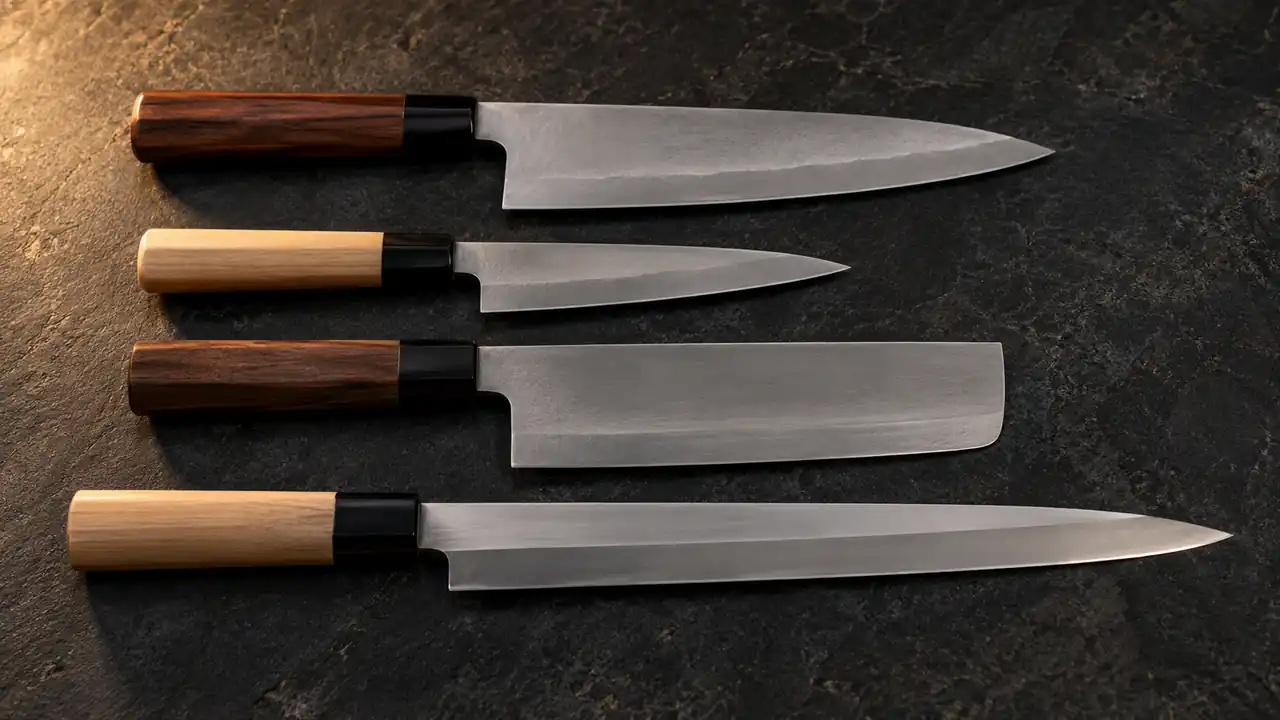
Japanese kitchen-knife names usually describe a blade’s shape, role, or tradition rather than one standard level of quality. A gyuto, santoku, or bunka can cover general preparation; a petty handles smaller work; a nakiri focuses on vegetables; and traditional deba and yanagiba patterns serve different fish-preparation tasks. The useful collection depends on what you cook, not on owning every named shape.
Building a matching collection is optional. If that is your preference, compare Japanese-style knife sets by their useful blade mix after identifying the tasks below, rather than treating a larger piece count as better coverage.
Read the Shape and the Specification Together
A name gives a starting point, but individual knives can differ in length, thickness, edge profile, steel, handle, and grind. Two knives sold under the same style name may feel and cut differently. A familiar silhouette does not establish the sharpening angle or whether a blade is single-bevel.
Country of manufacture is another separate question. “Japanese-style” describes an influence or profile; it does not establish where a knife was made. Check the product’s documented origin when that matters to the decision.
A Quick Map of Common Roles
| Knife type | Typical role | What to check |
|---|---|---|
| Gyuto | General slicing, chopping, and board preparation. | Length, curve, thickness, and handle clearance. |
| Santoku | Compact multipurpose preparation. | The actual edge profile and usable reach. |
| Bunka | General preparation with an angular pointed-tip profile. | Tip clearance, grind, and suitability for the intended motion. |
| Nakiri | Vegetable preparation with a relatively flat cutting profile. | Geometry and board contact, not just the rectangular outline. |
| Petty | Small preparation and utility work. | Blade length, height, and whether the task is on or off the board. |
| Deba | Traditional fish breakdown. | Construction, handedness, maker’s use limits, and technique. |
| Yanagiba | Long drawing slices, particularly for fish. | Edge geometry, handedness, reach, and maintenance. |
| Sujihiki | Long slices through boneless proteins. | Blade shape and grind; it is not simply another name for yanagiba. |
These are task descriptions, not an instruction to use any knife on every ingredient in the category. Shun’s blade-shape guide similarly separates general-purpose profiles from specialized forms. Its model-specific descriptions and dimensions should remain attached to those models.
Gyuto, Santoku, and Bunka Cover Overlapping Work
A gyuto commonly gives the cook a pointed tip and enough length for general board work. The amount of curve varies. A santoku often provides a more compact profile, but the name alone does not guarantee a particular motion or a better fit for smaller hands.
The bunka’s angular tip is a useful visual distinction. Compare bunka knives with different profiles and handle designs when that form interests you, but do not choose solely for the appearance of the tip. The knife still needs to fit the board, ingredient size, and cutting movement.
These profiles overlap enough that many home cooks can begin with one. Owning all three does not automatically increase useful coverage. A second knife earns its place when it solves a recurring limitation of the first, rather than repeating the same job in a different outline.
Nakiri and Usuba Are Not Interchangeable Labels
A nakiri is associated with vegetable preparation and a flatter working edge. Its broad blade can make transferring prepared ingredients convenient, but moving food should not involve dragging a sharp edge sideways across the board.
A traditional usuba is a more specialized form often associated with single-bevel vegetable work. Similar-looking rectangular blades should not be assumed to have the same grind, handling, or maintenance needs. Neither a thin nakiri nor an usuba should be treated as a heavy bone cleaver because of its shape.
Petty Knives Fill the Space Between Other Tools
A petty can suit trimming, small produce, or utility tasks that make a large main knife feel cumbersome. Its role depends on dimensions. A low blade may provide little knuckle clearance on a board even when the edge is long enough to make the cut.
The petty-knife comparison helps distinguish those layouts. Do not automatically equate a petty with every Western paring knife: some occupy similar roles, while others have noticeably more reach.
Shun’s utility-knife discussion illustrates how smaller preparation knives can differ in blade height and intended use. Check the individual shape instead of treating the translation of a name as a complete specification.
Deba and Yanagiba Handle Different Stages of Fish Preparation
A traditional deba is a substantial fish-preparation pattern. That does not authorize using every deba for any bone, chopping motion, or frozen ingredient. Construction and maker guidance matter, and the technique differs from following a fish with a flexible Western fillet knife.
A yanagiba is long and narrow, intended for controlled drawing slices rather than the same breakdown role. These yanagiba knives for suitable slicing work should be considered with the user’s technique and maintenance plan in mind. A long blade does not make it a universal tool for cutting through assembled sushi rolls or opening shellfish.
A sujihiki can also provide a long slicing edge, but its design is not defined by being a traditional yanagiba. Inspect the actual grind and intended work before treating the two as substitutes.
Single-Bevel Is Not a Synonym for Japanese
Many widely used Japanese and Japanese-style knives have double-bevel edges. Traditional specialist patterns are often single-bevel, and asymmetrical grinds also exist. A model name or a handle style cannot settle that question on its own.
Handedness can matter, especially for specialist grinds. Do not assume a blade is appropriate for both hands without checking its specification. Before maintenance, use the guide to sharpening Japanese knives by their edge geometry and follow the manufacturer’s instructions for the actual knife.
Build Useful Coverage Before Adding Specialists
List the food you prepare regularly, identify the cuts your main knife handles poorly, and add only the tool that resolves a real gap. Leave room in the budget and workspace for a suitable board, protected storage, and maintenance.
A matched set may provide that coverage, or it may repeat several similar multipurpose knives. Count useful tasks rather than printed piece totals. An unfamiliar specialist shape is not a required upgrade when the work it serves rarely occurs in your kitchen.
