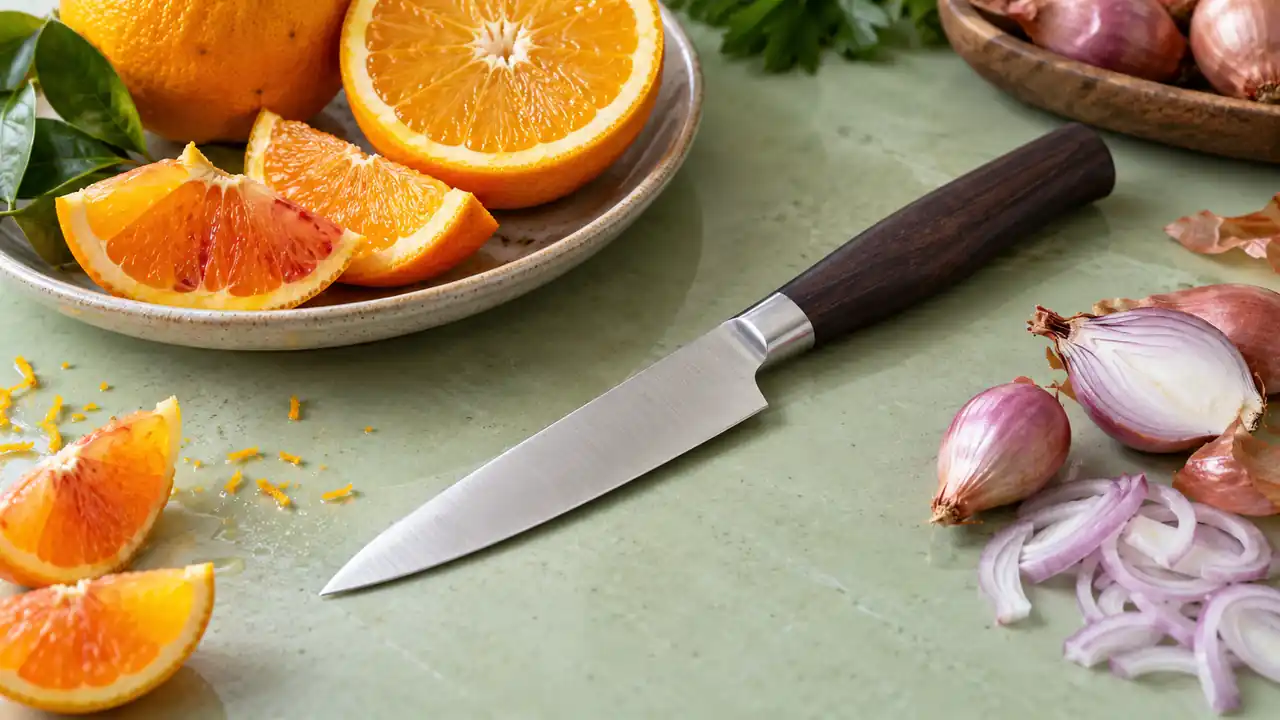
A petty knife fills the gap between a paring knife and a full-size chef’s knife. Its compact blade can peel an apple, trim a shallot, slice citrus, hull strawberries, or handle a small cutting board job without the reach and swing of a larger knife. That middle size is the appeal, but it also makes selection more nuanced. A 3.9-inch blade favors close, delicate work, while a 5.5- or 6-inch petty can take on larger vegetables and small portions of meat.
Common mistakes include choosing by Damascus pattern alone, assuming every Japanese-style knife has the same geometry, and overlooking maintenance. Steel designation, blade length, handle shape, weight, edge design, and intended cutting motion all affect ownership. A stainless petty may suit a busy household that wants simple cleanup, while a harder VG10 or AUS-10V model may appeal to cooks who are comfortable hand washing and sharpening with suitable equipment.
The nine knives below cover compact fruit knives, traditional Japanese petty designs, Western-handled utility models, and larger all-purpose options. The Misono Molybdenum Steel Petty Knife earns the top position because its 13 cm blade, moderate weight, thin listed back, Japanese construction, and stainless molybdenum steel form a particularly balanced everyday package. Different cooks will still favor different dimensions, handles, and maintenance requirements.
Quick Answer
The Misono Molybdenum Steel Petty Knife is the strongest overall match for shoppers seeking a compact, versatile petty with documented dimensions and a reinforced wood handle. Its 13 cm blade sits in a useful middle ground for fruit, vegetables, herbs, trimming, and small general prep.
The Tojiro DP Petty/Utility Knife is a strong choice for cooks who want a longer 15 cm blade and a Japanese-made stainless construction. For very fine peeling and coring, the KAWAHIRO 3.9-inch petty offers a shorter blade, K-tip, VG10 core, and octagonal wa handle.
Best Petty Knife Comparison Table
| Product | Best For | Blade Length | Steel | Handle |
|---|---|---|---|---|
| Misono Molybdenum Steel Petty Knife | Everyday petty work | 5.1 in / 13 cm | 13-chrome molybdenum stainless | Reinforced wood |
| Tojiro DP Petty/Utility Knife | Larger prep tasks | 5.9 in / 15 cm | Cobalt alloy and 13-chrome stainless | Laminated reinforced wood |
| Yoshihiro VG10 Hammered Damascus Petty | Traditional Japanese construction | 5.3 in / 135 mm | VG10, 16-layer Damascus | Mahogany Western handle |
| Dalstrong Shogun Utility Knife | Longer premium utility use | 6 in | AUS-10V core, 67-layer cladding | G10 full tang |
| SHAN ZU Damascus Utility Knife | Left- or right-handed prep | 6 in | 10Cr15MoV, 67-layer Damascus | G10 |
| Handcrafted Damascus VG10 Petty | Fruit, vegetables, and herbs | 5.5 in | VG10 core, 67-layer cladding | Resin wood full tang |
| XINZUO Damascus Paring Petty | Decorative small-knife design | 5.6 in | 10Cr15CoMoV, 67 layers | Burnt white oak |
| Japanese 8A Stainless Petty Knife | Peeling and small ingredients | 4.7 in / 120 mm | 8A stainless steel | Rose wood |
| KAWAHIRO VG10 Paring Petty | Close precision work | 3.9 in | VG10 core, 3-layer construction | Octagonal wa handle |
The detailed reviews explain how these differences translate to peeling, trimming, slicing, and everyday prep.
1. Misono Molybdenum Steel Petty Knife No. 532/13cm – Best Overall

A 13 cm petty is long enough for everyday slicing yet compact enough for close work beside a cutting board. The Misono No. 532 lists a 5.1-inch blade, a 9.1-inch overall length, and a 1.7 mm back thickness. Those dimensions point toward a nimble knife for trimming green beans, slicing garlic, portioning fruit, and handling ingredients that feel awkward under a chef’s knife.
Its documented 2.5-ounce weight keeps the knife in the lighter part of this group, while the black reinforced wood handle gives it a more traditional appearance than a molded polymer grip. The blade uses high-carbon, 13-chrome stainless molybdenum steel. That combination offers a useful maintenance compromise for cooks who want stainless construction but still expect to wash and dry the knife promptly. The Japanese-made build and restrained size make this the easiest recommendation for a broad range of home kitchens.
Pros
- Useful 13 cm blade length for general petty tasks.
- Listed 1.7 mm back thickness suits close, controlled preparation.
- Light 2.5-ounce construction is easy to maneuver.
- High-carbon 13-chrome molybdenum stainless steel is clearly identified.
- Reinforced wood handle and Japanese manufacture add practical appeal.
Cons
- The short blade is less suitable for larger vegetables or broad slicing.
- The wood-based handle requires sensible hand washing and drying.
This is the knife to choose for a cook who wants one compact blade for nearly every small preparation task. It has more reach than a tiny paring knife without becoming bulky. Those who regularly cut large squash, melon, or substantial pieces of meat will need a longer knife, while cooks seeking a decorative Damascus finish may prefer another option. For ordinary fruit, vegetables, herbs, trimming, and lunch-size prep, the Misono presents the most balanced combination of size, steel information, weight, and handle design in this group.
To buy this product, click here.
2. Tojiro DP Petty/Utility Knife – Best for Larger Prep Tasks

The Tojiro DP stretches the petty format toward utility-knife territory with a listed 15 cm blade and 10.2-inch overall length. That extra reach matters if your routine includes slicing a cucumber, trimming a chicken breast, cutting a sandwich filling, or dividing a larger piece of produce. It remains smaller than a chef’s knife, so it can feel less cumbersome on a crowded board or during quick preparation at the sink.
The blade combines cobalt alloy steel, 13-chrome stainless steel, and an 18-8 stainless base, while the handle uses black laminated reinforced wood. The available information does not provide a hardness figure or exact edge angle, so buyers should avoid assuming a particular sharpening schedule. Its 3.2-ounce weight is still modest, although it is heavier than the Misono. That makes the Tojiro a sensible pick for shoppers who value additional blade length more than the smallest possible footprint.
Pros
- 15 cm blade handles larger petty and utility tasks.
- Japanese-made construction is clearly identified.
- Cobalt alloy and 13-chrome stainless materials are listed.
- Laminated reinforced wood handle offers a substantial grip surface.
- Still relatively light at the listed 3.2 ounces.
Cons
- The longer blade may feel oversized for tiny peeling jobs.
- The supplied information does not state hardness or edge angle.
Choose this model if a petty knife needs to cover some work usually assigned to a small utility knife. It suits cooks who slice more than they peel and who want a little extra clearance from their knuckles and cutting board. A smaller 12 or 13 cm blade will be easier for coring and decorative work, while this Tojiro is better aligned with everyday ingredient prep that benefits from reach.
To buy this product, click here.
3. Yoshihiro VG10 16 Layer Hammered Damascus Stainless Steel Petty Utility Knife – Best Traditional Japanese-Style Option

The Yoshihiro occupies a useful 135 mm position between compact paring work and larger utility preparation. Its VG10 core and 16-layer hammered Damascus construction give the knife a documented material profile, while the hammered surface is described as helping reduce food contact with the blade. That feature matters most during moist slicing, where bits of fruit or vegetable can cling to a smooth surface.
A Western-style mahogany handle and full-tang construction create a familiar format for cooks who prefer a conventional grip over a wa handle. The listing specifies a double-edged blade, stain-resistant stainless construction, and HRC 60. It also gives unusually clear care guidance: hand wash and dry promptly, use water whetstones for sharpening and honing, and avoid bones, nutshells, and frozen foods. The knife has no saya cover listed, so storage needs attention.
Pros
- 135 mm blade offers a flexible middle size.
- VG10 core and 16-layer hammered construction are documented.
- Double-edged design suits standard right- or left-handed use.
- Western mahogany handle may feel familiar to many cooks.
- Published care restrictions provide useful maintenance guidance.
Cons
- No saya cover is listed for blade protection during storage.
- Hand washing, prompt drying, and water-whetstone care require commitment.
This is a strong fit for someone who wants Japanese-made petty construction with a Western handle and visible layered finish. It is less appealing for a household that puts knives in a dishwasher or stores them loose in a drawer. The documented HRC value and sharpening guidance make ownership more deliberate, while the 135 mm length keeps the knife useful for both small fruit and medium vegetable preparation.
To buy this product, click here.
4. Dalstrong 6-inch Utility Knife, Shogun Series – Best for a Full-Size Utility Feel

At 6 inches, the Dalstrong sits at the larger end of the petty category. Its AUS-10V core is enclosed by 67 layers of high-carbon stainless steel, and the listing gives a hardness of 62+ HRC. The blade is described as full tang, triple riveted, and vacuum heat treated, with an 8 to 12 degree angle per side. These details make it a specification-rich option for cooks who want a compact knife that can handle more substantial slicing and trimming.
The G10 handle and included polymer saya add a practical edge for storage and regular use. A sheath is handy for a knife that may travel between a home kitchen, cooking class, or second prep station. Its size is also the central trade-off. A 6-inch blade offers more reach for peppers, citrus, and small proteins, yet it can feel excessive for turning a small apple in the hand. The listed construction suggests a knife for users who have room for a longer petty and are prepared to maintain a fine edge carefully.
Pros
- 6-inch blade covers larger utility and petty tasks.
- AUS-10V core, 67-layer cladding, and 62+ HRC are listed.
- Full-tang, triple-riveted construction provides a substantial format.
- G10 handle is paired with a hand-polished spine.
- Polymer saya is included for protected storage.
Cons
- The long blade is less convenient for very close peeling and coring.
- The fine listed edge angle calls for careful use and suitable sharpening.
Pick this model if your idea of a petty knife leans toward a small chef’s knife. It makes more sense for slicing fruit, trimming proteins, and preparing larger portions than for tiny decorative cuts. Buyers who prefer a traditional compact Japanese petty will find it broad in scope and more substantial in hand, while cooks who want one blade to bridge several prep roles may appreciate the extra length and protective saya.
To buy this product, click here.
5. SHAN ZU Damascus Chef Knife 6-inch Utility Knife – Best Double-Edged Large Petty

This SHAN ZU is marketed as a 6-inch utility or petty knife, giving it a larger working area than traditional 4- or 5-inch paring knives. The blade uses a 10Cr15MoV core with 67-layer Damascus construction, and the listing states 62 HRC and a 12-degree cutting angle. Those figures describe the supplied product specification, but they do not independently establish edge life or cutting performance. The useful takeaway is that this is a fine-edged, compact utility design that deserves controlled use.
The double-edged blade is a practical detail for both right- and left-handed cooks. A full-tang G10 handle offers a different maintenance profile from wood, and the polygonal shape is intended to support a stable grip. The length makes it capable with fruit, vegetables, and some meat trimming, though its 6-inch reach moves it closer to a utility knife than a classic small petty. The patterned blade is attractive, but the steel core and geometry matter more to the purchase decision than the decorative layers.
Pros
- 6-inch blade provides useful reach for a petty-style utility knife.
- 10Cr15MoV core and 67-layer construction are specified.
- Double-edged design accommodates either hand.
- Full-tang G10 handle avoids the care needs of an untreated wood grip.
- Suitable listed applications include fruit, vegetables, and meat preparation.
Cons
- The 6-inch format may be too large for delicate hand-held peeling.
- The supplied information does not identify a country of manufacture.
This knife suits a household that wants a compact all-purpose blade with a modern handle and broad hand compatibility. It is a better match for board work than for intricate turning cuts, where a shorter blade gives more control. Those attracted by the Damascus appearance should treat it as a style feature and evaluate the stated core steel, edge specification, and handle construction instead of assuming layer count guarantees better cutting.
To buy this product, click here.
6. Handcrafted Damascus VG10 Kitchen Petty Knife – Best for Fruit and Herb Prep

The 5.5-inch length gives this knife a middle-ground role: agile enough for citrus, apples, herbs, and trimming, with more reach than a classic paring blade. The listing identifies a VG10 core, 67-layer Damascus cladding, 62 HRC, and a 12 to 15 degree angle per side. It also describes a full-tang design and a hand-polished spine. Together, those specifications point toward a controlled board knife with a decorative layered exterior.
The natural wood and blue resin handle gives this petty a distinctive presentation, especially with the included gift box. That visual appeal may matter to shoppers buying a kitchen gift, but the handle still calls for care around water and cleaning. The product is described for slicing cucumbers and citrus, dicing apples, trimming vegetables, and preparing fruit. Its 5.5-inch reach is more versatile than a 3.9-inch paring knife, although the available information does not provide a listed weight or exact blade thickness.
Pros
- 5.5-inch blade suits fruit, vegetables, herbs, and trimming.
- VG10 core, 67-layer cladding, and 62 HRC are documented.
- Full-tang construction is listed.
- Natural wood and resin handle gives the knife a distinctive appearance.
- Gift box adds practical presentation value.
Cons
- Exact weight and blade thickness are not provided in the available information.
- The wood and resin handle still calls for careful hand cleaning and drying.
This model is a good match for cooks who want a medium-length petty with a gift-ready appearance and clearly stated VG10 construction. It will appeal to someone preparing fruit plates, herbs, and vegetables more than someone seeking a plain workhorse for rough utility tasks. Since blade thickness and weight are unspecified, buyers who prioritize exact handling characteristics should choose a model with fuller dimensional information.
To buy this product, click here.
7. XINZUO 5.6-inch Damascus Paring Petty Knife – Best Decorative Compact Design

The XINZUO combines a 5.6-inch petty-style blade with a burnt white oak handle and a red G10 anti-slip ring. Its listed 10Cr15CoMoV core, 67-layer Damascus construction, 62 HRC hardness, and 15-degree-per-side V edge give shoppers a clear technical outline. The blade is also described as hammered, with the product information associating that surface with reduced sticking. These features suit cooks who want a visually distinctive knife for routine fruit and vegetable preparation.
A rounded spine and shaped wooden handle are intended to support a comfortable grip, although hand comfort remains individual and cannot be guaranteed from specifications alone. The 5.6-inch blade is long enough for slicing and dicing medium ingredients, while the petty format keeps it more nimble than a chef’s knife. The main maintenance point is simple: a natural wood handle and a fine edge favor hand washing, prompt drying, and appropriate sharpening rather than careless dishwasher use or hard-material cutting.
Pros
- 5.6-inch blade balances compact handling with useful reach.
- 10Cr15CoMoV core and 67-layer construction are listed.
- 62 HRC and 15-degree-per-side edge specifications are provided.
- Burnt white oak handle includes a listed G10 anti-slip ring.
- Rounded spine and hammered finish address practical handling and food contact.
Cons
- The natural wood handle requires more care than a fully synthetic grip.
- The decorative finish may matter less to shoppers focused on a plain utility knife.
Choose the XINZUO if appearance, medium reach, and a defined edge specification all matter. It belongs on a kitchen where the petty knife will handle fruit, vegetables, and herbs rather than bones or frozen foods. A shorter blade will be easier for close peeling, while the XINZUO makes more sense for cooks who want a compact board knife with a noticeable visual character.
To buy this product, click here.
8. Japanese 8A Stainless Steel Petty Knife – Best for Peeling and Small Ingredients

This Seki-style petty knife has a 4.7-inch, 120 mm blade and a listed weight of 1.8 ounces. That compact profile is well suited to peeling an apple at the counter, removing strawberry hulls, trimming small vegetables, and making decorative cuts. It is easier to guide around small ingredients than a 6-inch utility knife, though the shorter edge gives up reach during board work.
The listing identifies 8A stainless steel and a rosewood handle, with a 9.1-inch overall length. Stainless construction can be convenient for a busy home kitchen, but it should still be washed and dried rather than treated as immune to corrosion. The product is positioned as a general-purpose small kitchen knife, and its light weight should appeal to cooks who prefer a blade that does not feel imposing during quick, hand-held preparation.
Pros
- Compact 120 mm blade favors peeling, hulling, and decorative cuts.
- Very light listed weight of 1.8 ounces supports nimble handling.
- 8A stainless steel is clearly identified.
- Rosewood handle gives the knife a traditional appearance.
- 9.1-inch overall length remains easy to store and maneuver.
Cons
- The 4.7-inch blade is less capable with larger produce.
- The available information does not specify hardness or edge angle.
This is the petite choice for a cook whose petty knife will live near the fruit bowl or vegetable drawer. It should suit peeling, trimming, and small ingredient work better than broad slicing. Shoppers wanting one knife to replace a small utility blade may prefer the Misono, Tojiro, or a 6-inch option, while those who value low weight and close control will find the shorter format more appealing.
To buy this product, click here.
9. KAWAHIRO 3.9-inch VG10 Paring Petty Knife – Best for Close Precision Work

The KAWAHIRO takes the compact side of the petty category seriously. Its 3.9-inch blade is aimed at peeling, coring, hulling strawberries, slicing grapes, removing apple seeds, and preparing herbs. A sharp K-tip is listed, giving the blade a pointed profile for small, precise cuts. At 2.6 ounces, it is also among the lighter options here, although the supplied information does not provide the overall length or blade thickness.
The three-layer construction uses a VG10 core, and the listing gives a 60 to 62 HRC range. An octagonal wa handle made from ebony, turquoise, and ruby wood creates a traditional Japanese-style grip with a striking appearance. That handle may appeal to cooks who enjoy a more distinctive knife, but natural materials deserve careful cleaning and drying. The included wooden gift box makes the knife presentation-oriented, while the short blade keeps its role specialized rather than broad.
Pros
- 3.9-inch blade provides close control for peeling and coring.
- K-tip is suited to pointed, delicate preparation tasks.
- VG10 core and 60 to 62 HRC range are stated.
- Light 2.6-ounce weight supports compact handling.
- Octagonal wood handle and wooden box create a distinctive presentation.
Cons
- The short blade is limited for larger produce and extended board work.
- The listing does not provide overall length or blade thickness.
This is the right kind of petty for someone who thinks of the knife as a precision parer rather than a small chef’s knife. It can be a pleasant fit for citrus work, garnish preparation, and fruit trimming, while the Misono or Tojiro will cover a wider range of cutting tasks. Choose it for control and compactness, and skip it if your daily prep regularly involves large vegetables or long slicing strokes.
To buy this product, click here.
Buying Guide
Match Blade Length to the Work
Petty knives span a surprisingly broad range. A 3.9- or 4.7-inch blade is handy for peeling, coring, hulling, and turning small fruit. A 5.1- to 5.6-inch blade gives more room for slicing vegetables and herbs on a board. Six inches moves closer to a compact utility knife and can handle larger ingredients, though it may feel awkward during hand-held peeling. Think about the moment your current chef’s knife feels too large, then choose enough blade to solve that problem without recreating it at a smaller scale.
Consider the Cutting Motion
A petty knife can support short slicing strokes, trimming, push cuts, and small rocking motions, but its narrow blade and compact length do not make it a universal replacement for a chef’s knife. The KAWAHIRO’s K-tip favors detailed work, while the longer Tojiro and Dalstrong models offer more reach for board preparation. Avoid using these fine kitchen knives on hard bones, nutshells, or frozen food unless the supplied product information specifically supports it.
Read Steel Claims Carefully
Several knives here identify specific steels, including VG10, AUS-10V, 10Cr15MoV, 10Cr15CoMoV, 8A, and molybdenum stainless steel. A named steel gives more useful information than vague phrases such as premium Japanese steel, but it does not tell the whole performance story. Geometry, heat treatment, edge preparation, use, and sharpening all matter. A stated hardness figure describes one material property, not a guarantee of edge retention or toughness.
Separate Damascus Appearance From Cutting Function
Layer counts can describe construction or cladding, yet more layers do not automatically mean a better petty knife. The working edge comes from the blade geometry and core material, while the patterned surface may be partly decorative. The Yoshihiro, Dalstrong, SHAN ZU, XINZUO, and handcrafted VG10 models all present layered designs, but their blade lengths, handles, steels, and maintenance details differ. Compare those practical specifications before treating the pattern as a deciding factor.
Choose a Handle You Will Maintain
Wood and wood-based handles add warmth and traditional character, but they should be hand washed and dried promptly. G10 handles generally avoid some of the moisture concerns associated with natural wood, although every knife still benefits from careful cleaning. Western handles may feel familiar to cooks accustomed to conventional chef’s knives, while octagonal wa handles offer a different grip shape. No handle can be declared universally comfortable without accounting for hand size, grip style, and personal preference.
Plan for Sharpening and Storage
A petty knife is small, but its edge still needs appropriate care. Use a stable cutting board, avoid abrasive surfaces, and follow the product’s stated sharpening guidance where available. The Yoshihiro listing specifically directs owners toward water whetstones and hand washing. The Dalstrong includes a polymer saya, while the Yoshihiro listing does not include one. A blade guard, knife block, magnetic holder, or secure drawer position can prevent the edge from contacting other utensils.
Best Petty Knife FAQ
What is a petty knife used for?
A petty knife is a small, versatile kitchen knife used for peeling, trimming, slicing fruit, preparing herbs, removing stems, coring, and handling ingredients that feel too small for a chef’s knife. Longer petty knives can also work as compact utility knives for vegetables and small portions of meat.
Check whether a petty solves a gap in your basic kitchen-knife collection rather than duplicating another small knife.
What blade length is best for a petty knife?
There is no single ideal length. Blades around 3.9 to 4.7 inches suit close peeling and detailed fruit work. Blades around 5.1 to 5.6 inches offer a broader balance for everyday prep. A 6-inch model is better for cooks who want utility-knife reach, though it is less compact for hand-held tasks.
Is a petty knife the same as a paring knife?
They overlap, but the terms usually describe different size ranges and roles. A paring knife is commonly shorter and focused on close hand-held work. A petty knife often has a longer blade and can handle more board preparation. Product naming is not perfectly consistent, so the listed blade length and intended use matter more than the label alone.
A petty’s dimensions matter more than an English translation of its name. The guide to Japanese knife shapes and their roles explains where small utility blades fit.
Are Damascus petty knives sharper?
A Damascus pattern does not by itself prove greater sharpness. The core steel, edge geometry, heat treatment, and sharpening determine the cutting edge. Layered construction can provide a distinctive appearance and may be part of the blade structure, but layer count alone does not establish edge retention or cutting quality.
Can a petty knife cut meat?
Some longer petty or utility knives can trim and slice boneless meat, especially when the product description lists meat preparation among its uses. A petty knife should not be treated as a boning knife or cleaver. Avoid hard bones, frozen food, and other demanding materials unless the manufacturer specifically supports that use.
Should a petty knife go in the dishwasher?
Hand washing and prompt drying are the safer general practice, especially for knives with wood, reinforced wood, or resin-and-wood handles. Dishwasher heat, detergents, movement, and contact with other utensils can affect an edge and handle over time. Follow the exact care instructions supplied with the knife.
Is VG10 better than stainless molybdenum steel?
Neither designation makes one knife universally superior. VG10 and molybdenum stainless steel describe different material choices, but the final result also depends on blade geometry, heat treatment, edge preparation, handle design, and maintenance. Choose based on the complete knife and your willingness to care for it, rather than steel name alone.
Final Verdict
The Misono Molybdenum Steel Petty Knife is the best overall choice in this group because it balances a useful 13 cm blade with light weight, a listed thin back, clearly identified stainless molybdenum construction, and a reinforced wood handle. It is compact enough for fruit and vegetable detail work yet broad enough for everyday board preparation. The Tojiro DP is the better alternative for cooks who want a longer 15 cm blade, while the Yoshihiro is compelling for shoppers who value Japanese-made VG10 construction, a hammered finish, and a Western handle.
For close peeling and coring, the KAWAHIRO’s 3.9-inch K-tip design is more focused. The Dalstrong and SHAN ZU make sense for cooks who want a 6-inch utility feel, while the Japanese 8A model keeps things light and compact. Before buying, match the blade length to your actual prep, check whether the handle material suits your cleaning habits, and plan safe storage and sharpening. A petty knife earns its place through control and convenience, so the best choice is the one that fits the small tasks you perform most often.
